- Home
- Cruising Sailboats
- Sailboat Galley Layout
- 12-Volt Boat Fridge
The Offshore Sailor's Guide to Mastering the 12-Volt Boat Fridge: Efficiency & Reliability
In a Nutshell: Optimising Your 12-Volt Boat Fridge
The 12-volt boat fridge is an essential comfort on any serious sailing vessel, but its power draw is a major concern for offshore sailors. To optimise performance and minimise drain, you must prioritise superior insulation (a minimum of 100mm is ideal), ensure the condenser is efficiently cooled (seawater cooling is best in hot climates), and consider a eutectic holding plate system paired with an Automatic Start-Up (ASU) controller to leverage surplus charging energy. Proper installation, including correctly sized wiring and excellent ventilation, is absolutely critical to maintaining efficiency and avoiding voltage drop.
Table of Contents
- Mechanics & Efficiency: The 12-Volt Fridge Cycle
- The Main Components & Key Efficiency Choices
- Installation & Sizing Considerations for Expert Sailors
- Monitoring & Data-Driven Efficiency
- System Adaptation for Extreme Climates
- Advanced Electrical Efficiency: Power Management for Extended Voyages
- Emergency Troubleshooting & Mid-Voyage Repairs
- Cost & Reliability
- Summing Up
- Frequently Asked Questions (FAQs)
Mechanics & Efficiency: The 12-Volt Fridge Cycle
Having spent much of my life in the tropics and more than a few of them aboard a sailboat, I know the simple pleasure of grabbing a truly cold drink or finding fresh produce days into a passage. A reliable 12-volt boat fridge is worth its weight in gold, yet it remains one of the largest continuous draws on a yacht's electrical system. Understanding its inner workings is the first step to mastering its power consumption—you can't fix what you don't understand.
Let's cut right to the chase on the age-old question: top-opening versus front-opening. It’s often touted that top-opening is vastly superior because cold air 'sinks' and won't spill out when you open the lid. That's true in theory. However, my experience is that the convenience of shelves in a front-opening model allows for quicker access, meaning the door is open for less time, potentially balancing out the efficiency difference. The real secret to efficiency isn't the opening style; it's the quality and thickness of the insulation—aim for at least 100mm—and the integrity of the door or lid seal.
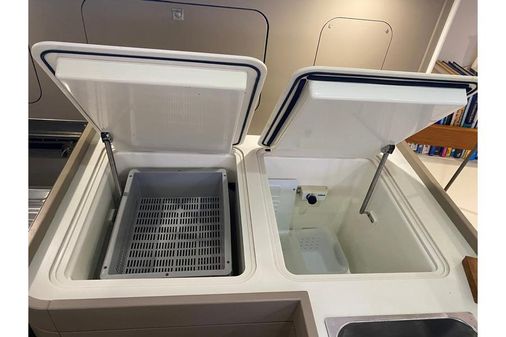 One of the two 12v marine fridge/freezer unit...
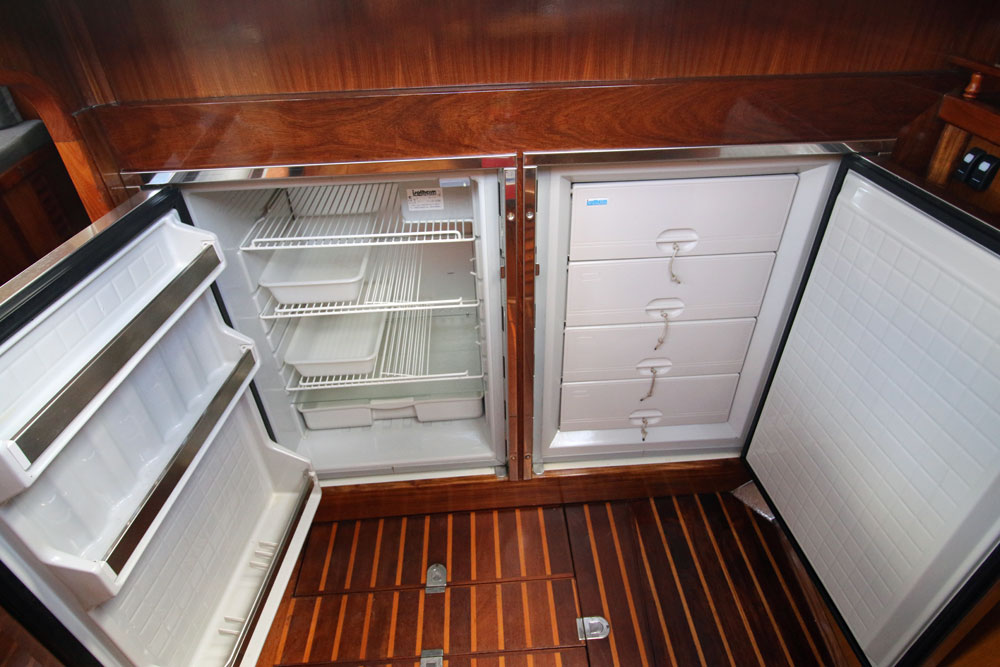 The other being a front-opening unit
How Does A Boat Fridge Work? The Refrigeration Cycle
Every boat fridge, from a small ice box conversion to a large chest freezer, operates on the same core principle established by Robert Boyle back in 1662: manipulating the pressure and volume of a gas changes its temperature.
The core components—the compressor, condenser, expansion valve, and cold plate—work in a continuous cycle:
- Compression: The compressor draws in low-pressure, heat-bearing refrigerant gas, reducing its volume. This drastically raises its temperature & pumps it along to the condenser.
- Condensation: The hot, high-pressure gas flows through the condenser (a heat exchanger). Here, it dissipates its heat to the surrounding air or seawater, causing the gas to cool and condense into a high-pressure liquid.
- Expansion: The liquid flows through the expansion valve or capillary tube. Moving from a high-pressure zone to a low-pressure zone, it rapidly expands, vaporises, and cools dramatically (we call this the 'flashing off' stage).
- Evaporation: This super-cooled liquid enters the cold plate (evaporator). Inside the plate's coils, it absorbs heat from the surrounding fridge air, completing the cooling process.
- The now heat-bearing gas returns to the compressor, and the cycle repeats, continuously lowering the temperature inside the fridge cabinet.
The Main Components & Key Efficiency Choices
The performance of your refrigeration system hinges on the design and integration of its key components.
The Compressor & Power Source
Marine compressors are typically 12-volt DC and fall into two main types:
- Diaphragm Type: Compact, quiet, and highly efficient. These are almost always sealed units and are standard in most proprietary 'packaged units'. They can't be stripped down and must be replaced if they fail.
- Piston Type: Resemble small reciprocating engines. More costly but can be serviced by a competent mechanic.
A less common, high-power alternative is the engine-driven compressor, which uses a belt from the main engine. While it makes almost zero demand on the electrical system (aside from the thermostat), it requires you to run the main engine, typically for an hour or so a day, which isn't always practical or desirable on a sailing yacht.
The Condenser: Air & Seawater Cooling
The condenser's job is to get rid of the heat the fridge just extracted from your food. How it does this is critical to efficiency, especially in warm climates.
| Condenser Type | Pros | Cons & Application |
|---|---|---|
| Air Cooled | Simpler installation, no plumbing, elegant solution. | Struggles in hot climates (engine room location is a definite no). Requires excellent ventilation; best if installed below the waterline where bilge air is cooler. |
| Seawater Cooled | Far more effective at dissipating heat, as water is a better heat conductor than air. Essential for hot climates like the Med & Caribbean. | Requires a dedicated pump & skin fitting or a specialised skin fitting with a built-in heat exchanger (no pump required). More complex plumbing, risk of blockages or corrosion. |
Practical Tip: If you're planning a trip into the tropics, seawater cooling is nearly always a necessity. Trying to make an air-cooled unit work effectively in an unventilated cockpit locker in 30°C heat is a losing battle.
The Cold Plate: Evaporator vs. Eutectic
This is where the cooling transfer happens and is another key factor in power management.
- Basic Evaporator Plate: Cools down quickly but also warms up quickly, leading to 'constant cycling'. The compressor kicks in and out frequently. In a hot climate, it could be running for 45 minutes out of every hour, leading to high current drain.
- Cold Storage (Eutectic) Plate: Coils are immersed in a eutectic liquid that stores 'cold energy' by freezing. This system takes a larger, initial effort (often with an oversized compressor) to freeze the plate solid. Once frozen, it retains its 'cool' for a long time, only gradually thawing out. This significantly reduces the duty cycle.
Expert Opinion: The eutectic plate is by far the superior choice for offshore cruising. It allows you to run the compressor when you have surplus energy available (e.g., when the engine is running or solar panels are peaking) and then rely on the stored cold for the rest of the time, making your energy management far more predictable.
The Automatic Start-Up (ASU) System
This clever technology is a game-changer for cruisers. The ASU system senses when surplus electrical energy is available—from the alternator, solar panels, or a wind generator. It speeds up the compressor to rapidly freeze the eutectic plate. When the surplus energy drops, it stops the compressor, letting the frozen plate take over. It will only restart in a low-speed, low-current mode to maintain temperature, or kick back into high-speed mode when surplus energy returns. This ensures you're cooling your fridge with energy that would otherwise go unused or be throttled by your regulator.
Installation & Sizing Considerations for Expert Sailors
Sizing & Power Consumption: Doing the Maths
Determining the right size (volume) and understanding the power draw is crucial for managing battery banks.
| Fridge Type & Size (Approx. Internal Volume) | Typical Daily Amp-Hour Consumption (12V System) | Notes |
|---|---|---|
| Small Top-Loading (30-50 Litres) | 25 - 40 Ah | Best for weekends/minimal use. |
| Medium Top-Loading (50-80 Litres) | 35 - 60 Ah | Good for couples on longer trips. |
| Large Top-Loading (80+ Litres) | 50 - 80+ Ah | Higher consumption; requires excellent insulation & cooling. |
| Eutectic/Holding Plate (Size Varies) | 40 - 70+ Ah (Initial freeze cycle) | Lower average daily consumption once frozen, as the run time is greatly reduced. |
Calculating Daily Amp-Hour Consumption:
The key is the duty cycle—the percentage of time the compressor runs. In the tropics, this can hit 50% or more.
Daily Amp-Hour = (Consumption Compressor Amp Draw) x (Average Daily Run Time in Hours)
Example: A 5-amp compressor with a 50% duty cycle runs for 12 hours a day (12 hours runtime x 5 amps = 60 Amp-hours per day). This 60 Ah must be factored into your daily energy budget alongside lights, navigation instruments, and auto-pilot.
Voltage Drop Calculation for the 12-Volt Boat Fridge
Voltage drop is the silent killer of fridge efficiency. The compressor will work harder and run longer if it's starved of volts. For a fridge, the voltage drop should be kept below 3% to ensure efficiency.
The required wire size in Circular Mils (CM) is calculated as follows:
CM = K x I x 2L / Delta V
Where: K (copper resistivity) = 10.75; I is the current draw in Amps; 2L is the total length of the wire (out and back) in feet; and Delta V is the maximum allowable voltage drop (e.g., 0.36V for a 3% drop on 12V). Always select the next largest available wire gauge (AWG) based on your required CM. Run a dedicated circuit directly from the battery bank or a dedicated distribution panel, and use appropriately sized, heavy-gauge wiring to minimise resistance.
Installation & System Integrity
For a reliable offshore system, you can't skimp on the installation details:
- Location: Airflow is paramount. An air-cooled condenser needs ample, cool air. Ideally, locate it in a large, well-ventilated bilge area below the waterline for more stable, lower ambient temperatures. Do not stuff it into a tiny, unventilated locker.
- Noise & Vibration: Compressors vibrate. Mount the unit on heavy-duty rubber mounts or vibration-dampening pads to prevent that relentless humming from transmitting through the hull and turning your peaceful night watch into a headache.
- Plumbing (Seawater Cooled): All connections must be secure and double-clamped. Check hoses regularly for signs of wear or pinches. The integrity of the skin fitting & the pump is essential to prevent a serious flood.
Monitoring & Data-Driven Efficiency
The days of simply relying on a thermostat are over. Modern boat management systems provide the data needed to truly optimise power use.
- Integrated Monitoring: Link your fridge’s current draw to your main battery monitor (e.g., Victron BMV or similar shunt-based system). This allows you to track the exact Amp-hours per day consumed by the fridge against your total production. You can then calculate your actual duty cycle under different conditions (e.g., day versus night, calm versus rough seas).
- High/Low Voltage Logging: Use monitoring equipment to log voltage at the compressor terminals during a startup cycle. A significant dip here often reveals a wiring issue or a struggling battery bank before it becomes a critical failure. This is often the first sign of a loose or corroded connection.
- Remote Temperature Sensors: Place a digital temperature sensor near the thermostat probe & another near the lid/door. A consistent or rising temperature difference can alert you to a developing insulation or seal issue long before food starts to spoil.
System Adaptation for Extreme Climates
The optimal setup for a chilly North Atlantic passage is the opposite of a Caribbean cruise. Knowing how to adapt your system is key to cruising comfort.
Tropical Zone Sailing (High Heat & Humidity):
- Prioritise Seawater Cooling: This becomes essential. Monitor the water intake and clean strainers daily, as tropical growth can clog them fast.
- Ambient Temperature Standoff: Never place the compressor/condenser unit in the engine room in the tropics. Find the coolest, lowest-point locker for installation.
- Minimise Frost: High humidity causes rapid frost build-up. This acts as an insulator on the cold plate, destroying efficiency. You must be prepared to defrost the box every 2-3 days.
High Latitude/Cold Water Sailing:
- Reduce Power Draw: In cold water, your fridge will barely need to run. Consider a simple switch to turn the unit off entirely at night, relying on the insulation and cold water to maintain the temperature.
- Freezer/Fridge Conversion: If you have a two-compartment system, you can often turn the freezer into an extra fridge or even just an insulated locker, dramatically reducing the demand on the remaining unit.
Advanced Electrical Efficiency: Power Management for Extended Voyages
This is where the expert sailor's knowledge comes into play. Minimising the power load of the 12-volt boat fridge is a constant battle on the ocean.
Beyond Insulation: Strategies for Reduced Duty Cycle
- Passive Cooling & Pre-cooling: Load the fridge with food that is already cold. When stocking up in port, pre-chill all drinks and perishables in a bucket of seawater or in a shore-powered fridge before transferring them.
- Organise for Speed: Use baskets, dividers, and clever organisation so you know exactly what you’re grabbing. The less time the door is open, the less cold air you lose. Minimise door openings is one of the most effective habits you can adopt.
- Defrost Regularly: A layer of ice or frost on the cold plate acts as an insulator, drastically reducing the plate's ability to absorb heat and forcing the compressor to run longer. Defrost as soon as the ice layer becomes noticeable.
- Optimise Thermostat Settings: Experiment to find the highest setting that safely keeps food cold. Running the fridge a few degrees warmer will make a noticeable difference to the duty cycle.
Integrating the System with Charging
The most efficient approach treats the fridge as an integral part of your charging system:
- Solar & Wind Synchronisation: The ASU/Eutectic system described earlier is the most effective way to use the fridge as a temporary energy storage device. Programme the ASU to run at maximum power only when your solar panels are producing peak output or when the wind generator is spinning fast.
- Alternator Overdrive: When running the engine to charge batteries, ensure the fridge is running simultaneously. The relatively short, high-power draw of a rapid freeze cycle is less of an electrical burden than continuous low-level cycling.
Emergency Troubleshooting & Mid-Voyage Repairs
While preventative maintenance is vital, offshore sailing means expecting the unexpected. What happens when your fridge quits 1,000 miles from the nearest technician?
- Suspected Refrigerant Leak: If the compressor runs continuously but the cold plate is barely cool, you likely have a leak. This requires professional repair. However, if the system is completely devoid of refrigerant, the ultimate backup is to switch to passive cooling: use the fridge box as a super-insulated icebox. Stocking emergency bags of ice (frozen water bottles) can keep core perishables safe for several days.
- Compressor Overheating: Often linked to poor ventilation. If the unit cycles off after a few minutes, check if the compressor or control unit is excessively hot. Temporary Fix: Direct a small 12V computer fan to blow air directly over the compressor unit. For air-cooled condensers, rig a temporary duct to force cooler bilge air over the coils.
- Control Module Failure: The electronic "brain" is often the weakest link. Many experienced sailors carry a spare control module (especially for common models like the Secop BD series) and the necessary tools for a swap-out. This is a five-minute fix that can save a week's worth of food.
Basic Troubleshooting Checklist for 12-Volt Fridges
- Power Supply Check: Confirm voltage at the compressor terminals (should be around 12-13V). A low battery or high voltage drop will trigger the LVC.
- Fuses & Breakers: Inspect the dedicated fuse & ensure the circuit breaker is not tripped.
- Ventilation: Check for obstructed airflow around the condenser; clean any dust.
- Temperature Settings: Verify the thermostat is set correctly.
- Connections: Look for loose, corroded, or warm connections at the unit and power source—heat means resistance.
- Compressor & Fans: Listen for unusual rattling or continuous whine, which suggests a mechanical issue.
- Door Seal: Check the seal integrity using the 'paper test'.
Cost & Reliability
For high-end, efficient, and reliable systems favoured by offshore sailors (like Isotherm or Dometic units with Secop/Danfoss compressors), you should budget for the following:
| System Type | Price Range (Excl. Installation) | Typical Lifespan (Compressor) |
|---|---|---|
| Mid-Range Packaged Unit (50L Front-Opening) | £800 – £1,500 | 5 – 8+ Years |
| High-End Eutectic Plate System (Custom/Large) | £2,500 – £4,000 | 8 – 10+ Years |
A reliable compressor can last a decade or more with good maintenance. However, don't underestimate the cost of professional installation for complex seawater systems or custom box insulation; it may add 25-50% to the total project cost but ensures the system runs at peak efficiency.
Summing Up
A 12-volt boat fridge is a huge contributor to crew morale & food safety on a long voyage. Achieving maximum efficiency isn't just about buying a good unit; it's about a holistic approach: starting with superior, professional-grade insulation and a reliable seal, selecting the most appropriate condenser for your cruising grounds, and crucially, managing its power demand with a eutectic plate and ASU controller. Treat your fridge not as a simple appliance, but as an integral, power-hungry system, and you'll keep your food cold and your battery banks happy. Mastering this system is an essential part of The Ultimate Blue Water Sailing Guide and the larger discipline of reliable offshore yacht management.

This article was written by Dick McClary, RYA Yachtmaster and author of the RYA publications 'Offshore Sailing' and 'Fishing Afloat', member of The Yachting Journalists Association (YJA), erstwhile member of the Ocean Cruising Club (OCC) and owner/administrator of 'Liveaboard Sailboats for Sale'.

Frequently Asked Questions (FAQs)
What is the ideal insulation thickness for a marine fridge?
What is the ideal insulation thickness for a marine fridge?
For serious cruising in warm climates, the ideal insulation thickness is a minimum of 100mm (4 inches) of high-quality foam (like polyurethane) on all sides, the bottom, and the lid/door. Thicker insulation, up to 150mm, is even better for dedicated freezers or systems used in the tropics.
Do I need a seawater-cooled condenser for my boat fridge?
Do I need a seawater-cooled condenser for my boat fridge?
You should seriously consider a seawater-cooled condenser if you plan to sail extensively in the tropics or other warm climates. It is significantly more efficient at dissipating heat than an air-cooled unit when the ambient air temperature is high, leading to a reduced compressor duty cycle and lower overall power consumption.
What is the most common cause of high power consumption in a 12-volt boat fridge?
What is the most common cause of high power consumption in a 12-volt boat fridge?
The most common cause is a poor duty cycle due to inadequate insulation or poor door/lid seals. Other major factors include insufficient ventilation around an air-cooled condenser, and frequent or prolonged door openings, which force the compressor to run much more often than necessary.
What is a eutectic plate & why is it useful for sailing?
What is a eutectic plate & why is it useful for sailing?
A eutectic plate is a cold plate where the coils are immersed in a liquid that stores 'cold energy' by freezing. It's useful for sailing because it allows the system to store a large amount of cooling capacity during periods of high energy availability (e.g., peak solar or engine run time), drastically reducing the need for the compressor to run when batteries are the sole power source.
Why is voltage drop a major problem for my fridge?
Why is voltage drop a major problem for my fridge?
Voltage drop reduces the power supplied to the compressor. This forces the compressor to draw more current to compensate, leading to excessive heat, reduced efficiency, and longer run times. In severe cases, it can trigger the compressor's low-voltage cut-off, prematurely shutting down the fridge, even if the batteries have sufficient charge to run other devices.
What is the simplest way to check if my door seal is leaking cold air?
What is the simplest way to check if my door seal is leaking cold air?
The simplest way is the 'paper test'. Place a thin strip of paper (like a £5 note) against the seal and close the door or lid. If you can easily pull the paper out without tearing it, the seal is compromised and needs replacement or adjustment.
Recent Articles


-
Mystery 35 Review: Specs, Performance & Buying Guide
Aug 29, 26 09:42 AM
An in-depth review of the Mystery 35 sailboat. Read technical specs, design ratios, sail performance, and common buyer inspection areas. -
Beneteau First 405 Review: Specs, Performance & Buyer’s Guide
Aug 26, 26 03:58 AM
Detailed Beneteau First 405 review covering specs, performance, bluewater capability, layouts and buyer’s checklist. -
Moody S38 Review: Specs, Ratios & Buyer’s Guide
Aug 12, 26 04:22 AM
In‑depth Moody S38 review covering specs, performance, design ratios, layout, strengths, trade‑offs & buyer inspection points.