Sponsored editorial
What You and Your Boat May Be Missing

This article was provided by Galvanic Works and reviewed by Sailboat-Cruising.com prior to publication. If you purchase using the discount code below, Sailboat-Cruising.com may earn a commission at no additional cost to you.
1. The blind side
Let’s start with a confession. I don’t keep a logbook, because I don’t have the discipline to write it every day, and the day after it is too late. So this is from memory. It starts before leaving.
- I have sailed with a liferaft long past its service date;
- I have forgotten to check the engine oil level regularly;
- I have run my batteries down to zero because I forgot to check the charge the evening before, and I have run out of fuel because I believed the gauge;
- At sea, I have heard the horn of a large boat from far too close, with embarrassment, and passed a cardinal buoy on the wrong side, because I couldn’t see it;
- I have reefed too late and torn my wonderful trade wind sail, and I have fallen asleep on watch;
- Arriving at an anchorage, I have grazed the seabed while looking for the right spot and talking to my wife at the bow;
- I have dragged anchor. One stormy night I thought I had set the anchor alarm, and only the next morning I discovered it wasn’t working;
- Even in harbour, the boat kept trying to tell me something: I damaged my gelcoat because I moored lazily and didn’t know a storm was battering the boat, and I discovered a seacock leak far too late, because the bilge pump was clearing the water without telling me;
- And I still fear the day I go back on deck to relieve a crew mate from the watch, and they are not there.
And we at Galvanic Works have bought more useless accessories than we ever wanted. So why did we go into business to offer you one more?
We love our boats, and love is never short of presents to ourselves. The boat may be old and battered, or brand new and still being built in the yard. Either way, the gadget sellers are waiting just round the corner, satisfying our appetite for improving our boats and our safety.
Boats are becoming increasingly complex, for good reasons, and managing that complexity 24 hours a day, in all conditions, is the new challenge: every new instrument asks for more knowledge and your attention. They pile up and, before long, they make you lose control and you become the boat’s passenger, not to speak of the crew members, who may be completely lost.
So you go for the final aggregator: the multifunction display (MFD). Sometimes two or three, the larger the better (if it fits). You read the hundreds of pages in the manual, learn every menu and every box to tick, and you feel in control of your boat. Almost. And it doesn’t change what it is: a display, and a display only works if the person really knows the boat and watches it. The COLREGs tell us to watch the horizon at all times, by the way. So the accident waits for you to look away, or to fall asleep, as at some point you must.
“Boats are becoming increasingly complex, for good reasons. Managing that complexity 24 hours a day, in all conditions, is the new challenge.”
The day you forget one detail, skip one menu, or silence the beep that annoys you while you’re busy with something else is the day it catches you on your blind side. You forget to set the anchor alarm, and the boat drags. You miss checking one more time for the fast AIS target that was invisible just a few minutes ago, and you face their horn. The depth sounder knows that the seabed is rising towards your keel, but you are not watching your MFD depth field because you are looking out for obstacles and telling the bow to drop the anchor. A crew mate goes on deck for the usual night watch while you rest, and the next watch doesn’t find them there. Unfortunately, it happens every year.
Boats are designed to destroy themselves over time, and accidents increase with the time spent aboard, as our insurers know well. Your boat’s safety is a mixture of immediate and long-term actions: it could be the timing belt you should have changed at 2,000 hours and forgot. On most of the diesel engines in use today, the valves and pistons share the same space if the timing is wrong. For the record, a broken timing belt means losing all your pistons, connecting rods, valves, injectors and cylinders in a few seconds.
Humans are easier to blame, your crew as well. Take reefing: you’ve asked everyone, many times, to reef when the wind passes 25 knots. Yet somehow it’s always you doing it at 35 knots, because your less experienced mate hoped the wind would go down instead of up. And sometimes your beautiful blue sail is torn to pieces.
Dramas don’t only happen in the busy moments. They mostly happen in the quiet ones: about 90% of man-overboard deaths happen in calm water (BoatUS Foundation, 2003–2007), and 69% of boats that sink do it in harbour (BoatUS insurance claims). You didn’t come down last week for your usual check, the water kept rising, and by the time anyone noticed, the damage was too expensive to save it. You wish you could have seen it on your phone. Too late.
2. What we made for you
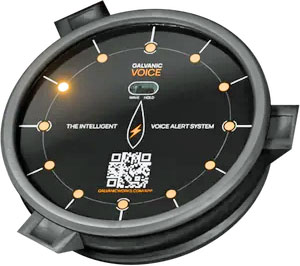 Figure 1: Galvanic Voice: 500+ alerts. One voice.
These are, more or less, the mistakes we wanted to avoid when we started the development of the Galvanic Voice, an Intelligent Voice Alert System designed specifically for sailing boats. Commercial ships carry bridge alert management systems for everything that needs the crew’s attention, from the critical to the mundane. For whatever reason, pleasure sailboat owners were never offered them. The Galvanic Voice brings them to a sailing boat, with a voice. We built it for you and for us: galvanicworks.com/products (but keep reading down to the end, we have a present for you).
The Galvanic Voice watches that complexity and tells you, out loud, what matters, when it matters. It also sends it to every phone and tablet connected to it, aboard and ashore. So let’s go back to the blind side, one moment at a time.
“The Galvanic Voice watches that complexity and tells you what matters, when it matters.”
The anchor alarm you forgot to set: there is none to set. The Galvanic Voice automatically detects whether you are at anchor, in harbour, at a fuel station, sailing or motoring, and even the navigation context, and it acts according to the situation. At anchor, it automatically locates the anchor position, estimates the chain length and calls out any drag. It wakes you up before the wind is blowing 40 knots, or when the barometer starts falling in the hours before and the snubber isn’t on yet.
The fast AIS target: the Galvanic Voice calculates the trajectories to know how and when each vessel will cross your path, cross-checks them against COLREG principles to help the crew assess the developing situation well in advance, and animates them in the Galvanic Sailing app, so that you decide with the full information, before the horn makes you spill your coffee.
The seabed rising towards your keel: the depth sounder always knew it, and at the right moment the Galvanic Voice says it out loud, while you keep looking out for obstacles and talking to the bow.
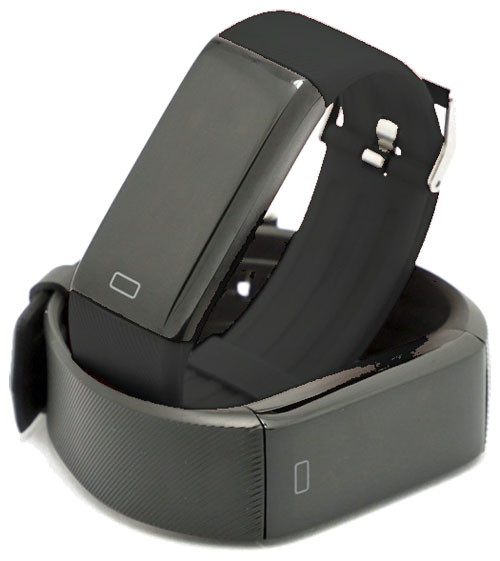 Figure 2: Galvanic Pulse
The crew mate on night watch: through its Galvanic Pulse bracelets, the Galvanic Voice checks several times a second that every crew member is still aboard. When a signal has been missing for the time the captain has set, from seconds to minutes, it guides you back to the place where it was lost. It takes the boat’s precise position from the moment the signal was lost, marks it as MOB on the chart, names the missing crew member, and gives spoken directions back to that point. It manages the watches, too. It reminds the helmsman that a short nap may be fine, but a long one can put everyone’s life at risk or your boat on the rocks.
Maintenance and duties: whether it is a multi-year job, a routine check on every watch or an occasional task, the Galvanic Voice keeps them all in one place, connected to a network or not, and always in sync with the crew. The timing belt reminder comes up at 2,000 engine hours, not before and not after. The seacock you know is leaking gets checked on every watch, by whoever is on it.
The engine oil: the Galvanic Voice calls for preventive maintenance when your engine oil pressure reads just 3.55 bar, not 0.5 bar as your standard alarm does, because at that rpm and that oil temperature it should be 3.6. The oil pump is volumetric, so the pressure depends only on rpm, the relief valve, temperature and the oil grade. The Galvanic Voice learns what your engine does in good conditions, for example after an oil change, and a sudden but subtle deviation from that is a problem.
Engines, Oil and ConspiraciesThe fuel gauge you believed: the Galvanic Voice works out your engine’s fuel consumption more reliably than your tank gauge, which knows little about the shape of the tank and even less about the sloshing that goes on all the time.
The reef at 25 knots: you set it once, as captain, and go below. The wind builds, and your mate is still hoping it will go down. The Galvanic Voice doesn’t hope. Under sail, it measures the apparent wind, the sustained wind and the gusts, as defined by the World Meteorological Organization, along with the wind angle and the heel. When your number comes up, it says so out loud to whoever is on watch. And your beautiful blue sail stays in one piece.
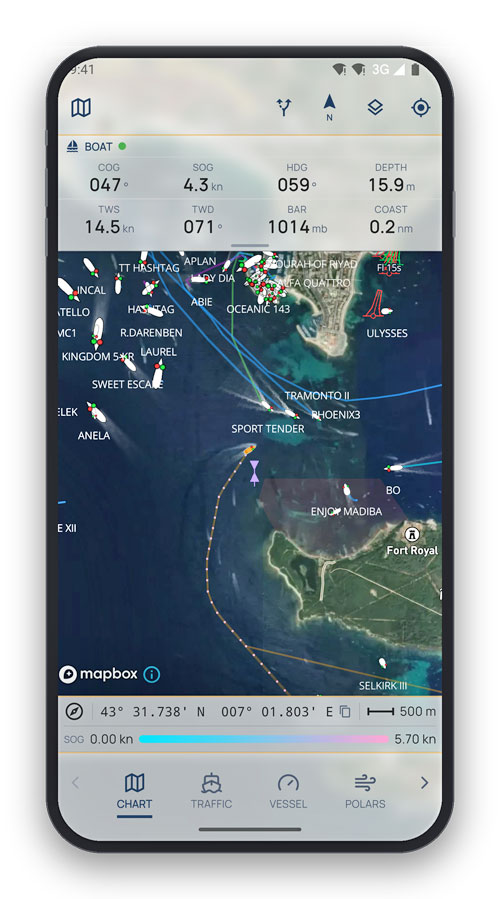 Figure 3: Galvanic Sailing app, free: your boat in your pocket, from anywhere.
The boat in harbour while you are away: this time you see it on your phone, with a critical notification when the barometric pressure has dropped and the wind is rising, or when the water is rising in the bilge. The people ashore know what is happening at any moment, as if they were on deck. And sometimes the most anxious moments arrive when you are not on your boat.
This only works because it is designed as one system, bringing together aspects of safety that are all connected. The Galvanic Voice measures, all the time: every relevant parameter, tens of times a second, on just 1.1 W, 20 to 40 times less than a modern phone draws when it charges. The Galvanic Pulse bracelets keep count of the crew. The Galvanic Voice speaks, out loud and in your language, the things you should have noticed before it is too late, because you were too tired, because you simply forgot, or because you didn’t know yet.
And not everything can be said out loud. The Galvanic Sailing app, which you can download for free, shows what a voice can’t: the picture, the weather, your boat’s polars and the history, like the logbook you never kept: every anchorage and every passage, how much you sailed and how much you motored, without a single click. It works alongside your MFD, on the phones and tablets you already have, and gives the same information to everyone aboard, even from their bunk, and to the people ashore, synchronising everybody, even without a network.
The accident waits for you to look away. The Galvanic Voice Intelligent Alert System never does.
3. Why here, and a present for you
Galvanic Works approached Sailboat-Cruising.com because of its long-established readership of cruising sailors, liveaboards and passagemakers. The website’s focus on practical seamanship and onboard safety makes this audience a natural fit for the Galvanic Voice system.
As a reader of Sailboat-Cruising.com, you qualify for an exclusive Galvanic Works offer:
Exclusive Offer for Sailboat-Cruising.com Readers
Using code CRUISING before 19 February 2027:
- Galvanic Voice with two Galvanic Pulse bracelets : free delivery
- Full system, Galvanic Voice with two Galvanic Pulse bracelets plus the 4-pack : free delivery plus an additional Galvanic Pulse bracelet free (value €200)
Learn more and order here: galvanicworks.com/products
Sailboat-Cruising.com receives a commission on qualifying purchases made using this code. This comes at no additional cost to you and helps support the continued publication of independent sailing content. Your feedback can make the Galvanic Voice system a better sailing aid. We commit to listening and learning: info@galvanicworks.com.
