- Home
- Essential Safety Gear
Serious Sailboat Safety Gear: The Offshore Sailor's Guide to Beacons, Lifejackets & Liferafts
Key Takeaways: If you're wondering what serious sailboat safety gear looks like once the land has dropped astern, here's the short version. Every crew member needs a properly fitted gas-inflatable lifejacket with crotch straps, a light and a sprayhood, ideally carrying a personal locator beacon and an AIS man overboard device. The boat needs a registered 406 MHz EPIRB, a liferaft that's in date and can be launched in seconds, and a plan for getting a casualty back aboard.
One thing has changed recently: since March 2026, UK-flagged boats must register 406 MHz PLBs as well as EPIRBs. Kit only saves lives when it's registered, serviced, within reach and rehearsed, so most of this guide is about those four habits.
Last checked: 28 September 2026. Regulations move, so always confirm against your flag state and any race or rally organiser before you sail.
Offshore, the gap between a scare and a tragedy is usually measured in minutes. Nobody buys a liferaft hoping to use it, and most of us have met the sailor who bought the right gear and then stowed it where nobody could reach it. This page pulls the pieces together: what the rulebooks ask for, what the gear does, and the gaps that catch even experienced crews out. Each section links to a deeper page on the individual item.
Table of Contents
- What Counts as Serious Sailboat Safety Gear
- Start With the Rulebook: World Sailing Offshore Special Regulations 2026-2027
- EPIRBs: The Boat's Last Word
- PLBs: Now a Legal Duty on UK Boats
- AIS MOB Beacons and Class M: Finding Someone Fast
- Offshore Lifejackets: What Proper Fit Really Means
- Liferafts: Choose, Stow and Service Them Properly
- Staying Aboard: Harnesses, Tethers and Jackstays
- Man Overboard Recovery Systems: Lifesling & Ocean Safety
- Training and Practice: The Part You Can't Buy
- Servicing, Expiry Dates and Pre-Passage Checks
- Summing Up
- Frequently Asked Questions
What Counts as Serious Sailboat Safety Gear
Think in layers. The first layer keeps you on the boat: harness, tethers, jackstays and sensible habits. The second layer keeps you alive and findable if you go in: the lifejacket, its light, a PLB and an AIS MOB beacon. The third layer covers the boat itself: EPIRB, liferaft, radio and flares. The fourth layer is human: training, drills and a crew that knows where everything lives.
| Layer | Main items | Job it does | Registration or servicing |
|---|---|---|---|
| Stay aboard | Harness, tethers, jackstays | Prevents the fall | Inspect stitching and hardware regularly |
| Survive and be found | Lifejacket, PLB, AIS MOB | Keeps the casualty afloat and locatable | Rearm kits, beacon batteries, PLB registration |
| Boat-level rescue | EPIRB, liferaft, VHF, flares | Raises the alarm and buys survival time | EPIRB registration, liferaft service certificate |
| People | Sea survival course, drills | Turns kit into a working system | Refresh training and rehearse each passage |
Start With the Rulebook: World Sailing Offshore Special Regulations 2026-2027
Even if you'll never race, the Offshore Special Regulations (OSR) are the best free checklist in sailing. The 2026-2027 edition covers January 2026 to December 2027 and tweaks the rules on communications equipment and AIS, search and rescue visibility, flashlights and searchlights, EPIRBs, storm sail specifications and lifejackets. If you race, read those clauses against your own boat before the season starts.
Cruisers should note that the OSR is a racing document, and national or flag rules can sit on top of it. The World Cruising Club uses the OSR as a guideline for its own rally requirements, then adds specifics such as how a liferaft is stowed and launched. That's a useful model: take the OSR category that matches your passage, then add whatever your own experience says is missing.
EPIRBs: The Boat's Last Word
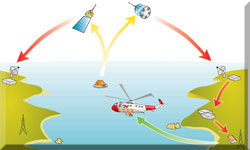
An EPIRB is the beacon you hope stays in its bracket. Activated manually or automatically on contact with seawater, it sends a 406 MHz signal to the Cospas-Sarsat satellite network, which relays it to a rescue coordination centre. For a UK-registered beacon that's the Joint Rescue Co-ordination Centre at Fareham, according to the RYA. The unique identity code in the signal tells rescuers who you are, and a beacon with built-in GPS also gives them where you are.
Under UK guidance, an EPIRB has to float upright to transmit and should run for at least 48 hours. Mount it in a float-free bracket where it will still release if the boat rolls, and where you can also grab it by hand. Some crews keep a second beacon in the grab bag, and there's nothing to stop you registering more than one per vessel. For buying advice, see our full guide: EPIRBs for offshore sailors.
PLBs: Now a Legal Duty on UK Boats
A personal locator beacon is a smaller, manually activated 406 MHz device, normally worn on a lifejacket or in a pocket. It isn't required to float, and it has to be held out of the water to transmit. UK guidance says the battery typically lasts around 24 hours, which is about half an EPIRB's minimum.
Here's the bit that's caught plenty of sailors out. The Merchant Shipping (EPIRB and PLB Registration and Radiocommunications) (Amendment) Regulations 2026 were published on 24 March 2026. They extend mandatory registration, already in place for EPIRBs, to 406 MHz PLBs carried on UK-registered ships and watercraft, and the Maritime and Coastguard Agency says non-compliance can lead to prosecution. Registration is free and takes around 15 minutes on GOV.UK, and you'll need the beacon's HEX ID, serial number, model and an emergency contact. The MCA also notes that 92 per cent of UK distress alerts received via 406 MHz beacons in 2024 were false alerts, which is why accurate registration matters: it lets the coastguard check before a lifeboat launches.
If you sail under another flag, check your own authority's rules, but register anyway. An unregistered beacon still works, yet it leaves rescuers guessing. Details on models and fitting are on our PLB page.
AIS MOB Beacons and Class M: Finding Someone Fast
PLBs and EPIRBs alert the world. An AIS MOB beacon alerts your own boat. It transmits on AIS frequencies so the vessel's plotter can show the casualty's position and set off an alarm, which is what you want in the first five minutes when nobody ashore can help yet. Many offshore crews carry both: the AIS device for the immediate recovery and the PLB as the wider alert.
Manufacturers report that AIS Class M rules for these devices came into effect in Europe from 1 January 2025, requiring them to interact with other onboard systems rather than simply transmitting. If you're buying a new AIS MOB, check that it carries the current approval, and check that your plotter or AIS receiver actually displays and alarms on it. A beacon your chartplotter ignores is only decoration.
Offshore Lifejackets: What Proper Fit Really Means
For offshore work, the benchmark in the OSR has long been a gas-inflatable lifejacket meeting ISO 12402-3 (Level 150), with an automatic or manual inflation system, a ride-up prevention system, a light, a sprayhood and a deck safety harness. World Sailing has adjusted clause 5.01 for 2026-2027, so racing crews should read the current wording rather than rely on last edition's checklist. A recent World Sailing committee paper also lists a personal location device among the fittings, another reason to read the final text.
Fit matters more than brand. A jacket that rides up over the chin because the crotch straps are slack will do its job badly, however good it looks on the shelf. Try it on wearing your foulweather gear, adjust it in harbour, then adjust it again after the first cold night. Mary and I wear Spinlock Deckvest Lite+ and Deckvest 6D Offshore lifejackets ourselves, and the lesson from years of use is the same for any model: the best jacket is the one that's comfortable enough to be worn every single watch. Our offshore lifejackets guide compares the main options.
Service them too. Check the bobbin and cylinder, inspect the bladder and stitching, and follow the manufacturer's servicing schedule rather than a rule of thumb from the pub.
Liferafts: Choose, Stow and Service Them Properly
A liferaft only helps if it gets into the water. The World Cruising Club's 2027 safety requirements are a good illustration of what experienced organisers look for: a purpose-made, self-inflating raft with capacity for the whole crew, built to ISO 9650 Type 1 Group A or a SOLAS equivalent, mounted externally or ready at the lifelines to launch within 15 seconds. For multihulls, the raft should be deployable whether the boat is upright or inverted. Note that these are rally requirements, not law, but they're a sensible yardstick.
The stowage details are just as telling. If the raft lives in a locker, that locker should be dedicated to it, with nothing else that could hinder access or cause damage. The painter line has to be permanently made fast to a strong point on the boat, and the service certificate must be valid for the whole passage. WCC also asks for the test certificate to be submitted before the safety inspection.
Ask yourself a practical question: could two tired people, in a rolling boat, at night, launch it? If the answer is a wince, rearrange the stowage now. Our liferaft guide covers sizing, valise versus canister and what a service involves.
Staying Aboard: Harnesses, Tethers and Jackstays
Every serious offshore skipper will tell you the best rescue is the one you never need. A harness is worth nothing if the tether is clipped to the wrong thing. Jackstays should run from bow to stern on both sides, led so you can move forward without unclipping, and a short tether should keep you inside the guardrails rather than dragged alongside the hull. Crotch or thigh straps are worth having on any harness, because without them a harness can slide up and hurt the wearer. Inspect stitching, hooks and webbing for UV damage and chafe, and retire anything of doubtful age.
Man Overboard Recovery Systems: Lifesling & Ocean Safety
This is the gap in many safety kit lists. Crews spend hundreds on beacons and then have no way to lift a soaked, possibly hypothermic adult over the guardrail. Two products, from Lifesling and Ocean Safety, are built specifically to close that gap, and each takes a different approach.
The Lifesling is a horseshoe-shaped flotation collar on a long floating line, mounted near the helm so one person can deploy it. According to UK Sailmakers, the traditional method is to drop the Lifesling astern and circle the casualty so the towline pays out around them, much as you'd bring a towrope to a water skier, which trades pinpoint accuracy for a wider margin of error. A newer, faster method has the crew tack, backwind the jib to stop the boat, motor back and toss the Lifesling to the casualty like a throw rope, staying five to fifteen feet off so the propeller stays well clear. Once the person is inside the collar, they're physically attached to the boat, and the same line and collar double as a lifting sling with a halyard and winch, or a dedicated block and tackle, to bring them aboard.
Ocean Safety's Jon Buoy Recovery Module takes a different tack: it inflates automatically on contact with water and supports the casualty horizontally rather than vertically, which matters for a hypothermic casualty, since a sudden switch to an upright position can trigger complications during recovery. The current MK6 version carries a safe working load of around 200kg, a SOLAS automatic light, a lifting harness and roughly five metres of throwing line, and Ocean Safety says it's accepted as a direct replacement for a traditional danbuoy, horseshoe, drogue, light and whistle under the World Sailing Offshore Special Regulations. It's supplied in a hard case or a slimline valise for bulkhead mounting, with service intervals of up to three years on the valise version.
Either system only helps if the crew has actually rehearsed with it. Try a recovery with a fender and a full-weight crew member in calm water before you need the real thing; it's humbling, and it's far cheaper than learning at sea. We compare the Lifesling and Jon Buoy ranges, along with lifting tackle and pricing, on our man overboard recovery systems page.
Training and Practice: The Part You Can't Buy
For crews racing under the OSR, a recognised personal safety qualification is part of the requirement, and courses such as Irish Sailing's Offshore Personal Safety and Sea Survival, which meets World Sailing's Appendix G requirements, cover survival techniques, liferaft procedures, distress signalling and man overboard response. Cruisers aren't obliged to attend, but the case for going is strong: handling a raft in a pool is a very different experience from reading the label. Follow it with a short briefing at the start of every passage, covering where the beacon lives, how the liferaft is launched and what the plan is if someone goes over.
Servicing, Expiry Dates and Pre-Passage Checks
Most safety failures are dull ones. A battery past its date. A jacket with a spent cylinder. A raft whose certificate lapsed mid-passage. World Cruising Club states that any equipment requiring regular servicing must be in date at the start of a rally and stay in date until the end, and that's a habit worth borrowing for any long passage. Put the expiry dates in one place, and set reminders well before they fall due.
| Item | What to check | Who should know |
|---|---|---|
| EPIRB | Registered, details current, battery and hydrostatic release in date, bracket clear | Whole crew |
| PLBs | Registered in the owner's name, battery in date, fitted to the jacket, self-test done | Each wearer |
| AIS MOB | Battery in date, plotter shows and alarms on it | Navigator and watch leaders |
| Lifejackets | Cylinder and bobbin sound, bladder and stitching checked, crotch straps adjusted | Each wearer |
| Liferaft | Service certificate valid, painter secured, stowage clear, launch route rehearsed | Whole crew |
| Jackstays and tethers | Webbing, stitching and hooks inspected, jackstays rigged | Whole crew |
| Recovery gear | Method chosen, hardware accessible, practised in calm water | Whole crew |
Summing Up
Good offshore safety isn't a shopping list, it's a chain. The lifejacket keeps a person afloat, the light and beacons help people find them, the EPIRB calls in the professionals, and the liferaft gives everyone a place to wait. Break any link and the rest struggle. The unglamorous work of registering beacons, dating batteries, stowing the raft where two people can reach it and practising a recovery is what turns expensive kit into a working system. Spend the money, then spend an afternoon making sure you can use it.

This article was written by Dick McClary, RYA Yachtmaster and author of the RYA publications 'Offshore Sailing', member of The Yachting Journalists Association (YJA), erstwhile member of the Ocean Cruising Club (OCC) and owner/administrator of 'Liveaboard Sailboats for Sale'.

Frequently Asked Questions
Do I need both an EPIRB and a PLB on an offshore sailboat?
Do I need both an EPIRB and a PLB on an offshore sailboat?
Many offshore crews carry both. The EPIRB covers the boat, with a longer battery life and a float-free release. PLBs go on people, so they still work if someone is separated from the boat. They do different jobs, and one doesn't replace the other.
Is PLB registration compulsory?
Is PLB registration compulsory?
On UK-registered ships and watercraft, yes. The 2026 regulations extended mandatory registration to 406 MHz PLBs, and the MCA says failing to register can lead to prosecution. If you sail under another flag, check your national authority, and register regardless.
Which lifejacket standard should I look for offshore?
Which lifejacket standard should I look for offshore?
The OSR has long specified a gas-inflatable lifejacket meeting ISO 12402-3 (Level 150) with crotch straps, a light and a sprayhood. If you race, check clause 5.01 in the current 2026-2027 edition.
How often does a liferaft need servicing?
How often does a liferaft need servicing?
Follow the manufacturer's label and your servicing agent's advice, and make sure the certificate covers your entire passage. Rally organisers such as the World Cruising Club require the test certificate to be valid for the whole event.
Where should I stow a liferaft on a cruising boat?
Where should I stow a liferaft on a cruising boat?
Somewhere it can reach the water fast. The World Cruising Club asks for external mounting, or a raft ready at the lifelines that can launch within 15 seconds, and a dedicated locker if it's stowed below. Make the painter fast to a strong point.
Is a PLB enough without an AIS MOB device?
Is a PLB enough without an AIS MOB device?
A PLB alerts rescue services, which takes time. An AIS MOB alerts your own boat instantly and shows the casualty's position on the plotter. For short-handed crews, the AIS device is often the one that gets someone back aboard.
Do cruisers really need sea survival training?
Do cruisers really need sea survival training?
Racing crews need a recognised course under the OSR. Cruisers aren't obliged to take one, but a sea survival course teaches liferaft handling, signalling and man overboard response in a way no manual can.
Recent Articles


-
Best Offshore Liferaft: Compare 3 Trusted Options
Sep 29, 26 06:52 AM
Comparing offshore liferafts? See three tested options, from a budget valise raft to a premium ISO 9650 canister raft, with prices and key specs. -
Offshore Liferaft Guide: Choosing, Stowing and Servicing One
Sep 29, 26 06:49 AM
Choosing an offshore liferaft? Learn what ISO 9650 Group A means, where to stow it, how often to service it and what to pack in the grab bag. -
Serious Sailboat Safety Gear: Beacons, Lifejackets, Liferafts
Sep 29, 26 06:38 AM
Serious sailboat safety gear for offshore crews: EPIRBs, PLBs, lifejackets and liferafts, plus the 2026 UK beacon registration change and pre-passage checks.