- Home
- Cruising Yachts 30' to 35'
- Olson 35 Sailboat
The Olson 35 Sailboat:
Specs, Performance Analysis & Cruising Characteristics
Key Takeaways
The Olson 35 is a sophisticated, performance-oriented cruiser-racer that prioritises speed and light-air efficiency without sacrificing offshore integrity. Unlike many of its contemporaries that relied on heavy displacement for stability, the Olson 35 utilizes a high ballast-to-displacement ratio and a refined hull form to achieve a nimble, "sporty" feel. It is ideally suited for sailors who value tactile feedback and the ability to outpace the fleet in light to moderate conditions, though its narrower beam compared to modern wide-stern designs means internal volume is more focused on functional sea-berths than palatial lounging areas.
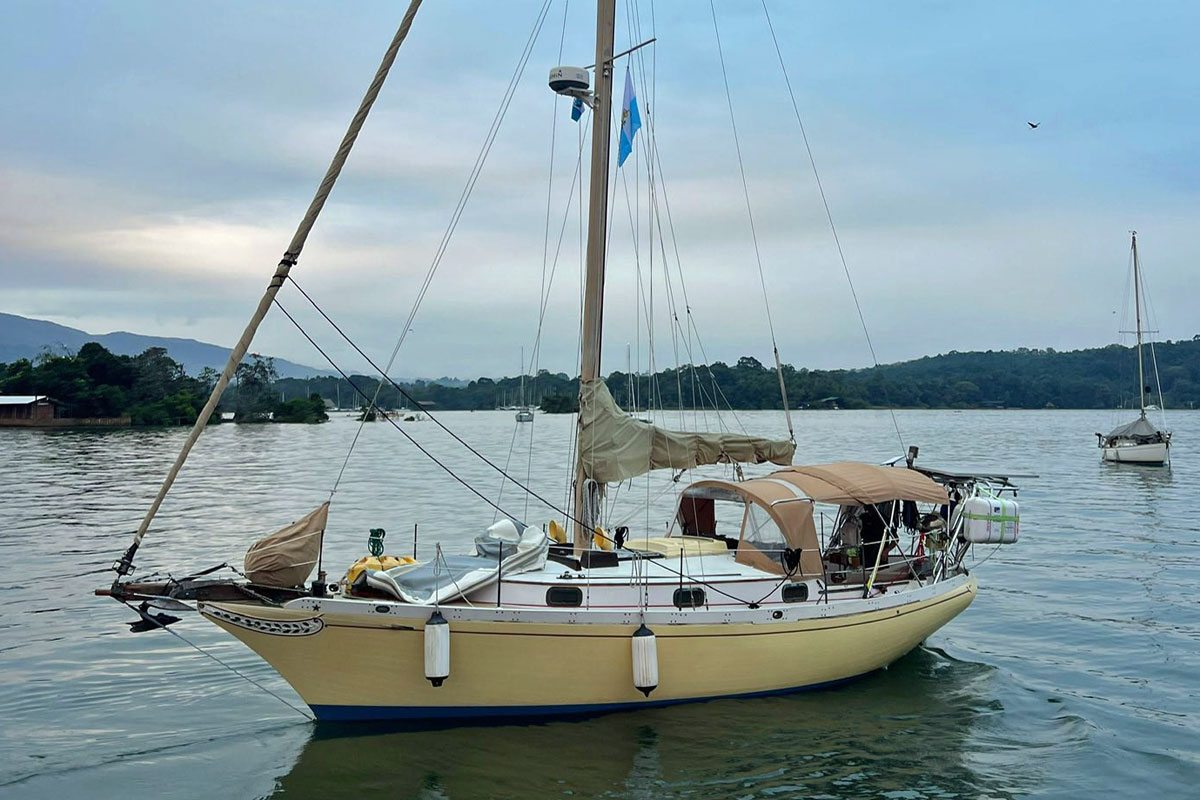
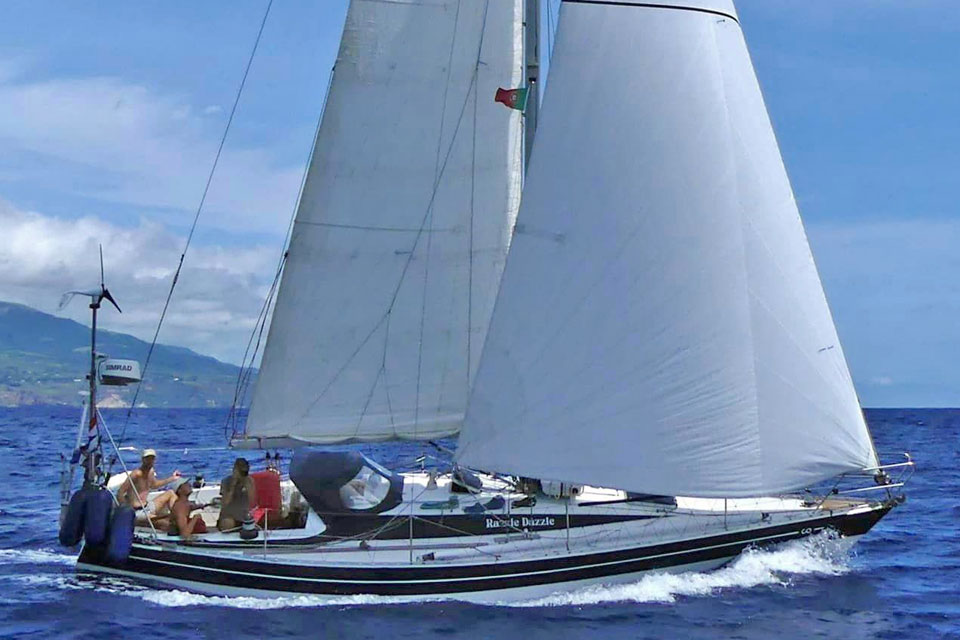
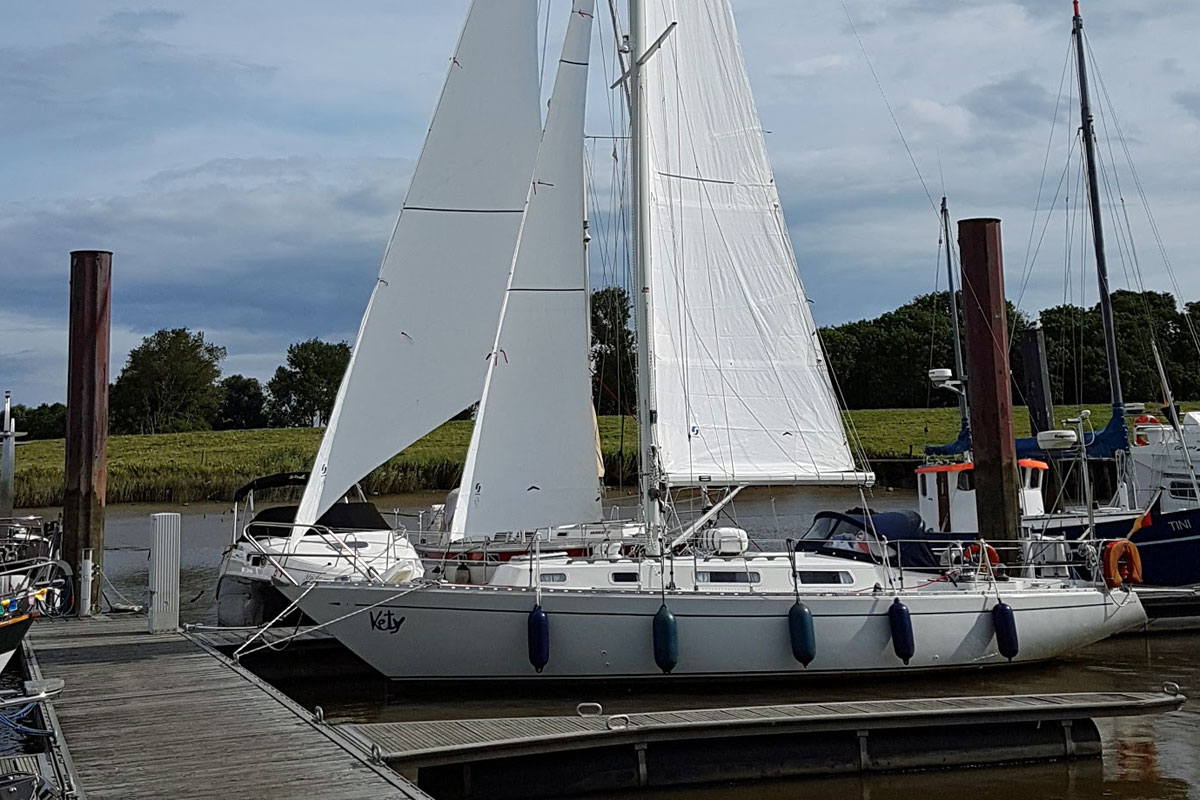 An Ohlson 35 with a custom cutter rig
Pic kindly provided by owner Olaf Ketelsen
Design & Construction
To understand the Olson 35, one must first navigate a common point of maritime confusion. There are two entirely distinct vessels frequently conflated in databases:
- the Ohlson 35, a classic, heavy-displacement Swedish design by Einar Ohlson from the 1950s, and
- the Olson 35, the modern performance cruiser reviewed here.
The latter was born from the board of George Olson, a designer synonymous with the "ULDB" (Ultra Light Displacement Boat) movement of the California coast.
Built by Ericson Yachts in the mid-1980s, the Olson 35 represents a transition point in boat building where performance geometries began to merge with production-line reliability. The hull is a hand-laid fibreglass laminate, incorporating a balsa core in the deck and topsides to maintain a high strength-to-weight ratio. This construction method allows for a rigid, light structure, though it requires diligent maintenance of deck hardware seals to prevent moisture ingress.
The defining feature of the Olson 35 is its high-aspect fin keel and balanced spade rudder. This combination provides exceptional responsiveness, allowing the boat to turn with precision. While some performance boats of this era can be a handful when the wind picks up, the Olson 35 is known for a predictable, albeit lively, helm. Unlike the Swedish Ohlson 35, which relies on a full keel and traditional lines for stability, the George Olson design uses modern foil shapes and a high ballast ratio to keep the boat on its feet.
While primarily produced as a deep-fin keel sloop, Ericson Yachts offered the boat with a high-quality interior finish that differentiated it from the more "stripped-out" racing shells of the period. This ensures that while the boat can win trophies on the weekend, it remains a viable platform for coastal cruising.
Ohlson or Olson?
It seems there's confusion about the Ohlson (Olson?) 35. As mentioned above, there are two entirely distinct vessels.
To clear up the confusion, it is essential to distinguish between the designer’s name and the builder’s branding. The similarity in names—Olson versus Ohlson—has led to decades of data cross-contamination in the yachting world.
The connection between the two is non-existent in terms of company mergers or design lineage; the "connection" is entirely a result of phonetics and naming conventions.
The Two Distinct Paths
1. The Swedish Ohlson 35 (Einar Ohlson)
This is the boat built in the UK by the Tyler Boat Company and in Sweden by Malö Yachts.
- Designer: Einar Ohlson (Swedish).
- The Tyler/Malö Link: The Tyler Boat Company in the UK was a prolific moulder of GRP hulls for many designers. They produced the hulls and decks for the Ohlson 35. These were then often sent to other yards for fit-out. Malö Yachts in Sweden completed a number of these, which is why you see high-quality Scandinavian timber interiors in many Ohlson 35s.
- Characteristics: These are traditional, long-keel yachts with elegant, narrow lines, often featuring wooden superstructures or very traditional GRP styling.
2. The American Olson 35 (George Olson) This is the boat built by Ericson Yachts.
- Designer: George Olson (American).
- The Ericson Link: In the mid-1980s, Ericson Yachts (based in California) sought to expand their range with a performance-oriented cruiser-racer. They commissioned George Olson—already famous for the ultralight Olson 30—to design the Olson 35. Ericson built the boat entirely in the USA using their internal production methods.
- Characteristics: This is a modern, light-displacement performance boat with a fin keel, spade rudder, and a much wider beam than the earlier Swedish design.
Sail Areas & Rig Dimensions
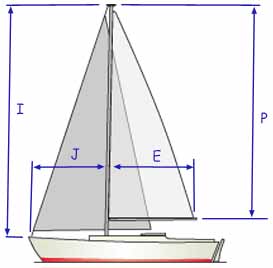 Rig dimensions
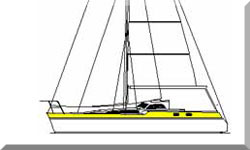
The Olson 35 carries a powerful masthead rig designed to keep the boat moving when the breeze dies down. The primary dimensions provide a generous sail plan that rewards careful trimming.
- I (Forestay Height): 45'0" (13.72 m)
- J (Foretriangle Base): 13'6" (4.11 m)
- P (Mainsail Hoist): 39'5" (12.01 m)
- E (Mainsail Foot): 13'1" (3.99 m)
- Mainsail Area: 258.42 ft² (24.01 m²)
- Fore Sail Area (100%): 303.75 ft² (28.22 m²)
- Total Sail Area (100% Foretriangle): 562.17 ft² (52.23 m²)
Published Specification: The Olson 35 Blueprint
| Specification | Data & Measurement |
|---|---|
| LOA | 34'8" (10.57 m) |
| LWL | 28'8" (8.74 m) |
| Beam | 11'3" (3.43 m) |
| Draft | 6'3" (1.91 m) |
| Displacement | 10,500 lbs (4,763 kg) |
| Ballast | 4,250 lbs (1,928 kg) |
| Rig Type | Masthead Sloop |
| Hull Material | GRP (Fibreglass) |
| Production Dates | 1985 – 1988 |
Performance Analysis: Understanding the Design Ratios
To truly understand how the Olson 35 behaves on the water, we must look at the mathematical relationships between its dimensions. These figures place the boat firmly in the "performance cruiser" category.
| Ratio | Value | Interpretation |
|---|---|---|
| Sail Area / Displacement (SA/D) | 18.7 | High performance; indicates excellent light air capability. |
| Displacement / Length (D/L) | 198 | Light-moderate; balances surfing potential with carrying capacity. |
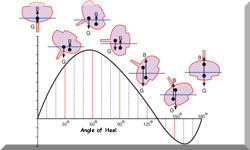
| Ballast / Displacement (B/D) | 40.5% | Extremely stiff; reflects a high resistance to heeling. |
| Capsize Screening Formula (CSF) | 2.06 | Borderline; technically just over the "2.0" offshore threshold. |
| Brewer Motion Comfort Ratio | 21.2 | Low; expect a quicker, more active motion in a seaway. |
For those looking to explore how these figures compare to other hulls, you may wish to refer to our guide on Understanding Boat Performance & Design Ratios.
Interpretation of the Ratios
The SA/D of 18.7 confirms that the Olson 35 is no "slug." It will begin moving in whispers of wind that would leave heavier cruisers motoring. However, the Comfort Ratio of 21.2 suggests that this is not a boat that will "steamroll" through a chop. The motion will be lively and somewhat "jerky" compared to a heavy-displacement double-ender. The B/D ratio of 40.5% is the standout figure; this is a very high percentage of ballast for a production boat, meaning it can carry its sail area longer than most before needing a reef.
Structural Integrity & Stability Dynamics
The use of GRP (fibreglass) in the Olson 35 was executed during an era where Ericson Yachts had refined their lamination processes. While not as "bulletproof" as solid aluminium in a collision with a container, the material allows for the complex, slippery curves that George Olson intended. Maintenance is straightforward, provided the balsa core remains dry.
The defining fin keel provides a low centre of gravity, which is essential for its high ballast ratio. This makes the boat exceptionally stable in terms of "stiffness," but because it is a lighter boat, it relies on the sailor to manage the rig actively. Compared to a full-keel design, the Olson 35 will require more attention at the helm but will reward the skipper with significantly higher speeds and better upwind angles.
Configuration, Layout & Cruising Characteristics
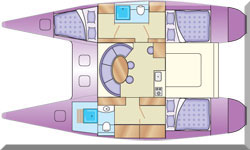
Down below, the Olson 35 reflects its dual-purpose nature. The layout is functional for offshore passages, featuring a proper galley and a navigation station that can actually be used at sea. The tankage is moderate, usually consisting of around 25 gallons (95 litres) of fuel and 40 gallons (151 litres) of water, which is sufficient for coastal hops but would require supplementation for long-range voyaging.
The cockpit is designed for efficiency. Winches are well-placed for a short-handed crew, though the mainsheet traveller is often located in the cockpit, which can be a "shin-knocker" for those used to unobstructed lounging areas. The galley is typically U-shaped, providing good bracing for the cook when the boat is heeled.
Impressed?

Has this article suggested that this could be your ideal cruising boat and, as a result, deserves to be on your "Worth a Look" list?
But if, like me, you find sailboats to be seductive creations, then that list could rapidly get to be a pretty long one. If that is the case, wouldn't it be good if you could narrow it down bit through an objective, pragmatic process?
Well, that's where my eBook 'How to Avoid Buying the Wrong Sailboat' comes in...
Summing Up
The Olson 35 is a masterclass in balanced design from the 1980s. It avoids the extremes of the "bleeding edge" ultralights while offering a level of performance that modern "fat" cruisers struggle to match. Its high ballast ratio provides safety and stiffness, while its light displacement ensures a rewarding sailing experience. While it may lack the interior volume of a modern 35-footer and the soft motion of a heavy cruiser, it remains a premier choice for the sailor who wants to arrive at their destination quickly and with a smile on their face.
If you'd like to compare this boat with others in this size range, take a look at Cruising Boats from 30' to 35' overall....
This article was written by Dick McClary, RYA Yachtmaster and author of the RYA publications 'Offshore Sailing' and 'Fishing Afloat', member of The Yachting Journalists Association (YJA), and erstwhile member of the Ocean Cruising Club (OCC).
Frequently Asked Questions (FAQs)
How does the Olson 35 handle heavy weather?
How does the Olson 35 handle heavy weather?
While light, its high ballast percentage keeps it upright. However, because of its lower motion comfort ratio, the crew will feel the sea state more than on a heavier boat. Early reefing is key to keeping the boat under control.
Is the Olson 35 suitable for single-handed sailing?
Is the Olson 35 suitable for single-handed sailing?
Yes, thanks to its high ballast ratio and balanced helm, it is quite manageable. Many owners lead all lines aft to the cockpit and install a high-quality linear drive autopilot to handle the boat's responsive nature.
Are there known issues with the balsa-cored decks?
Are there known issues with the balsa-cored decks?
Like any boat of this vintage, moisture ingress around stanchion bases and deck hardware can cause core rot. A thorough survey with a moisture meter is essential before purchase.
Can the Olson 35 be used for competitive PHRF racing?
Can the Olson 35 be used for competitive PHRF racing?
Absolutely. It was designed with racing in mind and continues to be a formidable competitor in coastal and offshore races, often performing well above its handicap in light air.
Is the interior comfortable for long-term liveaboard use?
Is the interior comfortable for long-term liveaboard use?
It is functional rather than luxurious. The beam is carried well aft but the boat is narrower than modern designs. It is ideal for a couple, but might feel cramped for a family for extended periods.
Recent Articles


-
Mystery 35 Review: Specs, Performance & Buying Guide
Aug 29, 26 09:42 AM
An in-depth review of the Mystery 35 sailboat. Read technical specs, design ratios, sail performance, and common buyer inspection areas. -
Beneteau First 405 Review: Specs, Performance & Buyer’s Guide
Aug 26, 26 03:58 AM
Detailed Beneteau First 405 review covering specs, performance, bluewater capability, layouts and buyer’s checklist. -
Moody S38 Review: Specs, Ratios & Buyer’s Guide
Aug 12, 26 04:22 AM
In‑depth Moody S38 review covering specs, performance, design ratios, layout, strengths, trade‑offs & buyer inspection points.