- Home
- Cruiser Yachts under 30'
- Catalina 30 Sailboat
The Catalina 30 Sailboat:
Specs, Performance Analysis & Cruising Characteristics
Key Takeaways: The Catalina 30 is arguably the most successful production sailboat in history, with over 6,500 units built between 1974 and 2008. It is renowned for its cavernous interior volume, which rivals many 35-foot yachts, making it an exceptional coastal cruiser and liveaboard option. While its medium-heavy displacement and moderate sail area mean it is not a greyhound of the seas, its stability and predictable handling offer great security for recreational sailors.
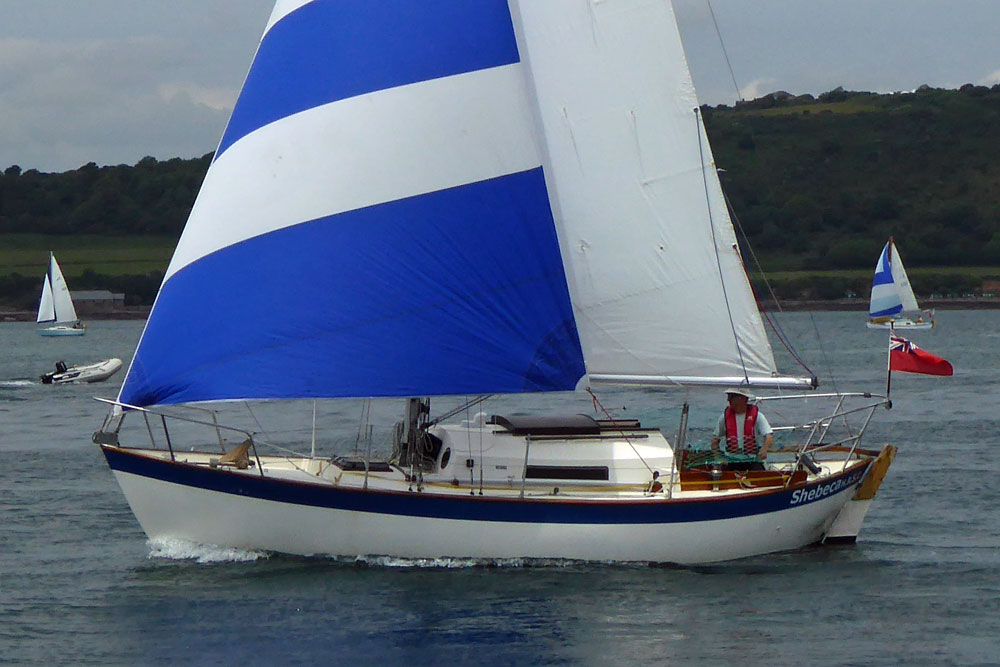
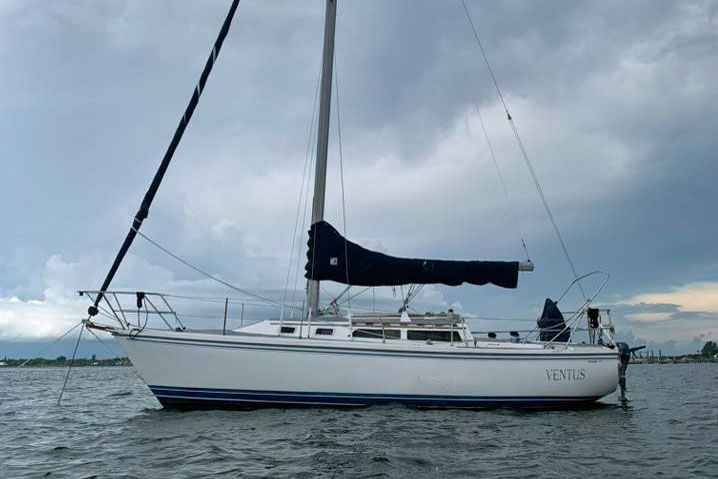 A Catalina 30 Mk2
Design & Construction
The Catalina 30 was designed by Frank Butler and built by Catalina Yachts in California. Butler’s philosophy was simple yet revolutionary for the time: provide the maximum possible interior volume and comfort at a price point that the average family could afford. Constructed from solid hand-laid fibreglass for the hull and a balsa-cored deck, the boat was designed for durability and ease of maintenance rather than high-end racing performance.
The key defining feature of the Catalina 30 is its extraordinary beam of 10'10" (3.30m). This width, carried well aft, was unprecedented for a thirty-footer in the mid-1970s and remains impressive today. Practically, this translates to a saloon that feels more like a lounge than a cabin, allowing for a layout that includes a proper galley, a dedicated navigation station, and comfortable sleeping quarters for up to seven people.
Over its thirty-four-year production run, the model evolved through three distinct versions.
- The Mark I (1974–1986) established the legend, featuring the traditional cockpit and wooden interior accents.
- The Mark II (1986–1993) introduced a T-shaped cockpit and subtle deck profile changes.
- Finally, the Mark III (1993–2008) modernised the design further with a walk-through transom and improved interior finishes.
Throughout these iterations, owners could choose between various configurations, including a deep fin keel for better upwind performance, a shoal draught or wing keel for shallow-water cruising, and either the standard rig or a tall rig for light-air regions.
Sail Areas & Rig Dimensions
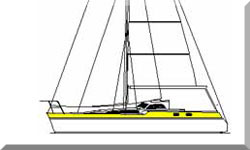
The Catalina 30 is a masthead sloop. The rig was offered in two primary configurations: the standard rig, suited for areas with consistent breeze, and the tall rig, which added roughly 2'0" (0.61m) to the mast height to catch lighter air.
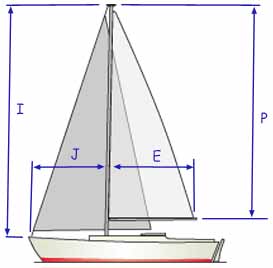
- Main Sail Area: 191.00 ft² (17.74 m²)
- Foresail Area (100% Foretriangle): 254.58 ft² (23.65 m²)
- Total Sail Area (100% Foretriangle): 445.58 ft² (41.40 m²)
- I (Foretriangle Height): 43'0" (13.11m)
- J (Foretriangle Base): 13'2" (4.01m)
- P (Mainsail Luff): 37'0" (11.28m)
- E (Mainsail Foot): 12'0" (3.66m)
(Note: Dimensions reflect the Tall Rig version; Standard Rig "I" is 41'0" / 12.50m)
Published Specification: The Catalina 30 Blueprint
| Specification Parameter | Measurement & Detail |
|---|---|
| Length Overall (LOA) | 29'11" (9.12m) |
| Length at Waterline (LWL) | 25'0" (7.62m) |
| Beam | 10'10" (3.30m) |
| Draught (Max - Fin Keel) | 5'3" (1.60m) |
| Draught (Min - Wing/Shoal) | 3'10" (1.17m) |
| Displacement | 10,200 lbs (4,627 kg) |
| Ballast (Lead) | 4,200 lbs (1,905 kg) |
| Rig Type | Masthead Sloop |
| Hull Material | GRP (Solid Fibreglass) |
| Production Dates | 1974 – 2008 |
Performance Analysis: Understanding the Design Ratios
To understand how the Catalina 30 behaves on the water, we must look beyond its physical dimensions and examine the mathematical relationships that define its personality.
| Design Ratio | Calculated Value | Interpretation |
|---|---|---|
| Sail Area/Displacement (SA/D) | 15.2 | Indicates a conservative cruiser; requires more breeze to get moving. |
| Displacement/Length (D/L) | 291 | Medium-heavy displacement; provides a stable, predictable motion. |
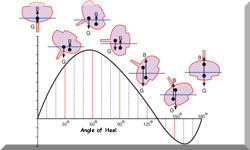
| Ballast/Displacement (B/D) | 41.2% | Relatively high; suggests good stiffness and resistance to heeling. |
| Capsize Screening Formula (CSF) | 1.86 | Below the 2.0 limit; considered suitable for offshore coastal use. |
| Brewer Motion Comfort Ratio | 21.6 | Moderate comfort; typical for a coastal cruiser of this size. |
Interpretation of Ratios
The Sail Area/Displacement Ratio of 15.2 places the Catalina 30 firmly in the cruising category. It is not a boat that will excel in light airs unless equipped with the tall rig and a generous overlapping genoa. However, this lower ratio also means the boat is less likely to become overpowered quickly when the wind picks up, making it a safe choice for less experienced crews.
The Displacement/Length Ratio of 291 confirms its status as a medium-heavy boat. This mass provides momentum to punch through a coastal chop, though it will never be a "surfing" hull. Combined with a Ballast/Displacement Ratio of over 40%, the Catalina 30 is surprisingly stiff. It carries its sail well and does not require early reefing.
The Capsize Screening Formula of 1.86 is a crucial figure for those considering longer passages. A value below 2.0 is generally accepted for ocean-going vessels. While the Catalina 30 is primarily a coastal cruiser, this ratio suggests it has the inherent stability to handle more challenging conditions than its "weekend warrior" reputation might imply. For more depth on these metrics, see our guide on Understanding Boat Performance & Design Ratios.
Structural Integrity & Stability Dynamics
The choice of solid fibreglass for the hull construction is a double-edged sword. While it adds weight, it also provides a robust structure that is relatively easy to repair and maintain compared to cored hulls. In the context of safety, a solid hull offers better impact resistance against submerged objects, a significant comfort for coastal sailors. However, owners should be mindful of the "Catalina smile"—a separation at the leading edge of the keel-to-hull joint. While often cosmetic, it can indicate the need for re-torquing keel bolts or reinforcing the sump area.
The massive beam, which is the boat’s defining feature, significantly impacts stability. It provides high initial stability, meaning the boat feels very "flat" and secure at the dock or in light winds. However, a wide-beamed boat can sometimes have a more abrupt motion in a heavy seaway compared to a narrower, more traditional hull. In the case of the Catalina 30, the design balances this with a substantial lead keel that keeps the centre of gravity low.
Configuration, Layout & Cruising Characteristics
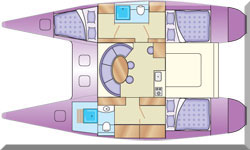
The interior of the Catalina 30 is where the design truly shines. By pushing the furniture to the hull sides and utilising the full beam, Frank Butler created a living space that changed expectations for thirty-footers. The galley is typically U-shaped and located to port, offering a secure place to prepare meals while underway. It generally features a two-burner stove, a deep sink, and a large icebox or refrigerated unit.
Tankage is adequate for coastal hops, with approximately 21 gallons (79 litres) of fuel and 43 gallons (163 litres) of water. While this is not enough for transoceanic voyaging without supplementation, it is perfectly suited for a week of island hopping or coastal exploring. The cockpit is another highlight; it is deep, safe, and long enough to allow for napping under the stars. The Mark III walk-through transom is a particularly sought-after feature for those who enjoy swimming or easy boarding from a dinghy.
Under power, most Catalina 30s are equipped with Universal diesel engines, ranging from 11hp to 25hp. The later models with the larger 25hp engines are much preferred, providing the grunt necessary to make headway against a strong tide or headwind.
Impressed?

Has this article may suggested that this could be your ideal cruising boat and, as a result, deserves to be on your "Worth a look at" list?
But if, like me, you find sailboats to be seductive creations, then that list could rapidly get to be a pretty long one. If that is the case, wouldn't it be good if you could narrow it down bit through an objective, pragmatic process?
Well, that's where my eBook 'How to Avoid Buying the Wrong Sailboat' comes in...
Summing Up
The Catalina 30 is a masterclass in compromise. It sacrifices ultimate speed and high-latitude ruggedness for incredible liveability and ease of handling. Its design ratios reveal a boat that is stable, predictable, and remarkably stiff, though somewhat sluggish in light winds. While buyers must be diligent regarding the maintenance of the keel joint and the ageing of original systems, the sheer volume of boats produced ensures an active owners' community and a plentiful supply of spare parts. For a sailor looking for a comfortable coastal home that can handle a bit of weather when required, it remains one of the best value-for-money propositions on the second-hand market.
Other Catalina Boats
Catalina owners often look at neighbouring models when comparing layouts, handling characteristics, and upgrade paths. The Catalina 30 sits at the heart of the range, so it’s natural for cruisers to explore slightly larger boats that offer more volume, improved systems, and longer‑range capability. The following models provide a useful sense of how Catalina’s design philosophy evolves as you move up in size.
Catalina 34
The Catalina 34 is a logical step up for sailors who appreciate the Catalina 30’s balance of comfort and performance but want more interior space. Its longer waterline delivers noticeably better passagemaking speed, especially when loaded for cruising. The cockpit is larger and more ergonomic, making it a favourite among couples who sail frequently. Down below, the increased beam provides a more generous saloon and a proper aft cabin. Systems access is also improved, which appeals to owners who do their own maintenance. Read more…
Catalina 36
The Catalina 36 is widely regarded as one of the brand’s most successful cruising designs. It offers a substantial jump in tankage, storage, and overall liveaboard comfort compared with the Catalina 30. The hull form is stiffer and carries sail well, giving it a reassuring feel offshore. Many owners appreciate the two‑cabin layout, which works equally well for coastal cruising or extended voyages. Its systems, rig, and deck layout are all designed with practical cruising in mind. Read more…
Catalina 380
The Catalina 380 introduces a more modern hull shape and a noticeable increase in interior volume. Cruisers stepping up from the Catalina 30 will find the 380’s aft cabin particularly appealing, with its large berth and improved ventilation. The boat’s rig is efficient yet manageable, making it suitable for shorthanded sailing. Its systems are more robust, supporting longer trips and heavier cruising loads. Overall, it represents a meaningful upgrade in comfort without becoming complex or demanding. Read more…
Catalina 400 Mk2
The Catalina 400 Mk2 offers a significant leap into true long‑range cruising territory. Its dual‑helm cockpit, larger sail plan, and deeper systems integration make it a capable passagemaker. Compared with the Catalina 30, owners will notice far more storage, better motion at sea, and a genuinely spacious interior suited to extended living aboard. The Mk2 refinements improve ergonomics and usability throughout the boat. For sailors considering a future of bigger adventures, it’s an inspiring next step. Read more…

Written by Dick McClary, cruising sailor and yachting journalist, publisher of Sailboat‑Cruising.com and admin of the Liveaboard Sailboats for Sale community.

Frequently Asked Questions (FAQs)
1. Is the Catalina 30 capable of blue-water ocean crossing?
1. Is the Catalina 30 capable of blue-water ocean crossing?
While some have successfully crossed oceans in a Catalina 30, it is primarily designed as a coastal cruiser. Its large companionway, cockpit volume, and tankage are better suited for coastal and near-shore work. For serious offshore use, significant modifications to the rigging, hatches, and stowage would be required.
2. What exactly is the "Catalina smile" and is it a deal-breaker?
2. What exactly is the "Catalina smile" and is it a deal-breaker?
It is a vertical crack that appears at the front of the keel-to-hull joint. It is usually caused by the hull flexing slightly around the rigid lead keel. In most cases, it is a cosmetic issue that can be repaired with epoxy, but a marine surveyor should always check the torque of the keel bolts and the condition of the structural grid.
3. Should I choose the tall rig or the standard rig?
3. Should I choose the tall rig or the standard rig?
If you sail in an area with notoriously light winds, the tall rig is a significant advantage, providing the extra sail area needed to maintain momentum. However, if you sail in a high-wind region, the standard rig is more than sufficient and will keep the boat more balanced without the need for constant reefing.
4. How does the wing keel compare to the fin keel in terms of performance?
4. How does the wing keel compare to the fin keel in terms of performance?
The wing keel allows for a shallower draught, which is vital for areas like the Bahamas or the Chesapeake Bay. However, the fin keel provides better lift and less leeway when sailing upwind. If your local waters are deep, the fin keel is generally the better performance choice.
5. Are parts still available for a boat that started production in 1974?
5. Are parts still available for a boat that started production in 1974?
Yes, this is one of the greatest strengths of the Catalina 30. Because so many were built, companies like Catalina Direct specialise specifically in providing replacement parts, from mast steps to rudder bushings, making it one of the easiest classic yachts to maintain.
Recent Articles


-
Should I Buy a Boat? Four Questions to Answer Before You Commit
Oct 02, 26 04:40 AM
Thinking "Should I buy a boat?" This guide helps you decide, with key considerations from cost & maintenance to your personal sailing aspirations. -
Offshore Internet with Starlink: Hardware, Plans, and Setup Guidance
Oct 01, 26 01:15 PM
A clear, practical guide to choosing the right Starlink hardware and plan for offshore cruising. Learn what to buy, how to install it, and how to manage power afloat. -
Offshore Liferaft Guide: Choosing, Stowing and Servicing One
Oct 01, 26 06:28 AM
Choosing an offshore liferaft? Learn what ISO 9650 Group A means, where to stow it, how often to service it and what to pack in the grab bag.