- Home
- Cruising Yachts 45' to 50'
- Jeanneau Sun Odyssey 50
The Jeanneau 'Sun Odyssey' 50 Sailboat
Specs, Performance Analysis & Cruising Characteristics
Key Takeaways
The Jeanneau Sun Odyssey 50, primarily known in its popular Deck Saloon (DS) configuration, represents a pinnacle of the "volume-plus-performance" era of yacht design. Designed by the prolific Philippe Briand, this yacht balances a relatively light displacement-to-length ratio of 165 with a robust Category A ocean rating. It is celebrated for its exceptional interior volume and the iconic 270-degree visibility offered by the raised coachroof windows. While its ballast ratio of 28% identifies it as a production cruiser rather than a heavy-displacement blue water tank, its hull form and moderate sail area-to-displacement ratio of 18.2 make it a surprisingly agile passage maker. For recreational sailors seeking a liveaboard that can handle offshore legs with confidence and style, the Sun Odyssey 50 remains one of the most practical second-hand options on the market.
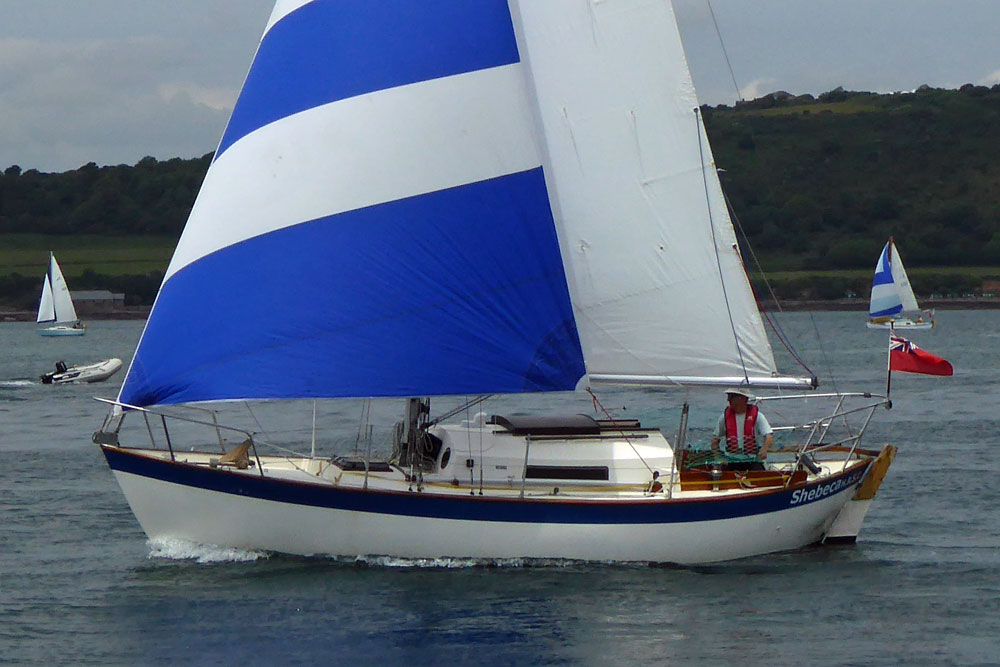
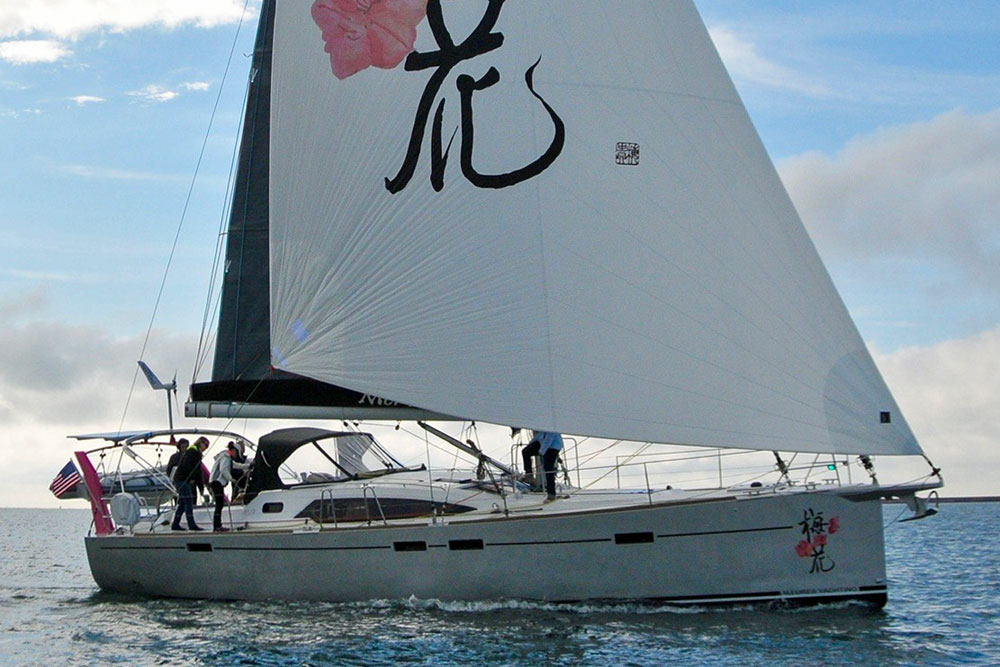
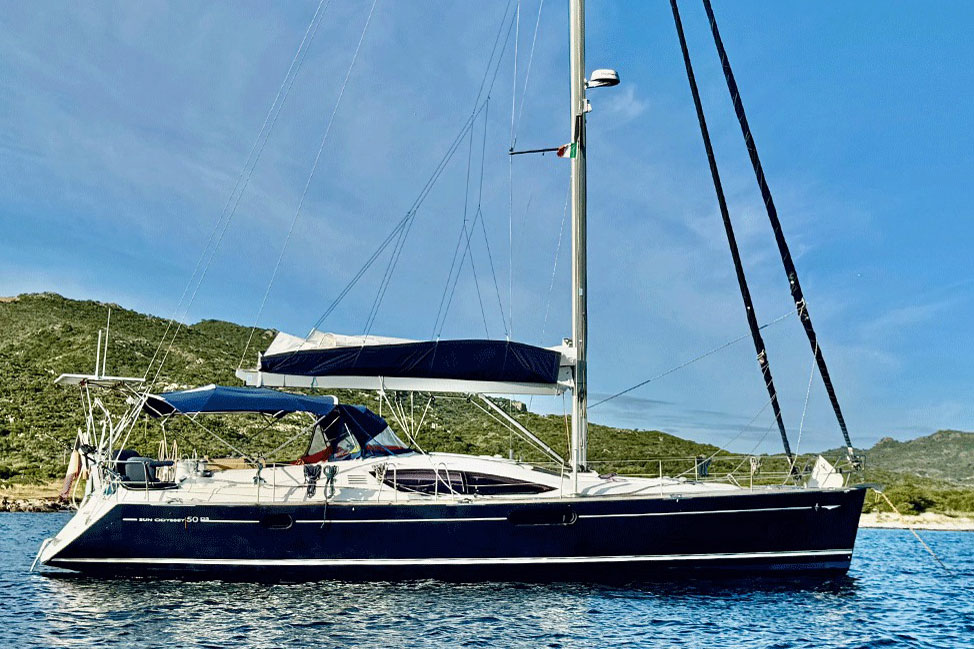 A Jeanneau Sun Odyssey 50
Image courtesy of Adventure Yacht Club
Design & Construction
The Jeanneau Sun Odyssey 50 was born from a collaboration between naval architect Philippe Briand and the Garroni Design studio. While the name is often used as a catch-all, the yacht is most famously encountered as the 50DS (Deck Saloon). Unlike custom aluminium builds like those from Alubat, which focus on extreme impact resistance and polar exploration, Jeanneau utilised high-quality, hand-laid glass reinforced plastic (GRP). The hull is solid laminate below the waterline, protected by a vinylester skin to resist osmosis, while the deck employs a discontinuous balsa core for stiffness and thermal insulation without excessive weight.
The defining feature of this model is the Deck Saloon concept. By raising the coachroof and the internal salon sole, the designers created a light-filled living space that eliminates the "basement feel" common in older monohulls. This design provides practical benefits for cruising, such as easier access to tankage and machinery beneath the floorboards and significantly better ventilation through the elevated ports.
Throughout its production, the Sun Odyssey 50 was offered with several variations to suit different cruising grounds. The most significant choice for owners was between the standard deep fin keel, drawing 7'1" (2.15 m), and a shoal draught version at 5'7" (1.69 m). The rig is a modern fractional sloop, typically featuring a furling mainsail for ease of handling, though performance-minded owners often sought out the "Performance" version with an increased mast height and deeper keel.
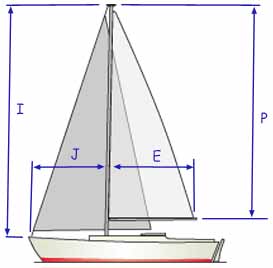
The rig dimensions provide a generous sail plan for a boat of this volume. The standard dimensions are as follows:
- I (Foretriangle Height): 55'9" (17.00 m)
- J (Foretriangle Base): 18'8" (5.68 m)
- P (Mainsail Luff): 51'8" (15.75 m)
- E (Mainsail Foot): 18'4" (5.60 m)
- Mainsail Area: 475 ft² (44.1 m²)
- Genoa Area (140%): 668 ft² (62.1 m²)
- Total Sail Area: 1,088 ft² (101.1 m²)
Note that the standard rig for the Sun Odyssey 50 is a fractional rig, but the example in the pic has been fitted with a Solent Rig.
Published Specification:The Jeanneau 'Sun Odyssey' 50 Blueprint
| Measurement Category | Specification & Data |
|---|---|
| Length Overall (LOA) | 49'5" (15.07 m) |
| Length at Waterline (LWL) | 43'1" (13.12 m) |
| Beam | 14'9" (4.49 m) |
| Draught (Standard / Shoal) | 7'1" / 5'7" (2.15 m / 1.69 m) |
| Displacement | 29,542 lbs (13,400 kg) |
| Ballast (Standard Keel) | 8,267 lbs (3,750 kg) |
| Rig Type | Fractional Sloop |
| Hull Material | GRP (Solid Hull / Balsa Cored Deck) |
| Production Dates | 2008 – 2012 (late hulls to 2016) |
Performance Analysis: Understanding the Design Ratios
To truly understand how a 15-metre yacht will behave in a seaway, we must look past the brochure numbers and examine the physical ratios. These figures provide a mathematical footprint of the yacht's DNA, comparing it to other vessels in the offshore cruising category.
| Design Ratio | Value | Expert Interpretation |
|---|---|---|
| Sail Area / Displacement (SA/D) | 18.2 | A balanced cruiser; enough power for light air without being over-canvassed. |
| Displacement / Length (D/L) | 165 | Moderate-light; indicates a hull that is easily driven and fast on a reach. |
| Ballast / Displacement (B/D) | 28% | Standard for modern production boats; relies on hull form for initial stability. |
| Capsize Screening Formula (CSF) | 1.91 | Under the threshold of 2.0; considered safe for transoceanic passages. |
| Brewer Motion Comfort Ratio (MCR) | 28.3 | Respectable; provides a predictable motion in moderate offshore conditions. |
For a deeper dive into how these metrics influence your time at sea, see our associated guide: Understanding Boat Performance & Design Ratios.
The SA/D of 18.2 suggests that the Sun Odyssey 50 is no slouch. In a ten-knot breeze, it will outpace older, heavier traditional cruisers. However, the D/L ratio of 165 places it firmly in the "performance cruiser" bracket. This means it has less momentum than a heavy-displacement boat, so it may slow down more quickly when hitting a head sea, but it will pick up speed much faster in a gust.
The Capsize Screening Formula of 1.91 is a critical metric for those planning an Atlantic crossing. A value below 2.0 is the generally accepted benchmark for ocean-going yachts, suggesting that the boat's beam is well-proportioned relative to its displacement. While the Comfort Ratio of 28.3 is lower than that of a dedicated heavy blue water cruiser (which might exceed 35), it is high for a modern, flat-bottomed production yacht, ensuring that the motion remains tolerable during long offshore stints.
Advanced Analysis & Context
The choice of GRP as a hull material for the Sun Odyssey 50 is a pragmatic one for the modern sailor. While aluminium offers supreme impact resistance for high-latitude sailing, GRP provides superior insulation against the cold and heat, and it is significantly easier to maintain in standard marina environments. Jeanneau's use of a vinylester barrier in the layup is a vital safety and maintenance feature, as it provides a robust line of defence against the osmotic blistering that plagued earlier generations of fibreglass boats.
The Deck Saloon configuration does more than just brighten the interior; it impacts the yacht's stability profile. By raising the deck and the center of gravity of the interior components slightly, the design must compensate with a deeper keel or a heavier bulb to maintain a high righting moment. In the case of the Sun Odyssey 50, Briand utilised an elongated bulb on a fin keel, which concentrates the weight low down. This ensures that despite the high-volume topsides, the boat remains stiff and capable of carrying its sail area well into the upper Beaufort scales.
Configuration, Layout & Cruising Characteristics
Cruising in a yacht of this size is as much about the "living" as it is about the "sailing." The Sun Odyssey 50 shines in its cockpit and salon execution. The cockpit is exceptionally wide, featuring twin wheels that provide an unobstructed path from the companionway to the large folding swim platform. This layout is perfect for the Mediterranean style of "stern-to" mooring, but it also provides a clear workspace for a short-handed crew.
The galley is a highlight for long-term liveaboards. Located to starboard, it is a massive L-shaped affair with a high-capacity 67 US gallon (255 L) fridge and freezer setup. This is a crucial consideration for tropical cruising where refrigeration is the primary power draw and space is at a premium. The tankage is equally generous, with 162 US gallons (615 L) of water and 63 US gallons (240 L) of fuel, allowing for significant autonomy between port calls.
Internally, the yacht was most commonly configured with a three-cabin, two-head layout. The owner's cabin, whether situated forward or aft depending on the specific sub-version, typically features a large island berth. The heads are equipped with separate shower stalls, a luxury that makes a significant difference during a month-long cruise. For charter operators, a four-cabin version was also produced, though this is less desirable for private owners who value the extra storage and elbow room of the three-cabin master version.
Impressed?
Has this article may suggested that this could be your ideal cruising boat and, as a result, deserves to be on your "Worth a look at" list?
But if, like me, you find sailboats to be seductive creations, then that list could rapidly get to be a pretty long one. If that is the case, wouldn't it be good if you could narrow it down bit through an objective, pragmatic process?
Well, that's where my eBook 'How to Avoid Buying the Wrong Sailboat' comes in...
Summing Up
The Jeanneau Sun Odyssey 50 is a thoughtfully engineered compromise that leans heavily towards comfort and liveability without sacrificing the joy of sailing. Its design ratios reveal a yacht that is relatively light and fast, yet stable enough to carry a Category A rating. While it may not possess the "go-anywhere" ruggedness of an aluminium expedition boat, its GRP construction is well-proven, and its vinylester protection offers peace of mind regarding long-term hull integrity. For the recreational sailor who prioritises light, space, and a capable hull for coastal hops or occasional ocean crossings, the Sun Odyssey 50 represents a masterful blend of French elegance and practical naval architecture.
This article was written by Dick McClary, RYA Yachtmaster and author of the RYA publications 'Offshore Sailing' and 'Fishing Afloat', member of The Yachting Journalists Association (YJA), and erstwhile member of the Ocean Cruising Club (OCC).
Frequently Asked Questions (FAQs)
Is the Jeanneau Sun Odyssey 50 suitable for a solo or double-handed crew?
Is the Jeanneau Sun Odyssey 50 suitable for a solo or double-handed crew?
Yes, the yacht is designed for ease of handling. Most models are fitted with all lines leading aft to the cockpit, and many include electric winches as a standard or frequent option. The twin wheels and bow thruster make docking a 50-foot vessel manageable for a couple.
What is the common engine found in this model, and is it sufficient?
What is the common engine found in this model, and is it sufficient?
Most Sun Odyssey 50 units are powered by a 75 hp (56 kW) Yanmar diesel engine, often with a turbocharger. Some hulls were upgraded to a 110 hp (82 kW) version. The 75 hp engine is generally considered adequate, providing a cruising speed of around 7 to 8 knots in calm water.
How does the shoal draught version compare to the deep keel in terms of performance?
How does the shoal draught version compare to the deep keel in terms of performance?
The shoal draught version draws 5'7" (1.69 m) and uses a heavier ballast (4,100 kg) to compensate for the shorter lever arm. While it allows access to shallower anchorages, such as those in the Bahamas or the US East Coast, it will have slightly more leeway when sailing upwind compared to the 7'1" (2.15 m) deep fin keel.
Are there known issues with the Deck Saloon windows?
Are there known issues with the Deck Saloon windows?
The large windows are a hallmark of the design. While they are robust, owners should inspect the seals every few years. Exposure to high UV can eventually degrade the bedding compound, leading to minor leaks if not maintained.
Does the boat have enough storage for long-term blue water cruising?
Does the boat have enough storage for long-term blue water cruising?
The DS design provides excellent internal volume, but because it is a performance-oriented hull, there is less "bilge" storage than on a traditional full-keel boat. However, the dedicated sail locker forward and the large lazarettes in the cockpit provide ample room for fenders, sails, and a folded tender.
Resources Used
SailboatData Sun Odyssey 50 DS Technical Specs https://sailboatdata.com/sailboat/sun-odyssey-50-ds-jeanneau/
Jeanneau Manufacturer Archive: Sun Odyssey 50DS https://www.jeanneau.com/en-gb/yachts/6-sun-odyssey-ds/31-sun-odyssey-50ds/
Cruising World: Review of the Jeanneau 50DS https://www.cruisingworld.com/jeanneau-50-ds-big-and-bold/
Yachting Monthly: Sun Odyssey Series Analysis https://www.yachtingmonthly.com/reviews/yacht-reviews/jeanneau-sun-odyssey-50-ds
European Yacht of the Year Archives https://www.europeanyachtoftheyear.com/
Recent Articles


-
Mystery 35 Review: Specs, Performance & Buying Guide
Aug 29, 26 09:42 AM
An in-depth review of the Mystery 35 sailboat. Read technical specs, design ratios, sail performance, and common buyer inspection areas. -
Beneteau First 405 Review: Specs, Performance & Buyer’s Guide
Aug 26, 26 03:58 AM
Detailed Beneteau First 405 review covering specs, performance, bluewater capability, layouts and buyer’s checklist. -
Moody S38 Review: Specs, Ratios & Buyer’s Guide
Aug 12, 26 04:22 AM
In‑depth Moody S38 review covering specs, performance, design ratios, layout, strengths, trade‑offs & buyer inspection points.