- Home
- Cruising Yachts 35' to 40'
- Bavaria 37 Sailboat
The Bavaria 37 Sailboat
Specs & Key Performance Indicators
Key Takeaways: The Bavaria 37 series is a strong choice for coastal cruising and family holidays, balancing interior volume with predictable handling. The modern Cruiser 37 by Farr Yacht Design leans into modern ergonomics, twin-wheel layouts, and large hull windows, while the earlier J&J designs are often praised for their more traditional looks and robust construction. As a moderate-displacement yacht, it stays stiff and stable in a breeze, but it needs a clean hull and good sails to perform well in lighter airs. Potential buyers should prioritise inspecting the saildrive diaphragm and the integrity of the bonded coachroof windows.
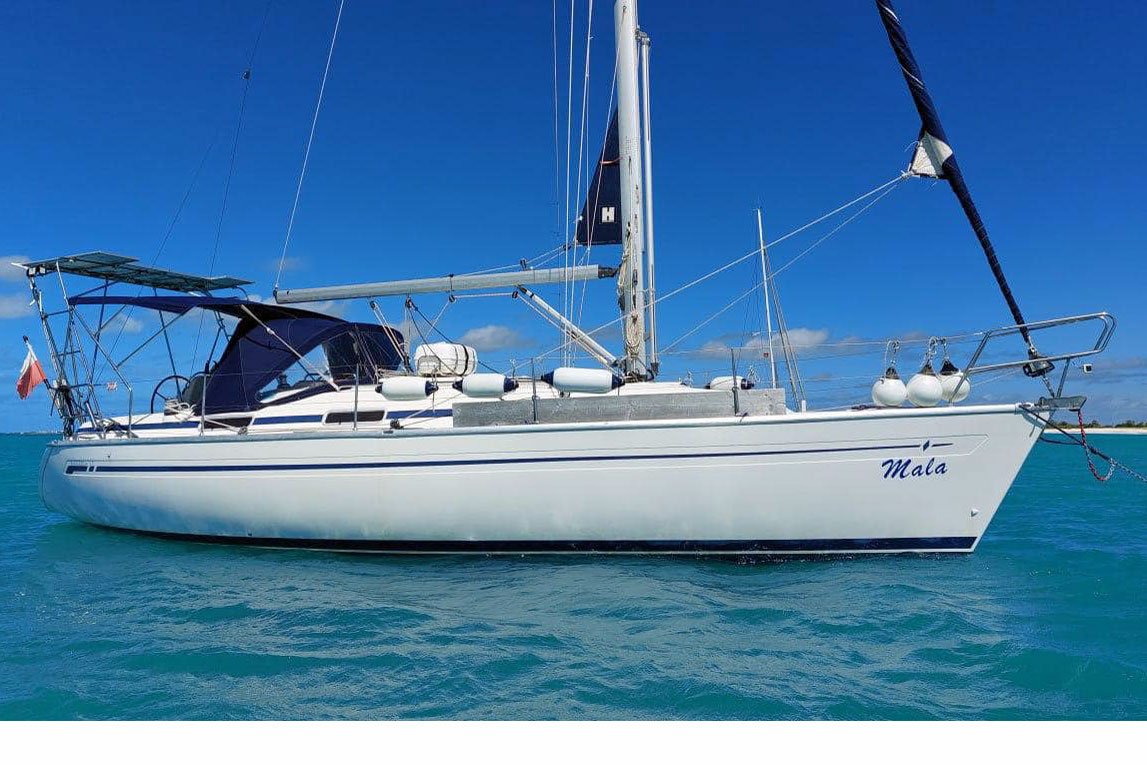 A Bavaria 37
Table of Contents
- Design & Construction
- Sail Areas & Rig Dimensions
- Configuration, Layout & Cruising Characteristics
- Published Specification: The Bavaria 37 Blueprint
- Performance Analysis: Understanding the Design Ratios
- The Buyer’s Checklist: Common Problem Areas
- Comparison: Bavaria 37 vs The Competition
- Summing Up
- Frequently Asked Questions (FAQs)
Design & Construction
The evolution of the Bavaria 37 is defined by two primary design eras. The original Bavaria 37 (produced roughly between 1999 and 2004) was designed by J&J Design. These boats are known for their classic profiles and are often considered part of the "golden era" of Bavaria’s build quality, featuring solid wood interiors and a more conservative hull shape.
In contrast, the Bavaria Cruiser 37 (launched in 2013) was penned by Farr Yacht Design. This version introduced a much more aggressive hull form with a "V-bow" and a beam that remains wide all the way to the transom. The construction transitioned to a sandwich core above the waterline for better thermal insulation and weight saving, while the underwater sections remained solid GRP.
Various versions were produced across both eras to suit different cruising needs:
- Draft Options: Standard deep fin keel at roughly 6'7" (2.02 m) and a shallow-draft version at 5'4" (1.63 m).
- Keel Material: Predominantly cast iron, requiring diligent maintenance to prevent rust weeping.
- Internal Layouts: Both generations offered two and three-cabin layouts. The Farr-designed Cruiser 37 is particularly famous for its massive hull windows that flood the cabin with natural light.
The Bavaria 37 is typically certified under CE Design Category A (Ocean). This signifies that the vessel is designed for extended voyages where conditions may exceed wind force 8 (Beaufort scale) and significant wave heights of 4 m and above.
Sail Areas & Rig Dimensions
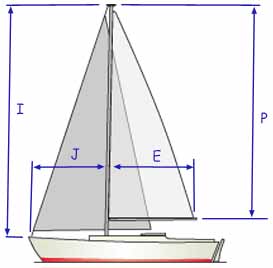 Rig dimensions
The Bavaria 37 typically utilises a fractional 9/10ths sloop rig. The Cruiser 37 variant often features a more modern, taller rig to compensate for its increased beam and windward resistance.
- Total Sail Area: Approximately 721 ft² (67 m²)
- Mainsail: 438 ft² (40.7 m²)
- Foresail (Genoa/Jib): 287 ft² (26.7 m²)
Rig Dimensions:
- I (Mast Height): 48'7" (14.80 m)
- J (Foretriangle Base): 13'1" (3.98 m)
- P (Mainsail Hoist): 46'11" (14.30 m)
- E (Boom Length): 15'3" (4.65 m)
Configuration, Layout & Cruising Characteristics
The interior of the Cruiser 37 is where the Farr design truly shines. By moving the mast slightly aft and widening the hull, the designers created a saloon that feels significantly larger than the older J&J 37. The sought-after "owner" version includes a dedicated, forward-facing navigation station and a larger heads compartment.
Cruising practicality is a hallmark of the range. The standard water capacity is around 360 litres (79 gallons), while the fuel tank holds 150 litres (33 gallons). The galley is a functional L-shape with deep double sinks and a large top-loading refrigerator. The modern Cruiser 37 cockpit is a standout feature. Twin wheels provide an unobstructed central walkway to the large fold-down bathing platform.
Published Specs: The Bavaria 37 Blueprint
| Specification | Data |
|---|---|
| Length Overall (LOA) | 37'1" (11.30 m) |
| Length at Waterline (LWL) | 33'6" (10.20 m) |
| Beam | 12'1" (3.67 m) |
| Draft (Standard / Shallow) | 6'7" (2.02 m) / 5'4" (1.63 m) |
| Displacement | 15,432 lbs (7,000 kg) |
| Ballast | 4,585 lbs (2,080 kg) |
| Rig Type | Fractional Sloop |
| Hull Material | GRP (Glass Reinforced Plastic) |
| Production Dates | 2013 – Present (Cruiser 37) |
Performance Analysis: Understanding the Design Ratios
The mathematical profile of the Bavaria 37 suggests a yacht that is efficient and forgiving for the recreational sailor.
| Design Ratio | Value | Interpretation |
|---|---|---|
| SA/D (Sail Area/Displacement) | 18.06 | Moderate. High enough for good light-air response but manageable for cruisers. |
| D/L (Displacement/Length) | 184 | Light-Moderate. Indicates a modern, efficient hull that can easily reach hull speed. |
| B/D (Ballast/Displacement) | 29.7% | Average for production boats. Reliant on hull form (beam) for initial stability. |
| CSF (Capsize Screening Formula) | 1.93 | Below 2.0. This qualifies the yacht for ocean-going service according to traditional metrics. |
| Comfort Ratio (Brewer) | 25.62 | Typical for a modern cruiser. It will feel livelier in a seaway than a heavy traditional cutter. |
For a deeper look at how these numbers influence your time at the helm, refer to our guide on Understanding Boat Performance & Design Ratios.
Structural Integrity & Stability Dynamics
The Farr Yacht Design era brought a more sophisticated approach to stability. While the hull remains standard GRP, isophthalic resins are used in the outer layers for superior osmosis protection. The high beam-to-length ratio ensures excellent initial stability, meaning the boat resists heeling in light to moderate winds.
However, as a production yacht with a B/D ratio under 30%, it relies heavily on form stability. Once the wind picks up, the Bavaria 37 performs best when sailed flat. Reefing early—typically around 18 knots of true wind—prevents the rudder from loading up and keeps the boat in its performance sweet spot.
The Buyer’s Checklist: Common Problem Areas
When inspecting a used Bavaria 37 or Cruiser 37, watch for these specific issues:
- Bonded Windows: The sleek coachroof windows are bonded. Over time, UV exposure can degrade the sealant, leading to leaks. Check for "weeping" streaks on the interior wood.
- Keel-to-Hull Joint: On ex-charter boats, look for the "Bavaria Smile"—a hairline crack at the leading edge of the keel joint. It is often just a cosmetic fairing issue, but it warrants a closer look at the keel bolts.
- Saildrive Diaphragm: Most are powered by Volvo Penta engines. The rubber seal has a recommended replacement interval (usually 7 years). Check the service history.
- Rudder Bearings: Check for excessive play in the steering. The Jefa steering systems used are high quality, but nylon bushings eventually wear.
Comparison: The Bavaria 37 vs The Competition
In the 37 to 40-foot market, the Bavaria competes directly with the Beneteau Oceanis 37.1 and the Hanse 388.
- Versus Beneteau: The Beneteau often feels slightly more spirited under sail, but the Bavaria generally offers a more robust-feeling interior with more solid wood trim in older models.
- Versus Hanse: The Hanse is the king of the "self-tacking jib," making it easier for solo sailors, but many find the Bavaria’s cockpit layout more sociable for larger groups.
If you'd like to compare this boat with others in this size range, take a look at Cruising Boats from 35' to 40' overall....
Could this be your ideal cruising boat?
It may well be, but before going any further, it might be worth taking a look at my eBook 'How to Avoid Buying the Wrong Sailboat'...
Summing Up
The Bavaria 37 is a masterclass in production engineering. It doesn't pretend to be a heavy-displacement, go-anywhere steel tank. Instead, it offers a fast, comfortable, and spacious platform for the way most people actually sail. Its design ratios point to a yacht that is efficient and safe, while its internal volume makes it a genuine home-from-home. If you reef early and stay on top of age-related maintenance for its seals and saildrive, it remains one of the most practical investments on the second-hand market.
This article was written by Dick McClary, RYA Yachtmaster and author of the RYA publications 'Offshore Sailing' and 'Fishing Afloat', member of The Yachting Journalists Association (YJA), and erstwhile member of the Ocean Cruising Club (OCC).
Frequently Asked Questions (FAQs)
Is the Bavaria 37 suitable for single-handed sailing?
Is the Bavaria 37 suitable for single-handed sailing?
Yes. With all lines led aft to the cockpit and the option for an autopilot and in-mast furling, it is very manageable.
How does the shallow draft version compare in performance?
How does the shallow draft version compare in performance?
The shallow draft version (1.63 m) allows access to tighter creeks but sacrifices some pointing ability upwind and increases leeway.
Is the engine powerful enough for the displacement?
Is the engine powerful enough for the displacement?
Most models come with a 28 hp Volvo Penta. While sufficient for flat water, it can feel underpowered when punching into a stiff headwind and chop.
Can the Bavaria 37 be used for blue water crossing?
Can the Bavaria 37 be used for blue water crossing?
Yes. Being Category A certified, many have crossed the Atlantic. However, you would need to upgrade the standard tankage for long passages.
How is the access for engine maintenance?
How is the access for engine maintenance?
Excellent. The companionway steps lift on gas struts, providing clear access to the front of the engine, while side panels in the aft cabins allow you to reach the saildrive easily.
Recent Articles


-
Rigging a Carbon Mast: Carbon, PBO or Dyneema Compared
Sep 20, 26 08:01 AM
Rigging a carbon mast: how carbon rod, PBO and Dyneema compare on cost, weight and inspection, and why stainless wire or rod rarely make sense. -
Top-Down Furling Guide: Code Zeros and Asymmetric Spinnakers
Sep 19, 26 04:57 PM
Top-down furling explained for cruisers: how it works, which boats need one, common faults, sock versus furler costs, and the rule everyone forgets. -
Standing Rigging Inspection Checklist: A Sailor's Full Guide
Sep 19, 26 03:46 PM
A complete standing rigging inspection checklist covering swage fittings, chainplates, tension and going aloft safely, plus when to call in a professional rigger.