- Home
- Sailboats 50'-55'
- Jeanneau Sun Odyssey 519 Review
Jeanneau Sun Odyssey 519 Sailboat
Specs, Performance Analysis & Cruising Characteristics
Key Takeaways: The Jeanneau Sun Odyssey 519 sits at the larger end of the production performance‑cruiser spectrum: a modern, beamy, aft‑cockpit cruiser aimed at fast passagemaking and comfortable living rather than heavy‑displacement voyaging. With a powerful fractional rig, twin wheels, a broad stern and generous interior volume, it suits sailors who want to cover miles quickly in comfort, often with family or friends aboard. The trade‑offs are typical of this genre: relatively light displacement, high freeboard and a big, open cockpit that favour speed and space over ultimate motion comfort and traditional “tank‑like” construction. Handled with sensible reefing and realistic loading, it can be a capable ocean boat, but it is best understood as a modern performance cruiser rather than a rugged expedition yacht.
Table of Contents
- The Jeanneau Sun Odyssey 519 at a Glance
- Design & Construction
- Published Specification: The Jeanneau Sun Odyssey 519 Blueprint
- Sail Areas & Rig Dimensions
- Performance Analysis: Understanding the Design Ratios
- How the Jeanneau Sun Odyssey 519 Sails
- Bluewater Capability: Strengths & Trade-Offs
- Configuration, Layout & Cruising Characteristics
- Who This Boat Is Best For
- The Buyer’s Checklist: Common Problem Areas
- Summing Up
- Frequently Asked Questions (FAQs)
The Jeanneau Sun Odyssey 519 at a Glance
- Type: Performance cruising monohull, aft‑cockpit
- Designer: Philippe Briand (exterior) with Jeanneau design team for interior
- Builder: Jeanneau, France
- Production years: Around 2015 to late 2010s (as part of the Sun Odyssey line)
- Rig: Fractional sloop, deck‑stepped mast, swept spreaders
- Best for: Fast coastal cruising, Atlantic circuits, Med liveaboard life, light‑crew family sailing
- Strengths: Speed for size, big cockpit, modern interior, strong owner and dealer support network
- Trade‑offs: Light to moderate displacement, high topsides, reliance on bonded glazing and moulded structural grid, less stowage for very heavy expedition loads
Design & Construction
The Sun Odyssey 519 is very much a child of its time. Philippe Briand drew a powerful hull with a long waterline, plumb bow, broad stern and hard chines aft. The aim was to deliver good average speeds, plenty of form stability and a large interior, while keeping the boat manageable for a small crew with modern sail handling systems.
Hull and deck
The hull is a GRP monocoque with an internal structural grid moulded and bonded into place to take keel, mast and rig loads. The deck is also GRP, typically with a balsa or foam core in non‑high‑load areas to save weight and improve stiffness. The hull‑deck joint is an inward flange, bonded and mechanically fastened.
The large hull windows and coachroof windows on this generation of Jeanneau are bonded rather than through‑bolted. That gives a clean exterior look and lots of light below, but it does mean that careful inspection for any signs of adhesive failure, crazing or leaks is important on a used boat.
Chainplates are internal, with stainless steel structures tied into the hull grid and bulkheads rather than external strap chainplates. This keeps the deck clean and reduces point‑load issues at the sheer, but it does mean inspection is more involved, as access is from the interior and often behind joinery. Any signs of water ingress around the chainplate penetrations, staining on liners or corrosion on the plates themselves should be taken seriously.
Keel and rudder
The Sun Odyssey 519 was offered with at least two keel options: a deep fin keel and a shoal‑draft version. The deep keel is roughly 7'6" (about 2.30 m) and the shoal version around 5'8" (about 1.75 m). Both are cast iron bolted to a substantial keel stub. The deep keel gives better upwind performance and a stiffer feel; the shoal keel is attractive for the Bahamas, US East Coast and parts of the Med but will give a little more leeway and a softer feel when pressed.
Steering is via a single spade rudder with twin wheels. The rudder is foam‑cored with a stainless stock. As with many modern production boats, the rudder is relatively deep and narrow, which gives good bite and control when the boat is sailed upright, but can ventilate if over‑pressed and heeled hard.
Layouts and variants
The 519 was offered in several interior configurations, broadly:
- Three‑cabin layout with a large forward owner’s cabin and two aft cabins
- Four‑cabin layout with a split forward cabin
- Five‑cabin charter‑oriented layout, sometimes with a small skipper’s cabin in the bow
Options included in‑mast furling or classic slab‑reefed mainsail, self‑tacking jib or overlapping genoa, bowsprit for Code sails, and various electronics and tankage packages. Draft options, as noted, were deep and shoal. All are aft‑cockpit; there was no centre‑cockpit or ketch version.
Stability and category
The boat is CE‑rated for Category A (Ocean) in typical configurations. A formal STIX number is not widely published in the open literature; in practice, the combination of beam, ballast ratio and hull form puts it in line with other modern Category A production cruisers of similar size.
Published Specification: The Jeanneau Sun Odyssey 519 Blueprint
Below is a consolidated “blueprint” of typical published specifications for the Sun Odyssey 519. Individual boats may vary slightly by year and option package.
| Specification | Value |
| Length overall (LOA) | 51'9" (15.8 m) |
| Length on waterline (LWL) | 45'9" (13.9 m) |
| Beam | 15'4" (4.7 m) |
| Draft (deep keel) | 7'6" (2.3 m) |
| Draft (shoal keel) | 5'8" (1.75 m) |
| Displacement (lightship) | 30,600 lb (13,900 kg) approx. |
| Ballast (deep keel) | 9,500 lb (4,300 kg) approx. |
| Rig type | Fractional sloop, deck-stepped mast |
| Hull material | GRP (fibreglass) with internal structural grid |
| Engine | Typically Yanmar 80 hp diesel (shaft drive) |
| Production dates | Circa 2015–late 2010s |
Sail Areas & Rig Dimensions
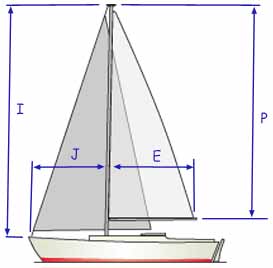 Rig dimensions
Typical rig dimensions and sail areas for a standard Sun Odyssey 519 with a full‑batten or furling main and overlapping genoa are as follows (figures vary slightly by sailmaker and configuration):
| Rig / Sail | Dimension | Value |
| I | Foretriangle height | 60.7' (18.5 m) |
| J | Foretriangle base | 19.7' (6.0 m) |
| P | Mainsail luff | 56.1' (17.1 m) |
| E | Mainsail foot | 18.4' (5.6 m) |
| Mainsail area | Approx. | 560 ft² (52 m²) |
| Genoa (140%) area | Approx. | 620 ft² (58 m²) |
| Total working sail area | Main + genoa | Approx. 1,180 ft² (110 m²) |
| Code sail / gennaker | Typical option | 1,300–1,600 ft² (120–150 m²) |
Performance Analysis: Understanding the Design Ratios
Using the typical figures above (displacement around 30,600 lb, LWL 45'9", beam 15'4", ballast 9,500 lb, sail area around 1,180 ft²), we can derive the key design ratios that help describe how the boat behaves.
| Ratio | Approx. value | What it suggests |
| Sail Area / Displacement (SA/D) | ~19.5 | On the lively side for a cruising boat; good light-air performance and quick passage speeds if reefed sensibly when breeze builds. |
| Displacement / Length (D/L) | ~140 | Light to moderate displacement; prioritises speed and responsiveness over heavy, slow-motion comfort. |
| Ballast / Displacement (B/D) | ~31% | Typical for a modern fin-keel cruiser; relies on hull form stability and beam as well as ballast for stiffness. |
| Capsize Screening Formula (CSF) | ~2.0 | Borderline between traditional “bluewater” comfort numbers and modern performance cruisers; acceptable for offshore use with prudent loading and seamanship. |
| Brewer Motion Comfort Ratio | ~26 | Moderate motion comfort; not a heavy-displacement ocean slogger, but reasonable for long passages if not overloaded high in the ends. |
Interpreting the numbers
Taken together, these ratios paint a consistent picture. The Sun Odyssey 519 is a relatively light, powerful cruiser that rewards active sail handling. It will slip along nicely in moderate airs and can maintain high average speeds on passage. It is not designed to behave like a heavy, narrow, long‑keel boat in a big sea, but for many real‑world cruising programmes it offers a good compromise between pace and comfort.
For more on this topic, you might want to take a look at Understanding Boat Performance & Design Ratios...
How the Jeanneau Sun Odyssey 519 Sails
Upwind, the 519 benefits from its long waterline and decent sail area. In flat to moderate seas, the deep‑keel version will track well and point respectably, especially with a good laminate genoa and a fair bottom. The shoal‑draft version gives away a little pointing ability and will make slightly more leeway, but remains perfectly adequate for cruising angles.
The helm is generally light and responsive. The single deep spade rudder gives good feel when the boat is sailed at sensible heel angles. Pressed too hard with too much sail, the wide stern and hard chine can encourage the boat to lean on its shoulder and load up the helm. Most owners who sail offshore settle on an early‑reefing regime: first reef in the main around 15–18 knots true, second reef in the low 20s, and a smaller headsail or rolled genoa to keep the boat on its feet.
Downwind and reaching is where the 519 comes alive. With a Code sail or asymmetric on the bowsprit, it will log very respectable daily runs without feeling stressed. The broad stern encourages surfing in the right conditions, though care is needed to avoid over‑steering when the boat accelerates on a wave.
Short‑handed, the boat is manageable provided the sail plan is set up sensibly. In‑mast furling, electric winches and a self‑tacking jib make life easier for a couple, at the cost of some sail shape and performance. A classic main with lazy jacks and a good reefing system is still perfectly workable for a fit pair, and gives better drive in light airs.
The motion is typical of a modern beamy cruiser. In a short, steep chop, the high freeboard and relatively flat aft sections can produce some slamming if driven hard. In a longer ocean swell with a reefed rig and the boat kept in trim, the motion is more comfortable than the numbers alone might suggest, helped by the length and the ability to keep speeds up.
Bluewater Capability: Strengths & Trade-Offs
The Sun Odyssey 519 is CE‑rated for ocean use and has already completed plenty of Atlantic crossings and extended cruises. That said, it is important to be clear about what “bluewater” means in this context.
Strengths
- Speed as a safety factor: The ability to maintain 7–8 knot averages on passage allows you to pick weather windows and outrun some systems.
- Modern deck layout: Wide side decks, decent handholds and a large cockpit with good coamings make life on deck straightforward in most conditions.
- Systems support: Jeanneau’s global dealer network and the use of mainstream hardware (Yanmar, common winch brands, standard rigging) make spares and support easier to find worldwide.
Trade‑offs
- Load carrying: Like many light‑moderate displacement cruisers, the 519 does not enjoy being loaded to the gunwales with gear, fuel and water. Performance and motion both suffer if weight is piled high and aft.
- Cockpit exposure: The big, open cockpit is wonderful in the Med. In a cold, wet ocean, you will want a serious sprayhood and cockpit enclosure, and you will need to think about how water drains and where crew brace themselves.
- Construction philosophy: Bonded windows, an internal grid and relatively light skins are not inherently weak, but they demand careful inspection and maintenance. This is not a belt‑and‑braces, over‑built custom bluewater boat.
For an Atlantic circuit, seasonal ocean crossings or extended coastal and semi‑offshore cruising, a well‑prepared 519 is entirely reasonable. For high‑latitude work, heavy‑weather voyaging or very remote cruising, many sailors would prefer something more conservative.
Configuration, Layout & Cruising Characteristics
On deck, the 519 is very much a modern cockpit‑centred cruiser. Twin wheels open onto a fold‑down transom platform that makes boarding and swimming easy. The primary winches are within reach of the helms, and the mainsheet is typically led to the coachroof rather than a cockpit traveller, which keeps the cockpit clear but reduces fine‑tuning options.
The side decks are wide, with shrouds taken to the hull sides. That gives a clear run forward but does mean you are outboard when passing the chainplates. The foredeck is generous, with space for a decent anchor locker and windlass, and many boats have a fixed bowsprit that doubles as an anchor roller and tack point for Code sails.
Below, the boat feels big. The beam carries well forward, so the saloon is wide and bright, helped by those large hull windows and overhead hatches. Joinery is typically light‑coloured, with modern styling. The galley is usually along the port side or L‑shaped, with plenty of counter space but, as with many production boats, you need to think about bracing points when cooking at sea.
The owner’s cabin in the three‑cabin layout is a real selling point: a large island berth forward with good headroom and an en‑suite. Aft cabins are generous doubles. In the four and five‑cabin versions, space is inevitably more divided, but still workable for charter or large families.
Storage is adequate for coastal and seasonal cruising, but if you are planning long‑term liveaboard life with lots of spares and toys, you will need to be organised. Under‑sole tankage and systems take up some of the volume that older, narrower boats might have used for deep lockers.
Who This Boat Is Best For
Good fit for:
- Sailors moving up from 35–40 footers who want more speed and space without a professional crew
- Couples or families planning Atlantic circuits, Med seasons or extended coastal cruising
- Owners who value modern comfort, light interiors and good performance in light to moderate airs
- Charter operators looking for a large, attractive performance cruiser with flexible layouts
Less ideal for:
- Skippers who prioritise heavy‑weather comfort above all else
- Very high‑latitude or expedition cruising where impact resistance and extreme load carrying are paramount
The Buyer’s Checklist: Common Problem Areas
On a used Jeanneau Sun Odyssey 519, a thorough survey and sea trial should pay particular attention to:
- Bonded windows and hatches: Look for any signs of leaks, crazing, UV degradation or failed sealant around hull windows, coachroof glazing and deck hatches.
- Chainplates and rig base: Check for staining, damp or corrosion around chainplate penetrations and the mast step area. Ask about rig age; standing rigging replacement around the 10‑year mark is a sensible baseline.
- Keel and grid: Inspect keel bolts, the keel‑hull joint and the internal grid for any signs of grounding damage, cracking or movement.
- Rudder and steering: Check for play in the rudder bearings, smooth steering, no tight spots and no signs of water ingress into the rudder blade.
- Teak in cockpit and on swim platform (if fitted): Worn, thin or lifting teak can be expensive to replace.
- Engine and saildrive: Typical Yanmar issues apply: service history, hours, cooling system condition. If a saildrive is fitted, check the age of the diaphragm seal and budget for replacement if due.
- Electrical system and batteries: Many boats of this size end up with a lot of added electronics, inverters and chargers. Look for tidy wiring, adequate battery capacity and evidence of professional installation.
- Canvas and sails: A boat of this age may be on its second set of sails and canvas. Budget realistically for new sails if the existing ones are tired; on a boat this size, a full suit is a significant line item.
Typical refit spends for a 10‑year‑old 519 moving from charter to private bluewater use might include: new standing rigging, partial or full sail replacement, upgraded batteries and charging, new electronics, canvas, safety gear and some cosmetic work. It is easy to spend a healthy five‑figure sum bringing a tired example up to a high standard, so factor that into your offer.
Could this be your ideal cruising boat?
It may well be, but before going any further, it might be worth taking a look at my eBook 'How to Avoid Buying the Wrong Sailboat'...
Summing Up
The Jeanneau Sun Odyssey 519 is a modern, performance‑leaning cruising yacht that offers a lot of boat for its length. The design ratios show a light to moderate displacement hull with a generous sail plan and good form stability. In practice, that translates into quick passages, rewarding sailing and a boat that feels lively rather than ponderous.
The trade‑offs are clear and should be embraced rather than ignored. This is not a heavy, over‑built, narrow‑beamed ocean plodder. It is a big, bright, comfortable cruiser that will look after you if you reef early, keep the weight sensible and maintain the structure and systems properly. Bonded windows, internal chainplates and a moulded grid are not reasons to walk away, but they are reasons to survey carefully and to budget for ongoing care.
For many sailors planning Atlantic circuits, Med seasons or extended coastal cruising with family and friends, the Sun Odyssey 519 hits a very attractive sweet spot between performance, comfort and cost. Choose the right example, invest in a thoughtful refit and you will have a fast, modern cruising platform with a lot of real‑world miles in it.
Other Jeanneau Models of a Similar Size
Jeanneau has produced a wide range of performance‑cruisers that share the same design philosophy as the Sun Odyssey 519: comfortable passagemaking, practical deck layouts, and easily managed sail plans. The boats below offer similar appeal for sailors comparing cruising capability, interior volume, and offshore suitability. Each one provides a useful reference point for readers considering boats in the same family and size range.
Jeanneau Sun Odyssey 49
The Sun Odyssey 49 is a powerful cruiser designed for long‑distance comfort and efficient passagemaking. Its hull form delivers steady tracking and reassuring stability, particularly when loaded for extended cruising. The interior is spacious, with multiple layout options that suit both private owners and charter use. On deck, the sail controls are well‑organised, making it manageable for a small crew. It’s a natural comparison for anyone looking at larger Jeanneau cruising yachts. Read more…
Jeanneau Sun Odyssey 51
The Sun Odyssey 51 sits firmly in the bluewater‑cruising category, offering generous displacement and a hull shape that handles ocean conditions with confidence. Its interior volume is notable, providing ample storage and comfortable living spaces for long voyages. The rig is straightforward and efficient, allowing good performance without demanding a large crew. Many owners appreciate its balance of traditional cruising comfort and modern Jeanneau styling. It’s an excellent reference point for sailors evaluating bigger offshore‑capable Jeanneaus. Read more…
Jeanneau 53
The Jeanneau 53 blends contemporary styling with serious cruising credentials, making it a popular choice for extended liveaboard use. Its wide beam creates a remarkably open interior, while still maintaining a hull form that performs well in a range of conditions. The cockpit layout is geared toward both comfort and efficient sail handling, with twin wheels and clear working areas. Owners often praise its ability to combine luxury with practical offshore capability. It aligns closely with the expectations of sailors considering the Sun Odyssey 519. Read more…
Jeanneau Sun Odyssey 54 DS
The Sun Odyssey 54 DS is one of Jeanneau’s most recognisable deck‑saloon cruisers, offering excellent visibility and a bright, open interior. Its hull is designed for comfortable long‑range sailing, with a motion that remains steady even in challenging conditions. The deck layout supports easy handling, and the raised saloon provides exceptional living comfort at anchor or underway. Many long‑term cruisers value its blend of performance, space, and offshore practicality. It’s a strong companion model for readers exploring larger Jeanneau passagemakers. Read more…

Written by Dick McClary, cruising sailor and yachting journalist, publisher of Sailboat‑Cruising.com and admin of the Liveaboard Sailboats for Sale community.

Frequently Asked Questions (FAQs)
1. Is the Jeanneau Sun Odyssey 519 suitable for an Atlantic crossing?
1. Is the Jeanneau Sun Odyssey 519 suitable for an Atlantic crossing?
Yes, many have already crossed the Atlantic. A well‑prepared 519 with up‑to‑date rigging, good sails, sensible loading and a conservative reefing plan is entirely suitable for a typical trade‑wind crossing. The key is preparation rather than raw design limitations.
2. How does the shoal‑draft version perform compared to the deep‑keel model?
2. How does the shoal‑draft version perform compared to the deep‑keel model?
The shoal‑draft keel gives away some pointing ability and stiffness. Upwind in a chop you will notice a little more leeway and a softer feel. For many cruising programmes in shallow areas, the trade‑off is worth it. If your sailing is mostly offshore and upwind performance matters, the deep keel is the better choice.
3. Are bonded windows on the 519 a serious concern?
3. Are bonded windows on the 519 a serious concern?
They are a maintenance item rather than an automatic red flag. Inspect carefully for leaks, crazing and UV damage. If the boat has lived in strong sun, budget for re‑bedding or replacement at some point. Properly installed and maintained, bonded windows can be reliable, but they should never be ignored.
4. What are the most valuable upgrades on a used Sun Odyssey 519?
4. What are the most valuable upgrades on a used Sun Odyssey 519?
For serious cruising, high‑value upgrades include: recent standing rigging, quality laminate or high‑spec Dacron sails, upgraded battery bank and charging (solar, alternator, possibly a generator), modern electronics with AIS, robust ground tackle and a good cockpit enclosure. These add more to real‑world cruising value than cosmetic extras.
5. How does the 519 compare to other 50‑foot bluewater cruisers?
5. How does the 519 compare to other 50‑foot bluewater cruisers?
Compared to heavier designs from builders like Hallberg‑Rassy or Oyster, the 519 is lighter, faster and more spacious inside, but offers less ultimate motion comfort and a different construction philosophy. Against similar production performance cruisers (Beneteau Oceanis, Bavaria Cruiser, Hanse), it sits squarely in the same camp: quick, comfortable and very capable in the hands of a thoughtful owner.
6. Can a couple handle the Sun Odyssey 519 without extra crew?
6. Can a couple handle the Sun Odyssey 519 without extra crew?
Yes, provided the sail handling is set up with that in mind. In‑mast furling, a self‑tacking jib and at least one powered winch make life easier. Even with a classic main and overlapping genoa, a fit and practised couple can manage the boat, especially with a good autopilot.
Recent Articles


-
Should I Buy a Boat? Four Questions to Answer Before You Commit
Oct 02, 26 04:40 AM
Thinking "Should I buy a boat?" This guide helps you decide, with key considerations from cost & maintenance to your personal sailing aspirations. -
Offshore Internet with Starlink: Hardware, Plans, and Setup Guidance
Oct 01, 26 01:15 PM
A clear, practical guide to choosing the right Starlink hardware and plan for offshore cruising. Learn what to buy, how to install it, and how to manage power afloat. -
Offshore Liferaft Guide: Choosing, Stowing and Servicing One
Oct 01, 26 06:28 AM
Choosing an offshore liferaft? Learn what ISO 9650 Group A means, where to stow it, how often to service it and what to pack in the grab bag.