- Home
- Cruising Yachts 40' to 45'
- Bavaria 41 Sailboat
The Bavaria 41 Sailboat:
Specs, Performance Analysis & Cruising Characteristics
Key Takeaways
The Bavaria 41 is arguably the benchmark for the modern mass-production cruiser, sitting at the sweet spot where manageable handling meets genuine blue-water potential. While older models focused on conservative stability, the newer Farr-designed versions prioritise form stability and massive internal volume, making them a favourite for liveaboard families. Crucially, with a capsize screening value below 2.0 and a respectable sail area to displacement ratio, it manages to be a comfortable home at sea without sacrificing the ability to eat up miles on a coastal passage. It is a boat built for the pragmatist: easy to handle short-handed, reasonably stiff in a breeze, and offering one of the best space-per-foot ratios in its class.
 The Bavaria 41
Design & Construction
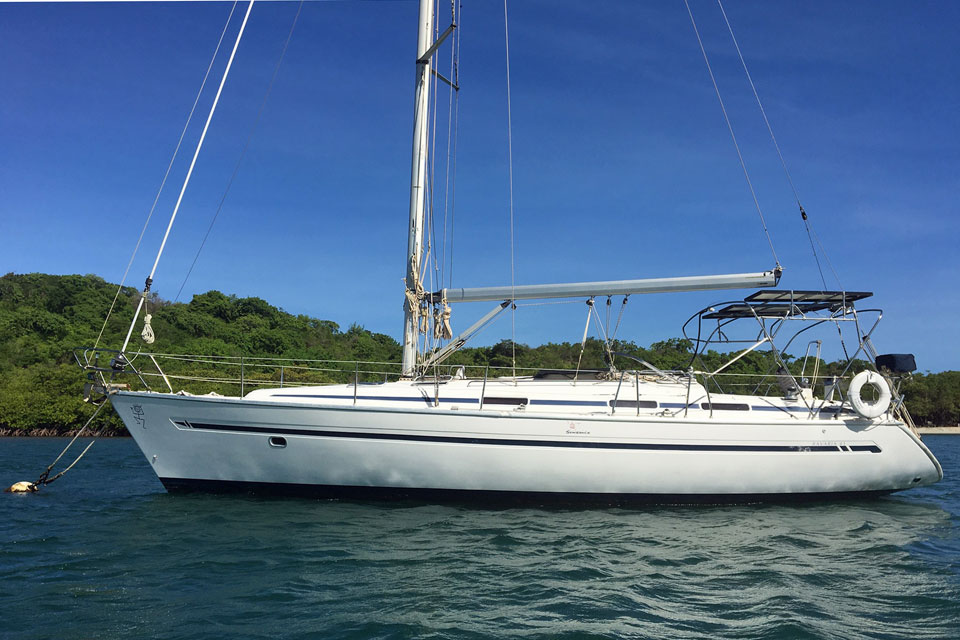
The lineage of the Bavaria 41 spans two distinct eras of naval architecture. The original models, produced from the mid-1990s into the early 2000s, were the work of J&J Design, focusing on a robust, conservative cruiser profile. However, the modern Bavaria Cruiser 41, which is the primary focus of contemporary offshore research, was born from a collaboration between Farr Yacht Design and Design Unlimited. This newer iteration shifted the design language toward a wider beam carried well aft and a more contemporary aesthetic.
Bavaria Yachts utilizes a GRP sandwich construction for the hull, incorporating a Divinycell foam core above the waterline to enhance stiffness and provide thermal insulation. Below the waterline, the hull is solid laminate to ensure impact resistance. A defining feature of this model is the massive form stability generated by its hull shape. Unlike older, narrower designs that rely heavily on lead ballast deep in the keel, the Bavaria 41 uses its wide beam and full hull sections to resist heeling, creating a much larger "living room" feel both on deck and below.
Over its production life, several versions were offered to suit different cruising environments. These include a standard deep-draught fin keel (approx. 2.05 m / 6'9") for better upwind performance and an optional shallow-draught version (approx. 1.65 m / 5'5") for sailors frequenting the Bahamas or the East Coast of the UK. While most are fractional sloops, a "Sport" or "41S" version was also produced, featuring a taller rig, deeper keel, and upgraded deck hardware for those with regatta ambitions.
Sail Areas & Rig Dimensions
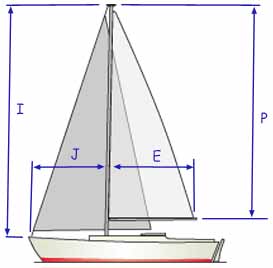
The rig is a modern 9/10 fractional sloop configuration, designed to be easily handled by a couple. The standard sail plan provides enough power to move the boat in light airs without becoming overwhelming when the breeze picks up.
- Total Sail Area: 883 ft² (82 m²)
- Mainsail Area: 484 ft² (45 m²)
- Foresail Area (Jib): 398 ft² (37 m²)
- I (Forestay Height): 54'4" (16.56 m)
- J (Fore-triangle Base): 14'1" (4.29 m)
- P (Mainsail Luff): 51'3" (15.62 m)
- E (Mainsail Foot): 16'11" (5.16 m)
Published Specification: The Bavaria 41 Blueprint
The following data represents the core specifications for the Farr-designed Bavaria Cruiser 41, which serves as the benchmark for this size class in the secondary market.
| Parameter | Measurement (Imperial & Metric) |
|---|---|
| Length Overall (LOA) | 40'6" (12.35 m) |
| Length Waterline (LWL) | 35'3" (10.75 m) |
| Beam | 13'0" (3.96 m) |
| Draught (Standard / Shallow) | 6'9" (2.05 m) / 5'5" (1.65 m) |
| Displacement | 19,136 lbs (8,680 kg) |
| Ballast | 6,032 lbs (2,736 kg) |
| Rig Type | Fractional Sloop |
| Hull Material | GRP Sandwich (Divinycell Core) |
| Production Dates | 2013 – 2022 (Cruiser Series) |
Performance Analysis: Understanding the Design Ratios
To truly evaluate how the Bavaria 41 handles offshore, we must look at the mathematical relationships between its dimensions. For a deeper dive into these metrics, refer to our guide on Understanding Boat Performance & Design Ratios.
| Ratio | Value | Interpretation |
|---|---|---|
| Sail Area/Displacement (SA/D) | 19.75 | A healthy performance cruiser ratio. It indicates the boat has enough "engine" to perform well in moderate coastal breezes. |
| Displacement/Length (D/L) | 195 | Categorised as a light-to-medium displacement cruiser. This allows for good surfing potential off the wind while maintaining momentum in a chop. |
| Ballast/Displacement (B/D) | 31.5% | Standard for a high-volume cruiser. Much of its stiffness comes from its hull shape rather than just the weight of the keel. |
| Capsize Screening Formula (CSF) | 1.94 | A value under 2.0 is the traditional benchmark for ocean-going suitability. The Bavaria 41 is safely on the right side of this line. |
| Brewer Motion Comfort Ratio | 26.5 | Reflects a moderate motion. It will be more "active" in a sea-way than a heavy traditional long-keeler but remains comfortable for its class. |
Structural Integrity & Stability Dynamics
The use of GRP sandwich construction with a foam core is a significant factor in the boat's long-term maintenance profile. While foam cores provide excellent insulation against condensation and sound, they require a fastidious surveyor to ensure no water ingress has occurred around deck fittings over time. The structural grid system used by Bavaria is bonded and glassed into the hull, providing the necessary rigidity to handle the loads of the fractional rig without the weight penalties of older construction methods.
The key defining feature of the 41 is its incredible form stability. With a beam of 13'0" (3.96 m) carried quite far aft, the boat resists heeling naturally. This is a practical benefit for cruising families, as it keeps the decks flatter and reduces fatigue during long passages. However, sailors should note that this wide beam increases wetted surface area in very light airs, meaning you may reach for the engine sooner than on a narrower, "slippery" boat.
Configuration, Layout & Cruising Characteristics
Inside, the Bavaria 41 is a masterclass in spatial ergonomics. Most models are found in a three-cabin, two-head configuration. The forward owner's suite is remarkably spacious for a 40-footer, often including a private en-suite. The twin aft cabins benefit from the hull's wide transom, offering standing headroom and adequate ventilation through multiple opening ports.
From a practical cruising perspective, the galley is typically arranged along the port side (linear) or in an L-shape, depending on the specific year of production. Tankage is adequate but not vast, with approximately 56 gallons (210 litres) of fuel and 56 to 95 gallons (210 to 360 litres) of water. For those planning extended blue-water passages, adding a watermaker or extra flexible tanks is a common modification. The cockpit is the heart of the boat, featuring a large drop-leaf table and twin helm stations that provide an unobstructed path to the fold-down bathing platform.
Impressed?

Has this article may suggested that this could be your ideal cruising boat and, as a result, deserves to be on your "Worth a look at" list?
But if, like me, you find sailboats to be seductive creations, then that list could rapidly get to be a pretty long one. If that is the case, wouldn't it be good if you could narrow it down bit through an objective, pragmatic process?
Well, that's where my eBook 'How to Avoid Buying the Wrong Sailboat' comes in...
Summing Up
The Bavaria 41 represents a highly pragmatic choice for the modern sailor. It excels as a coastal and cross-channel cruiser where interior volume and cockpit comfort are paramount. While its design ratios suggest it is a medium-displacement vessel that relies on form stability, its Capsize Screening Formula confirms it is more than capable of handling offshore conditions when sailed with respect. Maintenance is generally straightforward due to the accessibility of the engine and plumbing systems, though the GRP sandwich deck requires periodic inspection. Ultimately, the 41 offers a balanced blend of German engineering and Farr-designed performance that remains competitive in the pre-owned market.
If you'd like to compare this boat with others in this size range, take a look at Cruising Sailboats between 40' and 45' overall.
This article was written by Dick McClary, RYA Yachtmaster and author of the RYA publications 'Offshore Sailing' and 'Fishing Afloat', member of The Yachting Journalists Association (YJA), and erstwhile member of the Ocean Cruising Club (OCC).
Frequently Asked Questions (FAQs)
How does the foam-core hull affect maintenance?
How does the foam-core hull affect maintenance?
The Divinycell core provides excellent insulation and stiffness. The main maintenance concern is ensuring that any aftermarket deck hardware is properly bedded to prevent water from reaching the core. If well-maintained, these hulls are incredibly durable and resistant to the "sweating" common in solid GRP boats.
Is the Bavaria 41 suitable for single-handed sailing?
Is the Bavaria 41 suitable for single-handed sailing?
Yes, the modern Cruiser 41 is well-suited for solo or short-handed use. The twin-wheel setup allows easy access to the primary winches from the helm, and most lines are led back to the cockpit. The inclusion of a bow thruster on many used models further simplifies docking in tight marinas.
What is the realistic motoring range of the Bavaria 41?
What is the realistic motoring range of the Bavaria 41?
Equipped with the standard 40hp Volvo Penta engine and a 210-litre fuel tank, the boat typically cruises at 6 to 7 knots. At these speeds, fuel consumption is modest, providing a range of approximately 450 to 500 nautical miles under power, assuming a clean hull and moderate conditions.
Can the Bavaria 41 be used for serious offshore racing?
Can the Bavaria 41 be used for serious offshore racing?
While the standard Cruiser 41 is a dedicated cruising boat, the "41S" (Sport) version features a deeper keel and a taller mast. While it won't beat a pure racing yacht, it is highly competitive in "cruiser-racer" classes and offers a much higher level of comfort than a dedicated racing platform.
What are the common issues to look for when buying a used Bavaria 41?
What are the common issues to look for when buying a used Bavaria 41?
Prospective buyers should check the saildrive diaphragm (usually replaced every 7 to 10 years) and inspect the rudder bearings for play. Additionally, examine the bonding of the internal grid to the hull, although Bavaria re-engineered these to be exceptionally robust in the Farr-designed models.
Recent Articles


-
Should I Buy a Boat? Four Questions to Answer Before You Commit
Oct 02, 26 04:40 AM
Thinking "Should I buy a boat?" This guide helps you decide, with key considerations from cost & maintenance to your personal sailing aspirations. -
Offshore Internet with Starlink: Hardware, Plans, and Setup Guidance
Oct 01, 26 01:15 PM
A clear, practical guide to choosing the right Starlink hardware and plan for offshore cruising. Learn what to buy, how to install it, and how to manage power afloat. -
Offshore Liferaft Guide: Choosing, Stowing and Servicing One
Oct 01, 26 06:28 AM
Choosing an offshore liferaft? Learn what ISO 9650 Group A means, where to stow it, how often to service it and what to pack in the grab bag.