- Home
- Cruising Yachts 40' to 45'
- Dufour 425 Review
The Dufour 425 Sailboat
Specs, Performance Analysis & Cruising Characteristics
Key Takeaways: The Dufour 425 Grand Large is a versatile Category A ocean cruiser characterised by its balanced performance and generous liveaboard volume. Key findings include a moderate displacement hull that performs well in light to medium airs, a twin-wheel cockpit layout that enhances ergonomics, and a high-quality interior finish typical of the mid-2000s Dufour era. It offers high initial stability thanks to its generous beam, making it a predictable and safe platform for recreational coastal hopping or extended blue-water passages, provided the weight is managed correctly.
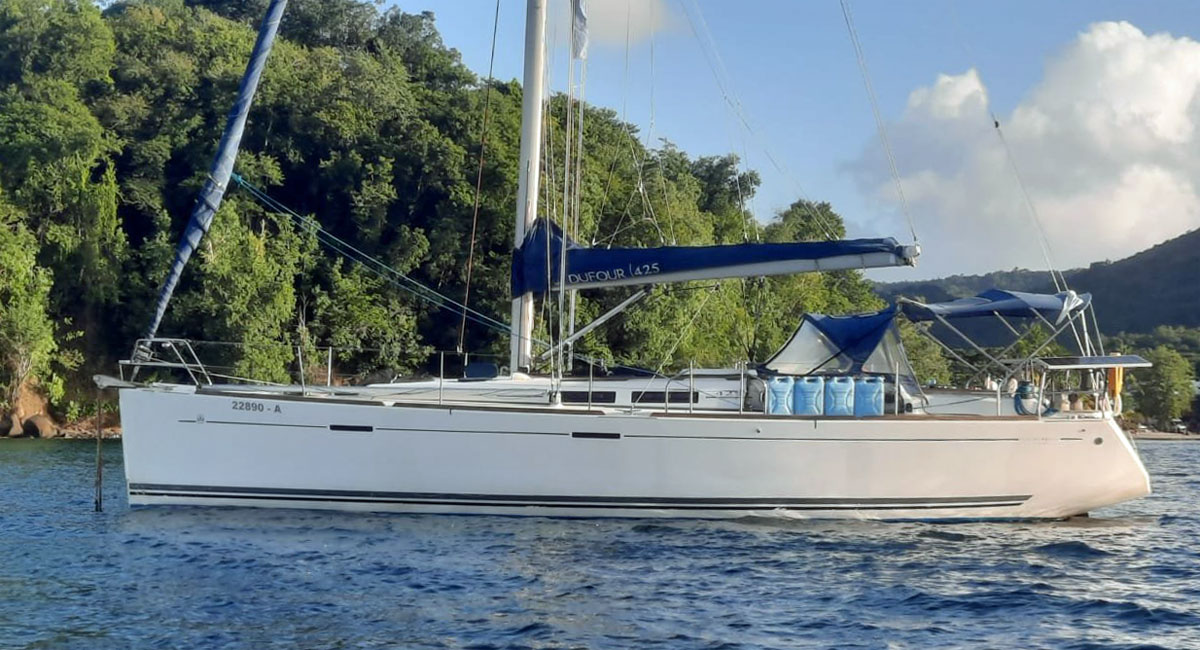 The Dufour 425 (aka the Dufour 425 "Grand Large")
The Dufour 425 Grand Large is a well-regarded mid-sized cruiser that strikes a pragmatic balance between modern production efficiency and genuine offshore capability. Designed during a period when Dufour was refining its "Grand Large" cruising identity, this model successfully integrates a voluminous interior with a hull shape that remains surprisingly rewarding for the helmsman. It is primarily identified by its twin-wheel configuration, which was a progressive feature for a 42' sailboat at the time of its launch, offering excellent cockpit accessibility and sightlines. While it prioritises comfort and volume for the cruising family, its Felci-designed hull ensures it does not suffer the sluggishness often associated with pure caravan-style cruisers.
Design & Construction
The Dufour 425 was born from a collaboration between the renowned naval architect Umberto Felci and interior designer Patrick Roséo. Built by Dufour Yachts in France, the vessel features a hull constructed from hand-laid solid glass fibre reinforced plastic (GRP) with a vacuum-bonded sandwich deck for weight reduction and thermal insulation. This construction method provides a robust, stiff structure that has aged well on the second-hand market. Unlike some of its contemporaries that leaned towards extreme light weight, the 425 maintains enough mass to feel secure when the sea state builds.
The defining feature of the Dufour 425 is undoubtedly its twin-wheel steering system. In 2006, twin wheels on a boat of this length were a statement of intent, moving away from the single, oversized wheel that often obstructed cockpit movement. Practically, this allows the helmsman to sit well outboard with a clear view of the tell-tales and the horizon, while creating a clear walkthrough to the fold-down swimming platform. This layout significantly improves the flow of life in the cockpit, whether under sail or at anchor.
Dufour offered the 425 in several configurations to suit different cruising grounds. The most common variation involves the draught, with a deep-draught iron keel at 6'11" (2.10m) for those prioritising upwind performance, and a shallow-draught version at 5'7" (1.70m) for coastal exploring in areas like the East Coast of England or the Bahamas. The internal layout was typically available in a two-cabin version with a massive lazarette and a larger heads, or a three-cabin version more suited to larger families or the charter market.
Sail Areas & Rig Dimensions
The Dufour 425 is stayed by a fractional sloop rig with two sets of swept-back spreaders, which removes the need for a permanent inner forestay in most conditions and simplifies tacking.
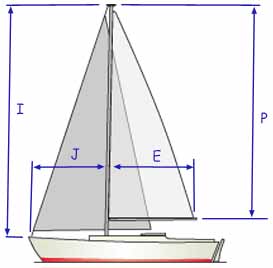
- I (Mainsail Luff): 49'7" (15.11m)
- J (Foretriangle Base): 14'7" (4.44m)
- P (Mainsail Hoist): 46'11" (14.30m)
- E (Mainsail Foot): 15'11" (4.85m)
- Mainsail Area: 420 ft² (39.01 m²)
- Genoa Area (140%): 484 ft² (44.96 m²)
- Total Sail Area: 904 ft² (83.97 m²)
Published Specification: The Dufour 425 Blueprint
| Specification Parameter | Data & Measurement |
|---|---|
| Length Overall (LOA) | 42'4" (12.90m) |
| Length at Waterline (LWL) | 36'10" (11.23m) |
| Beam | 13'8" (4.16m) |
| Draught (Deep/Shallow) | 6'11" (2.10m) / 5'7" (1.70m) |
| Displacement | 19,444 lbs (8,820 kg) |
| Ballast | 5,614 lbs (2,546 kg) |
| Rig Type | Fractional Sloop |
| Hull Material | GRP (Solid Laminate) |
| Production Dates | 2006 – 2012 |
Performance Analysis: Understanding the Design Ratios
The following ratios provide a mathematical insight into how the Dufour 425 behaves on the water. For a deeper dive into these metrics, see our guide on Understanding Boat Performance & Design Ratios.
| Design Ratio | Calculated Value | Interpretation |
|---|---|---|
| Sail Area/Displacement (SA/D) | 20.0 | Indicates a powerful rig capable of good speeds in light airs; very high for a cruiser. |
| Displacement/Length (D/L) | 173 | Classifies the boat as Light-Medium; it will surf easily but lacks heavy-weather "crushing" momentum. |
| Ballast/Displacement (B/D) | 28.8% | Standard for modern cruisers; relies on hull form and wide beam for stability. |
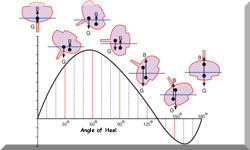
| Capsize Screening Formula (CSF) | 2.03 | Just on the limit of the 2.0 offshore recommendation; reflects the stability trade-off of a wide beam. |
| Brewer Motion Comfort Ratio | 24.1 | Predicts a somewhat "active" motion in heavy seas; typical for modern, flat-bottomed hulls. |
Structural Integrity & Stability Dynamics
The GRP construction of the Dufour 425 is focused on longevity and ease of maintenance. Unlike aluminium yachts which require strict galvanic protection, the Dufour's solid laminate hull is straightforward to survey and repair. However, owners should be mindful of the rudder bearings and the saildrive diaphragm, as these are common wear points in production boats of this age. The hull stiffness is aided by an internal grid structure that is bonded to the hull, distributing the loads from the keel and rig effectively.
The twin-wheel configuration and the wide aft sections significantly impact performance. The hull carries its beam well aft, which provides a massive amount of initial stability and interior volume. However, this design can lead to increased drag if the boat is allowed to heel too far. Experienced sailors will find that the 425 performs best when sailed relatively flat; once the leeward chine (though not a hard chine on this model) begins to dig in, the helm can become heavy. Reefing early is the key to maintaining a light touch and efficient speed.
Configuration, Layout & Cruising Characteristics
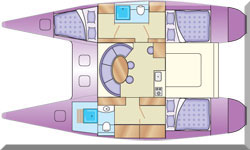
Down below, the Dufour 425 is a masterclass in space management. The linear or L-shaped galley (depending on the specific sub-model) offers excellent bracing for cooking at sea, with plenty of refrigeration and storage for long-term cruising. The saloon is bright, benefiting from large deckhouse ports and hull windows that bring in natural light, a feature that was quite forward-thinking for the mid-2000s.
Cruising practicality is further enhanced by the tankage. With 44 imperial gallons (200 litres) of fuel and 100 imperial gallons (450 litres) of water, the boat is well-equipped for week-long hops without needing to visit a marina. The cockpit function is excellent; the table is sturdy and provides a good foot-brace when the boat is heeled, and the split backstay makes access to the stern platform effortless. One minor criticism from offshore sailors is the relatively shallow cockpit coamings, which provide great visibility but can feel slightly exposed in a true gale compared to a traditional centre-cockpit design.
Impressed?

Has this article may suggested that this could be your ideal cruising boat and, as a result, deserves to be on your "Worth a look at" list?
But if, like me, you find sailboats to be seductive creations, then that list could rapidly get to be a pretty long one. If that is the case, wouldn't it be good if you could narrow it down bit through an objective, pragmatic process?
Well, that's where my eBook 'How to Avoid Buying the Wrong Sailboat' comes in...
Summing Up
The Dufour 425 Grand Large remains a compelling choice for the sailor who wants a modern-feeling yacht without the price tag of a brand-new vessel. Its design ratios reveal a boat that is "spirited" for a cruiser, with a Sail Area to Displacement ratio of 20.0 that promises good light-wind performance. While its Comfort Ratio and Capsize Screening Formula suggest it will be livelier in a seaway than a traditional heavy-displacement blue-water cruiser, its structural integrity and Category A rating confirm its offshore credentials. It is a pragmatic, well-built yacht that excels in providing a comfortable home at sea while remaining genuinely enjoyable to sail.
If you'd like to compare this boat with others in this size range, take a look at Cruising Yachts from 40' to 45' overall.
This article was written by Dick McClary, RYA Yachtmaster and author of the RYA publications 'Offshore Sailing' and 'Fishing Afloat', member of The Yachting Journalists Association (YJA), and erstwhile member of the Ocean Cruising Club (OCC).
Frequently Asked Questions (FAQs)
What are the common engine options for this model?
What are the common engine options for this model?
Most Dufour 425s were fitted with the Volvo Penta D2-40 (38hp) or the larger D2-55 (55hp) diesel engines with saildrives. The D2-55 is preferred for those cruising in areas with strong tides or for pushing against heavy head-seas.
Is the Dufour 425 suitable for single-handed sailing?
Is the Dufour 425 suitable for single-handed sailing?
Yes, the 425 can be managed solo, especially if fitted with an autopilot and lines led aft to the cockpit. The twin wheels allow the helmsman to reach the primary winches easily, though a bow thruster is highly recommended for solo berthing due to the high topsides and windage.
What should I look for when buying a used Dufour 425?
What should I look for when buying a used Dufour 425?
Pay close attention to the age of the saildrive seal (which should be replaced every seven years), the condition of the rudder bearings, and any signs of crazing around the keel-to-hull joint, which can indicate a previous grounding or the need for re-torquing the keel bolts.
How does the shallow-draught version compare to the deep-draught model?
How does the shallow-draught version compare to the deep-draught model?
The shallow-draught version (5'7") allows for much greater flexibility in coastal cruising but results in a slight loss of upwind pointing ability and a higher degree of leeway in breezy conditions. For most recreational cruisers, the trade-off for better anchorage access is worth it.
Is the Dufour 425 a true blue-water cruiser?
Is the Dufour 425 a true blue-water cruiser?
It is rated as CE Category A (Ocean), meaning it is designed for significant offshore voyages. While it lacks the heavy displacement of a dedicated "blue-water" tank, many have successfully crossed oceans, provided the rig and rudder systems are well-maintained.
Recent Articles


-
Should I Buy a Boat? Four Questions to Answer Before You Commit
Oct 02, 26 04:40 AM
Thinking "Should I buy a boat?" This guide helps you decide, with key considerations from cost & maintenance to your personal sailing aspirations. -
Offshore Internet with Starlink: Hardware, Plans, and Setup Guidance
Oct 01, 26 01:15 PM
A clear, practical guide to choosing the right Starlink hardware and plan for offshore cruising. Learn what to buy, how to install it, and how to manage power afloat. -
Offshore Liferaft Guide: Choosing, Stowing and Servicing One
Oct 01, 26 06:28 AM
Choosing an offshore liferaft? Learn what ISO 9650 Group A means, where to stow it, how often to service it and what to pack in the grab bag.