- Home
- Cruising Yachts 45' to 50'
- Dufour 470
The Dufour 470 Sailboat:
Comprehensive Specs, Performance Analysis & Cruising Characteristics
Key Takeaways
- A modern production cruiser with a beamy hull, high-volume interior, and a choice of three deck configurations.
- Moderate displacement and a relatively powerful sail plan give it decent light-air performance for a cruising yacht of its size.
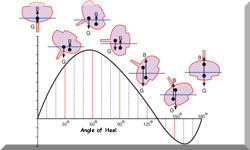
- Stability is typical of contemporary wide-stern cruisers: good form stability, but motion can be lively in a seaway.
- Built in fibreglass with a single rudder and a fixed bulb keel, it is optimised for coastal and offshore cruising rather than extreme passagemaking.
- Interior volume, cockpit ergonomics, and charter-friendly layouts are major selling points.
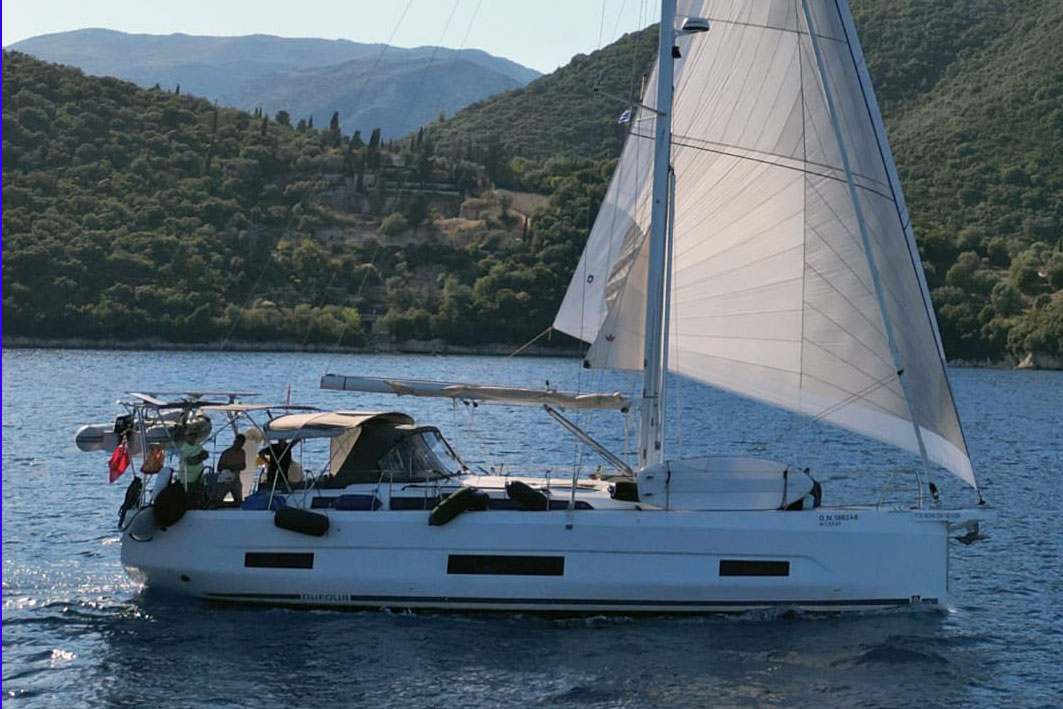 s/y Sommers, a Dufour 470, flying a special Code 0 by Legend Sails.
Pic courtesy of owner Asaf Sommer
Design & Construction
The Dufour 470 sits firmly in the modern European performance‑cruiser category. Designed by Umberto Felci and built by Dufour Yachts in La Rochelle, it follows the yard’s established formula: a broad hull, generous beam carried well aft, and a deck layout that prioritises ease of handling.
The hull is constructed in fibreglass with structural reinforcements and a fixed bulb keel. This is a conventional approach for a yacht of this size and purpose, offering a balance between cost, stiffness, and ease of repair. Unlike aluminium or steel yachts, fibreglass does not offer the same impact resistance, but it is lighter, easier to maintain, and well suited to warm‑water cruising.
Key Defining Feature
The defining feature of the Dufour 470 is its three‑version deck concept: Easy, Ocean, and Performance.
- Easy is aimed at charter fleets and casual cruisers, with simplified sail handling.
- Ocean offers a more traditional cruising layout with German mainsheet options.
- Performance adds a longer boom, upgraded deck gear, and a more powerful sail plan.
For cruising sailors, the practical implication is choice: you can prioritise simplicity, versatility, or a more hands‑on sailing experience.
Other Versions
The Dufour 470 is available with:
- A single fixed keel (standard or shallow draft).
- A single spade rudder.
- Multiple interior layouts ranging from three to five cabins.
- Optional electric propulsion packages.
There are no centreboard, bilge keel, ketch, or cutter variants.
Sail Areas & Rig Dimensions
From published data and manufacturer specifications:
- Mainsail area: 187 ft² (57 m²)
- Genoa/Jib area: 164 ft² (50 m²)
- Total reported sail area: 1,151.74 ft² (107 m²)
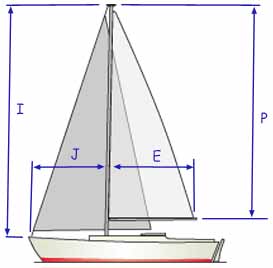 Rig dimensions
Rig Dimensions:
- I: 56.76' (17.30 m)
- J: 17.72' (5.40 m)
- P: 54.13' (16.50 m)
- E: 18.70' (5.70 m)
Published Specification: The Dufour 470 Blueprint
| Specification | Value |
|---|---|
| LOA | 48'9" (14.85 m) |
| LWL | 44'6" (13.55 m) |
| Beam | 15'7" (4.74 m) |
| Draft (max) | 7'5" (2.25 m) |
| Draft (shallow) | 5'9" (1.75 m) approx. |
| Displacement | 29,101 lb (13,200 kg) |
| Ballast | 7,826 lb (3,550 kg) |
| Rig Type | Fractional sloop |
| Hull Material | Fibreglass |
| Production Dates | From 2021 |
Performance Analysis: Understanding the Design Ratios
To truly understand how the Dufour 470 behaves on the water, we must look at the mathematical relationships between its weight, length, and sail power. These ratios provide a clearer picture than a brochure ever could.
| Ratio | Value |
|---|---|
| SA/D | 19.56 |
| D/L | 147.83 |
| B/D | 26.89% |
| Capsize Screening Formula | 2.03 |
| Comfort Ratio (Brewer) | 25.45 |
Interpreting the Ratios
- SA/D 19.56: This places the Dufour 470 in the moderate-to-lively performance cruiser bracket. It should move well in lighter airs but is not a high‑performance design.
- D/L 147.83: A relatively light displacement for a yacht of this length. Expect quicker acceleration but a more active motion offshore.
- B/D 26.89%: Typical for a modern beamy cruiser. Stability relies heavily on hull form rather than deep ballast.
- CSF 2.03: Slightly above the offshore‑ideal threshold of 2.0. Not a red flag, but it reflects the wide beam and lighter displacement.
- Comfort Ratio 25.45: Indicates a livelier motion in a seaway compared with heavier bluewater designs.
These interpretations align with the principles outlined in Understanding Boat Performance & Design Ratios.
Structural Integrity & Stability Dynamics
The use of vacuum infusion for the hull is a major plus for the Dufour 470. By controlling the resin-to-glass ratio, the builders achieve a stronger, lighter laminate that is less prone to osmosis than traditional hand-laid GRP. The structural grid is glassed and bonded to the hull, creating a rigid "monocoque" feel that minimizes creaking when the rig is under load.
The wide stern and high freeboard provide strong form stability, which is reassuring when the boat is upright and reaching. However, in a beam sea, the motion can be more abrupt than on a narrower, heavier yacht. The single rudder works well when the boat is sailed relatively flat, but in heavy weather or with too much canvas up, grip can be reduced compared with twin‑rudder designs.
Configuration, Layout & Cruising Characteristics
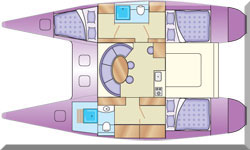
The Dufour 470’s interior is one of its strongest selling points. The beam creates a large saloon, a generous galley, and multiple cabin options. The galley-forward layout is particularly popular, giving the cook a stable working area and freeing up space aft.
Tankage is adequate for coastal and moderate offshore cruising:
- Fuel: 66 gal (250 L)
- Water: 140 gal (530 L)
The cockpit is wide and sociable, with twin wheels and a fold-down transom. The optional barbecue and outdoor galley are clearly aimed at warm‑weather cruising and charter use. For long passages, some owners may prefer to remove or modify these features to reclaim storage and reduce topside weight.
Under sail, the boat rewards good trim. The self‑tacking jib is convenient but limits power; the genoa option improves performance noticeably. The Performance version, with its longer boom and upgraded hardware, is the most appealing for experienced sailors.
Has this article suggested that this could be your ideal cruising boat and, as a result, deserves to be on your "Worth a Look" list?
But if, like me, you find sailboats to be seductive creations, then that list could rapidly get to be a pretty long one. If that is the case, wouldn't it be good if you could narrow it down bit through an objective, pragmatic process?
Well, that's where my eBook 'How to Avoid Buying the Wrong Sailboat' comes in...
Summing Up
The Dufour 470 is a sophisticated evolution of the modern cruising yacht. It successfully bridges the gap between the high-volume requirements of the charter market and the performance expectations of private owners. Its design ratios reveal a boat that is light for its size and carries a powerful rig, while its construction methods ensure a stiff and durable hull. While the motion in a heavy seaway may be more active than a traditional heavy-keel yacht, the trade-off is a boat that is faster, more spacious, and significantly more enjoyable to sail in moderate conditions. It is a pragmatic choice for the modern sailor who values aesthetics, space, and a bit of pace.
If you'd like to compare this boat with others in this size range, take a look at Cruising Boats from 45' to 50' overall....
This article was written by Dick McClary, RYA Yachtmaster and author of the RYA publications 'Offshore Sailing' and 'Fishing Afloat', member of The Yachting Journalists Association (YJA), and erstwhile member of the Ocean Cruising Club (OCC).
Frequently Asked Questions (FAQs)
How does the twin rudder setup affect docking?
How does the twin rudder setup affect docking?
Twin rudders do not benefit from "prop wash" like a single rudder does, which can make low-speed maneuvering trickier. However, most 470s are equipped with bow thrusters (and sometimes stern thrusters) to negate this issue.
Is the Dufour 470 suitable for solo or short-handed sailing?
Is the Dufour 470 suitable for solo or short-handed sailing?
Yes, particularly in the "Easy" version where the self-tacking jib and simplified control lines lead back to the primary winches near the helm, allowing the skipper to manage everything without leaving the wheel.
Which version is best for blue-water cruising?
Which version is best for blue-water cruising?
The "Ocean" version is generally preferred for long-distance cruising. It provides the right balance of sail control and storage, allowing for a more traditional sail plan and better reefing management compared to the Easy version.
What is the expected engine performance?
What is the expected engine performance?
Equipped with the standard 57hp or upgraded 75hp Volvo Penta Saildrive, you can expect a comfortable cruising speed of 7.5 to 8 knots at 2,400 RPM, with a relatively low fuel burn in calm seas.
Can the Dufour 470 handle heavy weather?
Can the Dufour 470 handle heavy weather?
With its CSF of 1.89 and modern hull form, it is well-equipped for offshore conditions. The high-volume bow helps prevent "burying" the nose in following seas, though the wide beam means you will want to reef early to keep the boat upright and comfortable.
Recent Articles


-
Mystery 35 Review: Specs, Performance & Buying Guide
Aug 29, 26 09:42 AM
An in-depth review of the Mystery 35 sailboat. Read technical specs, design ratios, sail performance, and common buyer inspection areas. -
Beneteau First 405 Review: Specs, Performance & Buyer’s Guide
Aug 26, 26 03:58 AM
Detailed Beneteau First 405 review covering specs, performance, bluewater capability, layouts and buyer’s checklist. -
Moody S38 Review: Specs, Ratios & Buyer’s Guide
Aug 12, 26 04:22 AM
In‑depth Moody S38 review covering specs, performance, design ratios, layout, strengths, trade‑offs & buyer inspection points.