- Home
- Yacht Construction & Cat A Standards
- Hard Biminis & Solar Arrays
Hard Biminis & Solar Arrays: Structural Impact & Safety
Key Takeaways: The addition of hard biminis and expansive solar arrays has become a hallmark of the modern blue-water cruiser, offering sustainable power and essential protection from the elements. However, these structures introduce significant changes to a vessel's original design profile, primarily through increased windage and a raised centre of gravity. While the convenience of "free" energy is undeniable, the structural impact on the deck-to-hull joint and the potential reduction in the Angle of Vanishing Stability (AVS) are critical factors that offshore sailors must address. Ensuring that these frames are engineered to withstand the vertical loads of a boarding sea is as vital as the electrical output they provide.
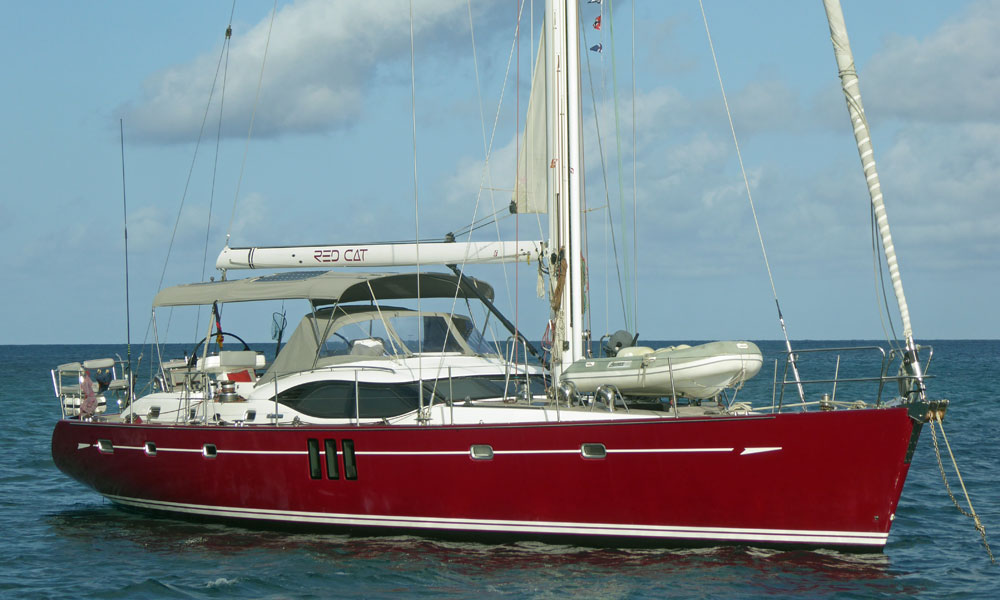
 On this heavy steel cutter, probably OK, but on a mass-produced lightly built cruiser? Probably not...
Table of Contents
- A Hard Bimini as a Solar Platform
- The Rise of the "Cruising Arch": Beyond Aesthetics
- Weight Distribution & the Impact on Category A Stability
- Windage: The Hidden Force in Survival Conditions
- Structural Loading: When Solar Panels Become Sails
- Deck Integrity & Reinforced Mounting Points
- Engineering for "Green Water" Impact
- Summing Up
- Frequently Asked Questions
A Hard Bimini as a Solar Platform
A hard bimini changes the character of a cruising boat more than most upgrades. It gives you permanent shade, a solid handhold when moving around the cockpit, and a structure that doesn’t flap, stretch or need replacing every few seasons. But for many cruisers, the real attraction is what a hard bimini can carry — namely, a properly sized solar array that finally keeps up with the boat’s daily electrical load.
Canvas biminis can take a couple of panels, but a rigid structure opens the door to far more capacity. With a stable platform, better airflow under the panels and the ability to mount them securely, you can often double or even triple your solar output. Before you start sketching out frames and panel layouts, it’s worth looking at the gear that makes a reliable system work.
Electrical, Solar & Power Systems
A dependable solar array relies on a few key electrical components working together, and these are the ones most cruisers end up fitting when building a system on a hard bimini.

- Renogy 200W Solar Panel Kit (2×100W) — A best‑selling, reliable solar kit ideal for adding renewable power to a cruising sailboat.
- Victron SmartSolar MPPT 100/30 Charge Controller — Premium MPPT controller with Bluetooth monitoring; extremely popular with liveaboards.
- LiTime 12V 100Ah LiFePO4 Lithium Battery — Lightweight, long‑life lithium battery with built‑in BMS; excellent value for cruisers.
- Ancor Marine Grade Tinned Copper Cable (10 AWG, Red/Black) — High‑quality, corrosion‑resistant wiring designed specifically for marine environments.
- Blue Sea Systems 12 Circuit Fuse Block (with Negative Bus) — A robust, marine‑grade fuse block ideal for rewiring or expanding a boat’s DC system.
- Victron BMV‑712 Smart Battery Monitor (Bluetooth) — The most trusted battery monitor among cruisers; essential for managing power usage.
- NOCO Genius GEN5X2 Dual Bank Smart Charger (10A) — A reliable multi‑bank charger for shore‑power charging of house and start batteries.
- Renogy 40A DC‑DC Charger — Perfect for safely charging lithium batteries from the engine alternator.
- Blue Sea Systems m‑Series Battery Switch (On/Off) — A compact, ignition‑protected battery switch suitable for house/start isolation.
This page includes affiliate links. If you click through and buy something, I may earn a small commission at no extra cost to you. It helps support the site and keeps the information free for everyone.
The Rise of the "Cruising Arch": Beyond Aesthetics
In the past, solar power on a yacht was often limited to a few flexible panels lashed to the guardrails. Today, the trend has shifted toward permanent, rigid structures. A well-designed hard bimini or cruising arch serves multiple roles: it provides a mounting point for high-output solar arrays, carries the weight of a dinghy on integrated davits, and offers a secure handhold in the cockpit.
However, from a naval architecture perspective, these are "post-factory" additions that were rarely accounted for during the initial stability tests for Category A certification. When you are assessing hard biminis & solar arrays, you must consider them not as furniture, but as structural appendages that interact with the wind and the waves.
Weight Distribution & the Impact on Category A Stability
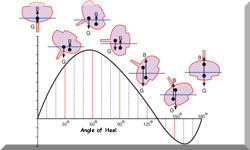
A Category A yacht is rated based on its ability to recover from a capsize. Adding a heavy stainless steel frame and glass-backed solar panels high above the waterline inevitably raises the boat's centre of gravity (VCG).
While 100 kilogrammes of equipment might seem negligible on a 10-tonne yacht, its position five or six feet above the deck has a disproportionate effect on the righting moment. In extreme conditions, this "top-heavy" configuration can reduce the angle at which the boat will naturally right itself, potentially turning a recoverable knockdown into a permanent capsize.
| Component | Weight / Surface Area | Primary Safety Risk |
|---|---|---|
| Stainless Steel Arch | 40kg to 80kg | Raised VCG & reduced stability |
| Rigid Solar Panels | 15kg to 25kg per panel | Windage & "wing" effect in gusts |
| Hard Bimini Top | GRP or Aluminium Sheet | Vertical load from boarding seas |
| Integrated Davits | Varies with Dinghy | Torsional stress on the transom |
Windage: The Hidden Force in Survival Conditions
Windage is often overlooked until a skipper tries to manouevre in a crowded marina during a gale. A hard bimini with side enclosures acts like a fixed sail that cannot be reefed. In a survival storm at sea, this extra surface area can make it difficult to "lie-to" or run off before the wind without the stern being pushed around.
The "wing" effect is also a concern. In high winds, a flat hardtop can generate significant lift. If the wind gets under the bimini during a period of heavy pitching, the upward force can put immense strain on the mounting bolts, effectively trying to "unzip" the structure from the deck.
Structural Loading: When Solar Panels Become Sails
The mounting points for a cruising arch are often the weakest link. On most production yachts, the deck is a cored sandwich construction. Bolting a heavy frame directly to the GRP skin without substantial backing plates is a recipe for disaster.
The vibration from the rig and the movement of the boat in a seaway create "fretting" at the mountings. Over thousands of miles, this can lead to core compression and water ingress. For an offshore-ready vessel, these mounts should be tied into the hull-to-deck joint or reinforced with oversized GRP "knees" to distribute the load into the primary structure.
Deck Integrity & Reinforced Mounting Points
The transition from traditional solid GRP to modern cored decks (using balsa or foam) has made yachts lighter and stiffer, but it has also introduced a critical vulnerability: core compression. For an offshore vessel, every deck fitting—from the windlass to the stanchion bases—must be engineered to handle loads that would tear a standard "coastal" deck apart.
1. The Peril of Core Compression
Most modern decks utilize a "sandwich" construction, where a lightweight core is bonded between two skins of fibreglass. While excellent for weight distribution, this core has very little "crush strength." If you bolt a heavy-duty cleat directly through a cored deck, the tightening of the bolts (or the snatch-load of a mooring line) will eventually crush the core.
- The "Solid" Solution: In a Category A build, manufacturers should replace the soft core with solid GRP or high-density phenolic inserts at every major mounting point.
- The "Potting" Method: For aftermarket additions, the core should be "dug out" around the bolt hole and backfilled with thickened epoxy to create a solid, uncrushable pillar.
2. Backing Plates: Distributing the Stress
In heavy weather, a single deck cleat or a genoa track can be subjected to several tonnes of instantaneous load. If that load is concentrated on the small area of the bolt heads, the bolts will simply pull through the laminate.
- Oversized Plates: Category A standards require substantial backing plates—ideally made of 316 stainless steel or G10 laminate—that extend well beyond the footprint of the fitting.
- Load Path Engineering: The most robust designs ensure that the backing plates for primary winches and chainplates are tied into the internal structural grid or bulkheads, effectively bypassing the deck skin altogether.
3. Hardware Sealing & UV Resistance
A deck’s integrity is only as good as its seals. Water ingress into a balsa-cored deck is a "stealth" failure; it can lead to widespread rot and delamination long before it is visible from the cabin.
- The "Oversize" Technique: A professional mounting protocol involves drilling an oversized hole, filling it with epoxy, and then re-drilling the bolt hole. This ensures that even if the sealant fails, water cannot reach the core.
- Structural Adhesives: Modern builders often combine mechanical fasteners with structural adhesives to bond hardware to the deck, creating a dual-layered defense against both movement and moisture.
| Fitting Type | Primary Load Stress | Cat A Reinforcement Requirement |
|---|---|---|
| Mooring Cleats | Horizontal Snatch Loads | Extended backing plates to prevent deck shear |
| Primary Winches | High-Torque Torsion | Solid GRP core replacement & structural ties |
| Stanchion Bases | Lateral Leverage | Under-deck "u-channels" to prevent prying |
| Windlass | Vertical & Horizontal Pull | Integrated structural bridge to the hull/deck join |
Engineering for "Green Water" Impact
The most dangerous scenario for a hard bimini is the "pooping" sea—when a wave breaks over the stern. A rigid bimini presents a large horizontal surface area. If several tonnes of water land on top of it, the downward force can be enough to buckle the stainless steel legs or, worse, crush the cockpit coamings.
Modern offshore arches should be designed with "shedding" in mind. This involves using curved surfaces or ensuring the structure has a slight aft-sloping angle to help water drain rapidly. Furthermore, the use of "breakaway" pins or sacrificial lacing for soft-centre panels can prevent the entire frame from being ripped out of the deck in a worst-case scenario.
Summing Up
Hard biminis and solar arrays represent the modern quest for autonomy at sea. They allow us to stay out longer and live more comfortably, but they require a "whole-boat" approach to safety. When modifying a Category A vessel, the sailor must balance the desire for power with the laws of physics. By using lightweight materials, ensuring robust mounting points, and remaining mindful of the centre of gravity, it is possible to enjoy the benefits of a modern arch without compromising the boat's ultimate offshore resilience.

This article was written by Dick McClary, RYA Yachtmaster and author of the RYA publications 'Offshore Sailing' and 'Fishing Afloat', member of The Yachting Journalists Association (YJA), erstwhile member of the Ocean Cruising Club (OCC) and owner/administrator of 'Liveaboard Sailboats for Sale'.

The article is #4 in an 8-part series on the topic of Modern Yacht Construction & Compliance with Cat A (Ocean) Standards.
Frequently Asked Questions
Can I use flexible panels to reduce weight?
Can I use flexible panels to reduce weight?
Yes, flexible "walk-on" panels are significantly lighter than glass-backed rigid panels. While they are slightly less efficient and have a shorter lifespan, they are much better for maintaining a low centre of gravity.
Should I remove my bimini in a hurricane?
Should I remove my bimini in a hurricane?
Absolutely. If you are expecting winds of tropical storm force or higher, the fabric or rigid top should be removed to reduce windage and prevent the entire frame from being bent or torn from the deck.
How do I reinforce my deck for a new cruising arch?
How do I reinforce my deck for a new cruising arch?
The core material (balsa or foam) should be removed around the bolt holes and replaced with solid epoxy resin. This prevents the core from crushing and ensures a watertight, high-strength mounting point.
Do solar panels affect my VHF or GPS reception?
Do solar panels affect my VHF or GPS reception?
Generally no, but the wiring must be shielded. If the charge controllers are of poor quality, they can emit electromagnetic interference (EMI) that may affect your AIS or VHF radio performance.
Is aluminium better than stainless steel for a bimini frame?
Is aluminium better than stainless steel for a bimini frame?
Aluminium is much lighter, which is great for stability, but it is harder to weld and more prone to fatigue in a marine environment. Stainless steel (316 grade) remains the standard for its strength and ease of repair.
Recent Articles


-
Mystery 35 Review: Specs, Performance & Buying Guide
Aug 29, 26 09:42 AM
An in-depth review of the Mystery 35 sailboat. Read technical specs, design ratios, sail performance, and common buyer inspection areas. -
Beneteau First 405 Review: Specs, Performance & Buyer’s Guide
Aug 26, 26 03:58 AM
Detailed Beneteau First 405 review covering specs, performance, bluewater capability, layouts and buyer’s checklist. -
Moody S38 Review: Specs, Ratios & Buyer’s Guide
Aug 12, 26 04:22 AM
In‑depth Moody S38 review covering specs, performance, design ratios, layout, strengths, trade‑offs & buyer inspection points.