- Home
- Yacht Construction & Cat A Standards
Modern Yacht Construction & Compliance with Cat A (Ocean) Standards
Key Takeaways
Modern yacht construction has transitioned from the heavy, overbuilt scantlings of the past to high-tech, engineered structures defined by the Recreational Craft Directive (RCD). For a vessel to be certified as Category A (Ocean), it must prove its self-sufficiency in wind speeds exceeding Force 8 and wave heights over 4 metres. This is not merely a marketing term; it is a legal engineering requirement in Europe and the UK, governed by the STIX (Stability Index). Understanding the shift from traditional "thick" GRP to integrated structural grids, lithium fire safety, and composite chainplates is essential for any sailor planning a blue-water circumnavigation.
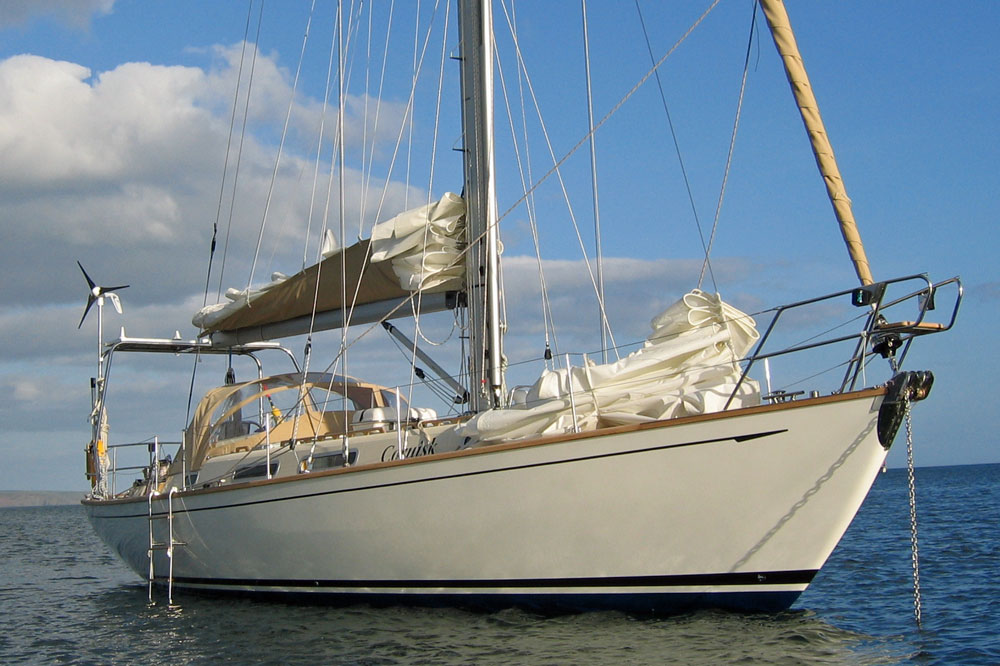 The Rustler 42, a highly-regarded Category A (Ocean) sailboat
Table of Contents
- The Genesis of Category A: More Than Just a Label
- The RCD Hierarchy: Defining the Boundaries
- The STIX Number: The DNA of Stability
- The Transatlantic Divide: EU vs. US Standards
- Structural Grids & the Integrity of Modern Keel Attachments
- The Saildrive Debate: Volvo Pentas & the Seven-Year Rule
- Glazing & Bonded Windows: Engineering for Green Water
- Hard Biminis & Solar Arrays: Structural Impact & Safety
- Hidden Fatigue: Composite vs. Stainless Steel Chainplates
- Steering Redundancy: Rudder Bearings & Twin-Rudder Geometry
- Bulkhead Bonding: The Integrity of the Internal Liner
- Energy Storage: Lithium Integration & Structural Fire Safety
- Summing Up
- Frequently Asked Questions (FAQs)
The Genesis of Category A: More Than Just a Label
When the Recreational Craft Directive (RCD) was first introduced, its goal was to harmonise safety across Europe. For those of us looking at blue-water cruisers, it provided a much-needed benchmark. A Category A (Ocean) rating isn't just a badge; it’s a formal certification that a vessel is engineered to be entirely self-sufficient in conditions exceeding Force 8 winds and wave heights of 4 metres.
In the past, we relied on "brute force"—heavy, hand-laid GRP that was thick but often inconsistent. Today, designers use Finite Element Analysis (FEA) to map out exactly where the stress loads fall. This allows for "Engineered" construction: hulls that are lighter and stiffer thanks to vacuum infusion and cored laminates, but with strength concentrated precisely where the boat needs it most. By removing excess resin and trapped air, builders have effectively eliminated the primary causes of osmosis while creating a more resilient, integrated structure.
The RCD Hierarchy: Defining the Boundaries
The Recreational Craft Directive (RCD) provides a clear regulatory framework for yacht safety. While Category A is the gold standard, understanding the limitations of Categories B and C is vital for coastal and offshore work.
| RCD Category | Description | Wind Speed (Beaufort) | Max Wave Height |
|---|---|---|---|
| Category A | Ocean (Self-Sufficient) | Exceeding Force 8 | Exceeding 4 Metres |
| Category B | Offshore (Up to 200 miles) | Up to Force 8 | Up to 4 Metres |
| Category C | Inshore / Coastal | Up to Force 6 | Up to 2 Metres |
| Category D | Sheltered Waters | Up to Force 4 | Up to 0.3 Metres |
The STIX Number: The DNA of Stability
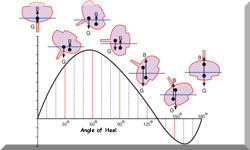
If Category A tells you where a boat can go, the Stability Index (STIX) tells you how it’s going to behave once you’re out there. This ISO calculation (ISO 12217) distils the yacht's physical geometry and weight distribution into a single figure, usually between 1 and 100. To earn that coveted Category A status, a boat must achieve a minimum STIX of 32.
Think of STIX as the boat's "survival DNA." It’s a weighted average of several critical safety factors:
- Dynamic Stability: This measures the energy needed to heel the boat to the point where it might start taking on water (the downflooding point).
- Inversion Recovery: Possibly the most vital stat for an ocean crosser—it predicts how the boat acts if it ends up completely upside down.
- Knockdown Resistance: This calculates how quickly the boat will pop back up after the mast hits the water.
- Displacement-Length Ratio: This ensures the boat has enough mass relative to its size to avoid being tossed around like a cork by breaking waves.
The Transatlantic Divide: EU vs. US Standards
It is a common mistake to assume "Category A" is a global rule. In reality, it is a European requirement. In the United States, there is no legal mandate for a builder to assign a category to a boat sold domestically.
A US-built yacht might be built like a tank, but it won’t carry a "Category A" plaque unless the builder specifically paid for RCD certification to export it to Europe. For a sailor in the UK or Europe, that plaque is a legal guarantee of stability. For an American buyer, finding an RCD-certified boat is more about "verified peace of mind"—it’s proof that the boat has been measured against the most rigorous engineering benchmarks in the world.
Structural Grids & the Integrity of Modern Keel Attachments
The shift from encapsulated lead keels to bolt-on fins has been the most debated evolution in offshore sailing. Modern production yachts typically use an internal structural grid—often called a "matrix"—which is bonded into the hull to distribute the massive leverage exerted by a deep-draught keel.
For the offshore sailor, assessing these grids is a matter of safety. While the ISO standards for keel bolts are robust, the bond between the grid and the hull remains a potential point of failure during a grounding. Checking for "crazing" or separation in the bilge is now a standard part of a blue-water survey.
Read more: Assessing Keel Bolts & Structural Grids in Production Yachts
The Saildrive Debate: Volvo Pentas & the Seven-Year Rule
A significant number of modern Cat A yachts utilise saildrives rather than traditional shafts. While they offer reduced vibration and easier installation, they introduce a large hole in the bottom of the boat. The Volvo Penta "seven-year rule" regarding the rubber seal replacement is a source of constant debate among cruisers. Although many seals appear pristine after a decade, the Cat A ethos of self-sufficiency suggests that following manufacturer intervals is the only way to ensure the hull's integrity remains uncompromised.
Read more: The Saildrive Debate: Volvo Pentas & the 7-Year Seal Rule
Glazing & Bonded Windows: Engineering for Green Water
The aesthetic trend toward large hull windows has presented a unique engineering challenge. In the past, a small, recessed porthole was the offshore standard. Today, we see expansive glazing. To maintain Cat A integrity, these windows are chemically bonded using polymers that allow the acrylic to flex with the hull. However, should a bond fail mid-ocean, the volume of water ingress would be catastrophic. Maintenance of these seals and having a plan for emergency repairs are now essential skills.
Read more: Bonded Hull Windows: Maintenance & Emergency Repairs
Hard Biminis & Solar Arrays: Structural Impact & Safety
The modern "cruising arch" or hard bimini is rarely considered in the original Cat A stability calculations. As sailors add hundreds of kilogrammes of solar panels and stainless steel frames high above the waterline, they inadvertently alter the yacht's centre of gravity. In a survival storm, the structural impact of a hard bimini catching a "green water" wave can be enough to compromise the deck-to-hull joint if the load paths are not correctly reinforced.
Read more: Hard Biminis & Solar Arrays: Structural Impact & Safety
Hidden Fatigue: Composite vs. Stainless Steel Chainplates
For decades, stainless steel chainplates were the industry standard, but their susceptibility to crevice corrosion—often invisible where they pass through the deck—remains a major point of failure. Modern Cat A construction is increasingly moving toward composite chainplates laminated directly into the hull structure. This eliminates the metal fatigue risk and the "hole in the deck" entirely, creating a monocoque structure that is far better suited for long-term offshore work.
Read more: Composite vs. Stainless Steel Chainplates: The Corrosion Crisis
Steering Redundancy: Rudder Bearings & Twin-Rudder Geometry
As beam carries further aft in modern designs, twin rudders have become common. While this provides incredible control when heeled, it doubles the maintenance requirement. Assessing rudder bearings for play and ensuring the steering linkage has true redundancy is a critical part of offshore prep. A seized bearing in a self-aligning system can be just as debilitating as a snapped cable.
Read more: Rudder Bearings & Steering System Redundancy
Bulkhead Bonding: The Integrity of the Internal Liner
The way bulkheads are attached to the hull has evolved from traditional glass-tabbing to structural adhesive bonding within an internal liner. While efficient, "popped" bonds between the bulkhead and the hull can lead to rig tension issues and structural creaking. For a yacht to maintain its Cat A status in heavy seas, the bulkhead must remain a rigid transverse frame.
Read more: Bulkhead Bonding & the Inner Moulding Debate
Energy Storage: Lithium Integration & Structural Fire Safety
The shift to Lithium (LiFePO4) battery banks has changed how we power our yachts, but it also introduces new structural safety requirements. High-capacity banks must be housed in compartments that account for both weight distribution and thermal containment. Ensuring your battery locker is structurally isolated and ventilated according to the latest standards is now a key part of modern yacht engineering.
Read more: Lithium Integration & Structural Fire Safety
Summing Up
The evolution of yacht construction has undoubtedly made offshore sailing more comfortable and efficient. However, a "Category A" rating is a baseline for design, not a substitute for rigorous seamanship. Whether it is the integrity of a saildrive seal, the hidden corrosion in a chainplate, or the load-bearing capacity of a structural grid, the modern sailor must look beyond the certificate. Understanding how these integrated systems—from bonded windows to keel attachments—function as a whole is what ultimately ensures a safe passage.

This article was written by Dick McClary, RYA Yachtmaster and author of the RYA publications 'Offshore Sailing' and 'Fishing Afloat', member of The Yachting Journalists Association (YJA), erstwhile member of the Ocean Cruising Club (OCC) and owner/administrator of 'Liveaboard Sailboats for Sale'.

Frequently Asked Questions (FAQs)
Is a Category A yacht unsinkable?
Is a Category A yacht unsinkable?
No, Category A refers to stability and structural integrity in specific sea states. It does not imply the vessel is unsinkable; it merely means it is designed to survive conditions of Force 8 and four-metre waves.
What happens if a bonded hull window fails at sea?
What happens if a bonded hull window fails at sea?
Bonded windows are structural. If the sealant fails, an emergency repair usually involves through-bolting a plywood or acrylic plate over the aperture to create a mechanical seal until the boat can be hauled out.
Why is the 7-year saildrive seal rule so controversial?
Why is the 7-year saildrive seal rule so controversial?
Many owners find that the seals last much longer in practice. However, insurers may use the manufacturer’s seven-year guideline to deny claims if a failure occurs, making it a critical compliance issue.
Do composite chainplates need to be replaced?
Do composite chainplates need to be replaced?
Unlike stainless steel, composite chainplates do not suffer from crevice corrosion. If they are engineered correctly and protected from UV, they can theoretically last the lifetime of the hull, though they should be inspected for delamination.
How do I check my bulkhead bonds?
How do I check my bulkhead bonds?
Look for "dust" or "powder" at the join between the wood and the GRP, or signs of movement in the cabinetry when the boat is under sail. These are indicators that the structural adhesive may have failed.
Recent Articles


-
Mystery 35 Review: Specs, Performance & Buying Guide
Aug 29, 26 09:42 AM
An in-depth review of the Mystery 35 sailboat. Read technical specs, design ratios, sail performance, and common buyer inspection areas. -
Beneteau First 405 Review: Specs, Performance & Buyer’s Guide
Aug 26, 26 03:58 AM
Detailed Beneteau First 405 review covering specs, performance, bluewater capability, layouts and buyer’s checklist. -
Moody S38 Review: Specs, Ratios & Buyer’s Guide
Aug 12, 26 04:22 AM
In‑depth Moody S38 review covering specs, performance, design ratios, layout, strengths, trade‑offs & buyer inspection points.