- Home
- Sails
- Mainsail Trim
- Loose Footed Mainsail
The Engineering & Advantages of Loose Footed Mainsails
Key Takeaways
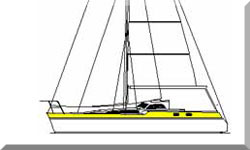
A loose footed mainsail is a design where the bottom edge of the sail is attached only at the tack and the clew, rather than being fed into a groove or track along the length of the boom. This configuration has become the gold standard for modern offshore sailing because it allows for a more efficient aerodynamic shape, specifically near the bottom of the sail where a traditional bolt rope would often create a restrictive "shelf." By removing the physical connection to the boom, sailors can achieve deeper draught in light airs and a flatter profile when the breeze refreshes, all while simplifying the reefing process and reducing friction.
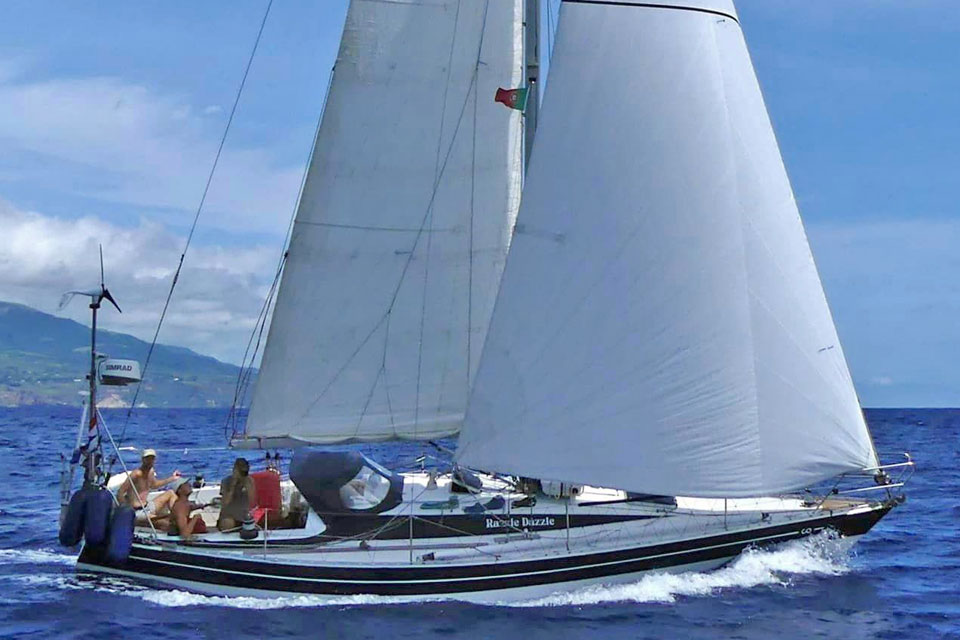
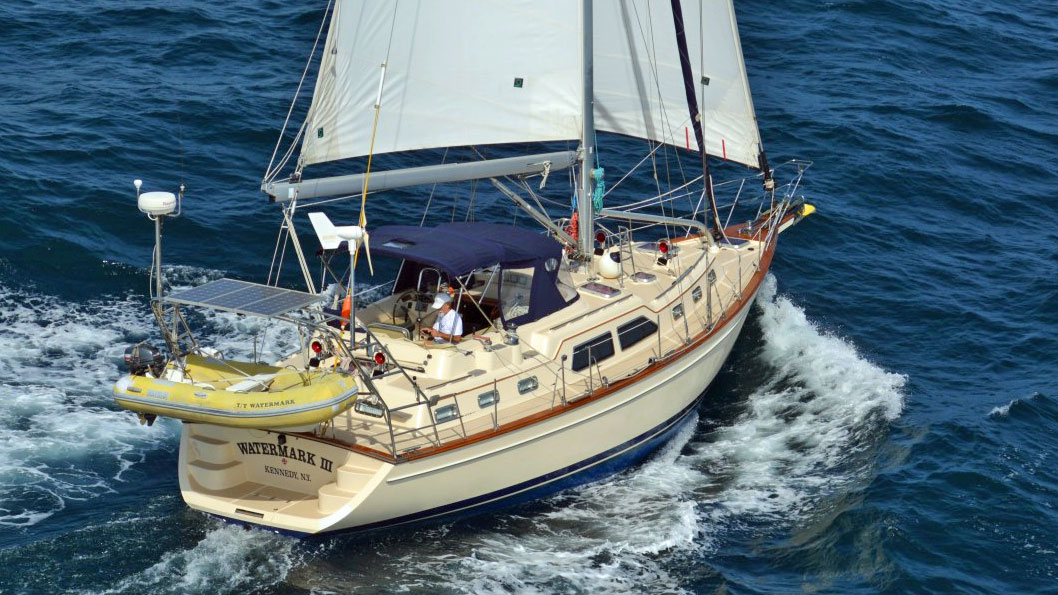 A loose-footed mainsail keeping its shape right down to its foot
Table of Contents
Aerodynamics & Shape Control
For decades, the standard approach was to secure the foot of the sail to the boom using a bolt rope or plastic slugs. While this felt "neat," it created a significant aerodynamic compromise. A sail attached to a straight spar cannot easily adopt a true aerofoil shape at its base; instead, it often forms a distorted crease or remains too flat to be efficient in light air.
With a loose footed mainsail, the outhaul becomes a far more powerful tool. Because the sail is free to move, adjusting the outhaul directly manipulates the depth of the lower third of the sail. In light winds, easing the outhaul creates a powerful, rounded shape that generates essential lift. As the wind increases, tensioning the outhaul flattens the sail perfectly, reducing drag and heeling moment without the cloth being constrained by a boom track.
The Structural Reality of Modern Booms
There is a common misconception among traditionalists that the boom provides essential structural support to the foot of the sail. In reality, modern sailcloth technology—specifically high-modulus dacrons and laminates—is more than capable of handling the horizontal loads between the tack and clew.
Most contemporary booms are designed as "compression members." The primary load is transferred through the outhaul car and the gooseneck. Switching to a loose footed setup rarely requires a boom upgrade, provided the outhaul casting and the gooseneck fittings are in good repair.
Practical Advantages for Offshore Cruising
Beyond pure speed, the practical benefits for a short-handed crew are substantial. One of the most significant wins is found in the neatness and ease of reefing. When you pull down a reef on a loose footed sail, the "tack" of the new reef point isn't fighting against a bolt rope trapped in a boom groove. This allows the redundant sail cloth to be flaked or tied away much more easily.
- Lazy Jack Compatibility: A loose footed sail sits more naturally within lazy jacks or a stack-pack system, as the cloth can "furl" over the boom without being bunched up at the track.
- Safety: In a crash gybe, a loose footed sail allows for a tiny amount of "give" in the foot, potentially reducing the peak shock load on the boom.
- Ease of Maintenance: Without a bolt rope in the boom, there is one less area for salt to crystallise and one less track to lubricate.s.
Integrating Stack-packs & Lazy Bags
One of the most elegant technical benefits of moving to a loose footed setup is the way it simplifies the installation of a stack-pack or lazy bag. On a traditional mainsail, the bag must be either strapped around the entire boom or connected to attachment points along either side of the boom, which is often bulky and prone to catching.
Because the foot of the sail no longer occupies the groove in the boom, that slot becomes perfectly available for the stack-pack. The bag can be fitted with plastic slugs or a bolt rope and fed directly into the existing boom track. This creates a far more secure and aesthetically pleasing attachment. It keeps the bag centred and tensioned properly, ensuring that when the halyard is eased, the sail falls directly into the "cradle" without the bag shifting or sliding off to one side. This use of the redundant slot is a clever way to repurpose the spar's original engineering for modern cruising comfort.
The Essential Link: In-Mast Furling & Loose Footed Sails
If you are operating an in-mast furling system, a loose footed mainsail is effectively essential. The geometry of a vertical furling mandrel relies on the sail being able to find its own natural lead as it rotates into the mast. If the foot of the sail were trapped in a boom track, the resulting diagonal tension would lead to uneven furling and the dreaded "mast jam."
By using a loose footed configuration with an in-mast system, the only point of contact with the boom is the outhaul car. This allows the sail to "self-align" as it is drawn into the mast slot. Furthermore, since furling mainsails are typically cut quite flat to ensure they fit inside the mast cavity, the ability to ease the outhaul on a loose footed setup is the only way to induce the depth required to keep the boat moving in lighter conditions.
Mainsail Trim & Control
Understanding the interaction between the mast, the boom, and the cloth is the secret to consistent offshore speed. To truly master your setup, you should look at how the foot tension coordinates with other control lines. We cover this in extensive detail in our guide on Mainsail Trim & Control, where we discuss the relationship between halyard tension, vang settings, and the outhaul. Balancing these three elements allows you to shift the "belly" of your sail forward or aft, ensuring the boat remains balanced on the helm even as the sea state gets messy.
The Mechanical Stress Factor
One area often overlooked in forum discussions is the concentration of load. In a loose footed mainsail, the clew slug or car takes the entire downward and outward load of the sail. It is vital that this hardware is over-engineered for offshore work.
| Feature | Loose Footed | Traditional Bolt Rope |
|---|---|---|
| Shape Adjustment | High (Full outhaul range) | Limited by boom track |
| Reefing Speed | Fast (Less friction) | Slower (Track friction) |
| Boom Stress | Point loaded at ends | Distributed along track |
| Aerodynamics | True aerofoil at base | Distorted "Shelf" foot |
Summing Up
The transition to a loose footed mainsail represents one of those rare moments in yacht design where a simpler system actually performs better. By untethering the foot from the boom, you gain a level of control over your sail's depth that is impossible with a fixed track. For the offshore sailor, the reduction in friction during reefing and the ease of stowing the sail into a stack-pack make it a logical choice. While it places more emphasis on the strength of your clew and tack fittings, the trade-off in performance and handling is undoubtedly worth it.

This article was written by Dick McClary, RYA Yachtmaster and author of the RYA publications 'Offshore Sailing' and 'Fishing Afloat', member of The Yachting Journalists Association (YJA), erstwhile member of the Ocean Cruising Club (OCC) and owner/administrator of 'Liveaboard Sailboats for Sale'.

Frequently Asked Questions
Is a loose footed mainsail weaker than a traditional one?
Is a loose footed mainsail weaker than a traditional one?
No. Modern sail design uses structural tapes and reinforced patches at the tack and clew to handle the loads. The sailcloth itself is designed to be self-supporting between these two points.
Can I convert my existing mainsail to a loose footed one?
Can I convert my existing mainsail to a loose footed one?
Yes, a sailmaker can usually remove the bolt rope or slugs and reinforce the clew and tack. It is a common and relatively inexpensive modification that can revitalise an older sail.
Does a loose footed sail put too much strain on the boom?
Does a loose footed sail put too much strain on the boom?
Most booms are designed to take the mainsheet and vang loads, which are far greater than the horizontal tension of the outhaul. However, you should ensure your outhaul car or slug is rated for the task.
How does it affect the use of a stack-pack?
How does it affect the use of a stack-pack?
It makes it easier. Since the sail is not attached to the boom, the stack-pack or lazy bag can be mounted to the boom independently, allowing the sail to drop cleanly into the bag without snagging.
What happens to the "shelf foot" in this design?
What happens to the "shelf foot" in this design?
The "shelf foot"—extra light cloth used to allow depth in a fixed sail—is redundant. A loose footed sail achieves that same depth (and more) simply by easing the outhaul, which is more durable and effective.
Recent Articles


-
Mystery 35 Review: Specs, Performance & Buying Guide
Aug 29, 26 09:42 AM
An in-depth review of the Mystery 35 sailboat. Read technical specs, design ratios, sail performance, and common buyer inspection areas. -
Beneteau First 405 Review: Specs, Performance & Buyer’s Guide
Aug 26, 26 03:58 AM
Detailed Beneteau First 405 review covering specs, performance, bluewater capability, layouts and buyer’s checklist. -
Moody S38 Review: Specs, Ratios & Buyer’s Guide
Aug 12, 26 04:22 AM
In‑depth Moody S38 review covering specs, performance, design ratios, layout, strengths, trade‑offs & buyer inspection points.