Mastering the Art & Science of Picking up a Mooring
Key Takeaways: Successfully picking up a mooring requires a blend of anticipation, precise throttle control, and an understanding of how your specific hull reacts to the elements. For the cruising sailor, this is not merely about grabbing a buoy; it is about executing a controlled approach that brings the vessel to a complete stop precisely over the gear without straining the crew or the deck hardware. This guide provides the technical expertise needed to handle complex scenarios, from wind-against-tide situations to securing the vessel for an approaching gale.
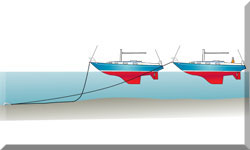
 Single-point, or 'swinging' moorings
Table of Contents
- Picking up a Mooring: The Fundamentals
- Assessing the Elements: Wind vs Tide
- Swinging vs Trot Moorings: Understanding the Difference
- The Technical Approach: Angles & Speed
- The Gear: Strops, Pick-up Lines & Mooring Rings
- Verifying the Hardware: Diving & Inspection
- Essential Equipment & Rigging the Bridle
- Security, Anti-Chafe & Heavy Weather Tactics
- Ethical Etiquette & Local Regulations
- Security & Anti-Chafe Strategies
- Summing Up
- Frequently Asked Questions
Picking up a Mooring: The Fundamentals
At its core, the manoeuvre is an exercise in energy management. You are transitioning a vessel with significant momentum into a stationary object held by ground tackle. The fundamental secret lies in the "slow-motion" finish. If the foredeck crew has to lunge at a buoy or strain against a boat hook, the approach has failed.
The process begins well before you reach the buoy. You must prepare the deck by clearing the bow of any obstructions, ensuring your lines are flaked and ready to run, and confirming that the crew knows exactly what is expected of them. Communication is paramount; hand signals are far more effective than shouting over the roar of a diesel engine and the wind.
Assessing the Elements: Wind vs Tide
Before making your final turn, you must determine which force is the dominant driver of your yacht’s movement. In many coastal cruising grounds, the tide will often trump a light breeze, but a stiff force 5 can easily override a weak neap flow.
The simplest way to judge this is to observe boats already on the trot. If they are all pointing in one direction, they are tide-rode or wind-rode. If they are sheer out of alignment, you are likely dealing with conflicting forces. Aim to approach the buoy heading into the stronger of the two forces to ensure maximum control over your steerage way.
Swinging vs Trot Moorings: Understanding the Difference
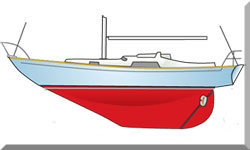
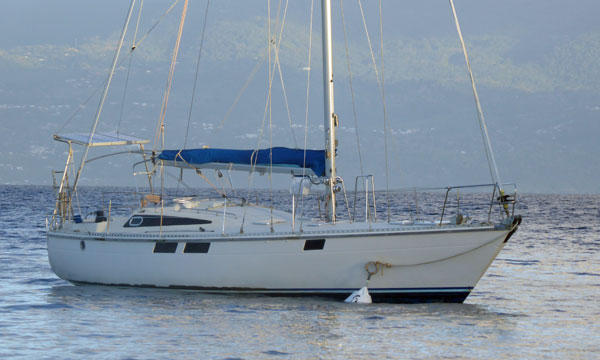 Easy to pick up, but not good news for your topsides
The offshore sailor will encounter two primary configurations: the single-point swinging mooring and the fore-and-aft (trot) mooring. Each demands a distinct tactical mindset.
Single-Point (Swinging) Moorings: A swinging mooring consists of a single riser attached to a heavy ground weight. The yacht is secured only at the bow, allowing it to "swing" 360 degrees to face the prevailing wind or tide. While this is the most common setup, it requires a significant amount of space (the swinging circle). When picking these up, the primary challenge is the "hunting" motion of the boat once secured, as the bow may wander in gusty conditions.
Fore-and-Aft (Trot) Moorings: Common in narrow rivers or crowded harbours, trot moorings involve two buoys. You secure your bow to the forward buoy and your stern to the aft buoy. This keeps the vessel fixed in a specific orientation, allowing for much higher density in the mooring field.
Approaching a trot requires more finesse; you must pick up the forward buoy first, then quickly secure a long trailing line to the stern buoy before the tide or wind slews the boat across the channel.
 Fore-and-aft, or "Trot" moorings
The Technical Approach: Angles & Speed
The "dead slow" approach is a misnomer; you need enough speed to maintain steerage but little enough that your wash does not push the buoy away.
- The Over-the-Bow Method: Preferred for high-freeboard vessels. The helm keeps the buoy fine on the starboard bow (for right-hand props) to counteract any prop walk when shifting into reverse to stop the boat.
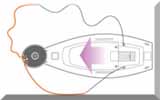
- The Midships Pick-up: This is an expert-level move often used by single-handed sailors. By bringing the buoy alongside the widest part of the boat, the skipper can secure a temporary line before walking it forward to the bow rollers.
The Gear: Strops, Pick-up Lines & Mooring Rings
The Gear: Strops, Pick-up Lines & Mooring Rings
Depending on the harbour and the depth of the water, the physical point of contact on the buoy can vary significantly. Understanding what you are reaching for before you are over the bow is critical.
- The Pick-up Line: Many modern visitors' moorings feature a small float attached to a light line (the pick-up line), which is spliced into the main heavy-duty strop. This is the easiest scenario: you hook the small float, haul it aboard, and the main strop follows.
- The Mooring Ring: In some older or more exposed moorings, there may be no strop at all, just a heavy galvanised ring on top of the buoy. This is a common source of stress for the foredeck crew. You must pass a temporary line (a slip line) through the ring and back to your boat to hold position.
Verifying the Hardware: Diving & Inspection
For the offshore sailor, trust is a commodity that must be earned. Just because a buoy is floating does not mean the tackle beneath it is sound. If you have any reason to suspect the efficacy of the mooring hardware—perhaps the buoy looks undersized or the chains appear heavily fouled—you must perform a visual check.
In warm, clear water, the most effective method is to don a mask and snorkel to dive on the mooring. You are looking for "wasp-waisting" in the chain links where they rub together, or a riser that is dangerously thin due to corrosion. Check the connection to the ground weight or sinker. If the water is too cold or murky for a dive, use your engine to "set" the mooring by backing down on it gently at first, then increasing the revs. If the buoy submerges or feels "springy," the ground tackle may be insufficient for your displacement.
Essential Equipment & Rigging the Bridle
A common mistake is relying on a single thin warp. For any stay longer than a lunch stop, a proper bridle is essential to prevent "hunting"—where the boat shears back and forth, putting immense snatch loads on the cleats.
| Component | Purpose & Specification |
|---|---|
| Boat Hook | Extending reach to grab the strops or pick-up buoy. |
| Primary Strop | Heavy-duty polyester or nylon with anti-chafe sleeving. |
| Bridle Arms | Two lines forming a 'V' to distribute load across two cleats. |
| Pick-up Buoy | A smaller buoy attached to the main riser for easy retrieval. |
Security, Anti-Chafe & Heavy Weather Tactics
The greatest enemy of a boat on a mooring is chafe. During an offshore passage, you might be used to monitoring lines, but on a mooring, the constant sawing motion at the fairleads can melt through a polyester line in hours during a storm. Use heavy-duty plastic hose or dedicated leather chafe guards where the lines exit the boat.
When the sun goes down or the wind picks up, the margin for error narrows. At night, use a powerful torch to identify the buoy’s reflective tape, but avoid shining it directly into the eyes of your foredeck crew.
In heavy weather, the risk is not just missing the buoy, but the yacht being blown down onto other moored vessels. If you miss on the first attempt, do not try to "save" it by leaning over the rail. Abort immediately, circle back, and reset. The safety of the crew is more important than a bruised ego or a second circuit of the mooring field.
A well‑made mooring and a properly set pickup line should keep the boat secure, but unexpected movement can still occur if conditions change or the gear is overloaded — and it’s not always obvious when that happens, particularly if you’re ashore. For real‑time movement alerts and onboard monitoring while your boat is unattended, see Sentinel Marine Monitoring.
Ethical Etiquette & Local Regulations
In many parts of the UK and Europe, mooring buoys are privately owned or managed by harbour authorities. Always check the weight limit marked on the buoy. Using a buoy rated for a 10-tonne boat when you are sailing a 20-tonne ketch is a recipe for disaster. If you are forced to use a private mooring in an emergency, stay aboard and be ready to move immediately if the owner returns.
While moorings provide a convenient alternative to the anchor, there are times when the available buoys are suspect or the field is full. In such instances, having a robust understanding of your own ground tackle becomes vital. If you find yourself needing to drop your own hook because the local moorings are untrustworthy, our article, The Definitive Guide to Anchoring a Boat, provides the technical depth required to ensure your vessel remains stationary in any bottom type.
Summing Up
Mastering the pick-up is a hallmark of a competent sailor. It requires patience, a quiet deck, and the ability to read the water. By prioritising the approach angle and ensuring your lines are protected against chafe, you can rest easy knowing your yacht is secure, regardless of how the weather turns during the night.

This article was written by Dick McClary, RYA Yachtmaster and author of the RYA publications 'Offshore Sailing' and 'Fishing Afloat', member of The Yachting Journalists Association (YJA), erstwhile member of the Ocean Cruising Club (OCC) and owner/administrator of 'Liveaboard Sailboats for Sale'.

Frequently Asked Questions
What should I do if the pick-up buoy is missing its strop?
What should I do if the pick-up buoy is missing its strop?
You will need to pass a line through the ring on top of the main mooring buoy. This is best done by bringing the buoy alongside at the lowest point of your rail and using a "threaded" line technique to get a temporary hold before leading it to the bow.
Is it better to use a single line or a bridle?
Is it better to use a single line or a bridle?
For an overnight stay, always use a bridle. It stops the boat from wandering and provides redundancy. If one line chafes through, the second will keep you off the rocks.
How do I handle a mooring when sailing short-handed?
How do I handle a mooring when sailing short-handed?
Prepare your lines at the midships cleat. Approach the buoy so it comes alongside the cockpit or the widest part of the beam. Once secured midships, the boat is held, and you can then take your time to lead a permanent line to the bow.
Can I use my anchor windlass to pull the boat to the mooring?
Can I use my anchor windlass to pull the boat to the mooring?
It is not recommended. Windlasses are designed for vertical lifts, not the horizontal snatch loads of a yacht moving in a seaway. Use your engine to get into position and then use human power or a winch to take up the slack.
How do I safely thread a line through a mooring ring in a swell?
How do I safely thread a line through a mooring ring in a swell?
Do not attempt to thread it from high up on the bow. Bring the buoy to the shrouds or the cockpit where you are closer to the water. Pass the line through the ring and quickly cleat both ends before moving the boat forward to its final position.
Recent Articles


-
Mystery 35 Review: Specs, Performance & Buying Guide
Aug 29, 26 09:42 AM
An in-depth review of the Mystery 35 sailboat. Read technical specs, design ratios, sail performance, and common buyer inspection areas. -
Beneteau First 405 Review: Specs, Performance & Buyer’s Guide
Aug 26, 26 03:58 AM
Detailed Beneteau First 405 review covering specs, performance, bluewater capability, layouts and buyer’s checklist. -
Moody S38 Review: Specs, Ratios & Buyer’s Guide
Aug 12, 26 04:22 AM
In‑depth Moody S38 review covering specs, performance, design ratios, layout, strengths, trade‑offs & buyer inspection points.