- Home
- Cruising Yachts 45' to 50'
- Aerodyne 47
The Aerodyne 47 Sailboat
Specs, Performance Analysis & Cruising Characteristics
Key Takeaways: The Aerodyne 47 is a high-performance offshore cruiser designed for sailors who value speed, modern aesthetics, and ease of handling. Unlike traditional cruisers, it features a light-displacement hull, a powerful fractional rig, and a distinctive open transom. It is best suited for experienced couples or short-handed crews looking to cover long distances quickly, though its shallow bilges and high-aspect appendages require a more active sailing style compared to a heavy-set blue water cruiser.
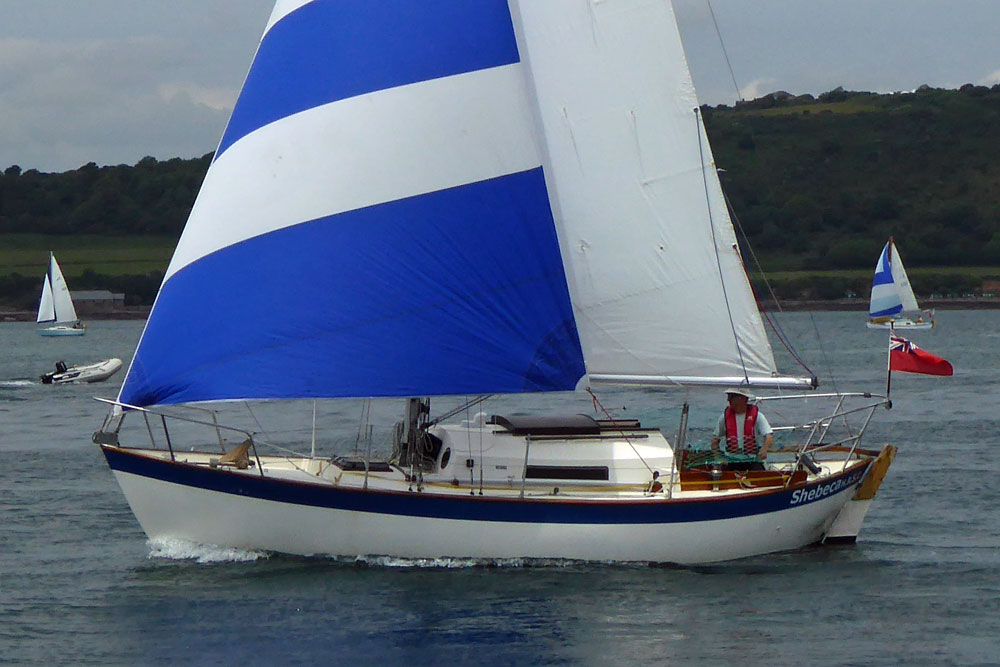
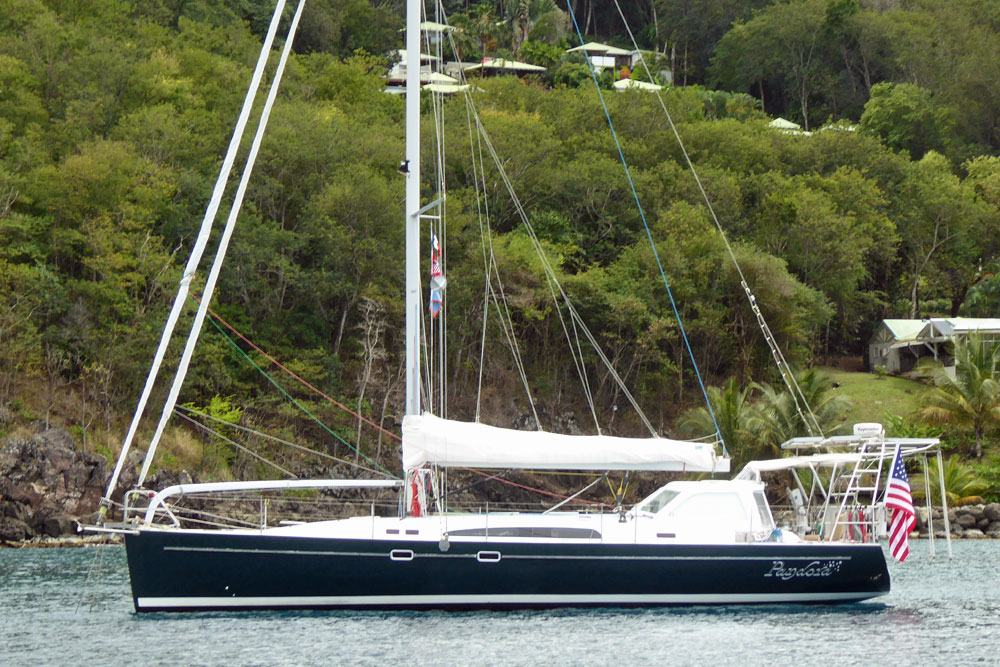 'Pandora', an Aerodyne 47 - Build #3.
Note the Code Zero on the Solent rig and self-tacking jib on the Hoyt boom.
Design & Construction
The Aerodyne 47 is the brainchild of the renowned New Zealand designer Rodger Martin. Known for his "performance with comfort" philosophy, Martin drew a hull that reflects his experience in open-ocean racing yachts. The boat was primarily built by TPI Composites in the USA, a builder famous for pioneering the Scrimp resin infusion process. This construction method ensures an exceptionally high strength-to-weight ratio, utilizing a balsa-cored sandwich laminate that provides both stiffness and thermal insulation.
The key defining feature of the Aerodyne 47 is its "Aero-rig"* compatibility and its exceptionally clean, ergonomic deck layout. Most notably, the design incorporates a "fin-and-bulb" keel and a high-aspect spade rudder. This combination allows the boat to track beautifully while maintaining the responsiveness of a racing yacht. While the 47-foot version is the most prominent, the design evolved from the successful Aerodyne 38, focusing on increased interior volume and waterline length for serious ocean passage-making.
* Many Aerodyne 47s you see today utilize a high-performance fractional sloop rig instead—a more "conventional" setup that still benefits from the boat’s racing-derived hull but uses traditional standing rigging.
The Aero-rig vs The Fractional Sloop: A Tale of Two Configurations
While the Aerodyne 47 hull remains constant, the choice of rig fundamentally alters how the boat is sailed and maintained. Most hulls were delivered with a high-performance fractional sloop rig, but a notable number of owners opted for the carbon-fibre Aero-rig. Understanding the trade-offs between these two setups is vital for any prospective buyer.
Handling & Performance Underway
The fractional sloop rig is the choice for the traditionalist and the racer. It offers more granular control over sail shape through the use of backstay tension, car positions, and halyard tension. Upwind, the fractional rig generally provides superior pointing ability, making it the better choice for those who enjoy the "tweakability" of a modern rig.
Conversely, the Aero-rig is the ultimate short-handed cruising tool. Because the entire unit rotates, the relationship between the jib and the mainsail is fixed at the optimal aerodynamic twist. When you tack, you simply turn the wheel; there are no jib sheets to winches, and no risk of the sail catching on the lifelines. However, the Aero-rig carries more weight aloft due to the heavy-duty carbon layup required for an unstayed mast, which can slightly increase the rolling motion in a beam sea.
Maintenance & Longevity
| Feature | Fractional Sloop Rig | Rotating Aero-rig |
|---|---|---|
| Standing Rigging | Required; needs replacing every 10–15 years. | None; fewer failure points for ocean crossings. |
| Weight Distribution | Lighter mast section; lower centre of gravity. | Heavier carbon section & boom assembly aloft. |
| Downwind Sailing | Requires a pole or bowsprit for efficiency. | Superior; rig can rotate 360° to catch wind. |
| Complexity | Standard parts; any rigger can service. | Specialised; requires expert carbon & bearing care. |
Practical Considerations for the Buyer
If you are looking at an Aero-rigged Aerodyne 47, the most critical inspection point is the main deck bearing. This massive component carries the entire load of the rig. Any grit, salt crystallisation, or wear in the bearings can make the rig difficult to rotate and expensive to repair.
For those planning to cruise remote areas, the fractional sloop is often more pragmatic. If a shroud breaks in the middle of the Pacific, it can be replaced with wire or Dyneema. If the carbon spar of an Aero-rig suffers a structural failure, the repair is a significantly more complex engineering task. However, for a couple who wants the fastest, easiest-handling 47-footer on the water, the Aero-rig version remains a masterclass in design.
Sail Areas & Rig Dimensions
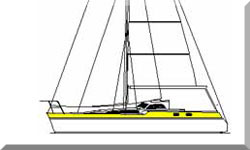
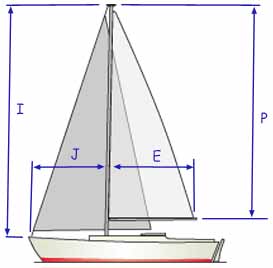 Rig dimensions
The Aerodyne 47 carries a powerful sail plan designed to keep the boat moving in light airs while remaining manageable when the breeze refreshes.
- I (Forestay Height): 56'6" (17.22 m)
- J (Foretriangle Base): 15'9" (4.80 m)
- P (Mainsail Luff): 52'10" (16.10 m)
- E (Mainsail Foot): 19'8" (6.00 m)
- Mainsail Area: 520 ft² (48.31 m²)
- 100% Foretriangle: 445 ft² (41.34 m²)
- Total Upwind Sail Area: 965 ft² (89.65 m²)
Published Specification: The Aerodyne 47 Blueprint
| Feature | Specification & Data |
|---|---|
| LOA | 47'6" (14.48 m) |
| LWL | 41'8" (12.70 m) |
| Beam | 14'1" (4.29 m) |
| Draft (Standard) | 7'6" (2.29 m) |
| Displacement | 24,000 lbs (10,886 kg) |
| Ballast | 8,200 lbs (3,719 kg) |
| Rig Type | Fractional Sloop |
| Hull Material | GRP (Scrimp Infused) |
| Production Dates | Late 1990s – Early 2000s |
Performance Analysis: Understanding the Design Ratios
To understand how this yacht behaves at sea, we look at the core mathematical relationships of her design.
| Ratio | Value | Interpretation |
|---|---|---|
| SA/D | 18.5 | High performance; excellent light-air capability. |
| D/L | 156 | Light-displacement; indicates speed & surfing potential. |
| B/D | 34% | Moderate ballast ratio; relies on form stability. |
| CSF | 1.96 | Below 2.0; considered safe for ocean crossings. |
| Comfort Ratio | 26.5 | Predicts a "lively" motion in a seaway. |
The Sail Area to Displacement ratio of 18.5 places the Aerodyne 47 firmly in the performance-cruising category. It will outrun most traditional cruisers of the same length, especially off the wind. However, the Displacement to Length ratio of 156 confirms this is a light boat. While this allows for exhilarating speeds, it means the boat is more sensitive to being overloaded with heavy cruising gear.
The Comfort Ratio of 26.5 is lower than that of a heavy-displacement vessel like a Westsail or a Hans Christian. In practice, this means the motion will be quicker and more energetic. For an expert sailor, this is a fair trade-off for the ability to sail at double-digit speeds. For more information on these metrics, see our guide on Understanding Boat Performance & Design Ratios.
Structural Integrity & Stability Dynamics
The Scrimp infusion process used in the hull construction is a major asset. It ensures that the resin is pulled through the laminate under a vacuum, eliminating air pockets and creating a monolithic structure that is significantly stronger than traditional hand-laid glass. This is vital for a light-displacement boat that may experience high slamming loads when driven hard upwind.
Stability is primarily achieved through the deep fin keel and the wide beam carried well aft. This "form stability" makes the boat very stiff initially, providing a stable platform for the crew. However, because the boat is light, the transition from "stiff" to "heeled" can be faster than on a heavy-keeled boat, requiring timely reefing of the large mainsail.
The Buyer’s Checklist: Common Problem Areas
When inspecting a used Aerodyne 47, focus on the following specific areas:
- Balsa Core Integrity: While the Scrimp process is excellent, any aftermarket deck hardware installed without proper sealing can lead to moisture ingress in the balsa core. Use a moisture meter around all stanchion bases and cleats.
- Keel Attachment: The deep fin keel exerts significant leverage on the hull grid. Inspect the floors and keel bolts for any signs of movement or "smile" lines at the hull-keel joint.
- Rudder Bearings: High-aspect spade rudders put considerable stress on bearings. Check for excessive play or stiffness in the steering system.
- Rigging Loads: Because this is a performance-oriented rig, the standing rigging works hard. Check the chainplates and the mast step for signs of compression or stress cracking.
Configuration, Layout & Cruising Characteristics
The interior of the Aerodyne 47 is surprisingly spacious given its performance pedigree. The galley is typically a sea-safe U-shape, positioned to remain functional even when heeled. Tankage is sufficient for coastal and mid-range offshore work, though serious ocean crossers may want to supplement the water capacity with a high-output watermaker.
The cockpit is the highlight of the deck layout. It is deep and secure, with excellent sightlines from the helm. The open transom makes boarding from a dinghy or swimming easy, though it does require a robust set of washboards for heavy weather to prevent a following sea from entering the cabin.
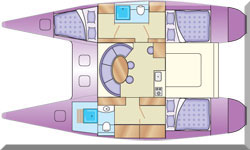
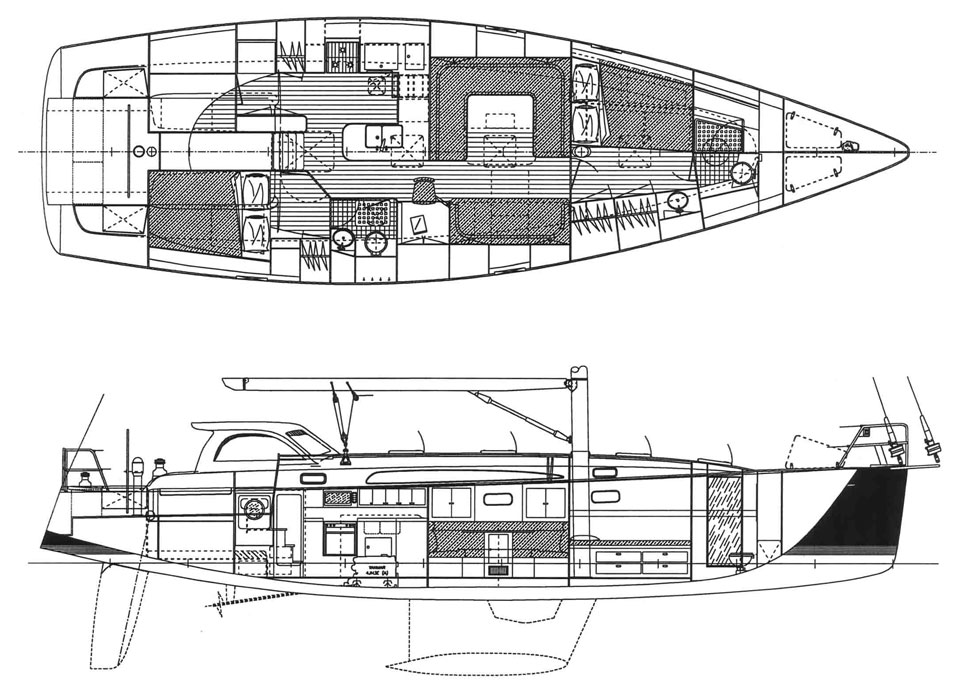 The accommodation layout
If you'd like to compare this boat with others in this size range, take a look at Cruising Boats from 45' to 50' overall....
Could this be your ideal cruising boat?
It may well be, but before going any further, it might be worth taking a look at my eBook 'How to Avoid Buying the Wrong Sailboat'...
Summing Up
The Aerodyne 47 is a sophisticated sailing machine that refuses to compromise on speed. It bridges the gap between a high-end racing yacht and a dedicated blue water cruiser. While its motion in a sea is more active than a traditional heavy boat, its ability to outrun weather systems and provide genuine sailing pleasure is unmatched. It is a boat for the sailor who enjoys the journey as much as the destination and possesses the skills to manage a powerful, responsive rig.
This article was written by Dick McClary, RYA Yachtmaster and author of the RYA publications 'Offshore Sailing' and 'Fishing Afloat', member of The Yachting Journalists Association (YJA), and erstwhile member of the Ocean Cruising Club (OCC).
Frequently Asked Questions (FAQs)
Is the Aerodyne 47 suitable for solo sailing?
Is the Aerodyne 47 suitable for solo sailing?
While large, the sail handling is centered in the cockpit. With a high-quality autopilot and a well-sorted slab-reefing system, an experienced sailor can handle the boat alone, though a couple is the ideal crew.
How does the light displacement affect its blue water capability?
How does the light displacement affect its blue water capability?
It means the boat "dances" over the waves rather than plowing through them. This reduces stress on the hull but increases the physical toll on a crew not used to a lively motion.
What is the typical cruising speed under sail?
What is the typical cruising speed under sail?
In a moderate breeze on a reach, the Aerodyne 47 will easily maintain 8 to 9 knots. In ideal conditions, it can surf into the low teens.
Are there common issues with the Scrimp construction?
Are there common issues with the Scrimp construction?
The process itself is superior to hand-layup. The only issues usually arise from poorly executed repairs or unsealed deck penetrations by previous owners.
Does the boat require a high-tech sail wardrobe?
Does the boat require a high-tech sail wardrobe?
To get the most out of the design, laminate or high-modulus sails are recommended. Traditional Dacron sails may stretch under the high loads of the powerful rig, compromising upwind performance.
Recent Articles


-
Mystery 35 Review: Specs, Performance & Buying Guide
Aug 29, 26 09:42 AM
An in-depth review of the Mystery 35 sailboat. Read technical specs, design ratios, sail performance, and common buyer inspection areas. -
Beneteau First 405 Review: Specs, Performance & Buyer’s Guide
Aug 26, 26 03:58 AM
Detailed Beneteau First 405 review covering specs, performance, bluewater capability, layouts and buyer’s checklist. -
Moody S38 Review: Specs, Ratios & Buyer’s Guide
Aug 12, 26 04:22 AM
In‑depth Moody S38 review covering specs, performance, design ratios, layout, strengths, trade‑offs & buyer inspection points.