- Home
- Cruising Yachts 45' to 50'
- Allures 45.9
The Allures 45.9 Sailboat
Specs, Performance Analysis & Cruising Characteristics
Key Takeaways
The Allures 45.9 is a high-volume, aluminium-hulled cruiser featuring a composite deck and a versatile lifting keel. It is designed for maximum safety in remote areas, offering exceptional impact resistance and the ability to beach or enter shallow lagoons. While not a light-air racer, its modern hull form provides surprising speed on a reach and stable motion in a seaway. It is a premium, light-to-medium displacement liveaboard suited for those prioritizing structural integrity and shallow-water access over raw upwind pointing ability.
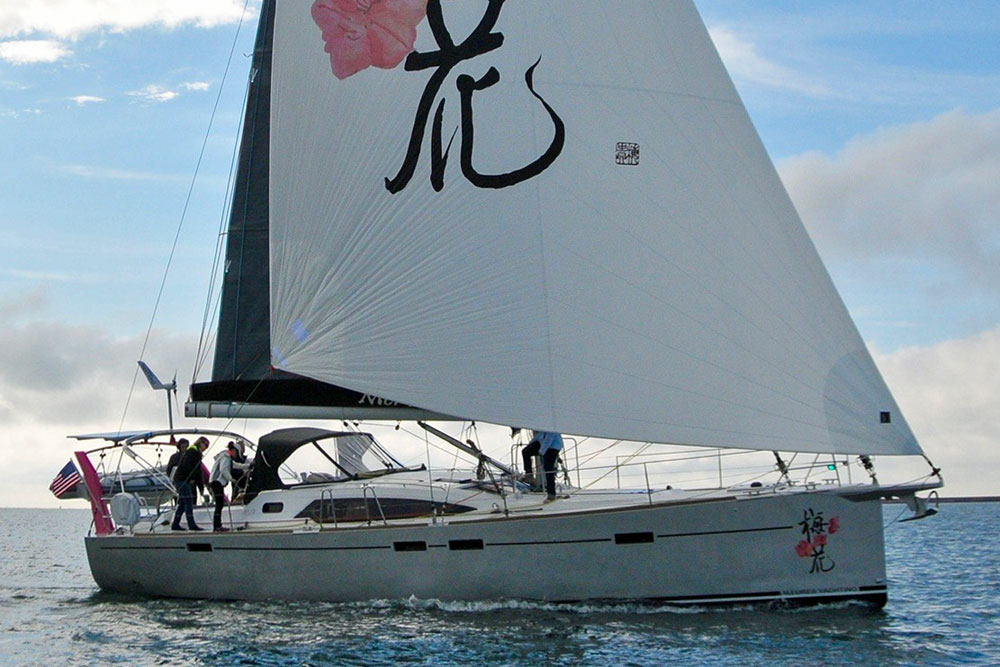 'Mei Hua', an Allures 45.9
The Allures 45.9 is a blue-water cruiser designed for sailors who refuse to choose between the rugged security of an aluminium hull and the performance of a modern, balanced hull shape. Built by the specialist French yard Allures Yachting, it represents an evolution of the earlier 45, refining the balance between a lifting-keel coastal explorer and a high-latitude voyager. This review examines why this specific model has become a benchmark for long-distance cruising couples and how its technical specifications translate to real-world handling in heavy seas.
Design & Construction
The Allures 45.9 is the product of a collaboration between the Berret-Racoupeau Design office and the Allures Yachting yard in Cherbourg, France. The construction philosophy is distinct: a marine-grade aluminium hull for strength and a vacuum-infused GRP composite deck for weight saving and insulation. This hybrid approach allows for a lower centre of gravity while providing the "armour-plated" peace of mind that aluminium aficionados demand for ocean crossings.
The defining feature of the 45.9 is its integral lifting keel (centreboard). Unlike a swing-keel where the ballast moves, this is a true centreboard design where the internal lead ballast is located in the bottom of the hull. This allows the draft to be reduced from 9'6" (2.90m) to just 3'6" (1.06m). Practically, this means you can tuck into shallow anchorages that are off-limits to most 45' boats or even dry out on a sandy beach.
While the lifting keel is standard, Allures also offered a "DL" (Deep Lifting) version with a deeper, higher-aspect foil for enhanced upwind performance. The layout is typically available in a two or three-cabin configuration, with a dedicated technical room often preferred by long-term cruisers for housing watermakers, generators, and tools.
Sail Areas & Rig Dimensions
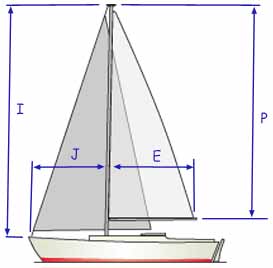 Rig dimensions
The 45.9 carries a powerful fractional rig, usually configured as a cutter with a removable inner forestay or a permanent staysail for heavy weather versatility.
- Mainsail: 560 ft² (52 m²)
- Genoa (105%): 517 ft² (48 m²)
- Staysail: 226 ft² (21 m²)
- I: 56'10" (17.32 m)
- J: 17'1" (5.21 m)
- P: 53'4" (16.25 m)
- E: 17'8" (5.38 m)
Published Specification: The Allures 45.9 Blueprint
| Feature | Specification Detail |
|---|---|
| LOA | 48'4" (14.75 m) |
| LWL | 43'8" (13.30 m) |
| Beam | 14'6" (4.43 m) |
| Draft (Min/Max) | 3'6" (1.06 m) / 9'6" (2.90 m) |
| Displacement | 28,219 lbs (12,800 kg) |
| Ballast | 10,538 lbs (4,780 kg) |
| Rig Type | Fractional Sloop/Cutter |
| Hull Material | Aluminium & Composite Deck |
| Production Dates | 2017 – Present |
Performance Analysis: Understanding the Design Ratios
To understand how the 45.9 behaves compared to its peers, we must look at the mathematical profile of the design.
| Ratio | Value | Interpretation |
|---|---|---|
| SA/D | 18.5 | Balanced; provides good light-air performance for a cruiser. |
| D/L | 151 | Light-Medium displacement; suggests modern, efficient hull speed. |
| B/D | 37% | High stiffness; ensures the boat can carry sail in a breeze. |
| CSF | 1.75 | Safe; well under the 2.0 limit for ocean crossings. |
| Comfort Ratio | 29.2 | Moderate; provides a predictable, non-snappy motion in waves. |
Interpretation
The Sail Area/Displacement (SA/D) of 18.5 places the Allures in the "performance cruiser" bracket. It is far more athletic than older, traditional heavy-displacement metal boats. The Displacement/Length (D/L) ratio of 151 is surprisingly low for an aluminium boat, indicating that the Berret-Racoupeau team succeeded in keeping the weight down, allowing for high average speeds on passage.
The Capsize Screening Formula (CSF) of 1.75 is excellent for an ocean cruiser, indicating high resistance to being rolled by a breaking wave. Finally, the Brewer Motion Comfort Ratio of 29.2 suggests that while the boat is modern and relatively light, it still possesses enough mass and hull volume to avoid the "cork-like" motion of lighter production GRP boats. For a deeper look at these metrics, see our guide on Understanding Boat Performance & Design Ratios.
Structural Integrity & Stability Dynamics
The use of aluminium provides a strength-to-weight ratio that GRP cannot match when it comes to point-loading and impacts. In a collision with a submerged object, aluminium will dent where fibreglass would shatter. This makes it the material of choice for high-latitude sailing.
The lifting keel system impacts stability in a unique way. Because the ballast is fixed in the hull, the stability does not rely on the board being down. The board is essentially a foil for lateral resistance. In heavy weather, one of the Allures' greatest "tricks" is the ability to partially retract the board when running before a storm, allowing the boat to "slide" sideways down the face of a wave rather than tripping over a deep keel.
The Buyer’s Checklist: Common Problem Areas
When inspecting a used Allures 45.9, focus on the specificities of its metal construction and complex keel mechanism:
- Galvanic Corrosion: Check the hull around through-hull fittings and the sail-drive leg. Ensure the cathodic protection system is maintained and that no "stray current" has been introduced by aftermarket electrical installs.
- Centreboard Mechanism: Inspect the lifting lines and the pivot pin. Ensure the board operates smoothly without excessive clunking, which could indicate worn bushings.
- Composite-to-Metal Join: Examine the joint where the GRP deck meets the aluminium hull. Look for any signs of cracking in the sealant or movement between the two materials.
- Paintwork: Aluminium is notoriously difficult to paint. Look for "bubbling" or chalking, which suggests the primer layer has failed or oxygen has reached the bare metal.
Comparison: Allures 45.9 vs The Competition
How does it stack up against other bluewater heavyweights?
- Garcia Exploration 45: The "big brother" from the same parent group. The Garcia is more focused on the Arctic, with a deck saloon and internal steering. The Allures is faster and more Mediterranean-friendly.
- Ovni 450: The Ovni is 100% aluminium. It is rugged but often considered more "industrial" and slightly slower than the Allures due to its chined hull design and heavier build.
- Boreal 47: An incredible high-latitude boat with a doghouse. However, the Boreal uses a daggerboard system rather than a weighted centreboard, offering different handling characteristics in a following sea.
If you'd like to compare this boat with others in this size range, take a look at Cruising Boats from 45' to 50' overall....
Configuration, Layout & Cruising Characteristics
The interior of the 45.9 is airy and bright, a departure from the "dark cave" feel of some older metal boats. The galley is linear and positioned to port, providing excellent bracing points for cooking while underway.
The cockpit is designed for shorthanded sailing, with all lines led aft to winches within reach of the twin helm stations. One specific cruising advantage is the large "sugar scoop" stern, which makes boarding from a dinghy or swimming far easier than on traditional vertical-transom cruisers. Tankage is generous, with roughly 660 litres (174 gal) of fuel and 420 litres (111 gal) of water, supporting extended autonomy.
Could this be your ideal cruising boat?
It may well be, but before going any further, it might be worth taking a look at my eBook 'How to Avoid Buying the Wrong Sailboat'...
Summing Up
The Allures 45.9 is a rare breed of sailboat that manages to look modern while being built like a tank. It offers the speed and comfort of a contemporary GRP cruiser with the "go-anywhere" security of a lifting-keel aluminium hull. While the maintenance of an aluminium boat requires more vigilance regarding electrolysis than GRP, the reward is a vessel that can take you from the glaciers of South Georgia to the shallow reefs of the Bahamas with equal aplomb. It is a boat for the serious voyager who values structural integrity above all else.
This article was written by Dick McClary, RYA Yachtmaster and author of the RYA publications 'Offshore Sailing' and 'Fishing Afloat', member of The Yachting Journalists Association (YJA), and erstwhile member of the Ocean Cruising Club (OCC).
Frequently Asked Questions (FAQs)
Is the Allures 45.9 difficult to maintain because of the aluminium hull?
Is the Allures 45.9 difficult to maintain because of the aluminium hull?
It is not more difficult, but it is different. You must ensure that no copper-based anti-fouling is used and that the electrical system remains isolated from the hull. If these protocols are followed, the hull can last a lifetime.
How does it perform upwind with a lifting keel?
How does it perform upwind with a lifting keel?
With the board fully down (9'6"), the 45.9 points surprisingly well. It will not match a deep-finned racing yacht, but it is significantly more weatherly than most traditional long-keel cruisers.
Can the boat truly be beached?
Can the boat truly be beached?
Yes. The 45.9 is designed to sit on its hull. The twin rudders and the reinforced bottom allow it to dry out on level ground, which is a massive advantage for hull cleaning or exploring tidal estuaries.
Is it easy to sail single-handed?
Is it easy to sail single-handed?
The boat is optimized for a couple. The twin wheels and well-placed winches allow one person to manage the sails while the other rests, though a reliable autopilot is essential given its displacement.
What is the "composite deck" benefit?
What is the "composite deck" benefit?
The GRP deck reduces top-heavy weight, improving stability. It also offers better thermal and acoustic insulation than a pure aluminium deck, making the interior quieter and more comfortable in varied climates.
Recent Articles


-
Best AIS Systems for Cruising Sailboats 2026 — Class B & B+ Guide
Sep 25, 26 05:20 PM
Find the best AIS systems for cruising sailboats in 2026. Clear guidance on Class B vs Class B+, transceivers vs receivers, NMEA 2000 compatibility, and top AIS units available on Amazon. -
Comparing Handheld VHF Radios
Sep 25, 26 04:38 PM
Budget, Mid-Range and Premium VHF Radios functionality and performance compared -
Rigging a Carbon Mast: Carbon, PBO or Dyneema Compared
Sep 20, 26 08:01 AM
Rigging a carbon mast: how carbon rod, PBO and Dyneema compare on cost, weight and inspection, and why stainless wire or rod rarely make sense.