- Home
- Cruising Yachts 40' to 45'
- Catalina 42 Mk1
The Catalina 42 MkI Sailboat:
Specs, Performance Analysis & Cruising Characteristics
Key Takeaways: The Catalina 42 mk1 prioritises interior volume and dockside comfort without completely sacrificing sailing performance. Launched in the late 1980s, it marked a shift for Catalina Yachts into the competitive 40-foot plus market. Key findings include its moderate displacement, exceptional three-cabin or two-cabin layouts, and a hull form designed by Nelson/Marek that performs surprisingly well off the wind. While not a heavy-weather blue water tank, its high stability and predictable handling make it a favourite for families and coastal liveaboards.
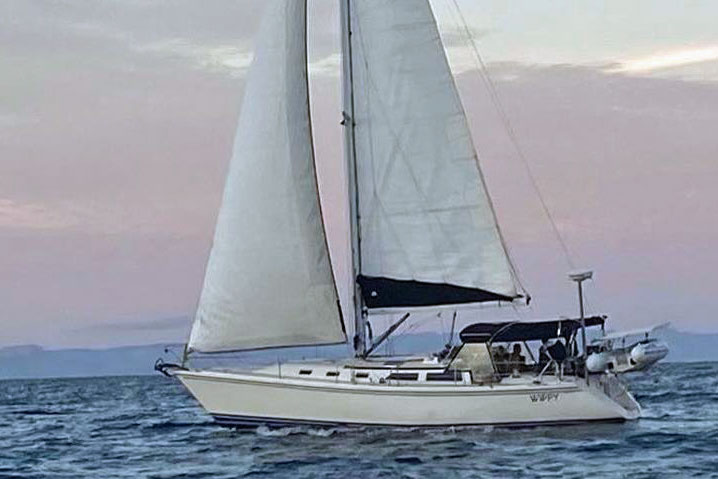 The Catalina 40 Mk1
Design & Construction
The Catalina 42 MkI was the result of a collaboration between the prolific builder Catalina Yachts and the design firm Nelson/Marek, known for their racing pedigree. Constructed primarily of solid fibreglass below the waterline with a balsa-cored deck, the hull was designed to be stiff yet manageable. Unlike many of its predecessors, the 42 MkI featured a more contemporary, sleek profile that aged remarkably well.
The defining feature of this model is its massive beam carried well aft, which creates a cavernous interior and a spacious cockpit. This design choice directly benefits cruising by providing a stable platform at anchor and plenty of room for a full crew to operate without tripping over one another.
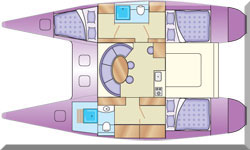
During its production run from 1988 to the early 1990s, the MkI was offered in two primary layouts: a three-cabin family version and a two-cabin "owner" version. The latter featured a large pullman berth forward. Buyers could also choose between a wing keel for shallow-draught areas or a traditional deep fin keel for better upwind tracking.
Sail Areas & Rig Dimensions
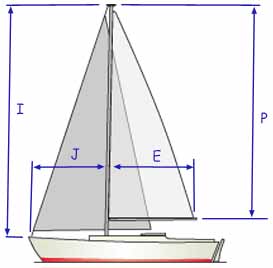 Rig dimensions
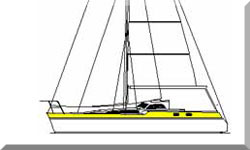
The sail plan is a masthead sloop rig, designed to be easily handled from the cockpit. The dimensions are as follows:
- Total Sail Area (100% Foretriangle): 797 ft² (74.04 m²)
- I (Forestay Height): 53'0" (16.15 m)
- J (Foretriangle Base): 16'5" (5.00 m)
- P (Mainsail Luff): 46'9" (14.25 m)
- E (Mainsail Foot): 15'6" (4.72 m)
Published Specification: The Catalina 42 MkI Blueprint
| Specification Category | Measurement & Data |
|---|---|
| LOA | 41'10" (12.75 m) |
| LWL | 36'0" (10.97 m) |
| Beam | 13'10" (4.22 m) |
| Draft (Fin Keel) | 6'0" (1.83 m) |
| Draft (Wing Keel) | 4'10" (1.47 m) |
| Displacement | 20,500 lbs (9,299 kg) |
| Ballast | 8,300 lbs (3,765 kg) |
| Rig Type | Masthead Sloop |
| Hull Material | GRP (Glass Reinforced Plastic) |
| Production Dates | 1988 – 1991 (mk1 edition) |
Performance Analysis: Understanding the Design Ratios
To understand how the Catalina 42 MkI behaves on the water, we look at the mathematical relationships between its dimensions. Further detail on these metrics can be found in our guide: Understanding Boat Performance & Design Ratios.
| Ratio Type | Value | Interpretation |
|---|---|---|
| SA/D | 17.1 | A moderate ratio suggesting good light-air performance without being overpowered too early. |
| D/L | 196 | Indicates a light-to-moderate displacement cruiser, capable of good speeds and easy surfing. |
| B/D | 40.5% | High ballast ratio providing excellent stiffness and a secure feeling when the wind picks up. |
| CSF | 1.97 | Below the 2.0 threshold, meaning it is technically rated for offshore work regarding capsize risk. |
| Comfort Ratio | 25.4 | Reflects a motion that is relatively "quick" compared to heavy bluewater yachts but stable for coastal use. |
Structural Integrity & Stability Dynamics
The use of GRP for the hull ensures a durable and relatively low-maintenance structure. Catalina utilised a structural grid system to distribute mast and keel loads. While some purists argue for heavier hand-laid schedules, the 42 MkI has proven its longevity over decades of use.
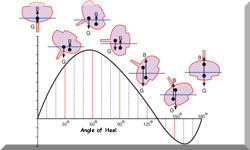
The high ballast-to-displacement ratio is a standout feature for a production boat of this era. By placing over 40% of the weight in the keel, the designers ensured that the boat stays upright and tracks well. The wide beam adds significant initial stability, which means the boat does not heel excessively in moderate breezes, a trait much appreciated by nervous passengers or family members.
Configuration, Layout & Cruising Characteristics
Cruising in a Catalina 42 MkI is largely defined by the "big boat" feel. The cockpit is deep and secure, with a large diameter wheel that provides good leverage. Primary winches are within reach of the helm, making it feasible for a couple to manage.
Inside, the galley is a highlight, often featuring a wrap-around design with substantial refrigeration space and a double sink. For long-term cruising, the tankage is adequate but not massive, with approximately 115 gallons (435 litres) of water and 46 gallons (174 litres) of fuel. The pullman berth in the owner's version is often cited as one of the most comfortable sleeping arrangements in this size bracket, though some find the narrow passage forward a trade-off for the large heads located in the bow.
Impressed?

Has this article suggested that this could be your ideal cruising boat and, as a result, deserves to be on your "Worth a Look" list?
But if, like me, you find sailboats to be seductive creations, then that list could rapidly get to be a pretty long one. If that is the case, wouldn't it be good if you could narrow it down bit through an objective, pragmatic process?
Well, that's where my eBook 'How to Avoid Buying the Wrong Sailboat' comes in...
Summing Up
The Catalina 42 MkI remains a benchmark in the used boat market for those seeking a balance of space, price, and respectable sailing manners. Its design ratios point to a boat that is nimble for its size and remarkably stable due to its high ballast ratio. While the hull is light enough to move well in light winds, it lacks the heavy-set momentum required for comfortable bashing through steep head seas. Ultimately, it is a well-engineered coastal cruiser that offers an entry point into large-scale cruising without the complexities of more exotic yacht builds.
If you'd like to compare this boat with others in this size range, take a look at Cruising Boats from 40' to 45' overall....
This article was written by Dick McClary, RYA Yachtmaster and author of the RYA publications 'Offshore Sailing' and 'Fishing Afloat', member of The Yachting Journalists Association (YJA), and erstwhile member of the Ocean Cruising Club (OCC).
Frequently Asked Questions (FAQs)
Is the Catalina 42 mk1 suitable for solo sailing?
Is the Catalina 42 mk1 suitable for solo sailing?
While it is a large vessel, the masthead sloop rig and lines led aft make it manageable for an experienced solo sailor, provided an autopilot is used and the sail handling systems are well-maintained.
How does the wing keel affect performance compared to the fin keel?
How does the wing keel affect performance compared to the fin keel?
The wing keel allows for a shallower draught, which is vital for areas like the Bahamas or the Chesapeake. However, it does sacrifice some upwind pointing ability and slightly increases drag compared to the deep fin version.
Are there known issues with the "Catalina Smile"?
Are there known issues with the "Catalina Smile"?
This refers to a small crack that can appear at the leading edge of the keel-to-hull joint. On the 42 mk1, it is usually a cosmetic issue caused by the flexing of the keel, but it should be inspected to ensure the keel bolts are torqued correctly.
Can the Catalina 42 mk1 be used for transatlantic crossings?
Can the Catalina 42 mk1 be used for transatlantic crossings?
Yes, many have made the crossing. However, it requires upgrades in terms of tankage, charging systems, and possibly strengthening the rigging. It is designed as a coastal cruiser, so prep work is essential for blue water.
What engine was standard in the mk1?
What engine was standard in the mk1?
Most mk1 models were fitted with a Yanmar 4JH series diesel engine, typically around 44hp to 50hp, which is widely regarded as reliable and easy to find parts for globally.
Recent Articles


-
Should I Buy a Boat? Four Questions to Answer Before You Commit
Oct 02, 26 04:40 AM
Thinking "Should I buy a boat?" This guide helps you decide, with key considerations from cost & maintenance to your personal sailing aspirations. -
Offshore Internet with Starlink: Hardware, Plans, and Setup Guidance
Oct 01, 26 01:15 PM
A clear, practical guide to choosing the right Starlink hardware and plan for offshore cruising. Learn what to buy, how to install it, and how to manage power afloat. -
Offshore Liferaft Guide: Choosing, Stowing and Servicing One
Oct 01, 26 06:28 AM
Choosing an offshore liferaft? Learn what ISO 9650 Group A means, where to stow it, how often to service it and what to pack in the grab bag.