- Home
- Cruising Sailboats
- Sailboat Galley Layout
- Galley-at-Sea (Linear Vs U Or L-shaped)
Design & Safety: Linear vs U-Shaped Galleys at Sea
Key Takeaways: When evaluating a sailboat's galley, the choice is a fundamental tug-of-war between entertaining space and offshore security. While a linear galley offers an open, social atmosphere and extensive counter space, it often lacks the essential bracing points required for safe cooking in a heavy seaway. Conversely, a U-shaped galley provides a "cockpit" for the cook, offering superior safety through physical containment when the boat is heeled. The ideal layout depends entirely on whether your primary goal is coastal hosting or blue-water passage making.
Table of Contents
- The Ergonomics of Offshore Cooking
- The U-Shaped Galley: The Offshore Gold Standard
- The Linear Galley: Space, Light & Social Flow
- The L-Shaped Compromise: Balancing Two Worlds
- Safety Infrastructure: Bracing Bars & Bum Straps
- Ventilation & Heat Management in Deep Sea Galleys
- Summing Up
- Frequently Asked Questions
The Ergonomics of Offshore Cooking
Cooking at sea is a contact sport. Unlike a kitchen on land, a boat’s galley is constantly in motion, subjected to the unpredictable forces of pitch and roll. For the offshore sailor, the primary requirement of a galley is not the size of the fridge or the number of burners, but the ability to remain upright and stable while both hands are occupied.
The concept of the "work triangle"—the distance between the sink, cooker and fridge—remains relevant, but it must be compressed. In a yacht, every step taken is a moment of vulnerability. A layout that requires the cook to take three steps across an open cabin floor to reach the sink from the stove is a liability in a gale. Serious offshore sailors prioritise a "wraparound" feel where everything is within arm's reach.
The U-Shaped Galley: The Offshore Gold Standard
For decades, the U-shaped galley has been the preferred choice for serious blue-water cruisers. By enclosing the cook on three sides, the layout creates a secure "well" where the cook can lean against the cabinetry on either tack.
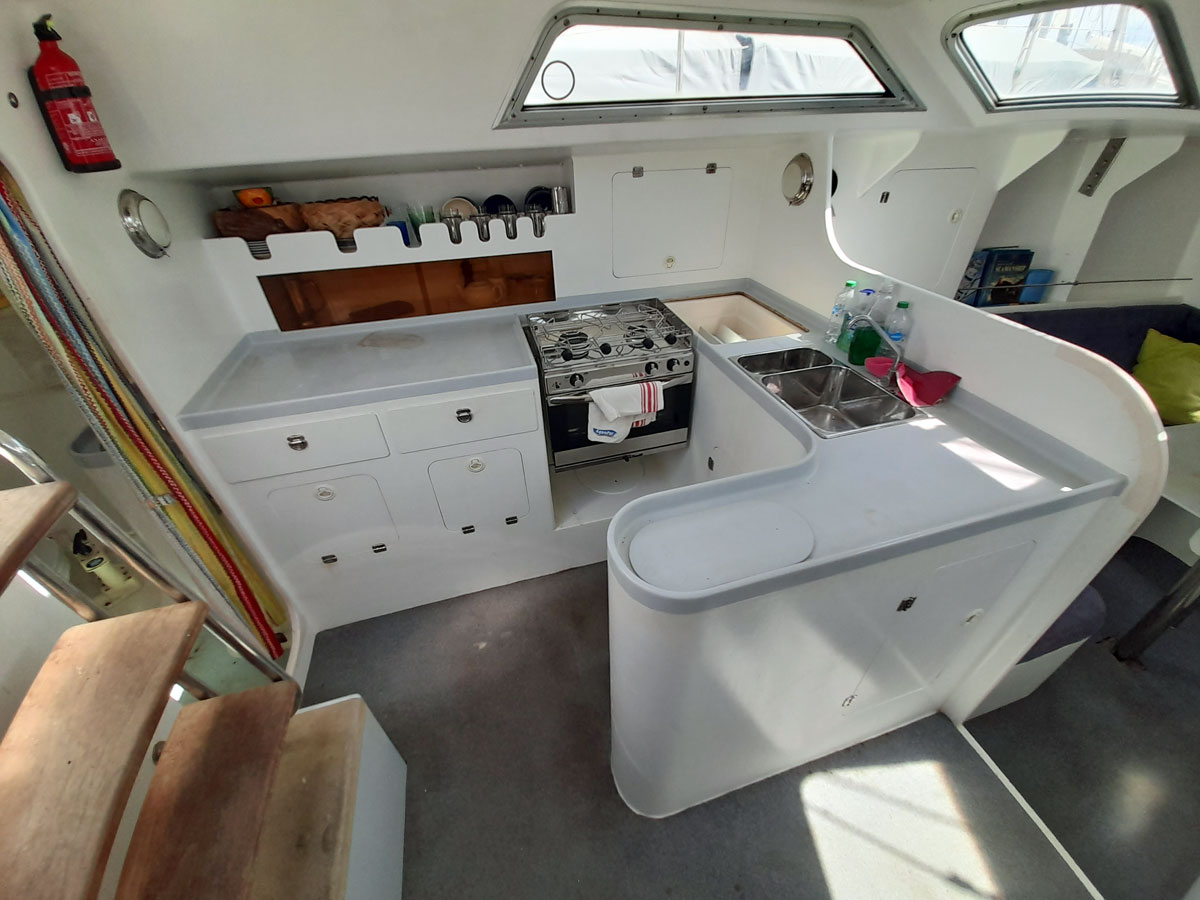 The U-Shaped Galley
Advantages of the U-Shape:
- Security: On a port tack, you lean against the inboard counter; on a starboard tack, you are supported by the hull-side cabinetry.
- Efficiency: Centrally located sinks near the centerline ensure they drain effectively even when heeled.
- Storage: The tight radius allows for deep lockers that are easily accessible without moving your feet.
However, the U-shape can feel cramped during tropical cruises, and it effectively limits the galley to a single person. If two people try to prepare a meal, they often end up in a clumsy dance for space.
The Linear Galley: Space, Light & Social Flow
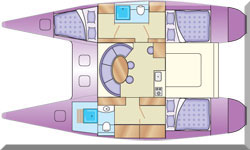
The linear galley, found increasingly on modern Mediterranean-style cruisers and large catamarans, runs along one side of the saloon. It opens up the living area, making the boat feel significantly larger and more integrated.
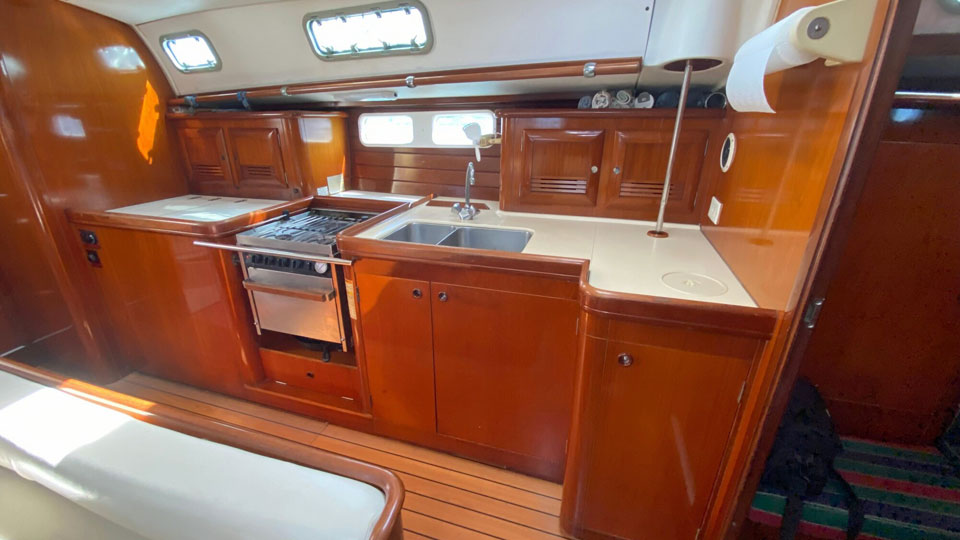 The Linear Galley
Advantages of the Linear Layout:
- Counter Space: These layouts often boast expansive work surfaces, perfect for elaborate meal prep when at anchor.
- Social Inclusion: The cook is part of the conversation in the saloon, rather than tucked away in a corner.
- Accessibility: It is much easier for multiple people to move past each other.
The significant drawback is the "dead zone" behind the cook. Without an island or a return to lean against, a linear galley requires the cook to rely entirely on a "bum strap" or bracing bar to stay in place while the boat is crashing through waves.
The L-Shaped Compromise: Balancing Two Worlds
The L-shaped galley is often seen as the middle ground. It usually features a sink module that returns toward the centreline, providing at least one solid bracing point. While it offers more "openness" than a U-shape, it still provides better security than a pure linear run. When you are in the process of Choosing the Best Sailboat Galley Layout, this configuration often represents the sweet spot for coastal jumpers who occasionally head offshore. It balances the need for a social "open plan" feel with the reality that, at some point, you will need to wedge yourself in to boil a kettle in a blow.
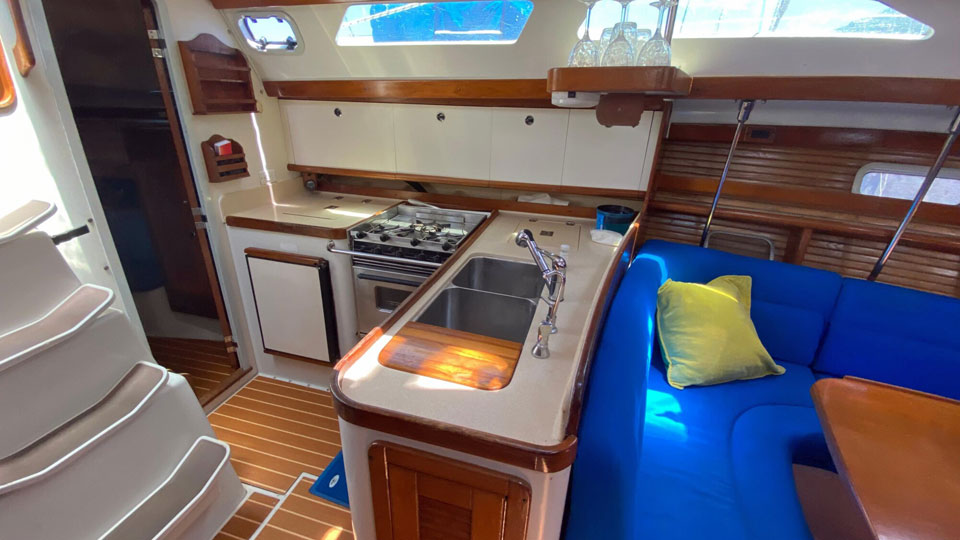 The L-Shaped Compromise
| Feature | U-Shaped Layout | Linear Layout |
|---|---|---|
| Safety at Sea | Excellent (Natural Bracing) | Poor (Requires Straps) |
| Counter Space | Compact & Functional | Extensive & Open |
| Social Factor | Isolated Cook | Highly Integrated |
| Storage Access | Easy Reach | Requires Walking |
Safety Infrastructure: Bracing Bars & Bum Straps
Regardless of the layout, certain hardware is non-negotiable for offshore work. A sturdy stainless steel "fiddled" rail should run the length of the galley. This serves two purposes: it prevents pots from sliding off the stove and provides a handhold for anyone moving through the cabin.
In a linear galley, a "bum strap" (a heavy-duty webbing strap attached to high-load pad eyes) is essential. The cook clips in or leans against the strap to prevent being thrown across the cabin during a sudden roll. Without this, a linear galley is arguably dangerous for offshore passage making.
Ventilation & Heat Management in Deep Sea Galleys
One often overlooked aspect in the debate between linear and U-shaped designs is heat dissipation. A U-shaped galley, being more enclosed, can become a "hot box" in the tropics. Research from organizations such as World Sailing emphasizes the value of overhead hatches directly above the cooker, allowing heat and steam to escape before they humidify the entire cabin. Linear galleys generally benefit from better airflow because they are integrated into the widest, most ventilated part of the saloon.
Summing Up
Choosing between a linear and a U-shaped galley is ultimately a reflection of your sailing philosophy. If your horizons are distant and your passages involve days of sustained heeling, the physical security of a U-shaped layout is irreplaceable. It offers peace of mind and reduces the physical fatigue of the cook.
However, if your time is spent mostly at anchor or in protected coastal waters, the airy, social nature of a linear galley will likely provide more daily enjoyment. Whatever you choose, prioritise high-quality fiddles, deep sinks and robust bracing points to keep the cook safe when conditions turn sour.

This article was written by Dick McClary, RYA Yachtmaster and author of the RYA publications 'Offshore Sailing' and 'Fishing Afloat', member of The Yachting Journalists Association (YJA), erstwhile member of the Ocean Cruising Club (OCC) and owner/administrator of 'Liveaboard Sailboats for Sale'.

Frequently Asked Questions
Which layout is better for a solo sailor?
Which layout is better for a solo sailor?
The U-shaped galley is superior for solo sailors as it minimizes movement. Being able to reach the fridge, stove and sink without moving your feet is a significant advantage when you are tired or short-handed.
Can I convert a linear galley to be safer for offshore use?
Can I convert a linear galley to be safer for offshore use?
Yes, by installing a robust island or a permanent bracing bar. Many owners also add a padded "leaning post" or a bum strap system to provide the stability that the cabinetry lacks.
Why are centerline sinks so important?
Why are centerline sinks so important?
Sinks located far from the centerline often fail to drain when the boat is heeled on the "wrong" tack. In a U-shaped galley, the sinks are typically brought as close to the middle of the boat as possible to avoid this issue.
Is counter space more important than storage?
Is counter space more important than storage?
For offshore work, storage is king. You need deep, secure lockers that won't dump their contents when opened on a heel. On a linear galley, counter space is often used as a selling point, but without proper fiddles, that space is unusable at sea.
How does a catamaran galley differ in these layouts?
How does a catamaran galley differ in these layouts?
Catamarans don't heel like monohulls, so the bracing requirements are less extreme. Consequently, linear and L-shaped galleys are very popular in cats, focusing more on the "galley up" social experience and connection to the cockpit.
Recent Articles


-
Mystery 35 Review: Specs, Performance & Buying Guide
Aug 29, 26 09:42 AM
An in-depth review of the Mystery 35 sailboat. Read technical specs, design ratios, sail performance, and common buyer inspection areas. -
Beneteau First 405 Review: Specs, Performance & Buyer’s Guide
Aug 26, 26 03:58 AM
Detailed Beneteau First 405 review covering specs, performance, bluewater capability, layouts and buyer’s checklist. -
Moody S38 Review: Specs, Ratios & Buyer’s Guide
Aug 12, 26 04:22 AM
In‑depth Moody S38 review covering specs, performance, design ratios, layout, strengths, trade‑offs & buyer inspection points.