- Home
- Cruising Yachts 45' to 50'
- Sirius 40
The Sirius 40 DS Sailboat
Specs, Performance Analysis & Cruising Characteristics
Key Takeaways: The Sirius 40 DS is a masterclass in spatial engineering, delivering the interior volume you’d expect from a 47-foot yacht in a manageable 40-foot class hull. Built by the family-run Sirius-Werft in Germany, it’s a moderate-displacement, CE Category A ocean cruiser designed for short-handed, long-distance sailing. Its defining feature is a genuine deck saloon that puts the galley, helm, and seating on one level, with 360-degree visibility. It won’t match a light-displacement racer for raw speed, but its stability, keel options, and meticulous build quality make it a premier choice for liveaboard couples.
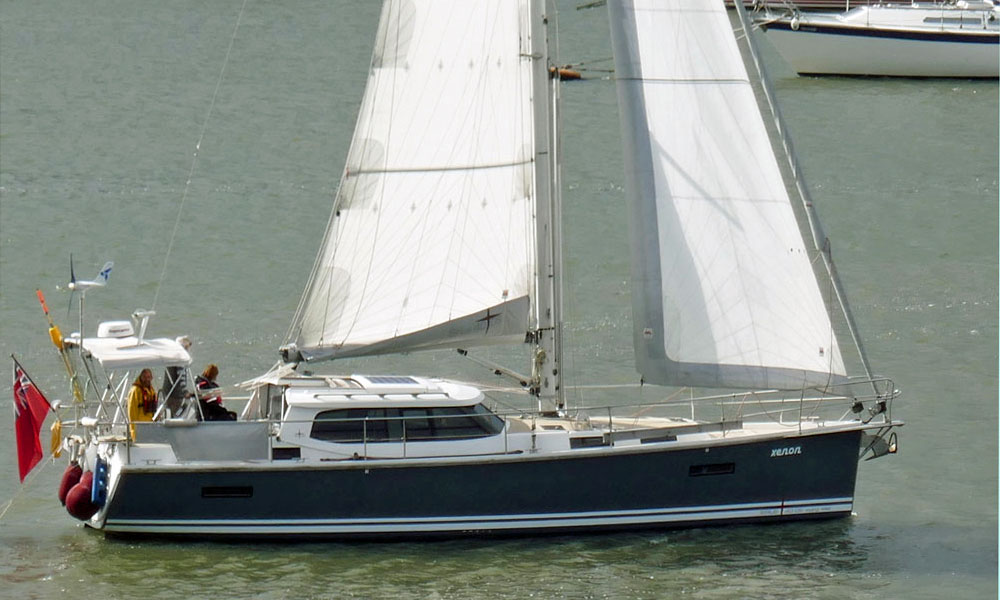
Table of Contents
- Design & Construction
- Sail Areas & Rig Dimensions
- Configuration, Layout & Cruising Characteristics
- Published Specification: The Sirius 40 DS Blueprint
- Performance Analysis: Understanding the Design Ratios
- The Buyer’s Checklist: Common Problem Areas
- Comparison: Sirius 40 DS vs The Competition
- Summing Up
- Frequently Asked Questions (FAQs)
Design & Construction
The Sirius 40 DS is the flagship of Sirius-Werft in Plön, Germany. Under the guidance of Torsten Schmidt, the yard has refined the deck saloon concept over decades. Unlike mass-produced cruisers, the Sirius 40 DS is semi-custom, and is often built to an owner’s specific requirements.
The hull is constructed from hand-laid GRP. Above the waterline, it uses a vacuum-adhered Corecell M-foam sandwich for thermal insulation and structural stiffness.
A key part of the concept is its “one-level living” philosophy. By raising the saloon floor, the designers create a cavernous “basement” area below. This space can house technical rooms, a workshop, or a midships cabin beneath the living area—effectively doubling usable floor space.
Keel Options
Sirius is famous for offering a bespoke approach to underwater profiles. Buyers can choose between:
- Deep Fin Keel: For maximum pointing and stability.
- Shallow Fin Keel: For restricted cruising grounds.
- Twin Keels: Optimised for drying out in tidal regions like the East Coast of England or the French coast.
- Lifting Keel: An electro-hydraulic system that allows the ballast to be raised for shallow-water exploration or lowered for offshore performance.
The yacht carries a CE Category A (Ocean) certification. Its Stability Index (STIX) typically exceeds the minimum offshore requirement of 32, often reaching the high 30s depending on keel configuration. That margin indicates the dynamic stability needed to recover from a knockdown in heavy seas.
Sail Areas & Rig Dimensions
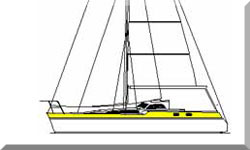
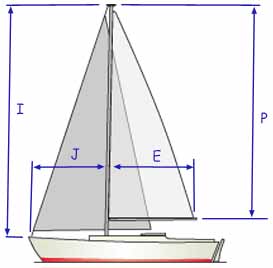 Rig dimensions
The rig is designed for ease of handling, typically featuring a self-tacking jib for effortless upwind work. In lighter airs, an overlapping genoa or a furling gennaker is highly recommended to keep the heavy hull moving.
- Mainsail: 49.0 m² (527 ft²)
- Self-tacking Jib: 32.3 m² (348 ft²)
- Genoa: 64.0 m² (689 ft²)
- Spinnaker: 160.0 m² (1,722 ft²)
- I (Foretriangle Height): 15.60 m (51'2")
- J (Foretriangle Base): 4.45 m (14'7")
- P (Main Luff): 15.20 m (49'10")
- E (Main Foot): 5.30 m (17'5")
Configuration, Layout & Cruising Characteristics
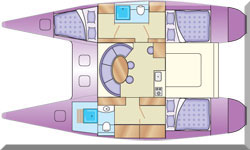
The internal volume of the Sirius 40 DS is frequently compared to yachts seven feet longer. This is achieved by utilizing the vertical dimension of the hull. The standard layout features a massive owner’s suite forward and a unique midships cabin located under the saloon seating.
Practicality is at the forefront of the design. The “basement” houses the engine with excellent 360-degree access, plus deep-set tanks that keep the centre of gravity low. The galley is positioned at eye-level with the saloon, ensuring the cook is never isolated from the rest of the crew.
Storage is abundant, with dedicated lockers for tools and spares—enough to impress any blue-water sailor. However, that system complexity—including extensive plumbing and electrical runs driven by semi-custom layouts—means owners should expect more involved maintenance than on a simpler coastal cruiser.
Published Specs: The Sirius 40 DS Blueprint
| Specification | Measurement / Detail |
|---|---|
| LOA | 42'4" (12.90 m) |
| LWL | 36'8" (11.17 m) |
| Beam | 13'5" (4.08 m) |
| Draft (Min/Max) | 3'1" (0.95 m) / 8'2" (2.50 m) |
| Displacement | 25,574 lbs (11,600 kg) |
| Ballast | 7,606 lbs (3,450 kg) |
| Rig Type | Fractional Sloop |
| Hull Material | GRP (Vacuum-infused Sandwich) |
| Production Dates | 2014 to Present |
Performance Analysis: Understanding the Design Ratios
The following ratios provide a mathematical insight into how the Sirius 40 DS behaves on the water. For a more detailed look at these metrics, visit our guide on Understanding Boat Performance & Design Ratios.
| Ratio | Value | Expert Interpretation |
|---|---|---|
| SA/D | 16.2 | A moderate ratio that leans towards cruising efficiency. It suggests enough power for light winds, but the boat prefers a steady breeze. |
| D/L | 232 | Technically a Moderate displacement cruiser. While modern hulls often drop below 200, the Sirius maintains a stout profile that pushes toward 'Heavy' once fully loaded with cruising stores. |
| B/D | 29.7% | Nearly 30% ballast provides a strong righting moment. The boat is designed to stand up to its canvas in offshore conditions. |
| CSF | 1.8 | A Capsize Screening Factor under 2.0 is the benchmark for ocean-going safety. This confirms its suitability for transoceanic passages. |
| Comfort Ratio | 32.6 | A score above 30 indicates a very comfortable motion in a seaway. It will not toss its crew around as aggressively as lighter, flatter boats. |
Structural Integrity & Stability Dynamics
The Sirius 40 DS occupies a middle ground in the modern design landscape. While its D/L ratio of 232 sits in the moderate bracket, its operational displacement tells a different story. Unlike mass-produced coastal cruisers, a Sirius is rarely sailed at its "lightship" weight. The inclusion of a dedicated technical room, high-capacity tankage, and heavy-duty joinery means that in a "ready-to-cross" state, the effective displacement increases significantly. This extra mass, combined with a high Brewer Motion Comfort Ratio of 32.6, results in a predictable and sea-kindly motion that is often associated with much heavier, traditional ocean-goers.
The use of a vacuum-infused foam core is a deliberate choice for both strength and comfort. Unlike solid GRP, the sandwich construction provides excellent acoustic and thermal insulation, virtually eliminating condensation—a critical factor for those sailing in high latitudes or living aboard year-round.
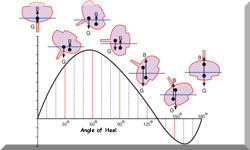
The key defining feature—the raised deck saloon—is not just about aesthetics. By increasing buoyancy on the heeled (high) side, the boat achieves an exceptionally high Angle of Vanishing Stability (AVS). In the rare event of a knockdown, the massive volume of the coachroof acts as a giant float, encouraging the boat to right itself quickly.
The Buyer’s Checklist: Common Problem Areas
While the build quality of a Sirius is legendary, prospective buyers should pay attention to several areas during a pre-purchase survey:
- Lifting Keel Mechanism: If equipped, the electro-hydraulic system and pivot pins require regular inspection. Check for any signs of hydraulic leaks or excessive play in the keel box.
- Window Seals: The panoramic windows are an essential feature. Look for signs of "crazing" or moisture ingress around the frames, which can be an expensive repair given the size and curvature of the glass.
- System Complexity: With custom layouts come custom wiring. Ensure there is a comprehensive circuit diagram available. Poorly documented aftermarket additions can be a nightmare for future troubleshooting.
- Engine Access: While access is generally excellent, check the "basement" for signs of standing water or corrosion on pumps and sea cocks, which are located deep in the hull.
- Deck Condition: Many Sirius yachts feature Flexiteek or real teak. Inspect the bonding, especially around the high-traffic cockpit and swim platform areas.
Comparison: The Sirius 40 DS vs The Competition
The Sirius 40 DS occupies a unique niche, but it is often compared to other high-end deck saloon cruisers.
- Moody 41 DS: The Moody offers a more modern, "one-level" cockpit-to-saloon transition with a larger patio door. However, the Sirius generally offers superior customisation and a more traditional, robust German build feel.
- Nordship 40 DS: Another Danish-built contender with excellent woodwork. The Nordship often has a slightly more "sporty" hull profile but lacks the multi-level "basement" storage of the Sirius.
- Southerly 42: If a lifting keel is the priority, the Southerly is the primary rival. While the Southerly is a legendary coastal explorer, the Sirius 40 DS feels more like a miniature ship, focusing heavily on interior luxury and 360-degree views.
If you'd like to compare this boat with others in this size range, take a look at Cruising Boats from 40' to 45' overall....
Could this be your ideal cruising boat?
It may well be, but before going any further, it might be worth taking a look at my eBook 'How to Avoid Buying the Wrong Sailboat'...
Summing Up
The Sirius 40 DS is a specialist tool. It’s not for sailors looking to shave seconds off a race time, or for the budget-conscious weekend warrior. Instead, it is a yacht for the serious cruiser who values safety, comfort, and the ability to live aboard without feeling cramped.
Its design ratios point to a sea-kindly motion and a hull built to take a beating. Meanwhile, the interior engineering delivers a level of luxury and utility that few others in the 40-foot class can match. It is a pragmatic choice for those who want a "forever boat" capable of tackling the North Sea or the Atlantic with equal confidence.
This article was written by Dick McClary, RYA Yachtmaster and author of the RYA publications 'Offshore Sailing' and 'Fishing Afloat', member of The Yachting Journalists Association (YJA), and erstwhile member of the Ocean Cruising Club (OCC).
Frequently Asked Questions (FAQs)
Is the Sirius 40 DS suitable for single-handed sailing?
Is the Sirius 40 DS suitable for single-handed sailing?
Yes, the boat is specifically designed for short-handed operation. All major lines are typically led back to the helm, and the self-tacking jib makes tacking as simple as turning the wheel.
How does the twin-keel version perform compared to the fin keel?
How does the twin-keel version perform compared to the fin keel?
Recent hydrodynamic testing suggests that there is very little loss in pointing ability. The twin keels are slightly heavier to maintain the same righting moment, but the benefit of being able to dry out upright makes them a popular choice for tidal cruising.
Can the Sirius 40 DS be used as a year-round liveaboard?
Can the Sirius 40 DS be used as a year-round liveaboard?
Absolutely. The foam-sandwich hull provides excellent insulation, and the yacht is often fitted with high-capacity heating systems and thermal-pane windows, making it one of the best 40-footers for winter living.
What is the typical cruising speed under power?
What is the typical cruising speed under power?
With the standard 51 HP Volvo Penta engine, the Sirius 40 DS comfortably cruises at 6.5 to 7 knots, with a top speed of around 8 knots depending on load and sea state.
Is it possible to fit a workshop in the standard layout?
Is it possible to fit a workshop in the standard layout?
One of the most popular semi-custom options is a dedicated walk-in workshop located under the saloon, which includes a workbench and tool storage, perfect for long-distance cruising self-sufficiency.
Recent Articles


-
Top-Down Furling Guide: Code Zeros and Asymmetric Spinnakers
Sep 19, 26 04:57 PM
Top-down furling explained for cruisers: how it works, which boats need one, common faults, sock versus furler costs, and the rule everyone forgets. -
Standing Rigging Inspection Checklist: A Sailor's Full Guide
Sep 19, 26 03:46 PM
A complete standing rigging inspection checklist covering swage fittings, chainplates, tension and going aloft safely, plus when to call in a professional rigger. -
Single-Line Reefing: Is It Right For Your Sailboat?
Sep 19, 26 11:54 AM
Single-line reefing promises easier cockpit reefing, but does it deliver offshore? We weigh friction, clew tension and safety data to help you decide.



%20with%20a%20Solent%20Rig)