- Home
- Cruising Yachts 45' to 50'
- Bavaria 50
The Bavaria 50 Sailboat: Specs, Performance Analysis & Cruising Characteristics
Key Takeaways: The Bavaria 50 is a spacious, stoutly built offshore cruiser designed for comfort and long-term liveaboard use. It lacks the nimble performance of lighter racing yachts, but its high stability and massive interior volume make it a favourite with blue water families and the Mediterranean charter trade. Owners should prioritise inspections of the rudder bearings and sail drive seals, as both are common age-related maintenance points on this model.
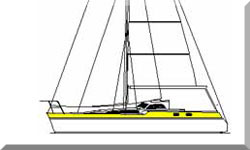
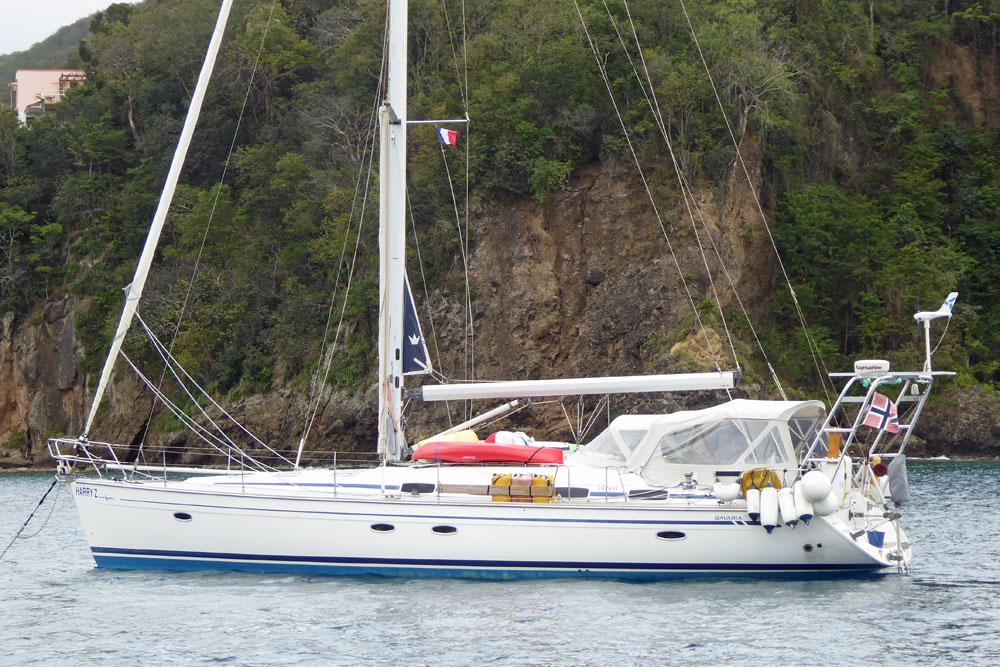 A Bavaria 50 Cruiser
Table of Contents
- Design & Construction
- Sail Areas & Rig Dimensions
- Configuration, Layout & Cruising Characteristics
- Published Specification: The Bavaria 50 Blueprint
- Performance Analysis: Understanding the Design Ratios
- The Buyer’s Checklist: Common Problem Areas
- Comparison: Bavaria 50 vs The Competition
- Summing Up
- Frequently Asked Questions (FAQs)
Design & Construction
The Bavaria 50 was designed by J&J Design, a studio known for balancing interior volume with respectable hull speeds. Bavaria Yachtbau built it in Germany. The hull is made of hand-laid solid GRP (Glass Reinforced Plastic) below the waterline, with sandwich construction above the waterline to improve insulation and save weight.
A defining feature of the Bavaria 50 is its sheer internal volume and high freeboard. This gives it immense headroom and storage capacity, both vital for ocean crossings and self-sufficiency. The trade-off is increased windage, which can make docking in a crosswind a lively experience for the uninitiated.
The Three Faces of the Bavaria 50
Several distinct versions were produced during the decade-long production run, each targeting a different type of sailor:
- Bavaria 50 Ocean (1998–2003): Often the most sought-after version for serious blue water cruisers. It features a centre-cockpit layout that offers a safer, drier ride in heavy seas and a magnificent master aft cabin.
- Bavaria 50 Cruiser (2005–2008): This version moved to an aft-cockpit configuration, providing more outdoor social space and often featuring a five-cabin layout popular for chartering.
- Bavaria 50 Vision (2007–2009): This was Bavaria's "Deck Saloon" contender. Built on the same hull as the Cruiser, the Vision features a raised coachroof with wrap-around windows, flooding the interior with light. Crucially, the Vision typically came with a higher standard specification, including a taller performance rig and a deep lead keel as standard, making it the "sailor’s choice" of the trio.
As a Category A (Ocean) certified vessel under the RCD (Recreational Craft Directive), the Bavaria 50 is legally and structurally rated for extended voyages. Those conditions may exceed wind force 8 on the Beaufort scale and significant wave heights of 4m or more.
Sail Areas & Rig Dimensions
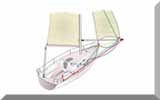
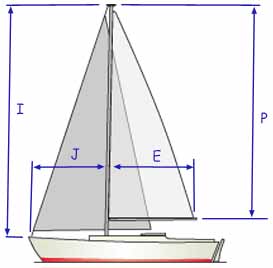 Rig dimensions
The Bavaria 50 typically carries a fractional sloop rig, though many have been retrofitted with inner forestays for heavy weather.
- Mainsail Area: 579.10 ft² (53.80 m²)
- Genoa Area (100%): 734.10 ft² (68.20 m²)
- Total Upwind Sail Area: 1,313.20 ft² (122.00 m²)
Rig Dimensions:
- I: 61'8" (18.80 m)
- J: 18'4" (5.60 m)
- P: 54'2" (16.50 m)
- E: 19'0" (5.80 m)
Configuration, Layout & Cruising Characteristics
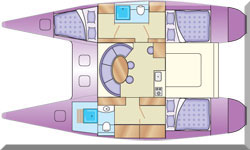
For practical cruising, the Bavaria 50 excels as a mobile home. The galley is typically linear and located to port, giving the cook solid bracing points at sea. Tankage is generous, often exceeding 700 litres of water and 270 litres of fuel, although long-range cruisers often add flexible tanks for transoceanic hops.
The cockpit is deep and well protected. In the Cruiser versions, the twin-wheel configuration creates an easy walkthrough to the bathing platform, a real luxury for Mediterranean-style mooring. Under power, the 75hp Volvo Penta fitted to many boats provides plenty of "grunt" to push the 15-tonne displacement into a head sea. The sail drive, however, requires diligent maintenance of its rubber gaiter.
Published Specification: The Bavaria 50 Blueprint
| Specification | 50 Ocean / Cruiser | 50 Vision (Deck Saloon) |
|---|---|---|
| LOA | 50'6" (15.40 m) | 51'6" (15.70 m) |
| LWL | 43'0" (13.10 m) | 43'7" (13.30 m) |
| Beam | 14'9" (4.49 m) | 14'9" (4.49 m) |
| Draft (Standard) | 6'7" (2.00 m) | 7'8" (2.35 m) - Lead Keel |
| Displacement | 33,000 lbs (14,969 kg) | 35,273 lbs (16,000 kg) |
| Ballast | 9,920 lbs (4,500 kg) | 10,141 lbs (4,600 kg) |
| Total Sail Area | 1,313 ft² (122 m²) | 1,474 ft² (137 m²) |
| Hull Material | GRP (Fibreglass) | GRP (Fibreglass) |
Performance Analysis: Understanding the Design Ratios
To understand how the Bavaria 50 handles the ocean, we must look at the core design ratios. While some figures might seem contradictory at first glance—suggesting both a light-footed performer and a heavy-duty cruiser—they actually describe a very well-balanced hull. You can find further context in our guide to Understanding Boat Performance & Design Ratios.
| Ratio | Value | Expert Interpretation |
|---|---|---|
| SA/D | 20.3 | Moderate to High. Indicates strong light-wind performance for a 15-tonne yacht. |
| D/L | 185 | Light-Moderate. Reflects an efficient hull shape that reaches hull speed easily. |
| B/D | 30% | Typical for modern cruisers; relies on form stability (beam) as much as ballast. |
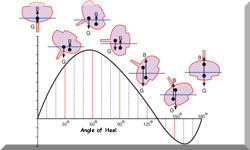
| CSF | 1.83 | Well below the 2.0 safety threshold, indicating excellent resistance to capsizing. |
| Motion Comfort | 32.4 | Solidly in the "Heavy Cruiser" range. Expect a predictable, gentle motion. |
Resolving the Displacement Paradox
On paper, the Bavaria 50 presents an interesting technical profile. Its Displacement to Length (D/L) ratio of 185 places it in the "Light-Moderate" category. This is because the yacht has a very long 43'0" (13.10 m) waterline relative to its total weight. In practical terms, this means the hull is "slippery" and efficient; it does not have to push a massive mountain of water out of its way to move forward. This is why the Bavaria 50 is not "sticky" in light airs and can maintain high average passage speeds.
However, the Brewer Motion Comfort Ratio tells a different story, ranking the boat as a "Heavy Cruiser" with a score of 32.4. This is not a contradiction. While the hull shape is efficient (low D/L), the boat still possesses 15 tonnes of absolute mass.
When a large wave meets 15 tonnes of yacht with a 14'9" (4.49 m) beam, the boat’s sheer inertia resists being tossed around. It doesn't "bob" like a light coastal cruiser; instead, it has a slower, more dignified motion that is far less fatiguing for the crew over long distances. In short, the Bavaria 50 uses its length to "cheat" the feeling of weight while sailing, but uses its actual tonnage to "tame" the motion of the sea.
Structural Integrity & Stability Dynamics
GRP gives the boat a durable, low-maintenance platform, but on a yacht of this age, moisture ingress in the balsa-cored decks is the main concern. The high stability reflected in the Capsize Screening Formula comes largely from the 14'9" beam. That beam creates a huge interior, but it also gives the boat high "initial stability"—she stays flat longer and may feel stiffer in a blow.
Compared with narrower, traditional heavy-displacement cruisers, the Bavaria 50 will be faster on a reach but may pound more when sailing to windward into a short, steep chop. Its behaviour is predictable, making it a safe choice for couples who prefer to avoid surprises at 3:00 AM.
The Vision 50, despite its higher profile, often exhibits superior stability characteristics due to its standard lead keel, which places the weight lower than the cast iron keels found on many Cruiser models. However, the increased height of the "Deck Saloon" coachroof further amplifies the windage issues mentioned earlier. When choosing between these models, a buyer must weigh the desire for interior light (Vision) against the lower profile and reduced windage of the Ocean or Cruiser.
The Buyer’s Checklist: Common Problem Areas
Rudder Bearings: Known to develop play. Check for "clunking" while at anchor or under power.
Sail Drive Seal: Volvo recommends replacement every seven years. Many owners push this, but it is a critical failure point.
Grid Matrix Bonding: Inspect the bilge for any signs of the internal structural grid lifting from the hull, particularly near the keel bolts.
Teak Decks: Many 50s came with thin teak veneer. If it looks "silvery" or the caulking is lifting, a full replacement or removal may be imminent—a costly job.
Comparison: The Bavaria 50 vs The Competition
When shopping for a 50-foot cruiser from the mid-2000s, the Bavaria 50 series—and specifically the Vision—is often measured against the French heavyweights and higher-end semi-custom builds.
The Deck Saloon Rivalry: Bavaria 50 Vision vs. Jeanneau 50DS
The most direct competitor to the Vision 50 is the Jeanneau Sun Odyssey 50DS. Both yachts share a similar design brief: maximum light, owner-focused luxury, and a "big boat" feel.
- Aesthetics & Light: The Jeanneau 50DS (designed by Philippe Briand) is often cited as having a sleeker, more integrated coachroof profile. However, the Bavaria 50 Vision offers a more vertical window arrangement that some owners find provides better peripheral visibility from the saloon.
- Performance: The Vision 50 typically carries a taller mast and more sail area than the standard Jeanneau 50DS. While the Jeanneau is slightly more "slippery" in light airs due to its hull shape, the Bavaria Vision is often stiffer in a blow thanks to its standard deep lead keel.
- Interior: Jeanneau focused heavily on the "convertible" forward cabin (moving bulkheads), whereas Bavaria prioritised a fixed, high-end master suite in the Vision.
The Charter Workhorse: Bavaria 50 Cruiser vs. Beneteau Oceanis 50
If you are looking at the standard Cruiser version, your primary alternative is the Beneteau Oceanis 50.
- Volume vs. Handling: The Bavaria is the "Value Leader," offering the most interior volume per pound sterling. It feels more substantial and "blocky." The Beneteau Oceanis 50, particularly the "Family" versions, feels a touch more contemporary below decks with Nauta Design interiors but can feel more "tender" (heels more quickly) than the steady Bavaria.
- Tankage: Bavaria generally wins on utility, often carrying significantly more water as standard, which is a major factor for those looking to spend weeks at anchor rather than tied to a marina dock.
The Blue Water Benchmark: Bavaria 50 Ocean vs. Hylas 49
For the dedicated offshore sailor, the Bavaria 50 Ocean (centre cockpit) is often compared to the Hylas 49.
- Build Philosophy: This is where the price gap is most evident. The Hylas is a semi-custom build with superior joinery and heavy-duty offshore systems. However, for a couple on a budget, the Bavaria 50 Ocean provides a very similar layout and the safety of a centre cockpit for a fraction of the price. The "Ocean" is widely regarded as the most robustly built of all the Bavaria 50 variants.
If you'd like to compare this boat with others in this size range, take a look at Cruising Boats from 45' to 50' overall....
Could this be your ideal cruising boat?
It may well be, but before going any further, it might be worth taking a look at my eBook 'How to Avoid Buying the Wrong Sailboat'...
Summing Up
The Bavaria 50 is a pragmatic choice for sailors who value space, stability, and value for money. Its design ratios suggest a boat that is relatively easy to move, but its real strength lies in motion comfort and liveaboard amenities. It is not a racing machine or a "bomb-proof" steel expedition vessel, but as a coastal or trans-oceanic family cruiser, it strikes an impressive balance. If you find one with a well-maintained rig and a dry bilge, it remains one of the most cost-effective ways to put a 50-foot yacht on blue water.
This article was written by Dick McClary, RYA Yachtmaster and author of the RYA publications 'Offshore Sailing' and 'Fishing Afloat', member of The Yachting Journalists Association (YJA), and erstwhile member of the Ocean Cruising Club (OCC).
Frequently Asked Questions (FAQs)
How does the Bavaria 50 perform in light winds?
How does the Bavaria 50 perform in light winds?
With a Sail Area to Displacement ratio of over 20, she performs surprisingly well in light air compared with heavier traditional cruisers. To really move in under 8 knots of breeze, however, she will need an asymmetric spinnaker or Code Zero.
Is the Bavaria 50 suitable for single-handed sailing?
Is the Bavaria 50 suitable for single-handed sailing?
While large, the lines are usually led aft to the cockpit. With an autopilot and a bow thruster (highly recommended), a competent sailor can manage her. Reefing the large mainsail, however, requires good winch technique.
What is the difference between the Ocean and Cruiser models?
What is the difference between the Ocean and Cruiser models?
The Ocean is a centre-cockpit boat focused on owner privacy and heavy-weather protection. The Cruiser is an aft-cockpit boat designed for socialising and often carrying more guests in additional cabins.
Are there known issues with keel attachments?
Are there known issues with keel attachments?
Bavaria uses a significant internal grid. While generally robust, any grounding can cause stress. A survey should always include a check of the "smile" at the leading edge of the keel-to-hull joint.
Can the Bavaria 50 be converted from a 5-cabin to a 3-cabin layout?
Can the Bavaria 50 be converted from a 5-cabin to a 3-cabin layout?
The non-structural bulkheads in the bow of many Cruiser models can sometimes be removed to create a large "Owner's Cabin," but this is a significant undertaking and should be evaluated by a shipwright.
Recent Articles


-
Offshore Internet with Starlink: Hardware, Plans, and Setup Guidance
Oct 01, 26 01:15 PM
A clear, practical guide to choosing the right Starlink hardware and plan for offshore cruising. Learn what to buy, how to install it, and how to manage power afloat. -
Offshore Liferaft Guide: Choosing, Stowing and Servicing One
Oct 01, 26 06:28 AM
Choosing an offshore liferaft? Learn what ISO 9650 Group A means, where to stow it, how often to service it and what to pack in the grab bag. -
Can an Inflatable Tender Replace a Liferaft? Offshore Verdict
Sep 30, 26 03:50 PM
Can an inflatable tender replace a liferaft? Offshore sailors get the honest answer: when a tender helps, where it fails and how to plan abandon ship.