- Home
- Cruising Yachts 35' to 40'
- Beneteau 393
The Beneteau 393 Sailboat: Specs, Performance Analysis & Cruising Characteristics
Key Takeaways: The Beneteau 393 is a voluminous, user-friendly cruiser designed primarily for coastal hopping and comfortable living. While it lacks the displacement for heavy-weather ocean bashing, its hull shape provides impressive interior space for its length. It is a reliable performer in light to moderate winds, though it requires early reefing to manage its relatively high-volume topsides and moderate ballast.
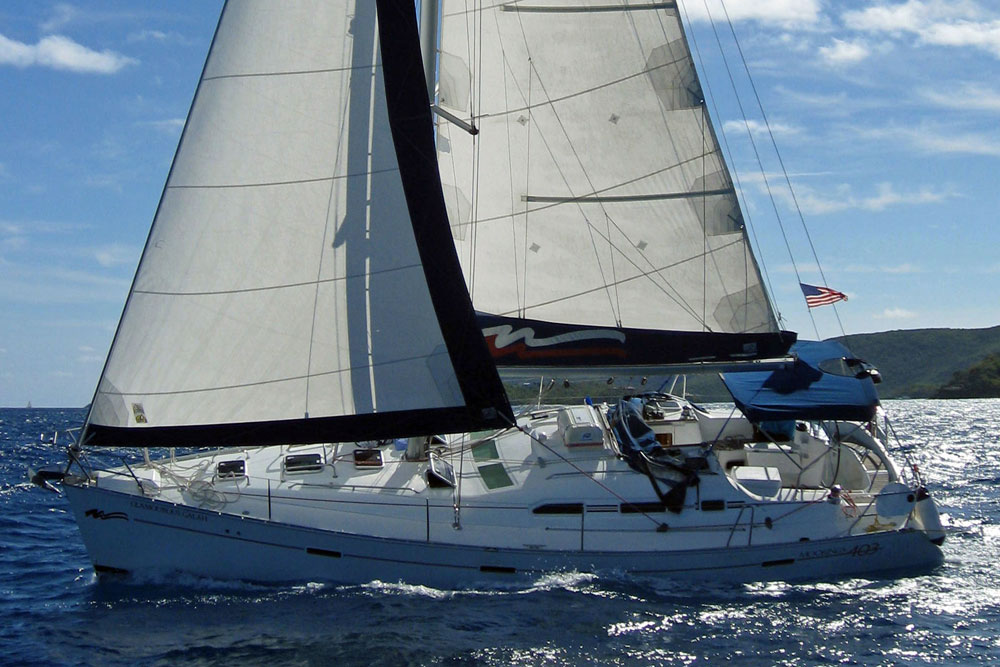 The Beneteau 393
Table of Contents
- Design & Construction
- Sail Areas & Rig Dimensions
- Configuration, Layout & Cruising Characteristics
- Published Specification: The Beneteau 393 Blueprint
- Performance Analysis: Understanding the Design Ratios
- The Buyer’s Checklist: Common Problem Areas
- Comparison: Beneteau 393 vs The Competition
- Summing Up
- Frequently Asked Questions (FAQs)
Launched at the turn of the millennium, the Beneteau 393 represented a significant shift in the French builder's approach to the mid-sized cruising market. Designed by Berret-Racoupeau, this model replaced the popular Oceanis 381. It was intended to bridge the gap between easy-handling coastal cruisers and more capable passage-makers. It stayed in production until roughly 2006, with over 700 hulls leaving the factory, making it one of the most successful designs in Beneteau's history.
Design & Construction
The Beneteau 393 is built using a solid GRP (glass-reinforced plastic) laminate for the hull, while the deck is a balsa-cored sandwich for weight savings and thermal insulation. This construction method is standard for Beneteau and relies on a bonded internal grid system for structural rigidity. This "liner" carries the loads from the mast, keel, and engine, allowing for a clean and open interior.
A defining feature of the 393 is its distinct stepped coachroof styling. It is not a true deck saloon with a raised seating area and 360-degree visibility. However, the cabin trunk is elevated and features large forward-facing windows. This design floods the interior with natural light and creates a sense of volume that was revolutionary for a 39-foot boat in the early 2000s.
Beneteau offered the 393 in several configurations to suit different cruising grounds. The most common is the sloop rig, but keel options varied significantly. Owners could choose between a deep fin keel for better windward performance or a shallow-draft bulb keel for cruising in shallower waters. Internally, the boat was available in two main layouts: a two-cabin version with a massive galley and storage for long-term cruising, and a three-cabin version targeted at the charter market or larger families.
Regarding stability, the Beneteau 393 is typically categorised under CE Category A (Ocean). This indicates the vessel is designed for voyages where conditions may exceed wind force 8 (Beaufort scale) and significant wave heights of 4 metres and above. Practical experience, however, suggests it is better suited to "tradewind" style ocean crossing than high-latitude exploration.
Sail Areas & Rig Dimensions
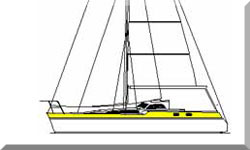
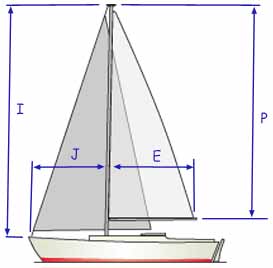 Rig dimensions
The 393 carries a masthead sloop rig that is relatively easy to manage shorthanded, especially when fitted with in-mast furling, which was a popular option.
- Total Sail Area (100% Foretriangle): 744 ft² (69.1 m²)
- I (Forestay Height): 46'11" (14.30 m)
- J (Foretriangle Base): 14'4" (4.38 m)
- P (Mainsail Hoist): 40'5" (12.33 m)
- E (Mainsail Foot): 14'9" (4.50 m)
Configuration, Layout & Cruising Characteristics
The 393 is widely regarded as a "liveaboard" dream for its size. The two-cabin version is particularly prized by cruising couples because it replaces the third cabin with an enormous lazarette locker and a linear galley that offers more worktop space than many larger yachts.
On deck, the cockpit is spacious and ergonomic, though the large fixed table can make moving forward a little tight during active manoeuvres. The swim platform is wide and easily accessible, a hallmark of Beneteau design that makes boarding from a dinghy or swimming at anchor effortless. Tankage is respectable for coastal work, with approximately 131 gallons (495 litres) of water and 35 gallons (132 litres) of fuel. Those planning longer offshore passages often supplement this with jerry cans or additional flexible tanks.
Published Specification: The Beneteau 393 Blueprint
| Specification | Detail |
|---|---|
| LOA | 39'3" (11.96 m) |
| LWL | 35'1" (10.69 m) |
| Beam | 13'1" (3.99 m) |
| Draft (Deep/Shallow) | 6'3" / 5'1" (1.90 m / 1.55 m) |
| Displacement | 17,152 lbs (7,780 kg) |
| Ballast | 5,357 lbs (2,430 kg) |
| Rig Type | Masthead Sloop |
| Hull Material | Solid GRP |
| Production Dates | 2001 – 2006 |
Performance Analysis: Understanding the Design Ratios
To truly understand how the 393 behaves at sea, we must look at the mathematical relationships between its dimensions. For a broader context on these figures, you may wish to refer to our guide on Understanding Boat Performance & Design Ratios.
| Ratio | Value | Interpretation |
|---|---|---|
| SA/D | 18.0 | Moderate. Provides decent light-air performance without being overpowered. |
| D/L | 177 | Light-Moderate. Indicates a hull that can achieve good speeds and surf occasionally. |
| B/D | 31% | Typical for modern cruisers. Relies on form stability from the wide beam. |
| CSF | 2.04 | Slightly above the ideal 2.0 threshold. Suggests careful management in extreme seas. |
| Motion Comfort | 24.5 | Relatively low. Expect a somewhat "lively" motion in a seaway compared to heavy yachts. |
Structural Integrity & Stability Dynamics
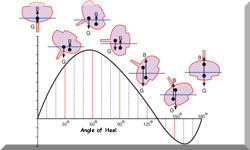
The use of solid GRP for the hull ensures a robust shell that is easy to maintain and repair. However, the 393's stability profile is heavily influenced by its beam. With a Ballast to Displacement ratio of 31%, it is not a "stiff" boat in the traditional sense. It will heel quickly to about 15 degrees and then firm up as the wide hull sections provide buoyancy.
The Capsize Screening Formula of 2.04 indicates that this is primarily a coastal and offshore cruiser rather than a dedicated blue-water storm-fighter. While perfectly capable of crossing oceans in the right season, its high freeboard and wide beam give it a higher center of gravity than a dedicated ocean voyager. Sailors should keep that in mind when tracking weather systems.
The Buyer’s Checklist: Common Problem Areas
When inspecting a Beneteau 393, several model-specific and age-related areas deserve close attention:
- The "Smile" at the Keel Joint: Check the forward end of the keel-to-hull joint for cracking. While often just a cosmetic issue in the filler, it can indicate movement in the keel bolts or the internal grid.
- Window Seals: The large forward-facing cabin windows are a signature feature but are prone to leaks as the sealant ages. Look for water staining on the woodwork below the windows.
- Grid Bonding: Inspect the areas where the internal liner is bonded to the hull, particularly around the mast step and keel bolts. Look for any signs of "crazing" or separation which might suggest high-load stress.
- Chainplates: The chainplate attachments should be inspected for signs of weeping or corrosion.
- Rudder Bearings: Check for excessive play in the steering. Beneteau rudders of this era often develop a "clunk" as the bushings wear down.
Comparison: The Beneteau 393 vs The Competition
In the early 2000s, the 393 faced stiff competition from the Jeanneau Sun Odyssey 40 and the Bavaria 38.
The Jeanneau 40 generally offers slightly more "spirited" sailing performance and a more traditional aesthetic, whereas the Beneteau 393 wins on interior volume and natural light. The Bavaria 38 was often seen as the more budget-friendly alternative, though many sailors find the Beneteau's joinery and finish a step above Bavaria models of that era. For a more rugged blue-water alternative, a used Westerly Oceanlord 41 or a Hallberg-Rassy 38 would offer superior heavy-weather comfort, but at the cost of interior space and light.
If you'd like to compare this boat with others in this size range, take a look at Cruising Boats from 35' to 40' overall....
Could this be your ideal cruising boat?
It may well be, but before going any further, it might be worth taking a look at my eBook 'How to Avoid Buying the Wrong Sailboat'...
Summing Up
The Beneteau 393 remains one of the most popular used cruisers on the market for a reason. It balances the key requirements of modern coastal cruising: it is easy to handle, exceptionally comfortable at anchor, and offers enough performance to make passage-making enjoyable. While its design ratios suggest it is not a heavy-weather specialist, its massive production run and enduring popularity prove it is a reliable and capable platform for those who value living space and ease of use.
This article was written by Dick McClary, RYA Yachtmaster and author of the RYA publications 'Offshore Sailing' and 'Fishing Afloat', member of The Yachting Journalists Association (YJA), and erstwhile member of the Ocean Cruising Club (OCC).
Frequently Asked Questions (FAQs)
How does the 393 handle in heavy air?
How does the 393 handle in heavy air?
The boat tends to be "tender" initially. It is best to reef the mainsail early—typically when the apparent wind reaches 18 knots—to keep the boat upright and prevent excessive weather helm.
Is the Beneteau 393 suitable for solo sailing?
Is the Beneteau 393 suitable for solo sailing?
Yes, it is very well-suited for solo or shorthanded sailing. All lines are led aft to the cockpit, and a large, balanced rudder makes it manageable under autopilot or manual helm.
Which is better: the two-cabin or three-cabin layout?
Which is better: the two-cabin or three-cabin layout?
For a private owner, the two-cabin layout is vastly superior. It offers a much larger galley, a bigger aft cabin, and a dedicated "garage" locker that is invaluable for storing sails, fenders, and cruising gear.
Are the forward-facing windows a safety concern in big seas?
Are the forward-facing windows a safety concern in big seas?
While they are toughened and well-constructed, they are a larger "weak point" than traditional small portlights. For serious offshore work, some owners fit removable storm shutters, though for standard cruising, they are perfectly adequate.
What is the typical cruising speed under power?
What is the typical cruising speed under power?
Most 393s were fitted with a 40hp or 54hp Yanmar engine. You can expect a comfortable cruising speed of 6.5 to 7 knots at moderate RPMs, with plenty of power to punch through a head sea.
Recent Articles


-
Should I Buy a Boat? Four Questions to Answer Before You Commit
Oct 02, 26 04:40 AM
Thinking "Should I buy a boat?" This guide helps you decide, with key considerations from cost & maintenance to your personal sailing aspirations. -
Offshore Internet with Starlink: Hardware, Plans, and Setup Guidance
Oct 01, 26 01:15 PM
A clear, practical guide to choosing the right Starlink hardware and plan for offshore cruising. Learn what to buy, how to install it, and how to manage power afloat. -
Offshore Liferaft Guide: Choosing, Stowing and Servicing One
Oct 01, 26 06:28 AM
Choosing an offshore liferaft? Learn what ISO 9650 Group A means, where to stow it, how often to service it and what to pack in the grab bag.