- Home
- Sailboats 50'-55'
- Beneteau 50
The Beneteau 50 Sailboat
Specs, Performance Analysis & Cruising Characteristics
Key Takeaways: The Beneteau 50 is a good example of the collaboration between the builder’s production efficiency and the performance pedigree of Farr Yacht Design. Often regarded as one of the most successful large-scale production yachts of its era, it strikes a balance between a powerful, offshore-capable hull and a highly adaptable interior. While it carries a moderate displacement that provides a stable motion at sea, it remains surprisingly agile in light to moderate winds due to its generous sail plan. Whether configured as a luxurious owner’s version or a high-capacity charter vessel, the Beneteau 50 is defined by its robust build, dual-cockpit arrangement, and its reputation as a reliable blue water cruiser that holds its value well on the pre-owned market.
Design & Construction
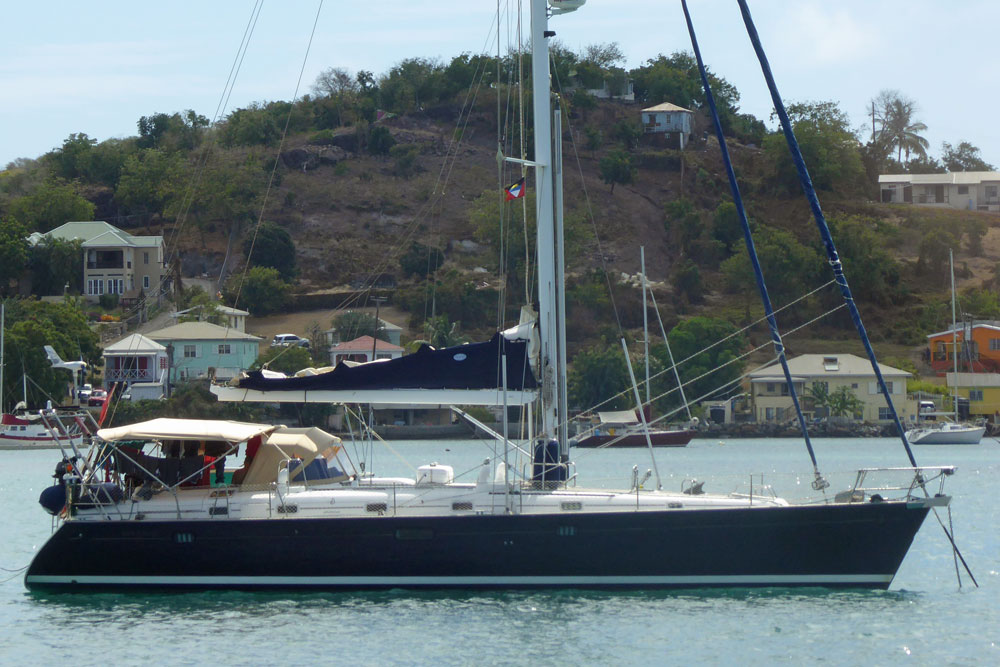
The Beneteau 50 was born from the drawing boards of Bruce Farr, a designer synonymous with racing success and efficient hull forms. Built by Beneteau in France and the United States between 1995 and 2004, the yacht was intended to bridge the gap between the performance-oriented First series and the comfort-focused Oceanis line. The hull is constructed from solid GRP (glass reinforced plastic) with a structural inner grid for stiffness, while the deck uses a balsa core for weight reduction and thermal insulation. This construction method offers a high level of durability and impact resistance, which is a primary concern for those planning long-distance passages where hitting submerged objects is a statistical possibility.
A defining feature of the Beneteau 50 is its dual-helm cockpit. At the time of its release, this was a relatively novel concept for a production boat of this size. Practically, this layout provides an unobstructed path from the companionway to the sugar-scoop stern, making it much easier to move around while under way or when at anchor. It also allows the helmsman to sit well outboard with excellent sightlines of the jib tell-tales.
Beneteau produced several variations to cater to different markets. The yacht was available with a deep fin keel for better upwind performance or a shallow draft version for cruising areas like the Bahamas or the Chesapeake Bay. The "Owner" version typically featured a massive forward stateroom, while the charter versions could be configured with four or even five cabins, each with its own head compartment, making it a staple of the Mediterranean and Caribbean charter fleets.
While the vast majority of Beneteau 50 yachts left the factory as masthead sloops, both cutter and solent configurations exist within the fleet. The cutter rig was primarily reserved for the "Custom" or "Flagship Series" models, which were built to a higher specification for private owners rather than the charter market. For the standard sloop-rigged versions, a solent stay—often removable—is one of the most popular retrofits for blue water cruising, providing a safer and more efficient sail plan for heavy weather.
Sail Areas & Rig Dimensions
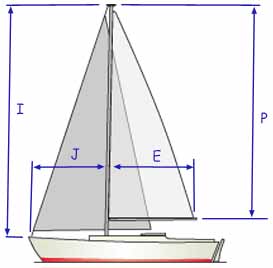
The rig on the Beneteau 50 is a masthead sloop with two sets of aft-swept spreaders. It is designed to be powerful enough to move a heavily laden cruising boat in light airs without requiring a massive crew to handle the loads.
 Rig Dimensions
- I (Forestay Height): 59'1" (18.01m)
- J (Foredeck Length): 18'1" (5.51m)
- P (Mainsail Hoist): 52'1" (15.88m)
- E (Mainsail Foot): 17'8" (5.38m)
- Mainsail Area: 460.10 ft² (42.74 m²)
- 100% Foretriangle Area: 534.15 ft² (49.62 m²)
- Total Sail Area (100%): 994.25 ft² (92.36 m²)
Published Specification: The Beneteau 50 Blueprint
| Specification Parameter | Measurement / Details |
|---|---|
| Length Overall (LOA) | 50'9" (15.48m) |
| Length at Waterline (LWL) | 45'5" (13.85m) |
| Beam | 14'8" (4.48m) |
| Draft (Deep Keel) | 7'7" (2.30m) |
| Draft (Shallow Keel) | 5'11" (1.80m) |
| Displacement | 28,660 lbs (13,000 kg) |
| Ballast | 9,315 lbs (4,225 kg) |
| Rig Type | Masthead Sloop |
| Hull Material | GRP (Solid Laminate) |
| Production Years | 1995 – 2004 |
Performance Analysis: Understanding the Design Ratios
When evaluating a yacht of this size, ratios provide a clear picture of how the vessel will behave in various sea states and wind conditions. For a deeper look at how these numbers impact your sailing experience, you may wish to refer to our guide on Understanding Boat Performance & Design Ratios.
| Performance Ratio | Calculated Value | Classification |
|---|---|---|
| Sail Area/Displacement (SA/D) | 17.02 | Moderate Cruiser |
| Displacement/Length (D/L) | 136.21 | Ultra-Light to Light |
| Ballast/Displacement (B/D) | 32.5% | Moderate Stability | Capsize Screening Formula (CSF) | 1.92 | Offshore Capable (< 2.0) |
| Brewer Motion Comfort Ratio | 26.75 | Coastal to Light Offshore |
Sail Area/Displacement (SA/D): At 17.02, the Beneteau 50 sits in the "moderate" category. This suggests the boat has enough sail area to perform well in light winds without becoming unmanageable as the breeze freshens. It is a balanced figure that suits a cruising couple.
Displacement/Length (D/L): A value of 136.21 is quite low for a 50-foot cruiser, placing it in the light displacement category. This is a hallmark of Farr's design philosophy, prioritising speed and surfing potential downwind. However, it also means the boat may be more sensitive to being overloaded with heavy cruising gear.
Ballast/Displacement (B/D): With nearly a third of its weight in the keel, the boat has a respectable righting moment. It will carry its sail well before needing a reef, contributing to a more comfortable, upright sailing experience.
Capsize Screening Formula (CSF): A value under 2.0 is the industry standard for ocean-going yachts. At 1.92, the Beneteau 50 is technically suitable for ocean passages, showing a good ratio of beam to displacement to prevent inversion.
Brewer Motion Comfort Ratio: A score of 26.75 indicates a relatively "active" motion. Compared to a heavy traditional full-keel yacht which might score over 40, the Beneteau 50 will be more prone to a quicker, jerkier motion in a choppy seaway. This is the trade-off for its higher speed potential.
Structural Integrity & Stability Dynamics
The use of solid GRP for the hull laminate below the waterline is a significant safety factor for long-term cruisers. Unlike sandwich construction, which can suffer from core delamination or water ingress if the outer skin is breached, a solid hull is easier to repair and more resilient to the "thumps" of cruising life. The balsa-cored deck provides stiffness, but owners should be vigilant about checking deck fittings for leaks to prevent the core from becoming soft over time.
The Farr-designed hull, with its relatively flat sections and wide beam carried well aft, allows the Beneteau 50 to plane or semi-plane in certain conditions. This is a major departure from older, heavy-displacement cruisers. While this makes for exciting and fast passages, it requires more active helming in heavy weather. The high-aspect spade rudder provides excellent control and manoeuvrability in tight marinas, though it lacks the protection of a skeg-hung design.
Configuration, Layout & Cruising Characteristics
In the cruising world, the Beneteau 50 is often praised for its "workable" layout. The galley is typically longitudinal, providing plenty of counter space and allowing the cook to brace themselves while under way. Tankage is generous for a production boat, with water capacity often exceeding 1,000 litres (220 gallons) and fuel around 500 litres (110 gallons), though these figures can vary by specific hull number and market.
The cockpit is the heart of the boat. Its massive size makes it ideal for entertaining, and the walk-through transom is a luxury when using a dinghy or swimming. One common critique from serious offshore sailors is the lack of bracing points in such a wide cockpit; when the boat is heeled at 20 degrees, the distance between the seats can feel like a canyon. Many owners add custom foot-braces or a larger fixed table to solve this.
Storage is another strong suit. The "sail locker" forward is often large enough to store a rolled-up inflatable dinghy, fenders, and spare lines, keeping the interior living spaces uncluttered. The engine access is generally excellent, with the companionway steps lifting on gas struts to reveal the Yanmar or Perkins powerplant.
Impressed?
Has this article suggested that this could be your ideal cruising boat and, as a result, deserves to be on your "Worth a Look" list?
But if, like me, you find sailboats to be seductive creations, then that list could rapidly get to be a pretty long one. If that is the case, wouldn't it be good if you could narrow it down bit through an objective, pragmatic process?
Well, that's where my eBook 'How to Avoid Buying the Wrong Sailboat' comes in...
Summing Up
The Beneteau 50 remains a benchmark in the large production yacht category. Its design ratios reveal a boat that is fast and light for its size, leaning more towards performance than a traditional, heavy blue water "tank." While its motion comfort ratio suggests it will be more lively in a seaway than a heavier ketch, its Farr-designed hull ensures it covers miles with efficiency. The solid hull construction and versatile layout options make it a pragmatic choice for sailors who want a modern, spacious home that can still hold a 7-knot average on a passage. It is not without its compromises—the spade rudder and light displacement require a more modern approach to heavy weather seamanship—but as a total package of value, space, and speed, it is difficult to beat.
If you'd like to compare this boat with others in this size range, take a look at Cruising Boats from 50' to 55' overall...

Written by Dick McClary, cruising sailor and yachting journalist, publisher of Sailboat‑Cruising.com and admin of the Liveaboard Sailboats for Sale community.

Frequently Asked Questions (FAQs)
What are the known issues with older Beneteau 50 models?
What are the known issues with older Beneteau 50 models?
Prospective buyers should check for "crazing" in the gelcoat and inspect the balsa-cored deck around stanchion bases for moisture. As with many yachts of this age, the original teak decks may be nearing the end of their life, which can be a costly replacement.
Is the Beneteau 50 suitable for a solo sailor or a couple?
Is the Beneteau 50 suitable for a solo sailor or a couple?
While the boat is large, the lines are typically led back to the cockpit, making it manageable for a capable couple. A solo sailor would likely require an upgraded autopilot and perhaps an electric winch for the halyards to handle the mainsail's weight.
How does the Beneteau 50 handle in heavy weather?
How does the Beneteau 50 handle in heavy weather?
Because of its light displacement and wide beam, the boat prefers to be sailed upright. Early reefing is key. It handles downwind conditions beautifully but can be "slammy" when punching into a short, steep head-sea.
What is the difference between the Beneteau 50 and the Oceanis 50?
What is the difference between the Beneteau 50 and the Oceanis 50?
The Beneteau 50 (often referred to simply as the "50") was a standalone model designed by Farr. Later Oceanis 50 models were designed by Berret-Racoupeau and featured different hull shapes and interior aesthetics. The Farr-designed 50 is generally considered the more "performance-oriented" of the two.
Is the spade rudder a concern for blue water cruising?
Is the spade rudder a concern for blue water cruising?
A spade rudder offers superior manoeuvrability but is more vulnerable to impact than a skeg-hung rudder. Many circumnavigators have used this boat without issue, but it is a point of consideration for those planning to sail in areas with high levels of floating debris.
Recent Articles


-
Rigging a Carbon Mast: Carbon, PBO or Dyneema Compared
Sep 20, 26 08:01 AM
Rigging a carbon mast: how carbon rod, PBO and Dyneema compare on cost, weight and inspection, and why stainless wire or rod rarely make sense. -
Top-Down Furling Guide: Code Zeros and Asymmetric Spinnakers
Sep 19, 26 04:57 PM
Top-down furling explained for cruisers: how it works, which boats need one, common faults, sock versus furler costs, and the rule everyone forgets. -
Standing Rigging Inspection Checklist: A Sailor's Full Guide
Sep 19, 26 03:46 PM
A complete standing rigging inspection checklist covering swage fittings, chainplates, tension and going aloft safely, plus when to call in a professional rigger.