- Home
- Cruising Yachts 40' to 45'
- Catalina Morgan 440
The Catalina Morgan 440 Sailboat
Specs, Performance Analysis & Cruising Characteristics
Key Takeaways
The Catalina Morgan 440 is a robust, deck-saloon cruiser designed specifically for couples seeking long-term comfort and safety. It successfully blends the manufacturing efficiency of Catalina with the heavy-weather heritage of the Morgan brand. Key highlights include an exceptionally spacious "living room" interior, a moderate-displacement hull that ensures a predictable motion in a seaway, and a versatile sail plan. While by no means a light-airs racer, it excels as a stable, reliable home for coastal hopping or blue-water transitions.
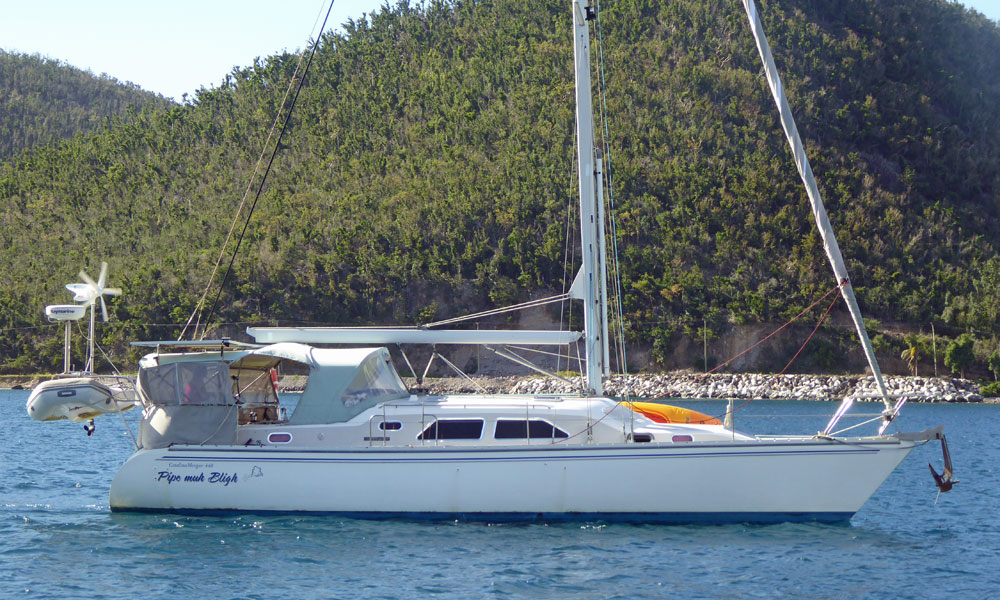 A Catalina Morgan 440
Design & Construction
The Catalina Morgan 440 was born from a collaboration between the legendary design team at Catalina Yachts and the heritage of Morgan Yachts, a brand Catalina acquired in the 1980s. Constructed by Catalina Yachts in Florida, the hull is made of solid hand-laid fibreglass below the waterline, with a balsa-cored deck to maintain a low centre of gravity and provide thermal insulation.
The defining feature of the 440 is its deck-saloon configuration. Unlike many "deck-saloon" boats that merely have larger windows, the 440 features a truly raised cabin sole. This allows the crew to enjoy a panoramic view of the horizon while seated in the saloon, a massive boon for watches kept in inclement weather or simply for the psychological benefit of natural light during a long stint at anchor.
Catalina produced the 440 in several configurations to suit different cruising grounds. Buyers could choose between a deep-draft wing keel for better upwind performance or a shallow-draft version for shallow-water cruising in areas like the Bahamas. The rig was typically a fractional sloop, though many owners have since added removable inner forestays for heavy-weather staysails.
While not all US-built boats from this era carry a formal STIX (Stability Index) rating common to European CE-certified vessels, the 440 was designed to meet Category A (Ocean) standards. This signifies the boat is capable of handling winds over 40 knots and significant wave heights exceeding 4 metres.
Sail Areas & Rig Dimensions
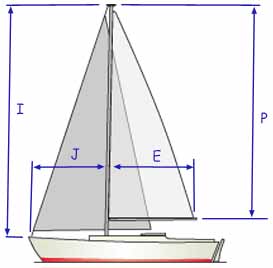 Rig dimensions
The sail plan is designed for ease of handling by a couple, often featuring in-mast furling as a standard convenience.
- Total Sail Area: 873 ft² (81.1 m²)
- I (Foretriangle Height): 52'1" (15.88 m)
- J (Foretriangle Base): 17'0" (5.18 m)
- P (Mainsail Luff): 46'9" (14.25 m)
- E (Mainsail Foot): 18'1" (5.51 m)
Published Specification: The Catalina Morgan 440 Blueprint
| Specification Item | Data Details |
|---|---|
| LOA | 44'3" (13.49 m) |
| LWL | 38'6" (11.73 m) |
| Beam | 14'0" (4.27 m) |
| Draft (Standard Keel) | 7'0" (2.13 m) |
| Draft (Wing Keel) | 5'0" (1.52 m) |
| Displacement | 25,628 lbs (11,625 kg) |
| Ballast | 8,628 lbs (3,914 kg) |
| Rig Type | Fractional Sloop |
| Hull Material | GRP (Fibreglass) |
| Production Dates | 2004 – 2011 |
Performance Analysis: Understanding the Design Ratios
The following ratios provide a snapshot of how the 440 behaves when the wind picks up. For a broader context, you can refer to our guide on Understanding Boat Performance & Design Ratios.
| Ratio Type | Value | Expert Interpretation |
|---|---|---|
| SA/D | 16.1 | A conservative ratio indicating a motor-sailer leaning. It needs a good breeze to find its feet. |
| D/L | 201 | Moderate displacement. It strikes a balance between load-carrying ability and agility. |
| B/D | 34% | Fairly standard for a modern cruiser, providing adequate stiffness under full canvas. |
| CSF | 1.89 | Below 2.0, which is the threshold for ocean-going safety regarding capsize recovery. |
| Comfort Ratio | 30.5 | A solid score suggesting a motion that won't punish the crew in choppy coastal waters. |
Structural Integrity & Stability Dynamics
The use of solid fibreglass below the waterline offers peace of mind when venturing into areas where debris or poorly charted shoals might be a concern. Unlike sandwich construction, a solid laminate is easier to repair and less prone to catastrophic delamination from impact.
The heavy wing keel version significantly impacts the stability profile by keeping the weight low while allowing the boat to enter shallower anchorages. This keel design creates a "vortex" effect at the tips, which helps reduce leeway despite the shorter foil. While it won't point as high as the 7'0" (2.13 m) fin keel, the trade-off in cruising flexibility is often worth it for the coastal explorer.
The Buyer’s Checklist: Common Problem Areas
When inspecting a used Catalina Morgan 440, focus on these specific areas:
- Window Seals: The large deck-saloon windows are a hallmark of the design, but they are prone to leaks if the bedding compound has aged. Check for water staining on the woodwork below the ports.
- Chainplates: Though generally robust, inspect the glass-in areas for any signs of movement or moisture ingress in the surrounding core.
- In-Mast Furling: If the boat has the standard furling main, check the foil tension. If it is too loose, the sail can jam, which is a significant safety risk during a blow.
- Keel Bolts: Ensure there is no "Catalina Smile" (a hairline crack at the leading edge of the keel-to-hull joint), which can indicate the need for re-torquing the bolts or renewing the sealant.
Comparison: The Catalina Morgan 440 vs The Competition
The 440 often finds itself on the same shortlist as the Hylas 44 or the Hallberg-Rassy 42. Compared to the Hylas, the Catalina offers more interior volume and a more modern "open plan" feel, though the Hylas is generally regarded as having a finer finish in the joinery. Against the Hallberg-Rassy, the Catalina is significantly more affordable on the second-hand market and offers a more social cockpit arrangement, though it lacks the legendary "tank-like" heavy-weather displacement of the Swedish builds.
If you'd like to compare this boat with others in this size range, take a look at Cruising Boats from 40' to 45' overall....
Configuration, Layout & Cruising Characteristics
The interior is where the 440 truly shines. The galley is "longitudinal" and located to port, providing excellent bracing points for the cook while underway. Tankage is generous, with 176 gallons (666 litres) of water and 100 gallons (378 litres) of fuel, making it a viable platform for island hopping without constant trips to the dock.
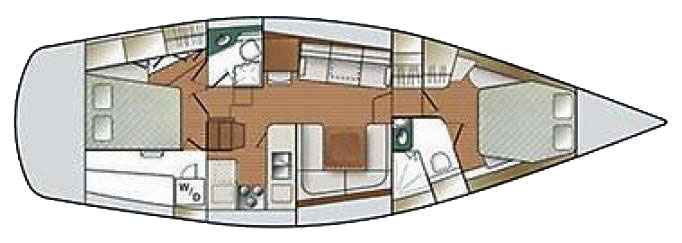 The Catalina Morgan 440 accommodation layout
The cockpit is deep and secure, with a walk-through transom that makes boarding from a dinghy or swimming effortless. The twin-helm setup found on some larger boats is absent here; instead, a large single wheel provides excellent feel and simplifies the mechanical steering linkage.
Could this be your ideal cruising boat?
It may well be, but before going any further, it might be worth taking a look at my eBook 'How to Avoid Buying the Wrong Sailboat'...
Summing Up
The Catalina Morgan 440 is a pragmatist's yacht. It does not pretend to be a carbon-fibre racer or a high-latitude steel expedition vessel. Instead, it offers a refined, comfortable, and remarkably spacious environment for sailors who value liveability as much as nautical miles. Its design ratios point to a boat that is predictable and safe, if a little sluggish in light airs. For the buyer looking for a coastal home that can confidently cross an ocean when required, the 440 remains a compelling choice on the pre-owned market.
This article was written by Dick McClary, RYA Yachtmaster and author of the RYA publications 'Offshore Sailing' and 'Fishing Afloat', member of The Yachting Journalists Association (YJA), and erstwhile member of the Ocean Cruising Club (OCC).
Frequently Asked Questions (FAQs)
Is the Catalina Morgan 440 suitable for solo sailing?
Is the Catalina Morgan 440 suitable for solo sailing?
Yes, provided the lines are led aft to the cockpit. The use of an electric winch for the halyards and the in-mast furling system makes it manageable, though its windage in close-quarters manoeuvring requires a confident hand.
How does the wing keel affect performance compared to the fin keel?
How does the wing keel affect performance compared to the fin keel?
The wing keel reduces the draft by 2'0" (0.61 m), which is vital for the Caribbean. You will lose about 3 to 5 degrees of pointing ability upwind compared to the deep fin keel version.
Are there known issues with the deck-saloon windows breaking?
Are there known issues with the deck-saloon windows breaking?
There are no widespread reports of structural failure, but the large surface area makes them vulnerable to "crazing" over time due to UV exposure. Replacement or polishing may be needed every 15 years.
What is the typical cruising speed under power?
What is the typical cruising speed under power?
With the standard 75hp Yanmar diesel, you can expect a comfortable cruising speed of 7.5 knots at 2,400 RPM, depending on the propeller configuration and hull cleanliness.
Does the 440 suffer from hull osmosis?
Does the 440 suffer from hull osmosis?
Catalina used vinylester resins in the outer layers of the hull to prevent blistering. While no GRP boat is completely immune, the 440 has a very good reputation for hull integrity.
Recent Articles


-
Morgan 41 Catalina Classic for Sale
May 06, 26 03:49 PM
Forget the "slow" reputation of the early full-keel Morgans. This is the sought-after Catalina-era redesign. -
DSC Radio Guide: Setup, MMSI & Pushbutton Distress Calls
Apr 25, 26 02:57 AM
Learn how to set up and use a DSC radio for emergency distress calls, MMSI registration, and routine marine communication. -
The Bayfield 40 Sailboat
Apr 13, 26 05:09 AM
An expert review of the Bayfield 40 staysail ketch. Explore technical specs, design ratios, and real-world cruising performance for this classic full-keel voyager.

Copyright © 2026 Dick McClary Sailboat-Cruising.com