Understanding Boat Performance Ratios & How to Use Them
Key Takeaways: Boat performance ratios are mathematical tools used to compare the handling, stability, and comfort of different vessels. While no single number provides a complete picture, understanding how Displacement/Length, Sail Area/Displacement, and Comfort Ratios interact allows sailors to predict how a boat will behave at sea.
Table of Contents
- What Are Boat Performance Ratios & How Should You Use Them?
- What Is the Displacement/Length (D/L) Ratio?
- What's the Sail Area/Displacement (SA/D) Ratio?
- The Ballast & Ballast/Displacement Ratio
- The Comfort Ratio & Its Role in Passage-Making
- How Should You Read These Ratios Together?
- The Prismatic Coefficient & Modern Hull Shapes
- The Limitations of Design Ratios: Why the Numbers Don't Tell the Whole Story
- Frequently Asked Questions
What Are Boat Performance Ratios & How Should You Use Them?
Boat performance ratios are numerical formulas that allow us to compare yachts of different sizes and shapes on an equal footing. By stripping away absolute dimensions—like total weight or total sail area—and looking at how these figures relate to one another, we can categorize a boat’s DNA.
These ratios matter because they move beyond the marketing brochure. They help you determine if a boat is a nimble racer, a steady blue-water cruiser, or something in between. However, it is vital to remember that no single ratio tells the whole story; a boat is a collection of compromises, and these numbers must be read together to understand the vessel's true character.
Quick-Reference Table: Major Performance Ratios
| Ratio | What it Measures | Low Means... | High Means... |
|---|---|---|---|
| D/L | Relative heaviness | Ultralight/Racing | Heavy/Traditional |
| SA/D | Power-to-weight | Under-canvassed | High Performance |
| Ballast % | Stability/Stiffness | Tender/Initial Heel | Stiff/Stable |
| Comfort | Motion in a seaway | Flighty/Jerky | Steady/Easy |
What Is the Displacement/Length (D/L) Ratio?
The D/L ratio is the foundational metric for establishing whether a boat is "light" or "heavy" relative to its waterline length. It tells you how much "bulk" a boat has to push through the water.
The Formula:
$$D/L = \frac{\text{Displacement (long tons)}}{(0.01 \times \text{LWL})^3}$$
- What it measures: The intensity of the boat's volume relative to its length.
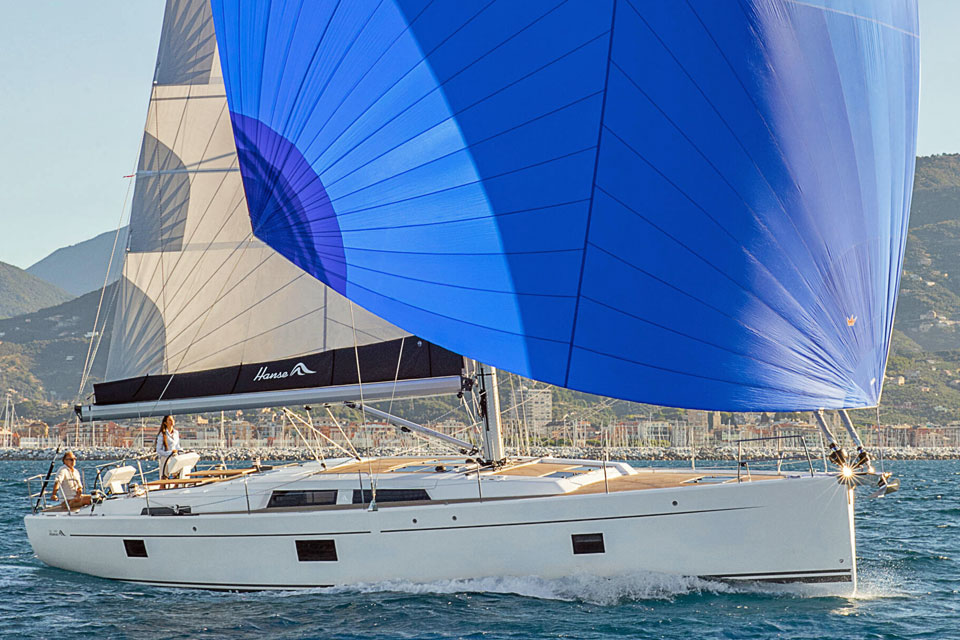
- What low means (Under 150): Indicates a light-displacement boat, often a racer or modern performance cruiser that can plane or reach high speeds easily.
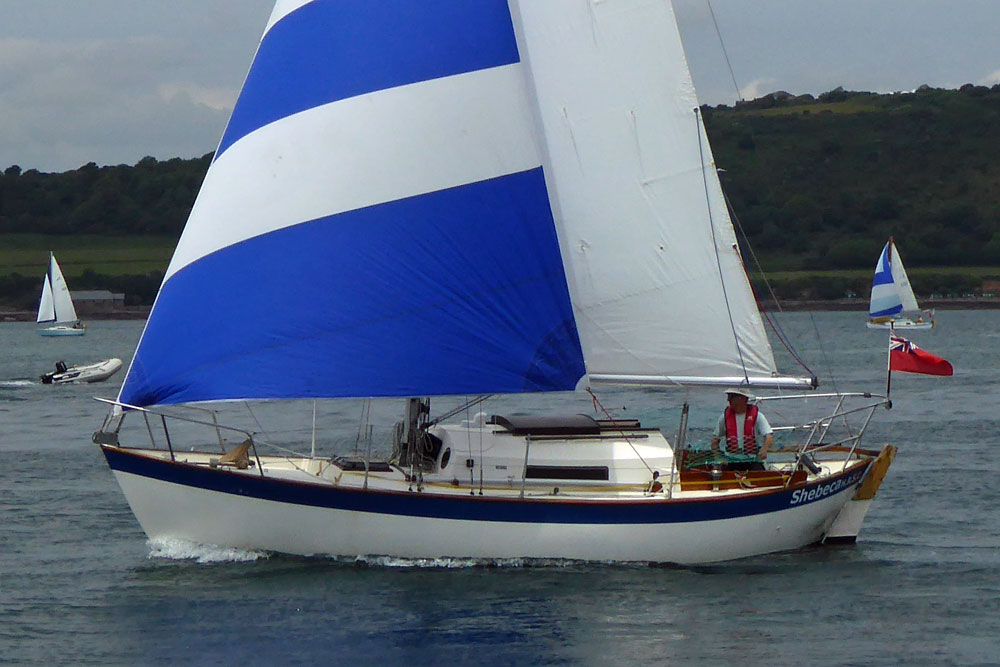
- What high means (Over 300): Indicates a heavy-displacement boat, typical of traditional long-keel cruisers designed to carry heavy loads and stay steady.
- What it does not tell you: It doesn't account for hull shape or where that weight is located (e.g., in a deep bulb or shallow stub keel).
What's the Sail Area/Displacement (SA/D) Ratio?
Naturally following the D/L, the SA/D ratio acts as the "accelerator pedal" of the boat. It describes the available power relative to the weight that must be moved.
The Formula:
$$SA/D = \frac{\text{Sail Area (sq ft)}}{(\text{Displacement (lb)} / 64)^{2/3}}$$
- What it measures: The power-to-weight ratio.
- What low means (Under 14): The boat may be under-powered in light winds and will likely require the engine sooner as breezes die down.
- What high means (Over 20): A high-performance vessel that excels in light air but will likely need reefing much earlier as the wind picks up.
- What it does not tell you: It doesn't factor in the efficiency of the rig or the quality of the sails.
The Ballast & Ballast/Displacement Ratio
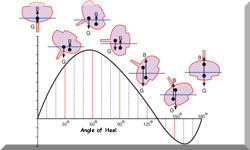
This ratio transitions our discussion into stability. It helps us understand how "stiff" a boat is—its ability to resist heeling when the wind hits the sails.
The Formula:
$$\text{Ballast Ratio} = \frac{\text{Ballast Weight}}{\text{Total Displacement}} \times 100$$
- What it measures: The percentage of the boat's total weight dedicated to stability.
- What low means (Under 30%): The boat might be "tender," meaning it heels easily, though modern wide-beam boats often use hull shape to compensate for low ballast ratios.
- What high means (Over 40%): Generally a "stiff" boat that can carry a lot of sail in a breeze without excessive heeling.
- What it does not tell you: The position of the ballast. 2,000kg at the bottom of a 2-metre fin keel provides far more stability than 2,000kg inside a shallow bilge.
The Comfort Ratio & its Role in Passage-Making
Developed by yacht designer Ted Brewer, this ratio connects the dry numbers to the actual human experience of sailing.
The Formula:
$$\text{Comfort Ratio} = \frac{\text{Displacement (lb)}}{0.65 \times (0.7 \times \text{LWL} + 0.3 \times \text{LOA}) \times \text{Beam}^{1.33}}$$
- What it measures: How "busy" the boat's motion will be in a seaway. It predicts how quickly a boat will kick and jerk in waves.
- What low means (Under 20): A light, fast boat that will likely have a "flighty" and potentially exhausting motion in rough seas.
- What high means (Over 40): A heavy, traditional cruiser with a slow, predictable motion that is much kinder to the crew on long passages.
- What it does not tell you: It cannot account for the specific period of the waves or the skill of the helmsman.
How Should You Read These Ratios Together?
To truly compare boat profiles, you must look at how these numbers interact. One ratio can often offset or enhance another.
- The Performance Flyer (Low D/L + High SA/D): This combination describes a boat built for speed. It is light enough to move and has a massive "engine" to push it. It will be exciting but may require constant attention to sail trim.
- The Blue-Water Cruiser (High D/L + Moderate SA/D + High Comfort): This profile suggests a boat that can carry all your stores for a year, won't scare the family in a blow, and will treat you gently during a night watch.
- The Modern Paradox (High Ballast + Low Comfort): You may find modern boats with high ballast ratios but low comfort scores. This is often due to wide beams which provide "form stability" but result in a snappy, uncomfortable motion in choppy water.
Quick Rule-of-Thumb
- Light & Fast: D/L < 150, SA/D > 20.
- All-Rounder: D/L 200–250, SA/D 16–18.
- Heavy Cruiser: D/L > 300, Comfort > 35.
The Prismatic Coefficient & Modern Hull Shapes
For those seeking an advanced layer of understanding, the Prismatic Coefficient (Cp) describes how "full" or "fine" the ends of the hull are. A boat with a high Cp has full bows and sterns, allowing it to exceed its theoretical hull speed more easily (common in modern racers). A lower Cp indicates a boat that is easily driven at low speeds but hits a "wall" sooner as speed increases.
The Limitations of Design Ratios: Why the Numbers Don't Tell the Whole Story
While these ratios provide a fantastic benchmark, they are based on static measurements. They do not account for:
- Hull Shape: Two boats with identical ratios can behave differently if one has a flat bottom and the other a deep V-shape.
- Weight Distribution: Centring weight (keeping heavy tanks and batteries over the keel) improves performance in a way no ratio can capture.
- The Human Element: A well-balanced rig and an ergonomic cockpit often matter more for "performance" than a decimal point in a formula.
Summing Up
Understanding performance ratios is about more than just doing maths; it is about finding the right tool for the job. Whether you are looking for a spirited weekend racer or a steady offshore home, these numbers serve as your first line of defence against choosing the wrong vessel. Always look at the D/L, SA/D, and Comfort Ratio as a trio to see the true soul of the yacht.

This article was written by Dick McClary, RYA Yachtmaster and author of the RYA publications 'Offshore Sailing' and 'Fishing Afloat', member of The Yachting Journalists Association (YJA), erstwhile member of the Ocean Cruising Club (OCC) and owner/administrator of 'Liveaboard Sailboats for Sale'.

Frequently Asked Questions
What's the difference between boat displacement and weight?
What's the difference between boat displacement and weight?
For a boat afloat, they're the same. Displacement is the weight of the volume of water the boat displaces, which is exactly equal to the boat's total weight.
Why is a boat’s waterline length more important than its overall length?
Why is a boat’s waterline length more important than its overall length?
Waterline length is the part of the hull that is actually in the water. It directly affects the speed potential of a displacement hull and is used in key performance formulas.
How do I find a boat's Displacement/Length Ratio and Sail Area/Displacement Ratio?
How do I find a boat's Displacement/Length Ratio and Sail Area/Displacement Ratio?
Many boat specifications list these figures. You can also use online calculators by inputting the boat's displacement and waterline length, which are typically available from the manufacturer.
What is the most important ratio for an offshore cruiser?
What is the most important ratio for an offshore cruiser?
While all are important, the Comfort Ratio and D/L are often prioritised for offshore work, as they indicate how the boat will handle heavy seas and heavy loads.
Can a boat have a high SA/D and still be safe?
Can a boat have a high SA/D and still be safe?
Yes, but it requires more active management. A high SA/D simply means you have a larger "engine," so you must be prepared to reef earlier than you would on a more conservative boat.
Does a high Ballast Ratio always mean a boat won't capsize?
Does a high Ballast Ratio always mean a boat won't capsize?
Not necessarily. The Ballast Ratio tells you about stiffness, but the "Limit of Positive Stability" (LPS) is the true measure of capsize recovery.
Why do modern boats have lower Comfort Ratios?
Why do modern boats have lower Comfort Ratios?
Modern designs favour wider beams and lighter materials for speed and interior space. While this makes them faster and roomier, it often results in a quicker, less "comfortable" motion compared to heavy traditional hulls.
The following sources were used:
- Sailboat Design Ratios: https://www.rustleryachts.com/useful-formulas-to-help-you-choose-a-boat/
- Performance & Hull Design: https://www.yachtingmonthly.com/yacht-reviews/understand-boat-statistics-30154
Recent Articles


-
Mystery 35 Review: Specs, Performance & Buying Guide
Aug 29, 26 09:42 AM
An in-depth review of the Mystery 35 sailboat. Read technical specs, design ratios, sail performance, and common buyer inspection areas. -
Beneteau First 405 Review: Specs, Performance & Buyer’s Guide
Aug 26, 26 03:58 AM
Detailed Beneteau First 405 review covering specs, performance, bluewater capability, layouts and buyer’s checklist. -
Moody S38 Review: Specs, Ratios & Buyer’s Guide
Aug 12, 26 04:22 AM
In‑depth Moody S38 review covering specs, performance, design ratios, layout, strengths, trade‑offs & buyer inspection points.