- Home
- Cruising Yachts 40' to 45'
- Mason 43
The Mason 43 Sailboat
Specs, Performance Analysis & Cruising Characteristics
Key Takeaways
The Mason 43 is a classic full-keel offshore cruiser, designed by Al Mason and built to exceptionally high standards by Ta Shing. It is defined by its heavy displacement, moderate beam, and elegant aesthetic, offering a secure and comfortable motion in heavy seas. While it is not a light-airs flyer, its high ballast ratio and significant momentum make it a formidable passage maker for those prioritising safety and liveaboard comfort over outright speed through the water.
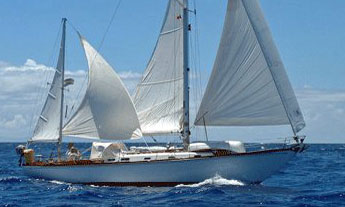
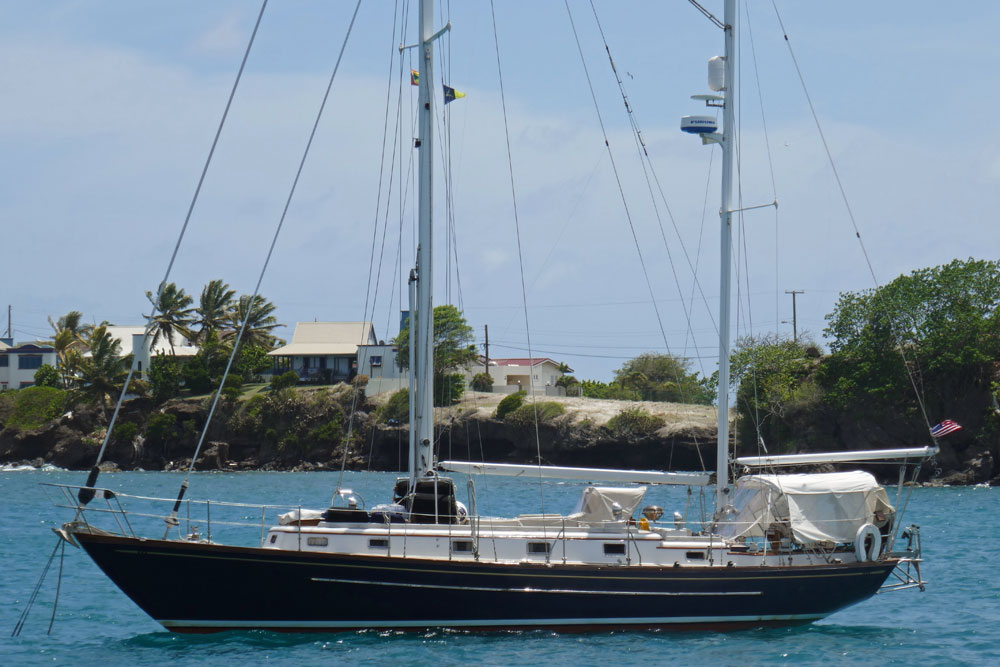 Many thanks to Sally & Al Pribyl for this pic of their Mason 43 staysail ketch 'Artemis', at anchor in Prickly Bay, Grenada.
Design & Construction
The Mason 43 was born from the drawing board of Al Mason, a designer renowned for his ability to blend traditional aesthetics with seaworthy geometry. Built by the Ta Shing Yacht Service in Taiwan, the vessel is constructed from solid hand-laid glass reinforced plastic (GRP). Unlike many contemporary yachts of the 1970s and 80s that utilised sandwich cores for hulls, the Mason 43 relies on the sheer strength and longevity of a thick, solid laminate.
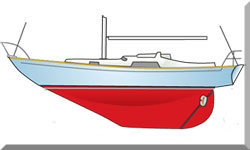
A defining feature of the Mason 43 is its long, full keel with a cutaway forefoot and a protected rudder attached to the trailing edge of the keel. This configuration provides immense directional stability and protects the running gear from collisions with submerged objects or lobster pots. While this design increases the turning circle and adds wetted surface area, the practical implication for a long-distance cruiser is a boat that tracks exceptionally well on a run and remains easy to steer when the weather turns foul.
The Mason 43 was primarily produced as a cutter, although a staysail ketch version was also available. The ketch version is particularly popular among shorthanded couples, as it breaks the sail plan into smaller, more manageable portions, allowing for better balance in a wider range of wind conditions.
Sail Areas & Rig Dimensions
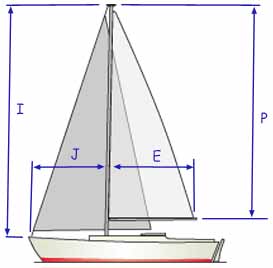 Rig dimensions
The sail plan of the Mason 43 is substantial, designed to move her significant mass once a breeze is established. The following dimensions represent the standard cutter configuration:
- Total Sail Area: 899 ft² (83.5 m²)
- I (Forestay Height): 52'0" (15.85 m)
- J (Foretriangle Base): 18'4" (5.59 m)
- P (Mainsail Luff): 46'0" (14.02 m)
- E (Mainsail Foot): 15'0" (4.57 m)
Published Specification: The Mason 43 Blueprint
| Specification | Data Detail |
|---|---|
| LOA (Length Overall) | 43'10" (13.36 m) |
| LWL (Length Waterline) | 31'3" (9.53 m) |
| Beam | 12'4" (3.76 m) |
| Draft | 6'3" (1.91 m) |
| Displacement | 25,000 lbs (11,340 kg) |
| Ballast | 9,400 lbs (4,264 kg) |
| Rig Type | Cutter or Staysail Ketch |
| Hull Material | Solid GRP |
| Production Dates | 1978 – 1986 |
Performance Analysis: Understanding the Design Ratios
To truly understand how the Mason 43 behaves at sea, we must look beyond the aesthetics and examine the mathematical ratios. For a deeper dive into these metrics, you may refer to our guide on Understanding Boat Performance & Design Ratios.
| Ratio Metric | Value | Interpretation |
|---|---|---|
| SA/D (Sail Area / Displacement) | 16.8 | Indicates a moderate cruiser; requires at least 10-12 knots of wind to perform well. |
| D/L (Displacement / Length) | 365 | Classifies the yacht as a heavy displacement vessel, offering high load-carrying capacity. |
| B/D (Ballast / Displacement) | 37.6% | A respectable ratio for a full-keel boat, ensuring good stiffness and recovery. |
| CSF (Capsize Screening Formula) | 1.68 | Values under 2.0 are considered safe for ocean passages; the Mason 43 is very seaworthy. |
| Brewer Motion Comfort Ratio | 38.5 | A high score, indicating a slow, predictable motion that reduces crew fatigue in a seaway. |
Structural Integrity & Stability Dynamics
The use of solid GRP in the hull construction, combined with a high displacement-to-length ratio, results in a vessel that is nearly impervious to the "pounding" often felt in lighter, flat-bottomed modern yachts. The momentum generated by 25,000 lbs (11,340 kg) of mass allows the Mason 43 to punch through head seas that would stop lighter boats in their tracks.
The full keel impacts performance in two distinct ways. Firstly, it provides a level of stability and tracking that makes the boat a joy to sail on long reaches, as it requires less input from an autopilot or wind vane. Secondly, it does mean the boat is less responsive in light air and more challenging to manoeuvre in tight marinas. For the blue-water sailor, the trade-off of "parking lot" difficulty for "mid-ocean" security is almost always a price worth paying.
Configuration, Layout & Cruising Characteristics
Stepping below deck, the Mason 43 reveals why it remains a favourite for liveaboard cruisers. The interior is typically finished in high-grade teak, with a level of joinery that is rarely seen in modern production boats.
The galley is usually U-shaped, providing a secure place for the cook to brace themselves while preparing meals at sea. Tankage is generous, often exceeding 100 gallons (454 litres) of fuel and 200 gallons (757 litres) of water, which is essential for extended periods away from the dock. The cockpit, while smaller than modern "entertaining" cockpits, is deep and well-protected, ensuring the crew stays dry and safe during offshore passages.
Impressed?
Has this article suggested that this could be your ideal cruising boat and, as a result, deserves to be on your "Worth a Look" list?
But if, like me, you find sailboats to be seductive creations, then that list could rapidly get to be a pretty long one. If that is the case, wouldn't it be good if you could narrow it down bit through an objective, pragmatic process?
Well, that's where my eBook 'How to Avoid Buying the Wrong Sailboat' comes in...
Summing Up
The Mason 43 is a masterclass in traditional yacht design. While its heavy displacement and high wetted surface area mean it will never be the first boat to arrive in light winds, its performance in heavy weather is exemplary. The design ratios confirm what the eye suspects: this is a stable, comfortable, and safe ocean crosser. Prospective owners should be mindful of the maintenance required for the extensive exterior teak and the slower speeds in light air, but for those seeking a vessel that can take them anywhere in the world with grace, the Mason 43 is an outstanding candidate.
If you'd like to compare this boat with others in this size range, take a look at Cruising Boats from 40' to 45' overall....
This article was written by Dick McClary, RYA Yachtmaster and author of the RYA publications 'Offshore Sailing' and 'Fishing Afloat', member of The Yachting Journalists Association (YJA), and erstwhile member of the Ocean Cruising Club (OCC).
Frequently Asked Questions (FAQs)
Is the Mason 43 suitable for solo or shorthanded sailing?
Is the Mason 43 suitable for solo or shorthanded sailing?
Yes, particularly the ketch-rigged version. The manageable sail sizes and the boat's natural ability to hold a course make it well-suited for a couple or an experienced solo sailor.
How does the full keel affect manoeuvrability in a marina?
How does the full keel affect manoeuvrability in a marina?
It makes the boat more difficult to turn in tight spaces compared to a fin-keel yacht. It also has a significant "prop walk" when in reverse, which requires practice and planning when docking in crosswinds.
Are there known issues with osmosis in these hulls?
Are there known issues with osmosis in these hulls?
While Ta Shing's build quality was excellent, any yacht of this era can be susceptible to blistering. However, the thick, solid laminate of the Mason 43 makes it a prime candidate for a peel and epoxy treatment if issues are found.
How does the Mason 43 handle heavy weather?
How does the Mason 43 handle heavy weather?
Excellently. The high Motion Comfort Ratio and protected rudder mean the boat remains controllable and comfortable when the sea state builds, far exceeding the comfort of modern light-displacement designs.
What is the average cruising speed I should expect?
What is the average cruising speed I should expect?
Under sail, you should expect to average 6 to 7 knots on a passage. In light winds (under 10 knots), the boat will likely require the engine or a large cruising chute to maintain progress.
Recent Articles


-
Coastal Passage Planning Made Easy: A 5-Phase Prep Guide
Oct 24, 26 10:51 AM
Master short coastal passage planning with our 5-phase preparation system. Avoid dockside stress, set safe limits, and cast off with complete confidence. -
Nonsuch 30 Sailboat Review, Specs, Performance and Buying Guide
Oct 21, 26 05:45 PM
Independent Nonsuch 30 review covering specs, performance, Classic vs Ultra layouts, owner feedback, common faults and buying advice. -
Hallberg Rassy 42E Review, Specs & Buyer's Guide
Oct 21, 26 07:00 AM
Hallberg Rassy 42E review with specs, design ratios, sailing performance, ownership insights, common issues and buyer guidance.