- Home
- Essential Safety Gear
- Offshore Liferaft Key Attributes
Offshore Liferafts: How to Choose, Stow and Service One You Can Trust
Key Takeaways: If you're weighing up an offshore liferaft, the short answer is this: buy the highest specification you can sensibly afford, ideally an ISO 9650 Type 1 Group A raft with a double floor, and size it for the crew you normally carry rather than the number of berths. Stow it where you can launch it in seconds, even if the boat's upside down. Service it on the manufacturer's schedule through an approved agent, and back it up with a properly packed grab bag and a 406 MHz beacon. Then practise. On a UK pleasure yacht under 13.7 metres none of this is a legal requirement, but the further you go from help, the more that raft becomes the only thing between your crew and the water.
Table of Contents
- Do You Actually Need an Offshore Liferaft?
- What the Standards Mean: ISO 9650, SOLAS & the Leisure Lottery
- Features That Matter Once You're Wet
- Choosing the Right Size: Why Bigger Isn't Safer
- Valise or Canister?
- Where to Stow It So You Can Actually Launch It
- Servicing: Intervals, Agents & the Problem of Being Abroad
- The Grab Bag, the Beacon & What the Raft Won't Carry
- Drills, Roles & Getting the Crew In
- Race & Rally Rules: OSR and ARC
- Summing Up
- FAQs
Do You Actually Need an Offshore Liferaft?
Legally, on a private UK yacht under 13.7 metres (45 ft), you don't. Above that length a properly approved raft may well be compulsory, and racing, rallies and coded charter work bring their own rules. Beyond the law, the honest test is distance from help. The further you are from the coast, from other boats and from rescue services, the stronger the case becomes.
Two arguments come up on every pontoon. The first is that an "unsinkable" boat doesn't need a raft. Fire can still destroy the vessel, and unsinkable doesn't mean liveable. The second is that a half-inflated tender on the foredeck will do the job. It won't, not for long. A tender is a poor second best if you have to leave the yacht quickly or in anything but very calm weather, and rigid dinghies often capsize and float upside-down in heavy seas.
One more point worth keeping in your head. Once you're in the raft, the length of the boat you've left behind is irrelevant. Choose the standard you'd be required to carry on a vessel over 13.7 metres in the same cruising area, because crew survival is what you're buying.
What the Standards Mean: ISO 9650, SOLAS & the Leisure Lottery
Modern leisure liferaft standards were born from bad days at sea. Fifteen sailors died in the 1979 Fastnet storm, and liferafts capsized and broke up in the seas. The first fix, the ORC standard, was thin: its requirements covered about half a page of A4. Then six more lives were lost in the 1998 Sydney-Hobart Race, and the inquiry called for something far more thorough. That became ISO 9650, which arrived in 2005 to set minimum standards for raft performance and survival equipment. Older ORC rafts have long since been dropped from coded vessel acceptance in the UK.
Naming trips people up, so here's the translation. Some guides say ISO 9650 Part 1 Category A and B. Manufacturers usually say Type 1 Group A and Group B. As far as I can tell, they mean the same thing.
| Standard | Temperature and floor | Where it fits |
|---|---|---|
| ISO 9650-1 Group A (also written Category A) | Operational range of -15 to +65 degrees C, with thermal insulation in the floor | Offshore and long-distance cruising, and the natural choice around the UK |
| ISO 9650-1 Group B (also written Category B) | Tested at 0 degrees C for use from 0 to +65 degrees C, no floor insulation | Warmer waters, such as the Mediterranean |
| SOLAS | Commercial standard, bulkier, heavier and dearer than yacht rafts | Strongly recommended for anyone going more than 150 miles from the coast |
| No recognised standard | Unknown until you read the spec sheet | Possibly fine for daylight coastal hops near shore, but buy with caution |
A word of warning about older stock: a raft labelled "ISO 9650 DIN" was built to a draft of the standard, and the standard took 14 years to finalise. Ask which draft, and don't assume it matches the final version.
Features That Matter Once You're Wet
A liferaft is a very small boat with no fixed ballast, so its survivability comes down to design details you can check before buying.
Stability
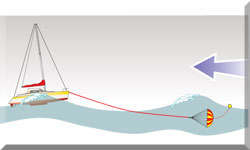
Look for large water-ballast pockets that fill quickly. As a minimum, expect four bags with a total capacity of at least 25 litres per person or 160 litres, whichever is greater. A drogue matters just as much. Its attachment line should be at least 30 metres of 6 mm nylon, and the drogue should be streamed as soon as the raft is launched.
Canopy, floor and boarding
An automatically erecting canopy protects the crew, and its arch helps stop total inversion if the raft lands upside-down or a wave rolls it. Two separate buoyancy compartments mean one can be damaged without losing the lot. For offshore use, choose a double floor and at least ISO 9650, preferably Type 1 Group A. A partial floor may be acceptable for short summer survival around the UK, but if you're heading anywhere cold, don't skimp here.
Boarding is where people are surprised. Climbing in wearing wet clothes and an inflated lifejacket is hard, especially if nobody's inside to help. A boarding ramp or step outside the entrance makes a big difference. Sea survival courses often teach partly deflating the lifejacket to make it easier. It's also worth knowing that heavier 275N jackets are bulkier and can make getting into a raft harder, which is one reason 150N remains the usual offshore choice (we cover that in our offshore lifejackets guide).
Choosing the Right Size: Why Bigger Isn't Safer
Your raft doesn't have to match your berth count. Take an eight-berth boat that only ever sails with two or four aboard. A four-person raft is cheaper and safer for that crew, because an eight-person raft carrying two people lacks stability in anything but the calmest seas.
The closer a raft is to full capacity, the more stable it is. If you occasionally sail with eight, two four-person rafts make more sense than one big one. You'll pay for two services, but each raft is easier to heave around and safer to use. For the odd voyage with a bigger crew, hiring an extra raft is another option.
Think about the weakest person aboard, too. Rafts are heavy, and if only one of you can lift it, that's your real capacity limit.
Valise or Canister?
A valise is a coated fabric bag that fits over the raft like a tight holdall. A canister is a two-part rigid shell in plastic or fibreglass. The trade-off is simple: valise rafts are lighter and usually cheaper, but give less impact, UV and water protection, so they belong in a dry locker. Canisters can live on deck, though they aren't fully waterproof and have drain holes for condensation.
| Point | Valise | Canister |
|---|---|---|
| Where it lives | Dry, accessible locker; must stay dry | Cradle on deck, transom or coachroof |
| Protection | Less impact, UV and water protection | Robust, can be stowed in the open |
| Weight and cost | Generally lighter and cheaper | Heavier, and you need a cradle |
| Automatic release | None. Needs a tie-off point and quick access | Hydrostatic release can be fitted |
| Watch out for | Vacuum-packed bags can swell over time and stop fitting the locker | Release unit has an expiry date, and cradles can be ripped off in extreme seas |
Where to Stow It So You Can Actually Launch It
This is the gap in most buying guides. People spend weeks comparing specs, then wedge the raft wherever it fits. Racing and rally organisers promote a 15-second rule: could you launch yours in that time from the depths of a cave locker, or from a cabin that might now be on fire? In a bad seaway it can take 15 seconds just to think.
Think about capsize
A raft in its canister wants to float upwards, so on an inverted boat it pushes hard into its own fixings and a lid can be held shut by water pressure. Hydrostatic releases trigger at roughly three to four metres depth. That's sinking depth, not capsize depth, so it may not release on an inverted yacht, and if it does, it does so beneath the hull.
The evidence is sobering. When Rambler 100 capsized in the 2011 Fastnet, the crew couldn't deploy two rafts mounted at the after end of the cockpit, which ended up well below the waterline. On Hooligan V in 2007, with a similar stowage position, the surviving crew managed to deploy theirs, just, after the boat lost her keel and turned turtle. Quick-release knots would have sped up the process. And when Cheeki Rafiki was found inverted, her raft was still aboard in its stowage space. Nobody can say what that meant for the outcome, but it's a hard thing to stop thinking about.
The stern is often the answer
On yachts of about 30 ft and up, a pushpit or sugar-scoop transom mounting is often the best compromise where the structure allows it. It generally means less lifting, a quicker release and less chance of snagging on damaged rigging. Check your pushpit first, though. On some production boats the rails and fixings aren't strong enough, mounting feet can flex and work loose, and the coachroof may end up as the fallback.
Whatever you choose, secure the painter to a strong point. It fires the inflation device, so it must stay attached to the yacht when you launch. Then test the whole sequence with the boat's crew, including the person who'd struggle to lift it.
Servicing: Intervals, Agents & the Problem of Being Abroad
Manufacturers typically specify a three-year service, carried out by a factory or factory-approved centre. Read your manual anyway. Some rafts need a first inspection at three years and others at five, and the interval can change after the first cycle. Coded charter use can also require annual inspections, so check the rule that applies to your boat.
Servicing isn't just a tick in a box. It replaces parts with limited life, so use an approved agent and, if you can, be there when the raft is opened and inflated. It's the best way to learn what's inside and how the raft behaves. Check the hydrostatic release date at the same time, since it carries its own expiry.
Servicing on a long passage
This is where cruisers get caught out, and it's rarely covered. A service that falls due in New Zealand can be expensive. A cheaper service in Fiji may come without certification. In parts of the Caribbean, the nearest approved agent for your brand may be on another island. Shipping is another headache, because the CO2 inflation cylinders count as hazardous cargo.
The lesson is to choose a brand with service stations along your intended route before you buy, and to plan where each service will fall. Prices vary widely, so get quotes rather than guessing.
The Grab Bag, the Beacon & What the Raft Won't Carry
The kit that comes inside a raft is basic. Supply packs range from under 24 hours to over 24 hours and SOLAS B, and all of them are thin, so ask to see the contents and add what's missing. Clip the ditch kit, a water jug and a marker float to the raft with carabiners so they don't drift off when you launch.
Pack the grab bag in priority order: first, anything that tells people you're in trouble and where you are; second, protection from the elements; third, medical supplies; fourth, food and water. The bag should float, ideally with a lanyard. Two bags work well, one with permanent contents you never borrow from and a second for items that move in and out, such as the EPIRB and handheld VHF.
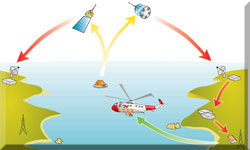
Beacons deserve their own thought. When the Beneteau Oceanis 50 Blue Pearl sank 900 miles from Bermuda, the three crew and their dog took to the raft, endured 8 m waves and 40 knots, and were found the next day. The EPIRB they carried into the raft alerted rescuers and guided them in. Keep a 406 MHz EPIRB on a quick-release bracket by the exit rather than buried in a bag, keep a PLB in the ditch bag, and update your beacon registration before ocean passages. Race rules typically expect a grab bag per raft with its own flotation, a high-visibility patch, the boat's name, a lanyard, a waterproof VHF, torch, flares and a strobe, and that's a good template for cruisers too.
Drills, Roles & Getting the Crew In
Hardware is only half of it. When it comes to the crunch, most people don't act rationally, and that includes experienced sailors. The answer is known, practised roles, written down by the chart table or cockpit bulkhead: who makes the distress call, who prepares the raft, who hands out lifejackets, who grabs the bag. Write the plan down and run through it as a dry drill at least once a season, ideally with everyone who might be aboard, not just the regular crew.
A simple liferaft drill sequence
You don't need to inflate the raft to get most of the value from a drill. Talk the crew through each step in order, on deck, with lifejackets on, so the sequence is familiar rather than something read for the first time in a real emergency.
- Make the call. Whoever's nearest the radio sends the mayday and gives position, before anything else happens. Agree in advance who this is, and who does it if that person is missing or hurt.
- Get everyone dressed for the water. Lifejackets on and inflated, and warm layers on underneath if there's time. Whoever's assigned to the grab bag fetches it now.
- Release and launch the raft. The person nearest the raft frees it from its cradle or locker, checks the painter is made fast to a strong point, and throws it clear before pulling the painter to inflate it.
- Board in order. Your two strongest or most agile crew go in first, to help everyone else. Each person has an agreed place to head for, so nobody's working it out on the day.
- Stream the drogue and check the ballast. Once aboard, someone checks the drogue is out and the ballast pockets are filling. This is what keeps the raft upright.
- Do a head count and take in the grab bag. Confirm everyone's aboard before anyone thinks about the painter.
- Cut the painter only when you're sure. Stay attached to the yacht for as long as it's safe to, since a boat that's still afloat is easier for rescuers to see than a raft.
Time yourselves the first time you run it, then again after everyone's had a go. Most crews are surprised how long step three takes when the raft's buried under gear nobody's moved in months.
Liferaft drill checklist
- Everyone aboard knows where the raft is stowed and how the release works, not just the skipper.
- Painter is tied to a strong point, and that point is checked at the start of each season.
- Roles are assigned and written down: radio call, raft release, grab bag, headcount.
- Grab bag location is known to more than one person, and its contents have been checked since the last trip.
- Boarding order is agreed, with the strongest or most agile crew going in first.
- The whole sequence has been talked through, on deck, within the last twelve months.
And remember that abandoning the yacht is a last resort. The old rule still holds: you step up into the raft, not down. A sea survival course is the best way to practise the parts you can't safely rehearse at home, ideally with the whole crew. If your service agent lets you watch your raft being inflated, go.
Race & Rally Rules: OSR and ARC (Atlantic Rally for Cruisers)
If you're racing or joining a rally, your organiser's rules override your preferences. World Sailing published the 2026-2027 Offshore Special Regulations in December 2025, and Version 2 takes effect on 1 January 2027. The OSR supplement rather than replace government requirements, and inspection cards for categories with a liferaft check servicing certificates and grab bag contents. For the ARC, the raft's test certificate must be submitted in advance and stay in date for the whole rally. Always read the current documents for your event, because requirements change from one edition to the next.
Summing Up
A liferaft is a tiny boat you buy in the hope of never sailing it. That's why the details matter so much: the specification that keeps you warm and upright, the size that keeps it stable, the position that lets you launch it when the deck's tilted or the boat's inverted, and the service history that says it'll inflate on the day. Add a beacon, a grab bag you haven't raided, and a crew who've rehearsed their roles, and you've turned an expensive lump in a locker into a genuine survival system. Buy well, stow it sensibly, service it on time, and practise until it feels boring.

This article was written by Dick McClary, RYA Yachtmaster and author of the RYA publications 'Offshore Sailing', member of The Yachting Journalists Association (YJA), erstwhile member of the Ocean Cruising Club (OCC) and owner/administrator of 'Liveaboard Sailboats for Sale'.

FAQs
Do I legally need a liferaft on my yacht?
Do I legally need a liferaft on my yacht?
Not on a UK pleasure vessel under 13.7 metres. Above that length an approved raft may be mandatory, and races, rallies and coded charter work impose their own requirements.
What's the difference between ISO 9650 Group A and Group B?
What's the difference between ISO 9650 Group A and Group B?
Group A is rated for -15 to +65 degrees C and has an insulated floor. Group B is tested at 0 degrees C, covers 0 to +65 degrees C and has no floor insulation. For high latitudes or long ocean passages, Group A is the safer choice.
How often should a liferaft be serviced?
How often should a liferaft be serviced?
Follow your manufacturer's schedule and use an approved agent. Three years is typical, though some makers differ on the first interval, and coded charter use may require annual inspections. Check the hydrostatic release expiry date at every service.
Should I choose a valise or a canister?
Should I choose a valise or a canister?
A valise suits a dry, accessible locker and is usually lighter and cheaper. A canister tolerates deck stowage and can carry a hydrostatic release. Whichever you pick, make sure you can launch it in seconds and that it can still be released if the boat's inverted.
What size liferaft do I need?
What size liferaft do I need?
Size it for the crew you normally sail with, not for the number of berths. A raft close to full capacity is more stable, and an eight-person raft with two aboard lacks stability in all but calm seas.
Can my inflatable tender replace a liferaft?
Can my inflatable tender replace a liferaft?
No. A tender is a poor second best if you have to abandon ship quickly or in anything but very calm weather. It might help in a fire in flat water, but it doesn't have a raft's canopy, ballast or stability features.
Recent Articles


-
Best Offshore Liferaft: Compare 3 Trusted Options
Sep 29, 26 06:52 AM
Comparing offshore liferafts? See three tested options, from a budget valise raft to a premium ISO 9650 canister raft, with prices and key specs. -
Offshore Liferaft Guide: Choosing, Stowing and Servicing One
Sep 29, 26 06:49 AM
Choosing an offshore liferaft? Learn what ISO 9650 Group A means, where to stow it, how often to service it and what to pack in the grab bag. -
Serious Sailboat Safety Gear: Beacons, Lifejackets, Liferafts
Sep 29, 26 06:38 AM
Serious sailboat safety gear for offshore crews: EPIRBs, PLBs, lifejackets and liferafts, plus the 2026 UK beacon registration change and pre-passage checks.