- Home
- Cruising Yachts 45' to 50'
- Bavaria 47 Sailboat
The Bavaria 47 Sailboat: Specs, Performance Analysis & Cruising Characteristics
Key Takeaways: The Bavaria 47 is a robust, spacious cruiser designed for long-distance passage making and comfortable liveaboard life. While it lacks the displacement-to-length ratio of a dedicated heavy-weather cutter, its Category A Ocean certification and impressive beam make it a stable, predictable performer in most offshore conditions. Buyers should prioritise inspections of the grid matrix and rudder bearings. Overall, it remains one of the best-value 47-footers on the secondhand market.
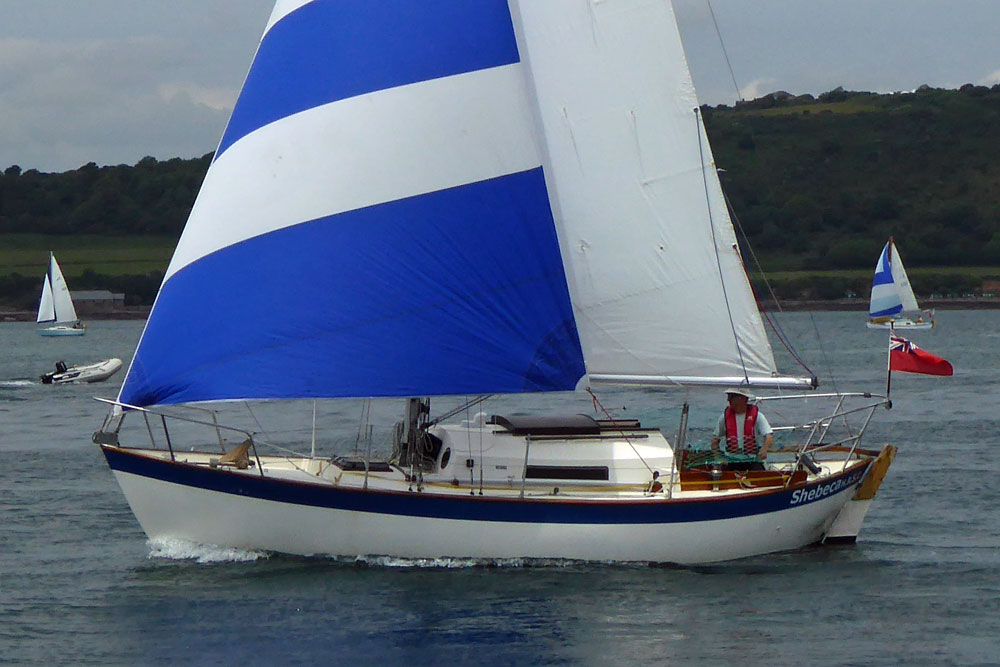
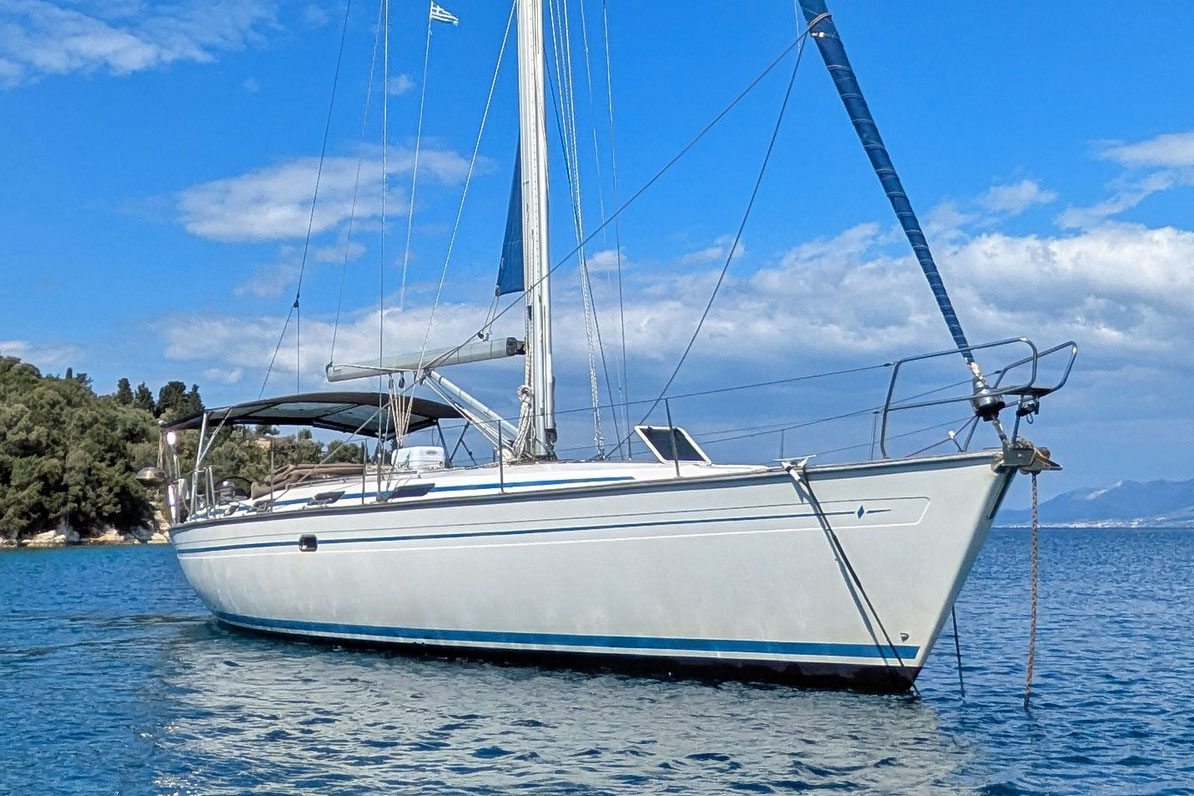 'Suri', a Bavaria 47
Table of Contents
- Design & Construction
- Sail Areas & Rig Dimensions
- Configuration, Layout & Cruising Characteristics
- Published Specification: The Bavaria 47 Blueprint
- Performance Analysis: Understanding the Design Ratios
- The Buyer’s Checklist: Common Problem Areas
- Comparison: Bavaria 47 vs The Competition
- Summing Up
- Frequently Asked Questions (FAQs)
Design & Construction
The Bavaria 47 was created during a golden era for the German shipyard and was designed by the renowned J&J Design team. Built between 1997 and 2002, this model represents the brand's transition into high-volume, efficient production without sacrificing the structural requirements of an offshore yacht. The hull is constructed of solid GRP (Glass Reinforced Plastic) below the waterline, with a Kevlar-reinforced bow section for additional impact resistance—a critical feature for those eyeing bluewater routes.
The defining feature of the Bavaria 47 is its immense interior volume. Unlike many of its contemporaries that sacrificed cabin space for narrow entries, the 47 carries its beam well aft. This design choice provides a massive cockpit and allows for a four-cabin layout that remains functional rather than cramped.
Several versions were produced to cater to different cruising styles. The most common is the deep-draft fin keel version (approximately 2.10m or 6'11"), though a shallow-draft option was available for those cruising the Bahamas or the East Coast of the UK. Rigging focused primarily on a masthead sloop configuration, typically with in-mast furling. This standard convenience defined the Bavaria "easy sailing" philosophy of that era.
Regarding stability, the Bavaria 47 holds a CE Category A (Ocean) rating. This means the vessel is designed for voyages where conditions may exceed wind force 8 on the Beaufort scale and significant wave heights of 4 metres and above. That confirms its status as a capable offshore cruiser.
Sail Areas & Rig Dimensions
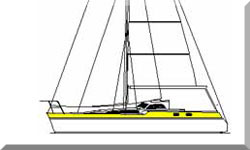
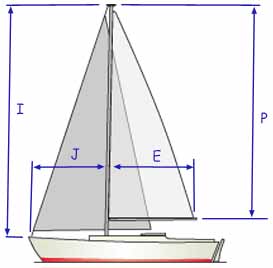 Rig dimensions
The Bavaria 47 utilises a powerful masthead rig that provides enough drive to move her significant displacement in light airs, provided the sails are of high quality.
- Total Sail Area: 1,216 ft² (113.0 m²)
- I (Forestay Height): 58'7" (17.86 m)
- J (Fore-triangle Base): 17'5" (5.31 m)
- P (Mainsail Luff): 51'2" (15.60 m)
- E (Mainsail Foot): 18'1" (5.51 m)
Configuration, Layout & Cruising Characteristics
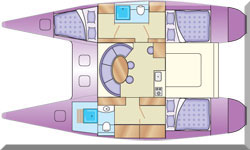
Stepping below decks, the layout is typically configured with either three or four cabins. The four-cabin version is particularly popular for larger families or those who enjoy hosting guests, featuring two double cabins aft and two forward, often in bunk configurations. The linear galley to port is a hallmark of this era, providing extensive workspace and excellent storage, though some traditionalists find it less secure than a U-shaped galley when preparing meals at a high angle of heel.
Tankage is generous for a production boat of this size. With approximately 460 litres (101 gallons) of fuel and 600 litres (132 gallons) of water, the Bavaria 47 is well equipped for extended periods away from the marina. The cockpit is designed for socialising, with a large fixed table and dual steering wheels on later versions. This allows for an easy thoroughfare to the sugar-scoop stern—a blessing for Mediterranean-style boarding or swimming.
Published Specification: The Bavaria 47 Blueprint
| Specification | Data |
|---|---|
| LOA | 47'3" (14.40 m) |
| LWL | 40'2" (12.25 m) |
| Beam | 14'8" (4.48 m) |
| Draft (Deep Keel) | 6'11" (2.10 m) |
| Displacement | 24,912 lbs (11,300 kg) |
| Ballast | 8,157 lbs (3,700 kg) |
| Rig Type | Masthead Sloop |
| Hull Material | GRP & Kevlar |
| Production Dates | 1997 – 2002 |
Performance Analysis: Understanding the Design Ratios
To understand how the Bavaria 47 behaves at sea, we need to look at the key relationships between her dimensions.
| Ratio | Value | Interpretation |
|---|---|---|
| SA/D | 23.0 | High performance; suggests good speed in light to moderate winds. |
| D/L | 172 | Light-medium displacement; indicates a boat that can surf but may have a busier motion. |
| B/D | 33% | Moderate ballast; relies on the wide beam for initial stability. |
| CSF | 1.91 | Below 2.0; considered safe for offshore and ocean passages. |
| Comfort Ratio | 27.8 | Moderate; comfortable for coastal work, will feel lively in a heavy seaway. |
Interpretation & Performance
The Sail Area/Displacement (SA/D) of 23.0 is surprisingly high for a cruising boat, indicating that the Bavaria 47 is not a "motor-sailer" but a genuine performer. In light winds, she will outpace many older, heavier cruising designs. However, the Displacement/Length (D/L) ratio of 172 places her in the light-medium category, so her motion will feel livelier than that of a traditional bluewater cruiser. The Brewer Motion Comfort Ratio of 27.8 supports that picture. For a deeper look at these metrics, see our guide on Understanding Boat Performance & Design Ratios.
Structural Integrity & Stability Dynamics
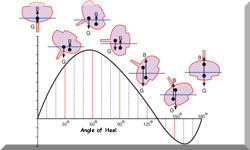
The inclusion of Kevlar in the forward sections of the hull is a significant safety bonus. While GRP is the primary material, the Kevlar adds protection against floating objects often encountered during ocean crossings. The Bavaria 47's stability is driven largely by form stability, meaning she gains much of her upright resistance from her 14'8" beam. This makes for a very stiff boat initially, which is comfortable for the crew because the boat does not heel excessively in moderate gusts.
The Buyer’s Checklist: Common Problem Areas
When inspecting a Bavaria 47, focus on these specific areas:
- Rudder Bearings: These are known to wear, leading to "play" in the steering. Check for any knocking sounds while underway.
- The Iron Keel: Unlike lead keels, the iron keel on the Bavaria requires diligent maintenance to prevent rust bleeding. Inspect the keel-to-hull joint for "smile" cracks.
- Internal Grid Matrix: Inspect the floors and stringers (the "matrix") bonded to the hull. Look for signs of debonding or cracking near the keel bolts, which could indicate a previous hard grounding.
- In-Mast Furling: If the original Selden rig is still in place, ensure the furling mechanism is smooth. A jammed mainsail at sea is a major safety risk.
- Original Volvo Penta Seal: Check the age of the sail-drive diaphragm. These generally require replacement every 7 to 10 years.
Comparison: The Bavaria 47 vs The Competition
- Beneteau Oceanis 473: The 473 is perhaps the closest rival. The Beneteau often feels slightly more refined in its interior joinery, but the Bavaria 47 usually offers a simpler, more robust deck layout that is easier for a couple to manage shorthanded.
- Sun Odyssey 45.2: The Jeanneau is often praised for its sleek lines, but it lacks the sheer internal volume and "big boat" feel of the Bavaria 47.
- Oceanis 411: While smaller, the 411 is often compared by buyers. The Bavaria 47 provides significantly better performance in light airs and much larger tankage for serious cruising.
If you'd like to compare this boat with others in this size range, take a look at Cruising Boats from 45' to 47' overall....
Could this be your ideal cruising boat?
It may well be, but before going any further, it might be worth taking a look at my eBook 'How to Avoid Buying the Wrong Sailboat'...
Summing Up
The Bavaria 47 is a masterclass in providing volume and speed at an accessible price point. While its design ratios suggest a boat that is more "performance-cruiser" than "heavy-weather tank," its CE Category A rating and Kevlar-reinforced hull provide the credentials needed for ocean crossings. It is a pragmatic choice for the sailor who wants a capable, spacious, and fast cruiser without the premium price tag of a boutique brand.
This article was written by Dick McClary, RYA Yachtmaster and author of the RYA publications 'Offshore Sailing' and 'Fishing Afloat', member of The Yachting Journalists Association (YJA), and erstwhile member of the Ocean Cruising Club (OCC).
Frequently Asked Questions (FAQs)
Is the Bavaria 47 suitable for a solo sailor?
Is the Bavaria 47 suitable for a solo sailor?
While large, the sail plan is manageable thanks to the furling systems, and the dual steering setup helps movement through the cockpit. However, a powerful bow thruster is highly recommended for close-quarters manoeuvring because of the high topsides.
How does the iron keel affect performance compared to lead?
How does the iron keel affect performance compared to lead?
The iron keel has a higher centre of gravity than a lead keel of the same weight. Consequently, the Bavaria 47 relies more on its hull shape (beam) for stability than on the weight of the keel alone.
Are there known issues with the hull-to-deck joint?
Are there known issues with the hull-to-deck joint?
The Bavaria 47 uses a traditional "shoebox" joint that is both glued and bolted. It is generally very dry and robust, though it should be checked at the stanchion bases for any signs of stress.
What is the typical cruising speed under engine?
What is the typical cruising speed under engine?
With a 50hp to 75hp Volvo Penta, you can expect a comfortable cruising speed of 7.5 knots at 2,200 RPM, with a top speed near 8.5 knots.
Does the wide beam make it difficult to find marina berths?
Does the wide beam make it difficult to find marina berths?
At 4.48m (14'8"), it is at the upper limit for standard 15-metre berths. You may find yourself paying a premium in some older European marinas with narrow slips.
Recent Articles


-
Discovery 55 Sailboat Review: Specs, Ratios & Bluewater Capability
Oct 14, 26 06:04 AM
Detailed Discovery 55 buyer’s guide covering specs, ratios, sailing behaviour, problem areas and bluewater suitability. -
Should I Buy a Boat? Four Questions to Answer Before You Commit
Oct 02, 26 04:40 AM
Thinking "Should I buy a boat?" This guide helps you decide, with key considerations from cost & maintenance to your personal sailing aspirations. -
Offshore Internet with Starlink: Hardware, Plans, and Setup Guidance
Oct 01, 26 01:15 PM
A clear, practical guide to choosing the right Starlink hardware and plan for offshore cruising. Learn what to buy, how to install it, and how to manage power afloat.