- Home
- Cruising Yachts 35' to 40'
- Beneteau First 375
The Beneteau First 375 Sailboat
Specs, Performance Analysis & Cruising Characteristics
Key Takeaways
The Beneteau First 375 is a versatile light-to-moderate displacement performance cruiser that excels in light-to-medium winds. It offers a stiffer, more predictable ride than its smaller predecessors, making it a capable coastal and occasional offshore voyager. While the hull is solid GRP, its balsa-cored deck requires careful inspection. Internally, the two or three-cabin layouts provide excellent ergonomics, though the modest original tankage reflects its design intent for fast cruising rather than indefinite off-grid living.
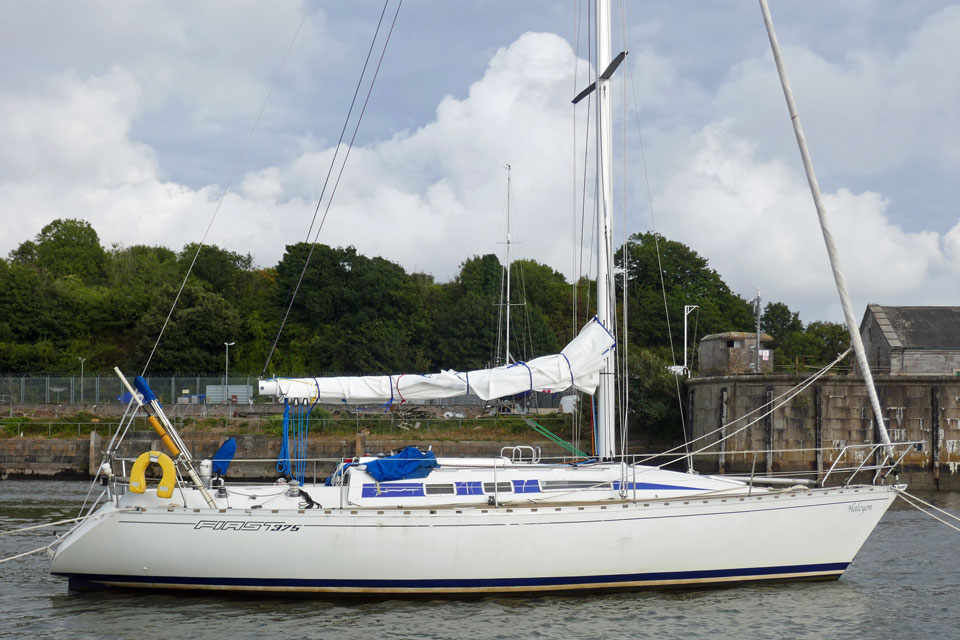 A Beneteau First 375
Table of Contents
- Design & Construction
- Sail Areas & Rig Dimensions
- Published Specification: The Beneteau First 375 Blueprint
- Performance Analysis: Understanding the Design Ratios
- The Buyer’s Checklist: Common Problem Areas
- Comparison: Beneteau First 375 vs The Competition
- Configuration, Layout & Cruising Characteristics
- Summing Up
- Frequently Asked Questions (FAQs)
The Beneteau First 375 occupies a unique space in the history of the French shipyard, arriving during a golden era when the "First" range was transitioning from pure racing pedigree to a more refined balance of speed and genuine cruising comfort. Designed by Jean Berret, a man whose portfolio helped define the performance cruiser, the First 375 was produced between 1985 and 1989. It remains a firm favourite for sailors who prioritise a "sailor’s boat" that can handle a cross-channel hop as easily as a weekend club race. With its sleek lines, balanced sail plan, and surprisingly commodious interior, it offers a robust alternative to modern, high-volume production boats that often sacrifice pointing ability for internal headroom.
Design & Construction
Jean Berret’s design for the First 375 was a masterful evolution. Unlike the utilitarian approach of some contemporaries, Berret injected an "artistic" flair into the hull lines, resulting in a yacht that still looks contemporary four decades later. Built by Beneteau in France, the hull is constructed of solid hand-laid GRP, bolstered in high-stress areas like the keel stub and chainplates.
Defining Feature & Versions
The defining feature of the First 375 is its balance of a long waterline length and a relatively narrow beam compared to modern 37-footers. This configuration allows for excellent tracking and a "sweet" helm that communicates clearly with the sailor.
Beneteau produced the 375 in several configurations to suit various cruising grounds:
- Deep Draft: A 6'6" (1.98m) fin keel version for those seeking maximum upwind performance.
- Shoal Draft: A 5'6" (1.50m) version intended for shallower coastal waters and estuaries.
- Layouts: Typically found in a two-cabin "Owner’s" version with a generous aft cabin and large head, or a three-cabin version more suited to larger crews or charter service.
Sail Areas & Rig Dimensions
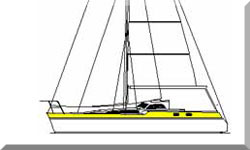
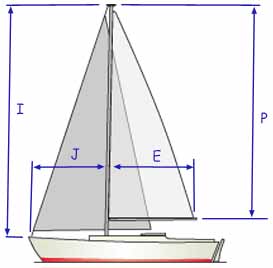 Rig dimensions
The First 375 carries a powerful masthead sloop rig. The mast is typically a deck-stepped aluminium spar with double spreaders, providing a stable platform for a variety of sail combinations.
- I (Foretriangle Height): 49'0" (14.94m)
- J (Foretriangle Base): 13'8" (4.18m)
- P (Mainsail Hoist): 43'1" (13.14m)
- E (Mainsail Foot): 14'6" (4.42m)
Individual Sail Areas:
- Mainsail: 312.5 ft² (29.0 m²)
- Forehand (100% Triangle): 335.7 ft² (31.2 m²)
- Total Upwind Sail Area (Standard): 648.2 ft² (60.2 m²)
Published Specification: The Beneteau First 375 Blueprint
| Specification Parameter | Data Value |
|---|---|
| Length Overall (LOA) | 37'1" (11.30m) |
| Waterline Length (LWL) | 33'2" (10.11m) |
| Beam | 12'4" (3.76m) |
| Draft (Deep/Shoal) | 6'6" (1.98m) / 5'6" (1.50m) |
| Displacement | 15,432 lbs (7,000kg) |
| Ballast | 5,291 lbs (2,400kg) |
| Rig Type | Masthead Sloop |
| Hull Material | GRP (Solid Fiberglass) |
| Production Dates | 1985 – 1989 |
Performance Analysis: Understanding the Design Ratios
To truly understand how the First 375 behaves, we must look beyond the aesthetics and into the mathematics of its design. These ratios provide a window into the boat’s soul. For a deeper dive into these metrics, see our guide on Understanding Boat Performance & Design Ratios.
| Ratio | Calculated Value | Expert Interpretation |
|---|---|---|
| Sail Area / Displacement (SA/D) | 16.8 | Indicates a "conservative performance" profile. It has enough power to move in light airs but isn't over-canvassed. |
| Displacement / Length (D/L) | 189 | Classified as light-to-moderate. This ensures the boat is easily driven and responsive to helm inputs. |
| Ballast / Displacement (B/D) | 34.3% | A respectable figure that suggests moderate stiffness. The boat stands up well to its canvas in a breeze. |
| Capsize Screening Formula (CSF) | 1.98 | Just under the critical 2.0 threshold. It is technically suitable for ocean passages, though coastal work is its forte. |
| Brewer Motion Comfort Ratio | 24.5 | Typical of a lighter coastal cruiser. It will have a more active motion in a heavy seaway compared to a heavy-displacement vessel. |
Structural Integrity & Stability Dynamics
The solid GRP hull provides a reassuring foundation. Unlike cored hulls of the same era, the 375’s hull is less prone to catastrophic delamination from water ingress. However, the use of a balsa-cored deck means that any poorly sealed hardware—cleats, winches, or stanchion bases—can lead to localized rot.
The stability of the First 375 is derived from its generous ballast and hull form. With a CSF of 1.98, it sits right on the line between a dedicated coastal cruiser and a yacht capable of blue water voyaging. In practice, this means while it is safe for offshore jumps, the motion will be "snappier" than a heavier boat, requiring more stamina from the crew during multi-day passages.
The Buyer’s Checklist: Common Problem Areas
When inspecting a First 375, keep a sharp eye on these model-specific and age-related issues:
- Deck Core Moisture: Use a moisture meter around all deck fittings. Spongy sections or brown staining around the headliner usually indicate balsa rot.
- Grid and Pan Bonding: Check the bilge for any separation between the internal structural grid and the hull, especially near the keel bolts. Hard groundings can compromise this bond.
- Engine Maintenance: Many original units were Volvo Penta 2003 series (28hp). While reliable, they are aging and spares can be pricey. Check for "weeping" at the raw water pump.
- Stanchion Bases: The cast aluminium bases are known to develop stress cracks. Inspect them closely for any signs of failure.
- Headliners: Like many French yachts of this era, the foam-backed vinyl headliners eventually degrade and sag. Replacing these is a labor-intensive refit.
- Rudder Bearings: Check for excessive play in the spade rudder. Nylon bearings may need replacement after 35+ years.
Comparison: Beneteau First 375 vs The Competition
While the First 375 is often compared to its sibling, the Oceanis 390 or the newer Oceanis 40, its true competition in the secondhand market often comes from the Voyage 12.50 or the Catalina 375.
The Voyage 12.50 is significantly larger and leans more toward the "charter-comfort" end of the spectrum, offering more interior volume but lacking the nimble feel of the First 375. If your goal is pure living space, the Voyage wins. However, for the sailor who enjoys the journey as much as the destination, the First 375 offers a far more rewarding experience at the helm.
Compared to a Catalina 375, the Beneteau feels more "Continental." The Catalina is beamier and offers better "dockside" comfort, but the First 375 typically carries more sophisticated hardware and displays better upwind performance in moderate chop.
Configuration, Layout & Cruising Characteristics
Stepping below deck, the First 375 greets you with a level of timber joinery that modern production boats struggle to match.
- The Galley: The U-shaped galley is a standout. It provides excellent bracing for the cook while underway and features impressive storage for a boat of this size.
- Tankage: One of the few drawbacks for long-distance cruising is the original tankage. With roughly 95 litres (21 gallons) of fuel and 136 litres (30 gallons) of water, you will likely need to install additional bladders or a watermaker for extended voyaging.
- Cockpit Function: The cockpit is narrower than modern designs, which is a boon at sea as it provides better bracing points. However, the 36" wheel can feel a bit intrusive when entertaining at anchor.
Could this be your ideal cruising boat?
It may well be, but before going any further, it might be worth taking a look at my eBook 'How to Avoid Buying the Wrong Sailboat'...
Summing Up
The Beneteau First 375 is a classic example of "they don't build them like they used to." It avoids the "caravan" feel of modern wide-stern cruisers in favour of a hull that slices through water with grace. While the design ratios suggest a boat better suited to coastal work than Cape Horn, its structural integrity and balanced handling make it a very safe and rewarding platform for a couple or small family. Provided you can find one where the balsa deck is dry and the engine has been loved, it remains one of the best value-for-money performance cruisers on the secondhand market.
If you'd like to compare this boat with others in this size range, take a look at Cruising Boats from 35' to 40' overall....
This article was written by Dick McClary, RYA Yachtmaster and author of the RYA publications 'Offshore Sailing' and 'Fishing Afloat', member of The Yachting Journalists Association (YJA), and erstwhile member of the Ocean Cruising Club (OCC).
Frequently Asked Questions (FAQs)
Is the Beneteau First 375 suitable for solo sailing?
Is the Beneteau First 375 suitable for solo sailing?
Yes. With all lines led aft to the cockpit and a relatively light displacement, the 375 is easily managed by a single-handed sailor, especially if equipped with an updated autopilot.
How does the First 375 handle in heavy weather?
How does the First 375 handle in heavy weather?
She is a stiff boat that carries her beam well aft. However, being a light-to-moderate displacement yacht, she will begin to feel lively as the sea state builds. Early reefing is the key to maintaining control and comfort.
Can I take a First 375 across the Atlantic?
Can I take a First 375 across the Atlantic?
While many have done so, her Capsize Screening Formula of 1.98 is right at the limit. For serious blue water work, you would want to upgrade the tankage and ensure the rudder and keel attachments are in top condition.
What is the typical cruising speed under power?
What is the typical cruising speed under power?
With a clean hull and a standard 28hp engine, you can expect a comfortable cruising speed of 6.0 to 6.5 knots, with a maximum hull speed of approximately 7.7 knots.
Which is better: the two-cabin or three-cabin version?
Which is better: the two-cabin or three-cabin version?
For a couple, the two-cabin version is vastly superior. It offers a much larger head and a more accessible aft cabin. The three-cabin version is best reserved for those frequently hosting large groups.
Recent Articles


-
Westerly Cirrus – Specs, Performance & Buyer’s Guide for the Cirrus 22
May 14, 26 03:32 PM
An in‑depth Westerly Cirrus 22 review covering specs, design ratios, sailing performance, bluewater limits, common issues and buyer’s checklist for this classic 22‑foot Westerly cruiser. -
Shearwater 45 Sailboat Review – Specs, Ratios & Bluewater Capability
May 14, 26 04:28 AM
A practical, owner‑focused review of the Shearwater 45 sailboat covering specs, design ratios, bluewater suitability, layouts, common issues and buyer tips for serious cruisers. -
Jeanneau Sun Odyssey 519 Review – Specs, Ratios & Cruising Insight
May 11, 26 03:32 AM
In‑depth Jeanneau Sun Odyssey 519 review covering specs, design ratios, sailing performance, bluewater capability, layouts and buyer checklists for serious cruisers researching this modern 50‑footer.

Specs, Performance Analysis & Cruising Characteristics of Popular Cruising Boats...
A few of our Most Popular Pages...


Copyright © 2026 Dick McClary Sailboat-Cruising.com