- Home
- Sailboats 50'-55'
- Beneteau Idylle 51 Review
Beneteau Idylle 51 Review: Offshore Capability and Buying Points
Key Takeaways: The Beneteau Idylle 51 (often listed as the Idylle 15.50 or Idylle 1550) is a mid‑1980s German Frers design aimed squarely at long‑range cruising rather than club racing. It is a solidly built, moderate‑displacement fin‑keel cruiser with a skeg‑hung or semi‑spade rudder lineage and a powerful masthead rig that rewards sailors who like to keep the boat moving in proper breeze rather than chase light‑air performance. It offers a big, practical interior, generous tankage and reassuring behaviour offshore, at the cost of some windward sharpness and marina manoeuvrability. Well‑kept examples suit experienced cruising couples or families planning ocean passages and liveaboard life; tired ex‑charter boats with deferred maintenance can be expensive projects if you buy with rose‑tinted glasses.
 Beneteau Idylle 51
Table of Contents
- The Beneteau Idylle 51 at a Glance
- Design & Construction
- Published Specification: The Beneteau Idylle 51 Blueprint
- Sail Areas & Rig Dimensions
- Performance Analysis: Understanding the Design Ratios
- How the Beneteau Idylle 51 Sails
- Bluewater Capability: Strengths & Trade-Offs
- Configuration, Layout & Cruising Characteristics
- Who This Boat Is Best For
- The Buyer’s Checklist: Common Problem Areas
- Summing Up
- Frequently Asked Questions (FAQs)
The Beneteau Idylle 51 at a Glance
- Type: Bluewater‑leaning cruising monohull, fin keel, skeg‑influenced underbody
- Designer: German Frers
- Builder: Beneteau, France
- Production years: Approximately 1984–1987 (marketed as Idylle 15.50 / Idylle 1550 and Moorings 51)
- Rig: Masthead cutter
- Best for: Long‑distance cruising, Atlantic circuits, liveaboard use, ex‑charter refits with eyes wide open
- Strengths: Strong hull lay‑up for the era, generous interior volume, good tankage, predictable offshore motion, respectable passagemaking speeds
- Trade‑offs: Age‑related refit burden, limited access behind moulded liners, ex‑charter hard use, not a light‑air flyer, big‑boat loads for short‑handed crews
Design & Construction
The Idylle 51 sits in Beneteau’s mid‑80s “Idylle” line, conceived as comfortable cruising yachts distinct from the racier First series. German Frers drew a moderate‑beam hull with a fairly deep canoe body, raked bow and a clean sheer that will look familiar to anyone who knows his Swan and Hylas work of the same period.
Hull, deck & structure
The hull is solid fibreglass, with reports of substantial laminate thickness at and below the waterline compared with later production Beneteaus. One well‑known brokerage review notes around 1½" (38 mm) laminate at the waterline increasing to roughly 3" (75 mm) lower down, which aligns with the “over‑built” reputation these boats have among surveyors and owners.
The deck is a balsa‑cored moulding, typical of the era. That keeps weight down high up but introduces the usual inspection points:
Deck core: look for moisture around chainplates, stanchion bases, genoa tracks and the mast step. Any long‑term leaks can lead to localised core damage and compression.
Beneteau used multiple moulded liners to form the interior structure and furniture. This gives a stiff, quiet boat but can make access to hull‑to‑deck joints, tankage and wiring runs more awkward. When you survey one, budget extra time to trace hidden spaces and confirm there are no trapped leaks.
Keel & rudder
Most Idylle 51s carry a deep fin keel with a 6'0"(1.83mm) draft, external lead bolted to a substantial keel stub.
Rudder configuration is described slightly differently across sources:
- SailboatData lists a fin with spade rudder.
- Narrative reviews and owner guides describe a skeg‑hung rudder or at least a partial skeg ahead of the blade, giving extra protection and tracking.
In practice, the underbody is more conservative than a pure fin‑and‑spade racer, with good directional stability and some protection for the rudder stock, which bluewater buyers tend to appreciate.
Windows & chainplates
Cabin windows / portlights: Mid‑80s Beneteaus of this size typically used framed aluminium portlights and large saloon windows that are mechanically fastened rather than purely bonded. On Idylle 51s, expect through‑bolted or screwed frames with sealant rather than modern adhesive‑bonded glass. The upside is straightforward replacement; the downside is that, after decades, seals harden and fasteners can weep, so leaks around the saloon windows and fixed lights are a common survey note.
Chainplates: Chainplates are stainless steel, passing through the deck and tied into substantial glassed‑in structure inside the hull. They are not usually fully “bonded and laminated” in the modern sense, but they are well integrated into the structural grid. After nearly forty years, crevice corrosion at deck level and hidden attachment points is a real concern. Pulling at least some chainplates for inspection is strongly recommended on purchase.
Versions & layouts
Across Idylle 51 / 15.50 / 1550 listings and brochures you will see:
Keel options:
Deep fin around 6'6" (1.98 m) most common; some boats closer to 6'0" (1.83 m) draft.
Rig options: Marketed variously as masthead sloop, cutter and “slutter”. In practice most boats have two forestays: a primary genoa and an inner forestay for a smaller headsail or storm jib. Many owners sail them as a single‑headsail boat day‑to‑day, using the inner stay offshore.
Cockpit: Aft cockpit only (no centre‑cockpit variant), with a relatively high, sheltered position that charter operators liked for visibility and safety.
Interior layouts:
- Master cabin either forward or aft with ensuite
- Two additional double guest cabins
- Twin‑berth crew cabin in the forepeak on many boats. This gives three or four sleeping cabins plus a large saloon and proper navigation station.
Published Specification: The Beneteau Idylle 51 Blueprint
| Specification | Value |
|---|---|
| LOA | 51'5" (15.68 m) |
| LWL | 37'11" (11.56 m) |
| Beam | 14'8" (4.47 m) |
| Draft (deep fin) | 6'0"–6'6" (1.83–1.98 m) |
| Displacement | 33,069 lb (15,000 kg) |
| Ballast | 13,007 lb (5,900 kg) lead |
| Rig type | Masthead cutter / slutter |
| Hull material | Fibreglass (solid laminate hull, balsa‑cored deck) |
| Engine (typical) | Perkins 4‑236 diesel, 85 hp |
| Fuel capacity | 132 gal (500 L) |
| Water capacity | 200 gal (757 L) |
| Production dates | c.1984–1987 |
Sail Areas & Rig Dimensions
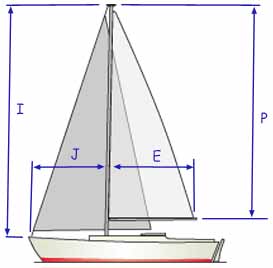 Rig dimensions
- I: 60.0' (18.30 m)
- J: 20.0' (6.10 m)
- P: 52.2' (15.90 m)
- E: 17.4' (5.30 m)
- Mainsail area (triangular): 453 ft² (42.1 m²)
- Foretriangle (100% headsail): 601 ft² (55.8 m²)
- Total working sail area (main + 100% foretriangle): 1,054 ft² (97.9 m²)
- Typical cruising genoa: up to around 1,410 ft² (131 m²) quoted sail area with overlap
For real‑world use, many owners cruise with a high‑cut genoa and a smaller inner headsail, plus a downwind sail (asymmetric or symmetric spinnaker) for lighter conditions.
Performance Analysis: Understanding the Design Ratios
Using the published displacement, waterline length and sail area, the key ratios are:
- Sail area / displacement (SA/D)
- Displacement / length (D/L)
- Ballast / displacement (B/D)
- Capsize screening formula (CSF)
- Brewer motion comfort ratio
| Ratio | Value | What it means in practice |
|---|---|---|
| Sail Area / Displacement (SA/D) | ≈ 22 | Indicates a reasonably powerful rig for a cruising boat of this size. The Idylle 51 is no light‑air rocket, but once the breeze is up into the low‑ to mid‑teens it has enough canvas to keep speeds in the 7–8 knot range on passage. |
| Displacement / Length (D/L) | ≈ 271 | A moderate‑to‑heavy figure by modern production standards. This points to good momentum and a comfortable, less jerky motion offshore, at the cost of some acceleration and light‑air agility. |
| Ballast / Displacement (B/D) | ≈ 39% | A healthy ballast ratio for a cruising yacht, contributing to stiffness and the ability to stand up to sail. Owners often report reefing later than on lighter, more lightly ballasted 50‑footers. |
| Capsize Screening Formula (CSF) | ≈ 1.83 | Below the commonly cited 2.0 threshold for offshore work. This supports the boat’s reputation as a capable ocean cruiser rather than a coastal‑only design. |
| Brewer Motion Comfort Ratio | ≈ 34 | A relatively high comfort ratio, suggesting a slower, more predictable motion in a seaway. This is one reason many long‑term cruisers favour the Idylle 51 over racier 50‑footers when planning long passages. |
Taken together, these ratios paint a consistent picture: the Idylle 51 is a moderately heavy, reasonably canvassed cruiser with good stability and a comfortable motion, optimised for passagemaking rather than light‑air club racing.
For more on this topic, you might want to take a look at Understanding Boat Performance & Design Ratios...
How the Beneteau Idylle 51 Sails
Upwind
Upwind, the Idylle 51 behaves like a serious cruiser rather than a modern performance boat. With a clean bottom and a decent headsail, you can expect:
- True wind 10–12 knots: 5–6 knots boatspeed, tacking angles wider than a modern fin‑and‑spade design.
- True wind 15–20 knots: 6.5–7.5 knots, with the boat settling into a steady groove and tracking well.
The relatively high D/L means it likes to lean on its waterline and carry momentum. Pointing is respectable but not razor‑sharp; if you are used to a performance cruiser, you will sail a few degrees lower and a touch faster rather than pinch.
Reaching & downwind
On a reach, the Frers hull comes alive. With the big genoa or a reaching kite, 7–8 knots is sustainable in mid‑teens breeze, and you will see higher bursts surfing in longer swells. Downwind, the longish waterline and directional stability make for relaxed steering, especially with a skeg‑influenced rudder and a well‑set autopilot.
Many owners report that the boat feels happiest on a broad reach in 15–25 knots, where it will cover serious miles without drama.
Helm & balance
The helm is generally described as light and predictable for a 51‑footer, with good feedback. The caveat is that loads are big: this is a boat that benefits from:
- Well‑maintained steering gear (hydraulic or cable)
- Sensible sail handling upgrades (electric windlass, decent winches, possibly electric primaries)
With the right headsail choice and a reef in the main at the right time, weather helm stays manageable and the autopilot can steer for long periods without complaint.
Short‑handed behaviour
Short‑handed, the Idylle 51 is entirely manageable for an experienced couple, but it is still a 50‑footer with big sails and heavy ground tackle. Key points:
- In‑mast furling is rare on original boats; most have slab‑reefed mains. Lazyjacks and a good boom bag are almost mandatory.
- A well‑set‑up inner forestay with a smaller headsail makes life much easier in rising breeze.
- The high, protected cockpit is a plus offshore, but the long foredeck means you want proper jackstays and handholds for sail changes.
If you are stepping up from a 35–40 footer, expect a learning curve in boat handling and line loads, not in basic manners.
Bluewater Capability: Strengths & Trade-Offs
Offshore suitability & seakindliness
The combination of moderate‑heavy displacement, decent ballast ratio and a relatively deep canoe body gives the Idylle 51 a reassuring, “big‑ship” feel offshore. Owners who have crossed oceans in them often highlight:
- Predictable motion in trade‑wind swell
- Good tracking downwind
- No tendency to slam excessively upwind in moderate seas
The CSF and comfort ratio figures support this anecdotal record.
Tankage & load‑carrying
With around 200 gal (757 L) of water and 132 gal (500 L) of fuel as standard, the Idylle 51 starts with respectable tankage for a 1980s cruiser. Many ex‑charter boats have had additional tanks or bladders added over the years.
The hull will carry cruising gear without complaint, but like any boat, there is a limit. Overloading the ends with heavy anchors, chain and toys will increase pitching and reduce performance. Kept sensible, the design tolerates bluewater loads well.
Deck safety
- High coamings and a deep cockpit give a secure feeling offshore.
- Side decks are wide, with a sensible toerail and decent handholds.
- Original guardwires and stanchions will likely need upgrading if they are still original.
The main safety trade‑off is age: you are relying on 1980s stainless, deck fittings and core. A thorough refit of standing rigging, chainplates, guardwires and key deck hardware should be treated as part of the purchase price, not an optional extra.
Configuration, Layout & Cruising Characteristics
Cockpit & deck ergonomics
The aft cockpit is large enough for charter guests yet still workable for a cruising crew. The wheel is well aft, with good visibility forward. Winch placement is generally sensible, though some boats benefit from upgraded primaries and additional rope clutches to bring more lines aft.
The long foredeck is excellent for sail handling and dinghy storage, but you will want:
- Strong padeyes for downwind gear
- A robust bow roller and windlass (many boats have already been upgraded)
Interior & liveaboard comfort
Below, the Idylle 51 feels like a proper small ship rather than a floating apartment:
- Saloon: big U‑shaped seating area, often to port, with a large table and a straight settee opposite.
- Galley: usually along the passage to the aft cabin or in an L‑shape, with good bracing points and plenty of stowage.
- Cabins: three main double cabins plus a twin‑berth crew cabin in the forepeak on many layouts.
- Heads: typically two or three, with at least one ensuite to the owner’s cabin.
Headroom is generous (around 6'6" / 2.0 m), and the beam gives a sense of space that still feels competitive today. Ventilation is adequate but can be improved with modern hatches and fans.
For liveaboard use, the boat scores highly on:
Stowage volume
- Workable galley at sea
- Proper navigation station
- Separation between owner and guest cabins
Noise and vibration levels under way are generally low thanks to the solid hull and structural liners.
Who This Boat Is Best For
Good fit for:
- Experienced cruising couples planning Atlantic circuits, Pacific hops or a circumnavigation who value comfort and seakindliness over light‑air performance
- Families wanting multiple real cabins and good privacy for long‑term liveaboard life
- Buyers comfortable taking on a serious refit in exchange for a strong, well‑designed hull at an attractive purchase price
Less ideal for:
- Sailors looking for a nimble, performance‑oriented 50‑footer for club racing
- First‑time boat owners stepping straight into a 50‑footer without the budget or appetite for big‑boat maintenance
- Buyers who want a low‑maintenance, “turn‑key” boat with all major systems already renewed in the last five years
The Buyer’s Checklist: Common Problem Areas
On a nearly 40‑year‑old Idylle 51, the hull design is rarely the weak point. The issues are age, charter history and refit quality. A pragmatic checklist:
- Osmosis & hull condition: Blistering is not endemic but can appear on any 1980s fibreglass hull. Look for previous peel and re‑coat work and check how it was done.
- Keel & keel bolts: Inspect for grounding damage, cracking at the keel‑to‑hull joint and corrosion on keel bolts. External lead keels are robust, but hard charter lives can leave scars.
- Rudder & steering: Check for play in bearings, moisture in the rudder blade and any signs of delamination. Steering systems (quadrant, cables or hydraulics) need careful inspection and, often, renewal.
- Deck core & leaks: Moisture around chainplates, stanchions, genoa tracks and mast step is common. Use a moisture meter and percussion testing; budget for localised recoring if needed.
- Windows & hatches: Leaks around saloon windows and older hatches are frequent. Replacement portlights and hatches are a straightforward but not trivial cost on a 51‑footer.
- Chainplates & rigging: If standing rigging is more than 10 years old, plan to replace it. Pull at least some chainplates to inspect for crevice corrosion. A full rig and chainplate refit can easily run into the low‑ to mid‑five figures in pounds, dollars or euros.
- Engine & systems: The original Perkins 4‑236 is a tough unit but now elderly. Check hours, service history, cooling system condition and mounts. Repowers are expensive; a tired engine should be reflected in the price.
- Tankage: Stainless tanks can suffer from pitting and access is sometimes awkward behind liners. Check for diesel leaks, water contamination and any history of tank replacement.
- Electrical & electronics: Many boats have had multiple generations of wiring and electronics layered on. A clean, well‑documented electrical refit is a big plus; a rat’s nest behind the panel is a warning sign.
Potential deal‑breakers
- Extensive, poorly repaired grounding with structural distortion
- Widespread wet core in deck and coachroof
- Severely corroded chainplates with no easy access
- Rudder with advanced structural failure
- Neglected ex‑charter boat with no meaningful refit history and a top‑of‑market asking price
A sound hull with honest cosmetic wear is far preferable to a shiny paint job hiding structural shortcuts.
Could this be your ideal cruising boat?
It may well be, but before going any further, it might be worth taking a look at my eBook 'How to Avoid Buying the Wrong Sailboat'...
Summing Up
The Beneteau Idylle 51 is one of those 1980s designs that has aged well for sailors who care more about miles than marina posing. On paper, the design ratios show a moderate‑heavy cruiser with a decent amount of sail, good ballast and reassuring stability. On the water, that translates into a boat that settles into a steady rhythm offshore, tracks well downwind and offers a comfortable motion when the sea gets up.
The trade‑offs are clear. You are buying age, with all the refit implications that brings: rigging, chainplates, tanks, wiring, windows and sometimes engines. You are also buying a big boat to handle, with loads that demand respect and sensible upgrades for short‑handed sailing.
If you find a structurally sound example with a documented refit history, the Idylle 51 can still be a very capable bluewater and liveaboard platform at a fraction of the cost of a newer “bluewater” brand. If you treat the survey and refit planning as seriously as the dream, it is a design that can look after you for a long time.
 DMcC
DMcCThis article was written by Dick McClary, RYA Yachtmaster and author of the RYA publications 'Offshore Sailing' and 'Fishing Afloat', member of The Yachting Journalists Association (YJA), and erstwhile member of the Ocean Cruising Club (OCC).

Frequently Asked Questions (FAQs)
Is the Beneteau Idylle 51 suitable for a circumnavigation?
Is the Beneteau Idylle 51 suitable for a circumnavigation?
Yes, many owners consider the Idylle 51 entirely suitable for a circumnavigation, provided the individual boat is structurally sound and properly refitted. The hull form, ballast ratio, CSF and comfort ratio all support offshore use, and owner reports from Atlantic crossings are positive about comfort and reliability. The limiting factor is not the design but the condition of a nearly 40‑year‑old yacht.
What sort of passagemaking speeds can I expect?
What sort of passagemaking speeds can I expect?
On a well‑prepared Idylle 51, you can plan on 6.5–7.5 knots average on ocean passages, with daily runs in the 150–180 nm range in settled trade‑wind conditions. In lighter airs you will be slower unless you are willing to fly bigger downwind sails and keep the boat pressed. The design is happiest once the true wind is in the low‑ to mid‑teens.
How does the Idylle 51 compare to other bluewater cruisers like an Amel Super Maramu or an Oyster 485?
How does the Idylle 51 compare to other bluewater cruisers like an Amel Super Maramu or an Oyster 485?
Compared with an Amel Super Maramu, the Idylle 51 is simpler and less systems‑heavy, with a more conventional rig and layout but without some of the integrated bluewater features Amel is known for. Against an Oyster 485, it is generally less expensive to buy, with a slightly more “production” interior finish but a similar focus on comfortable passagemaking rather than racing. In both comparisons, the Idylle 51 offers strong value if you prioritise hull and sailing qualities over brand cachet.
Can the Idylle 51 be handled by a couple?
Can the Idylle 51 be handled by a couple?
Yes, many are cruised by couples, but it is important to be realistic. The boat benefits from:
- Thoughtful sail handling systems (reefing, furling, winches)
- A reliable autopilot
- Sensible anchoring gear
If you are comfortable with a 40‑footer already and are willing to invest in ergonomics, a couple can manage the boat safely. If you are new to larger yachts, some coaching and a gradual build‑up of experience are wise.
What upgrades give the biggest real‑world benefit?
What upgrades give the biggest real‑world benefit?
For most buyers, the highest‑impact upgrades are:
- New standing rigging and inspected / renewed chainplates
- Modern autopilot and navigation electronics
- Sensible sail wardrobe (good main, working genoa, smaller heavy‑weather headsail, downwind sail)
- Improved ventilation (hatches, fans) and LED lighting for liveaboard comfort
- Electrical system rationalisation with clear labelling and adequate charging (solar, alternator, possibly wind)
These upgrades do more for safety and enjoyment than cosmetic work alone.
Recent Articles


-
Offshore Internet with Starlink: Hardware, Plans, and Setup Guidance
Oct 01, 26 01:15 PM
A clear, practical guide to choosing the right Starlink hardware and plan for offshore cruising. Learn what to buy, how to install it, and how to manage power afloat. -
Offshore Liferaft Guide: Choosing, Stowing and Servicing One
Oct 01, 26 06:28 AM
Choosing an offshore liferaft? Learn what ISO 9650 Group A means, where to stow it, how often to service it and what to pack in the grab bag. -
Can an Inflatable Tender Replace a Liferaft? Offshore Verdict
Sep 30, 26 03:50 PM
Can an inflatable tender replace a liferaft? Offshore sailors get the honest answer: when a tender helps, where it fails and how to plan abandon ship.