- Home
- Cruising Yachts 40' to 45'
- Hans Christian 43 Bluewater Cruiser
The Hans Christian 43 Sailboat:
Specs, Performance Analysis & Cruising Characteristics
Key Takeaways...
The Hans Christian 43 is a heavy-displacement, long-keel sailboat celebrated for its blue-water cruising capabilities and high level of traditional teak craftsmanship. Designed by Harwood Ives and built by Ta Shing in Taiwan, she offers exceptional stability and comfort in challenging conditions, making her a favourite liveaboard choice. While her heavy weight and full sections translate to slower performance in light airs compared to modern cruisers, her high Ballast-to-Displacement Ratio and substantial Comfort Ratio indicate a stiff, safe, and comfortable ride offshore. The most common rig is a staysail ketch, providing versatile sail handling. Potential owners should anticipate higher maintenance for the extensive external teak and accept the trade-off of speed for stability.
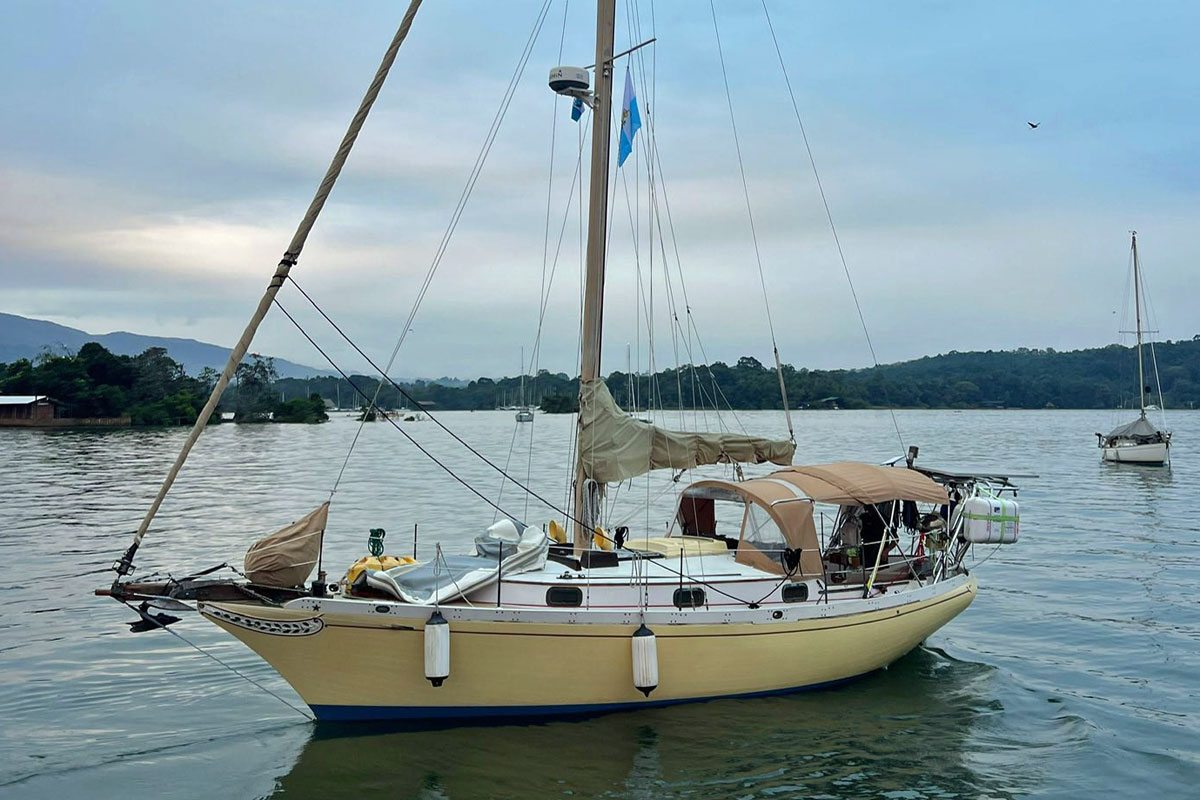
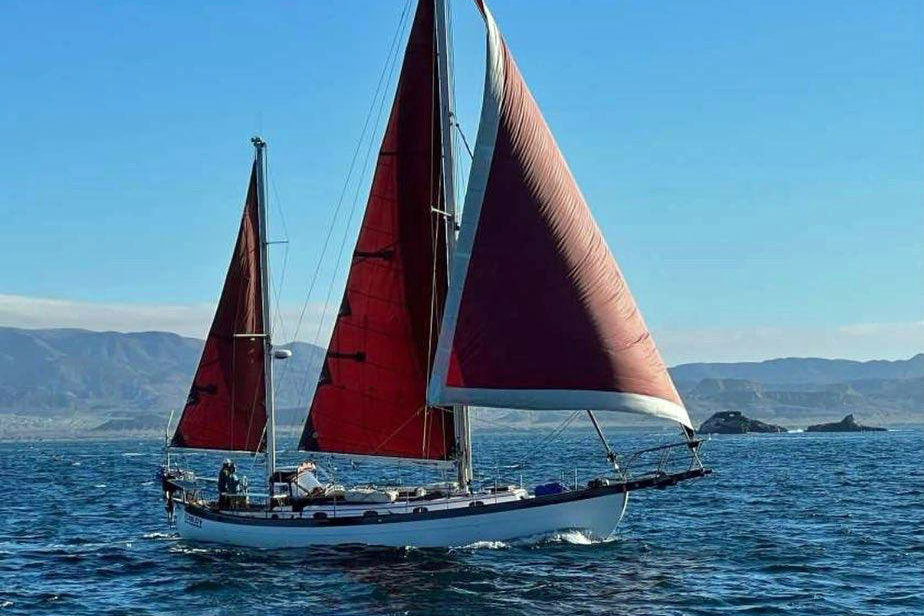 'Remedy', a staysail ketch version of the Hans Christian 43
Table of Contents
- Hans Christian 43 Specifications: A Heavyweight Cruiser
- Design Options and Later Versions
- Individual Sail Areas and Rig Configuration
- Rig Dimensions: I, J, P, and E
- Design Ratios for the Hans Christian 43
- Theoretical Sailing Characteristics
- Limitations of Using the Design Ratios
- Summing Up
- Frequently Asked Questions
Hans Christian 43 Specifications: A Heavyweight Cruiser
The Hans Christian 43, built primarily by Ta Shing Yacht Building Ltd. in Taiwan between 1974 and 1992, is the definitive example of a classic, heavy-displacement blue-water cruiser. Approximately 130 of these yachts were built, designed initially by Harwood Ives.
- Keel & Rudder Configuration: Monohull with a long keel and a keel-hung rudder or a modified Telstar* keel (on later versions).
- Hull Material: Solid fibreglass (GRP).
- Length Overall: 12.97m (42'7"). Note: This measurement typically includes the fixed bowsprit.
- Waterline Length: 11.23m (36'10").
- Beam: 4.22m (13'10").
- Draft: 1.83m to 2.02m (6'0" to 6'8"), depending on the specific keel variant.
- Rig Type: Primarily a Cutter Ketch configuration, though Sloop and Cutter rigs were also produced.
- Displacement: Approximately 14,300 kilograms (31,500 pounds) at half-load.
- Ballast: 5,600 kilograms (12,300 pounds).
- Sail Area (main plus 100% foretriangle): Approximately 83 m² (894 ft²).
- Water Tank Capacity: Varies, but commonly around 600 to 787 litres (158 to 208 US gallons).
- Fuel Tank Capacity: Varies widely, but typically 454 to 1,155 litres (120 to 305 US gallons), reflecting its long-range mission.
- Hull Speed: Approximately 8.13 knots.
- Designer: Harwood Ives (though some later models, like the Christina series, were designed by Scott Sprague).
- Builder: Ta Shing Yacht Building Ltd. (Taiwan), King Dragon Yacht Industry.
- Year First Built: 1974.
- Year Last Built: 1992 (traditional 43).
- Number Built: Approximately 130.
* See FAQs
Design Options and Later Versions
What variations of the Hans Christian 43 were built?
The original Hans Christian 43 design, often referred to as the 43T (Traditional), was most commonly built as a Staysail Ketch, a versatile rig well-suited for heavy-displacement yachts in offshore conditions. The rig provided excellent flexibility for balancing sails and reducing sail area in heavy weather.
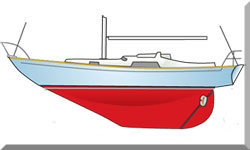
The hull itself featured the signature Hans Christian long keel and canoe stern, prioritising directional stability and protection for the rudder and propeller. Some later models featured a modified keel, such as the "Telstar keel," which was intended to improve manoeuvrability and light-air performance without compromising its offshore safety profile.
A notable evolution occurred in the mid-1980s with the introduction of the Hans Christian Christina 43. This version, designed by Scott Sprague, featured a more modern underwater profile, moving away from the full keel towards a fin-keel-with-skeg configuration. The Christina series was aimed at providing the renowned Hans Christian build quality and interior comfort but with a higher emphasis on speed and performance.
Individual Sail Areas and Rig Configuration
How does the Staysail Ketch rig provide versatile sail handling?
The Staysail Ketch rig provides exceptional versatility for a blue-water cruising sailboat, allowing the crew to adjust sail area in manageable increments. The individual sail areas, for a standard cutter ketch rig, are approximately:
- Mainsail Area (Cruising): 32m² to 35m² (343 ft² to 378 ft²).
- Staysail Area: Approximately 21m² to 26m² (226 ft² to 276 ft²).
- Mizzen Sail Area: Unverified but typically a smaller percentage of the total sail area, focused on balance and stability.
- 100% Foretriangle Area (Jib/Genoa): Approximately 51m² to 63m² (551 ft² to 675 ft²).
In a cutter rig, the sail area is divided between the mainsail, the staysail (set on the inner forestay), and a larger jib or yankee on the outer forestay. In the ketch configuration, a mizzen sail is added on the aft mast. This division of the total sail area into smaller, easily handled sails is ideal for single-handed or short-handed sailing in varied conditions.
Rig Dimensions: I, J, P, and E
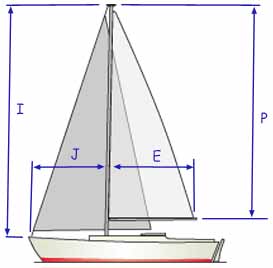
The primary dimensions used to define the size and geometry of a sailboat's working sail plan are the I, J, P, and E measurements. These are based on the traditional foretriangle (for the headsails) and the dimensions of the main and mizzen sails.
The approximate dimensions for the mainmast on the Hans Christian 43 Cutter Ketch are:
The approximate dimensions for the mainmast on the Hans Christian 43 Cutter Ketch are:
| Rig Measurement | Imperial Units | Metric Units |
|---|---|---|
| I (Mainmast height above deck) | 50'6" | 15.39 metres |
| J (Foretriangle base) | 21'10" | 6.65 metres |
| P (Mainsail Luff length) | 46'8" | 14.23 metres |
| E (Mainsail Foot length) | 14'8" | 4.48 metres |
The height of the mast above the waterline is typically around 17.15 to 17.68 metres (56'3" to 58'0").
Here's how to calculate sail areas...
Design Ratios for the Hans Christian 43
What do the key design ratios tell us about the yacht's performance?
Design ratios are non-dimensional numbers used by designers and sailors to offer a quick, comparative insight into a boat's theoretical performance and motion characteristics. The ratios for the Hans Christian 43 (Traditional) are typical of a heavy blue-water cruiser:
- Displacement-to-Length Ratio (D/L): Approximately 281.5 (ranging down to 209.3 on certain variants).
- Sail Area-to-Displacement Ratio (SA/D): Approximately 14.40.
- Ballast-to-Displacement Ratio (B/D): Approximately 39%.
- Comfort Ratio: Approximately 38.18.
- Capsize Screening Formula: Approximately 1.76.
Theoretical Sailing Characteristics
What kind of sailing performance can be expected based on the design ratios?
The design ratios confirm the Hans Christian 43's reputation as a heavy, comfortable, and safe offshore cruiser, rather than a light-wind speedster.
- Displacement-to-Length Ratio (281.5): This is squarely in the heavy displacement category. This translates to a vessel that is less sensitive to payload (ideal for liveaboards stocking up) and has a more deliberate, slower motion in a seaway. She will be slower in light air but will hold her speed better in heavier conditions, often powering through chop where lighter boats are stopped.
- Sail Area-to-Displacement Ratio (14.40): This figure is considered moderately low for a performance cruiser. This reinforces the expectation that the Hans Christian 43 is a steady, easily-driven boat designed for longer passages and offshore safety. She will need more wind than average to achieve her theoretical hull speed and will struggle to maintain way in very light air.
- Ballast-to-Displacement Ratio (39%): This is a high percentage. Coupled with the long keel's lower centre of gravity, this indicates a very stiff and powerful boat that is highly resistant to heeling. This stability is a key factor in her excellent offshore reputation and crew comfort.
- Comfort Ratio (38.18): This is a high number. The formula calculates the yacht's motion comfort and anything over 30 is generally considered very comfortable for extended offshore cruising. The high mass and full hull sections cushion the motion, preventing the quick, jerky movement found on lighter designs.
- Capsize Screening Formula (1.76): At 1.76, the Hans Christian 43 scores excellently for offshore safety and stability in extreme conditions, where a value of 2.0 or less is considered safe.
In summary, the design ratios suggest a yacht that is inherently stable, safe, and comfortable for long-term blue-water cruising and living aboard, favouring endurance and crew well-being over outright speed.
More on sailboat design ratios...
Limitations of Using the Design Ratios
Why aren't design ratios the complete picture of a sailboat's performance?
While the design ratios provide valuable comparative metrics, they are not a definitive description of a sailboat's real-world sailing characteristics, and relying solely on them can be misleading.
- Hull Shape is Crucial: Ratios like D/L do not account for the distribution of volume or the shape of the keel and rudder. A boat with a full keel, like the Hans Christian 43, will have significantly more wetted surface area than a fin-keel boat, leading to much higher frictional drag. The high drag is the primary reason for her slower performance, an element the design ratios alone do not fully capture.
- Sail Plan Nuance: The SA/D ratio typically only uses the theoretical 100 per cent foretriangle and mainsail area, often ignoring the contribution of a staysail or the efficiency of a high-roach mainsail. For a ketch rig, the total effect of the mizzen in balancing the helm or driving the boat is not accounted for.
- Ballast Placement: The B/D ratio only considers the weight of the ballast, not its vertical placement. A lighter keel with a very deep, dense bulb provides a greater righting moment (stiffness) than a heavier, shallower keel. Since the Hans Christian 43 has an integral long keel, its ballast is relatively shallow, which is less efficient than a modern deep fin keel. The high B/D ratio is necessary to compensate for this.
- Centre of Effort versus Centre of Lateral Resistance: Ratios do not account for the relationship between the centre of effort of the sails and the centre of lateral resistance of the hull underwater. This critical balance determines the boat's helm feel and its ability to sail close to the wind.
- Build Quality & Condition: Ratios say nothing about the boat's construction quality, the condition of her rigging, or the age of her sails, all of which are immense factors in performance and safety.
For the Hans Christian 43, the ratios paint a picture of stability and comfort, but the reality of the full keel means she will point less effectively and be markedly slower in light airs than the ratios might superficially suggest, a trade-off owners accept for her directional stability and robustness.
Could this be your ideal cruising boat?
It may well be, but before going any further, it might be worth taking a look at my eBook 'How to Avoid Buying the Wrong Sailboat'...
Summing Up
The Hans Christian 43 stands as a proud testament to a traditional school of yacht design: one that prioritised strength, stability, and comfort over pure speed. Her solid fibreglass hull, massive ballast, and high-quality teak interior make her a powerful and safe platform for a couple or family to undertake serious blue-water passages and live aboard for extended periods. The cutter ketch rig provides a versatile system for sailing short-handed. While she will frustrate sailors accustomed to light-displacement speedsters, for those who value a comfortable, deliberate motion in heavy weather and a yacht built like a tank, the Hans Christian 43 remains a highly attractive and capable choice.
Take a look at other cruising boats of similar length overall...

This article was written by Dick McClary, RYA Yachtmaster and author of the RYA publications 'Offshore Sailing', member of The Yachting Journalists Association (YJA), erstwhile member of the Ocean Cruising Club (OCC) and owner/administrator of 'Liveaboard Sailboats for Sale'.

Frequently Asked Questions
What is a Telstar keel?
What is a Telstar keel?
The Telstar keel is a modified full keel featured on some Hans Christian yachts. It incorporates a more pronounced cutaway of the hull profile than a traditional long keel, which helps to reduce wetted surface area, thereby improving manoeuvrability in tight spaces and boosting light-air performance, while retaining the safety and protection of a full keel.
What makes the Hans Christian 43 a good liveaboard sailboat?
What makes the Hans Christian 43 a good liveaboard sailboat?
The Hans Christian 43 is considered an excellent liveaboard sailboat due to its spacious, deep hull, providing generous headroom (often over 6'5") and ample storage space for provisions and gear. The high-quality, warm teak interior creates a cosy, traditional ship-like atmosphere, and the boat's heavy displacement ensures a comfortable, steady motion even in rolly anchorages or offshore.
How does the Hans Christian 43 perform to windward?
How does the Hans Christian 43 perform to windward?
Due to her heavy displacement and long, full keel, the Hans Christian 43 is not known for stellar performance to windward. The full keel creates significant wetted surface and thus higher drag, meaning she will sail at a wider angle to the true wind and be slower than boats with modern fin keels. She is best sailed on a beam reach or broad reach, which is typical for long-distance cruising.
What is the difference between the Hans Christian 43 and the Christina 43?
What is the difference between the Hans Christian 43 and the Christina 43?
The Hans Christian 43 (Traditional) features a long keel and a traditional, heavy-displacement hull shape designed for maximum stability and comfort. The Christina 43 is a later design by Scott Sprague that features a more modern underwater profile, often with a fin keel and skeg-hung rudder, resulting in lighter displacement and better all-around performance, especially in light air.
What are the main maintenance concerns with the Hans Christian 43?
What are the main maintenance concerns with the Hans Christian 43?
The primary maintenance concern is the extensive external teak joinery that defines the boat's traditional aesthetic, requiring regular oiling or varnishing. Other key areas include managing the risk of corrosion in the engine compartment or where dissimilar metals meet, and routine maintenance for any boat of this vintage, such as inspecting the rigging and servicing the engine.
Is the Hans Christian 43 a good choice for single-handed sailing?
Is the Hans Christian 43 a good choice for single-handed sailing?
Yes, the Hans Christian 43, particularly the cutter ketch rig, is well-suited for single-handed sailing. The rig allows the total sail area to be divided into small, manageable sails (main, staysail, mizzen), which can be easily hoisted, reefed, and controlled by one person, reducing the load on any single sail and easing sail changes in heavy weather.
Is the high fuel capacity necessary given the rig?
Is the high fuel capacity necessary given the rig?
While the cutter ketch rig provides excellent sailing versatility, the high fuel capacity is essential for a true blue-water cruiser. The heavy displacement and low sail area to displacement ratio mean the boat often requires long periods of motoring to maintain schedule, particularly in light winds or when punching into a head sea or current. The large tanks provide the necessary range and reserve for long, uninterrupted voyages.
Resources
Recent Articles


-
Offshore Internet with Starlink: Hardware, Plans, and Setup Guidance
Oct 01, 26 01:15 PM
A clear, practical guide to choosing the right Starlink hardware and plan for offshore cruising. Learn what to buy, how to install it, and how to manage power afloat. -
Offshore Liferaft Guide: Choosing, Stowing and Servicing One
Oct 01, 26 06:28 AM
Choosing an offshore liferaft? Learn what ISO 9650 Group A means, where to stow it, how often to service it and what to pack in the grab bag. -
Can an Inflatable Tender Replace a Liferaft? Offshore Verdict
Sep 30, 26 03:50 PM
Can an inflatable tender replace a liferaft? Offshore sailors get the honest answer: when a tender helps, where it fails and how to plan abandon ship.