- Home
- Cruising Yachts 45' to 50'
- Jeanneau Sun Odyssey 45
The Jeanneau Sun Odyssey 45 Sailboat: Specs, Performance Analysis & Cruising Characteristics
Key Takeaways
The Sun Odyssey 45 is defined by its impressive interior volume and a hull design that prioritises initial stability and ease of handling. It is a moderate-displacement cruiser that excels in light to medium airs but requires early reefing to manage its relatively low ballast ratio. With several layout options, it serves as an excellent liveaboard platform, though its performance can be hindered if overloaded with heavy blue-water equipment.
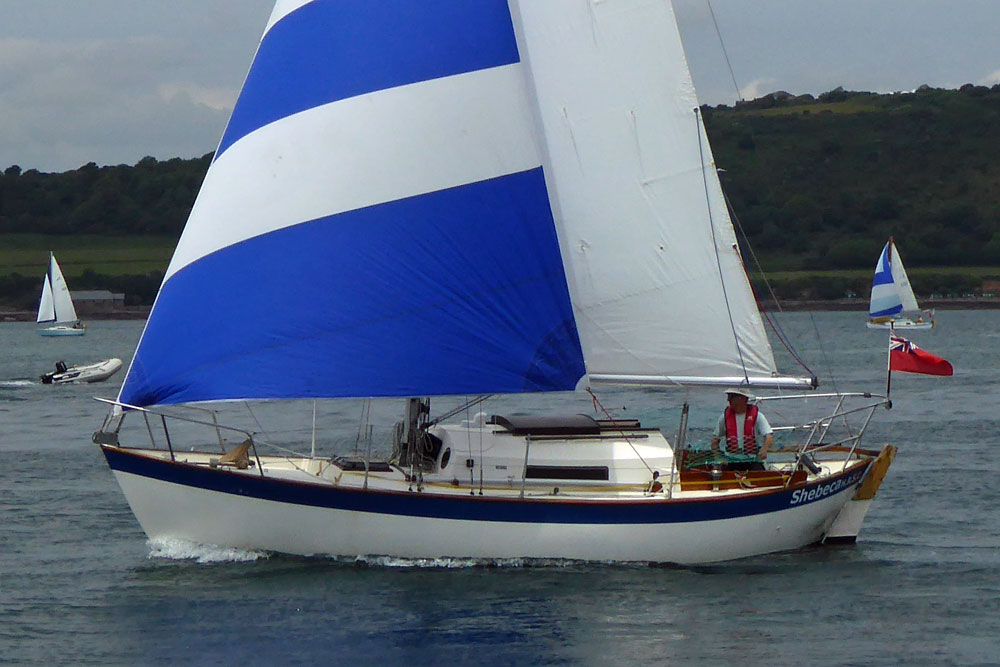
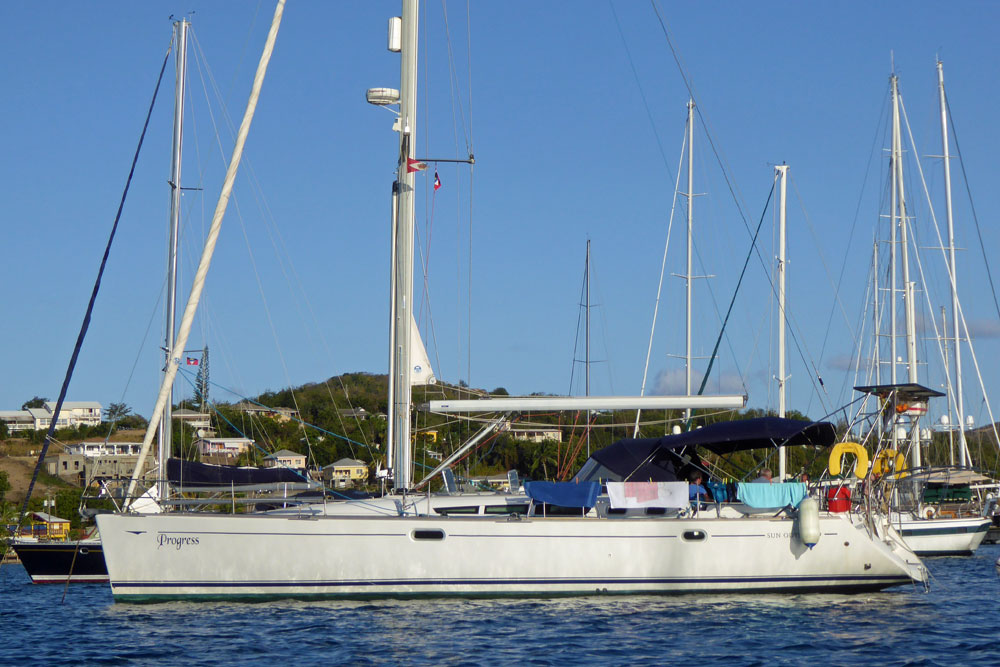 A Jeanneau Sun Odyssey 45
The Jeanneau Sun Odyssey 45 remains a benchmark for those seeking a balanced, mass-production cruiser that refuses to compromise on internal volume or cockpit ergonomics. Built during a period when Jeanneau was refining its "Prisma Process" for deck construction, this Philippe Briand design successfully captures the middle ground between a nimble coastal cruiser and a capable offshore passage-maker. While it lacks the heavy-duty displacement of a dedicated blue-water cruiser, its smart distribution of weight and high form stability make it a predictable, forgiving partner for families and shorthanded crews.
Design & Construction
Designed by the prolific Philippe Briand and the Jeanneau Design Office, the Sun Odyssey 45 was first introduced in 2004 as a successor to the popular 45.2. Constructed in France by Jeanneau, the hull is made of solid hand-laid glass fibre reinforced with a Kevlar "Shield" in the forward sections for added impact resistance. This focus on structural integrity is paired with a deck produced via injection moulding, which reduces weight aloft and results in a clean, finished look on both sides of the laminate.
The defining feature of this model is its "walk-through" transom and expansive cockpit, which utilised the boat's 14'3" (4.37 m) beam to create a social hub rarely seen in yachts of this era. The twin helm configuration was a practical necessity for a beam of this width, allowing the helmsman excellent visibility forward and easy access to the stern platform for swimming or boarding a tender.
Beyond the standard version, Jeanneau produced a "Performance" variant which featured a taller mast, a deeper 7'6" (2.30 m) keel, and upgraded deck hardware. For those navigating shallower waters, a shoal draft version was also available with a 5'5" (1.65 m) fin. The internal layout was equally adaptable, offered in two, three, or even four-cabin configurations, making it a versatile choice for both private owners and the charter market.
Sail Areas & Rig Dimensions
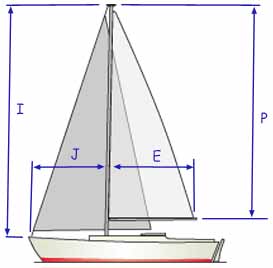 Rig dimensions
The Sun Odyssey 45 utilizes a modern fractional sloop rig that balances ease of use with enough power to keep the hull moving in light Mediterranean zephyrs. The standard rig measurements are as follows:
- I (Foretriangle Height): 54'3" (16.54 m)
- J (Foretriangle Base): 15'3" (4.65 m)
- P (Mainsail Luff): 50'1" (15.27 m)
- E (Mainsail Foot): 17'4" (5.30 m)
The total upwind sail area for the standard mast is approximately 1,072 ft² (99.6 m²), split between a 512 ft² (47.6 m²) mainsail and a 560 ft² (52.0 m²) furling genoa. This setup provides a manageable sail-handling set-up, ensuring that most adjustments can be handled by a single sailor from the safety of the twin helm cockpit.
Published Specification: The Jeanneau Sun Odyssey 45 Blueprint
The following data represents the core measurements for the standard fin keel version of the Sun Odyssey 45.
| Specification Category | Measurement & Data |
|---|---|
| Length Overall (LOA) | 45'0" (13.72 m) |
| Waterline Length (LWL) | 38'1" (11.61 m) |
| Beam | 14'3" (4.37 m) |
| Draft (Standard / Shoal / Perf) | 6'9" (2.05 m) / 5'5" (1.65 m) / 7'6" (2.30 m) |
| Displacement | 21,826 lb (9,900 kg) |
| Ballast (Standard Fin) | 6,504 lb (2,950 kg) |
| Rig Type & Hull Material | Fractional Sloop & GRP (Kevlar reinforced) |
| Production Dates | 2004 – 2009 |
Performance Analysis: Understanding the Design Ratios
To truly understand how the Sun Odyssey 45 behaves at sea, we must look beyond the raw dimensions and into the mathematical relationship between its weight, length, and power.
| Design Ratio | Value | Expert Interpretation |
|---|---|---|
| Sail Area / Displacement (SA/D) | 21.9 | Indicates a high-performance cruiser; plenty of power for light air sailing. |
| Displacement / Length (D/L) | 176 | Light displacement category; fast and responsive but sensitive to overloading. |
| Ballast / Displacement (B/D) | 29.8% | Relatively low; relies on beam for stability. Expect to reef early (15-18 knots). |
| Capsize Screening Formula (CSF) | 2.10 | Slightly above the preferred 2.0 limit for offshore; requires careful heavy weather management. |
| Brewer Motion Comfort Ratio | 24.2 | Suggests a livelier motion in a seaway; typical for modern, flat-bottomed cruisers. |
For a deeper understanding of how these figures compare to other yachts in this class, see the associated guide: Understanding Boat Performance & Design Ratios.
The SA/D ratio of 21.9 confirms that the Sun Odyssey 45 is no slouch; it has the canvas to maintain good boat speed even when the wind drops. However, the D/L of 176 warns that while she is quick, she is not a "load carrier." Adding heavy generators, air conditioning units, and massive battery banks will noticeably degrade her sailing qualities. The B/D ratio of just under 30% means she uses her wide hull form to stay upright initially, but as the wind builds, she will heel quickly unless the crew is proactive with reefing lines.
Structural Integrity & Stability Dynamics
The use of Glass Reinforced Plastic (GRP) with Kevlar reinforcement in the hull provides a high degree of confidence for coastal and occasional offshore work. While not as puncture-resistant as aluminium, the Kevlar layer adds a vital margin of safety against floating debris. Maintenance is straightforward, following standard GRP protocols, though owners should regularly inspect the keel-to-hull joint, as the relatively shallow sump means any hard grounding forces are transferred directly to the grid structure.
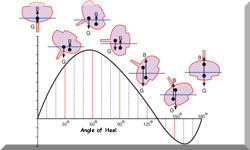
The yacht’s stability is heavily dependent on its 14'3" (4.37 m) beam. This "form stability" provides a very stiff platform in light winds, which is comfortable for guests and makes for easy moving about on deck. However, unlike a heavy-keeled traditional cruiser, the Sun Odyssey 45 has a lower limit of positive stability. This means in extreme conditions, she is less likely to self-right as quickly as a narrower, deeper-keeled vessel. For the vast majority of coastal and tradewind cruising, however, this trade-off provides a much more habitable and faster boat.
Configuration, Layout & Cruising Characteristics
The interior of the Sun Odyssey 45 is where the Briand design truly shines. The "Fine Teak" woodwork and abundant deck hatches create a bright, airy environment that avoids the "cave-like" feel of older designs.
- Galley & Saloon: Most models feature an L-shaped or linear galley to starboard. With a 615-litre water capacity and a 255-litre fridge, the boat is well-equipped for extended stays at anchor. The saloon can comfortably seat eight around a large central table.
- Cockpit Function: The dual-wheel layout is the star of the show. It creates a clear path from the companionway to the stern, allowing for a large, fixed cockpit table that doesn't obstruct movement.
- Tankage: The 240-litre fuel tank, paired with a reliable 54 hp or 75 hp Yanmar engine, provides a motoring range of approximately 400 to 500 nautical miles, essential for cruising through calm belts or entering difficult harbours.
Has this article suggested that this could be your ideal cruising boat and, as a result, deserves to be on your "Worth a Look" list?
But if, like me, you find sailboats to be seductive creations, then that list could rapidly get to be a pretty long one. If that is the case, wouldn't it be good if you could narrow it down bit through an objective, pragmatic process?
Well, that's where my eBook 'How to Avoid Buying the Wrong Sailboat' comes in...
Summing Up
The Jeanneau Sun Odyssey 45 is a masterclass in modern production boat design. Its design ratios point toward a yacht that is fast, responsive, and easy to handle in moderate conditions, though it lacks the ultimate "sea-kindliness" of a heavier, more traditional cruiser. The low ballast ratio and high capsize screening score suggest it is best suited for coastal hopping and seasonal offshore passages rather than high-latitude expeditions. For the cruising sailor who values interior luxury, a massive cockpit, and the ability to sail at 7 or 8 knots in a light breeze, it remains one of the most compelling options on the second-hand market.
If you'd like to compare this boat with others in this size range, take a look at Cruising Boats from 45' to 50' overall....
This article was written by Dick McClary, RYA Yachtmaster and author of the RYA publications 'Offshore Sailing' and 'Fishing Afloat', member of The Yachting Journalists Association (YJA), and erstwhile member of the Ocean Cruising Club (OCC).
Frequently Asked Questions (FAQs)
How does the shoal draft version compare in performance?
How does the shoal draft version compare in performance?
The shoal draft (1.65 m) version sacrifices some pointing ability upwind and is slightly more tender than the standard fin. It is an ideal compromise for the East Coast of the UK or the Bahamas, but the standard 2.05 m keel is preferred for better all-round stability.
What are the common maintenance issues with this model?
What are the common maintenance issues with this model?
Owners should monitor the rudder bearings for play and check the "Prisma" deck for any signs of delamination around high-load fittings. As with many Jeanneaus of this era, the "Fine Teak" is a thin veneer, so aggressive sanding should be avoided.
Can the 3-cabin version be converted to a 4-cabin?
Can the 3-cabin version be converted to a 4-cabin?
Some models featured a removable longitudinal bulkhead in the forward cabin, allowing it to be split into two smaller cabins. However, the 3-cabin "Owner" version with the large island berth forward is generally the most sought-after for private use.
How does it handle in heavy weather?
How does it handle in heavy weather?
Due to its light displacement and wide beam, the boat can become "slammy" when heading into a short chop. The key is to reef early—once the apparent wind hits 18 knots—to keep the boat flat and maintain rudder grip.
What is the engine access and maintenance like on the Sun Odyssey 45?
What is the engine access and maintenance like on the Sun Odyssey 45?
Access is generally excellent for a boat of this size. The companionway steps lift on gas struts to reveal the front of the Yanmar engine, while side panels in the aft cabins provide clear access to the filters, belts, and the shaft seal. One point for owners to check is the soundproofing foam; on earlier models, this can start to crumble and should be replaced to prevent it from being sucked into the air intake.
Recent Articles


-
Mystery 35 Review: Specs, Performance & Buying Guide
Aug 29, 26 09:42 AM
An in-depth review of the Mystery 35 sailboat. Read technical specs, design ratios, sail performance, and common buyer inspection areas. -
Beneteau First 405 Review: Specs, Performance & Buyer’s Guide
Aug 26, 26 03:58 AM
Detailed Beneteau First 405 review covering specs, performance, bluewater capability, layouts and buyer’s checklist. -
Moody S38 Review: Specs, Ratios & Buyer’s Guide
Aug 12, 26 04:22 AM
In‑depth Moody S38 review covering specs, performance, design ratios, layout, strengths, trade‑offs & buyer inspection points.