- Home
- Cruising Yachts 45' to 50'
- Morgan 46
The Morgan 46 Sailboat
Specs & Key Performance Indicators
Key Takeaways
The Morgan 46 is a heavy-displacement cruiser designed by Charley Morgan, primarily known for its immense interior volume and robust construction. It serves as an exceptional liveaboard platform with high stability and a predictable, sea-kindly motion. While it is not a light-air performer or a nimble racer, its ability to carry heavy loads and provide a secure environment in offshore conditions makes it a favourite for long-term voyagers.
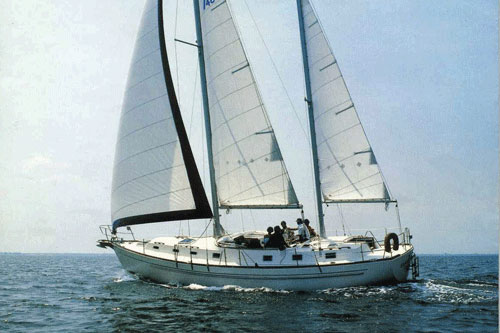
Table of Contents
- Design & Construction
- Sail Areas & Rig Dimensions
- Configuration, Layout & Cruising Characteristics
- Published Specification: The Morgan 46 Blueprint
- Performance Analysis: Understanding the Design Ratios
- The Buyer’s Checklist: Common Problem Areas
- Comparison: Morgan 46 vs. The Competition
- Summing Up
- Frequently Asked Questions (FAQs)
Design & Construction
The Morgan 46 was designed by Charley Morgan and was built by Morgan Yacht Corporation in Florida. Constructed from solid fibreglass (GRP), the hull is built to the thickness standards common in the 1970s and 1980s, prioritizing overbuilt durability over weight savings.
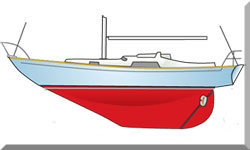
The defining feature of the Morgan 46 is its centre-cockpit configuration combined with a long-fin keel and skeg-hung rudder. This layout maximizes the master aft cabin, providing a level of privacy and comfort rarely seen in boats of this era. The deck is typically balsa-cored, a common practice for stiffness, though one that requires careful inspection today.
While the original Morgan 46 was a sloop or ketch-rigged performance cruiser, the design evolved significantly into the Morgan 462 and later the 463. These variants often featured a ketch rig, which allows for smaller, more manageable sail areas for a short-handed crew. Most versions use a moderate draft, allowing access to shallower cruising grounds like the Bahamas while maintaining enough lateral resistance for ocean passages.
Sail Areas & Rig Dimensions
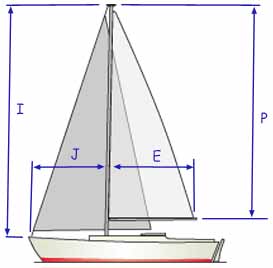 Rig dimensions
The rig is substantial, designed to drive a heavy hull across a range of wind strengths.
- Total Sail Area: 1,032 ft² (95.87 m²)
- I (Mast Height): 53'0" (16.15 m)
- J (Foretriangle Base): 18'4" (5.59 m)
- P (Mainsail Hoist): 46'9" (14.25 m)
- E (Mainsail Foot): 15'0" (4.57 m)
Configuration, Layout & Cruising Characteristics
The Morgan 46 is essentially a floating apartment. The galley is typically U-shaped, located in the passageway to the aft cabin, providing excellent security for the cook while at sea. Tankage is generous, often exceeding 200 gallons (757 litres) of water and 100 gallons (378 litres) of fuel, which supports extended autonomy.
The cockpit is high and dry. However, being farther from the water can make motion feel more pronounced in a heavy swell than in some aft-cockpit designs. The expansive deck space and the sheer volume below deck make it one of the most comfortable boats for a family of four to live aboard indefinitely.
Published Specification: The Morgan 46 Blueprint
| Feature | Specification |
|---|---|
| LOA | 45'9" (13.94 m) |
| LWL | 37'3" (11.35 m) |
| Beam | 13'6" (4.11 m) |
| Draft (Standard) | 6'6" (1.98 m) |
| Displacement | 30,000 lbs (13,608 kg) |
| Ballast | 12,000 lbs (5,443 kg) |
| Rig Type | Sloop or Ketch |
| Hull Material | GRP (Fibreglass) |
| Production Dates | 1971 – 1982 |
Performance Analysis: Understanding the Design Ratios
The following ratios provide a snapshot of how the Morgan 46 handles the rigours of the open sea.
| Ratio | Value | Interpretation |
|---|---|---|
| SA/D | 17.0 | Moderate power; requires a stiff breeze to reach hull speed. |
| D/L | 259 | Medium-heavy displacement; ensures a steady, comfortable motion. |
| B/D | 40% | High ballast ratio contributing to excellent stiffness and safety. |
| CSF | 1.74 | Well below the 2.0 limit, indicating high ocean-crossing safety. |
| Comfort Ratio | 35.8 | Excellent; provides a heavy, gentle motion in rough seas. |
For a broader look at what these numbers mean for your sailing style, see our guide on Understanding Boat Performance & Design Ratios.
Structural Integrity & Stability Dynamics
The solid GRP hull offers peace of mind when venturing into poorly charted waters or facing debris at sea. Unlike modern lightweight sandwich constructions, this hull can withstand significant impacts. The high ballast-to-displacement ratio ensures that the boat remains upright and recovers quickly from knockdowns, a critical factor for offshore security.
The Buyer’s Checklist: Common Problem Areas
- Chainplates: These are often glassed into the hull or hidden behind cabinetry. Check for signs of water ingress or corrosion at the deck level.
- Blisters: Boats of this era are prone to osmotic blistering. A moisture meter test on the hull is essential.
- Deck Core: Inspect for soft spots around stanchions and windlasses where water may have reached the balsa core.
- Fuel Tanks: The original iron or aluminium tanks may be nearing the end of their life; replacing them in a centre-cockpit boat often involves significant joinery work.
- Engine Access: While the engine room is generally large, check for leaks in the cooling system and the condition of the shaft log.
Comparison: The Morgan 46 vs The Competition
When compared to the Irwin 43 or the Gulfstar 44, the Morgan 46 feels more robust and "shippy."
The Irwin 43 offers a bit more speed in light air but lacks the heavy-weather confidence of the Morgan. The Gulfstar 44 has a similar layout but often suffered from lower-quality interior finishings in early models. The Morgan 46 remains the choice for those prioritizing structural mass and ultimate stability over coastal racing performance.
If you'd like to compare this boat with others in this size range, take a look at Cruising Boats from 45' to 50' overall....
Could this be your ideal cruising boat?
It may well be, but before going any further, it might be worth taking a look at my eBook 'How to Avoid Buying the Wrong Sailboat'...
Summing Up
The Morgan 46 is a classic example of: “They don’t build them like they used to.” It is a heavy, stable, and incredibly spacious cruiser that excels as a long-term home on the water. While its design ratios suggest a boat that is slow to start in a light breeze, its comfort in a gale and its vast storage capacity make it a premier choice for serious bluewater sailors.
This article was written by Dick McClary, RYA Yachtmaster and author of the RYA publications 'Offshore Sailing' and 'Fishing Afloat', member of The Yachting Journalists Association (YJA), and erstwhile member of the Ocean Cruising Club (OCC).
Frequently Asked Questions (FAQs)
Is the Morgan 46 suitable for single-handed sailing?
Is the Morgan 46 suitable for single-handed sailing?
While large, the ketch-rigged versions make sail handling manageable for one person, provided an autopilot or windvane is fitted.
How does the Morgan 46 perform off the wind?
How does the Morgan 46 perform off the wind?
With its heavy displacement and long-keel characteristics, it tracks exceptionally well on a reach or downwind, requiring less active steering than lighter fin-keel boats.
Are parts still available for these older models?
Are parts still available for these older models?
Basic hardware is standard, but model-specific items often require the support of the Morgan Owners Group or custom fabrication.
What is the typical cruising speed under power?
What is the typical cruising speed under power?
With a well-maintained 50–80 hp diesel, you can expect a comfortable cruising speed of 6.5 to 7 knots.
Does the Morgan 46 suffer from "hobby-horsing" in a head sea?
Does the Morgan 46 suffer from "hobby-horsing" in a head sea?
Due to its high Displacement/Length ratio and weight distribution, it handles head seas better than most, though its blunt bow can occasionally slam in short, steep chops.
Recent Articles


-
Best AIS Systems for Cruising Sailboats 2026 — Class B & B+ Guide
Sep 24, 26 05:03 AM
Find the best AIS systems for cruising sailboats in 2026. Clear guidance on Class B vs Class B+, transceivers vs receivers, NMEA 2000 compatibility, and top AIS units available on Amazon. -
Rigging a Carbon Mast: Carbon, PBO or Dyneema Compared
Sep 20, 26 08:01 AM
Rigging a carbon mast: how carbon rod, PBO and Dyneema compare on cost, weight and inspection, and why stainless wire or rod rarely make sense. -
Top-Down Furling Guide: Code Zeros and Asymmetric Spinnakers
Sep 19, 26 04:57 PM
Top-down furling explained for cruisers: how it works, which boats need one, common faults, sock versus furler costs, and the rule everyone forgets.