- Home
- Sailboats 50'-55'
- Tayana 55 Offshore Cruising Yacht Review
The Tayana 55 Sailboat
Specs & Key Performance Indicators
Key Takeaways: The Tayana 55 is a heavy‑displacement, centre‑cockpit offshore cruiser designed for long passages. She carries a moderate sail plan on a fin keel with skeg‑hung rudder, giving steady tracking and reassuring behaviour when the sea state gets up, at the cost of modest light‑air speed. Build quality from the Ta Yang yard is generally strong, with substantial glass lay‑up, teak‑rich interiors and generous tankage, but age‑related issues such as teak decks, deck core moisture, chainplate structure and original systems now dominate the survey conversation. She suits experienced couples or small crews planning extended voyaging and living aboard; she is less suited to those wanting nimble coastal performance or low‑maintenance ownership.
Table of Contents
- The Tayana 55 at a Glance
- Design & Construction
- Published Specification: The Tayana 55 Blueprint
- Sail Areas & Rig Dimensions
- Performance Analysis: Understanding the Design Ratios
- How the Tayana 55 Sails
- Bluewater Capability: Strengths & Trade-Offs
- Configuration, Layout & Cruising Characteristics
- Who This Boat Is Best For
- The Buyer’s Checklist: Common Problem Areas
- Summing Up
- Related Boats
- Frequently Asked Questions (FAQs)
The Tayana 55 at a Glance
- Type: Centre‑cockpit bluewater cruising monohull
- Designer: Pieter (Peter) Beeldsnijder
- Builder: Ta Yang Yacht Building Co, Taiwan
- Production Years: 1982–1991 (approx. 65 hulls), with related deck‑saloon derivative Tayana 58DS launched around 2000
- Rig: Primarily cutter; ketch option on some hulls; keel/centreboard variant and shoal‑draft option
- Best for: Long‑distance passagemaking, liveaboard cruising, tradewind routes where comfort and load‑carrying matter
- Strengths: Solid construction, seakindly motion, secure centre cockpit, versatile layouts, good tankage and stowage
- Trade‑offs: Slow in light airs, big‑boat handling in tight marinas, ageing teak decks and systems, refit costs can be substantial
Design & Construction
The Tayana 55 sits firmly in the tradition of serious Taiwanese cruising yachts of the 1980s: a substantial glass hull, conservative lines and a rig sized for ocean work rather than club racing. Beeldsnijder’s hull uses a fin keel with a skeg‑hung rudder, giving a blend of directional stability and manoeuvrability that has earned the boat a loyal following among passagemakers. Standard draft is around 6'6" (2.0m), with a deeper early keel around 7'6" (2.29m) on some boats and a keel/centreboard option with roughly 5'3" (1.60m) board‑up and 9'10" (3.00m) board‑down, which is attractive for Bahamas‑style cruising or mixed coastal/ocean use.
Below the waterline the hull is solid hand‑laid fibreglass, while the deck is typically a glass/balsa sandwich. That combination gives stiffness and helps keep weight under control, but it does mean that any long‑term leaks around deck fittings, stanchion bases or the teak overlay can lead to core issues. Many Tayana 55s were delivered with teak decks; by now, those decks are either a survey focus or have already been stripped and replaced with non‑skid. The hull‑deck joint is robust, with an aluminium toerail acting as both mechanical fastener and fairlead system.
Windows are usually custom stainless‑framed fixed units with safety glass, supplemented by opening ports and hatches. These fixed windows are mechanically fastened rather than simple adhesive‑bonded panes, which is reassuring from a structural point of view, but the sealant around frames and the bedding of the stainless to the deck moulding still need careful inspection for corrosion and leaks. Chainplates are conventional stainless steel structures bolted into substantial glassed‑in bulkheads and internal framing, then tied into an electrical bonding system that links plates, through‑hulls, engine and rudder to sacrificial anodes. They are not fully encapsulated or hidden; access is reasonable, but after four decades, crevice corrosion at deck level and around fasteners is a known concern.
Variants matter with this design. As well as the standard centre‑cockpit cutter, there are ketch‑rigged boats with a mizzen and different interior arrangements, plus the keel/centreboard version and shoal‑draft option mentioned above. Interiors were largely semi‑custom, so you will see both aft‑owner’s‑cabin layouts with saloon amidships and rarer arrangements with the saloon aft and master cabin forward, more common on ketches. The later Tayana 58 deck‑saloon shares much of the underwater profile but adds a raised saloon and updated systems; it is effectively a development of the 55 rather than a separate concept.
Published Specification: The Tayana 55 Blueprint
| Specification | Imperial | Metric |
|---|---|---|
| LOA | 55'0" | 16.76m |
| LWL | 45'11" | 14.00m |
| Beam | 16'1" | 4.90m |
| Draft (standard) | 6'6" | 2.0m |
| Draft (deep keel, early boats) | ~7'6" | ~2.29m |
| Draft (keel/centreboard, board up/down) | 5'3" / 9'10" | 1.60m / 3.00m |
| Displacement | 48,400lb | 21,954kg |
| Ballast | 17,600lb | 7,983kg |
| Rig Type | Cutter (ketch option) | — |
| Hull Material | GRP (solid below WL, cored deck) | Fibreglass |
| Production Dates | 1982–1991 | — |
Sail Areas & Rig Dimensions
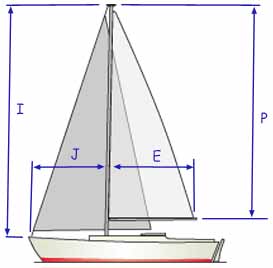 Rig dimensions
For the standard cutter rig:
- I (foretriangle height): 70.3' (21.43m)
- J (foretriangle base): 22.6' (6.89m)
- P (mainsail luff): 63.3' (19.29m)
- E (mainsail foot): 19.1' (5.82m)
Published sail areas (100% foretriangle plus main):
- Mainsail area: ~604.5ft² (56.16m²)
- Foretriangle (staysail/genoa triangle) area: ~794.4ft² (73.80m²)
- Total working sail area: ~1,399ft² (129.96m²)
Some centreboard and ketch variants carry slightly different spar dimensions (for example, a mizzen with roughly 39.3' luff and 11.5' foot) and may have larger overlapping genoas, pushing total sail area higher, but the core ratios remain similar.
Performance Analysis: Understanding the Design Ratios
| Ratio | Value | Practical Interpretation |
|---|---|---|
| Sail Area/Displacement (SA/D) | ~16.9 | Moderate sail power: enough drive for respectable passage speeds without overwhelming a short‑handed crew when the breeze rises. |
| Displacement/Length (D/L) | ~223 | Firmly in the moderate‑to‑heavy band: the boat moves through the sea rather than skipping over it, favouring comfort and load‑carrying over light‑air speed. |
| Ballast/Displacement (B/D) | ~36% | A relatively stiff hull that stands up to its rig, giving reassuring resistance to heel and supporting offshore stability. |
| Capsize Screening Formula (CSF) | ~1.77 | Comfortably below the 2.0 offshore guideline, indicating a hull form with good margin against knock‑down in ocean conditions. |
| Brewer Motion Comfort Ratio | ~38 | High comfort rating: motion is slower and more predictable, reducing fatigue on long passages compared with lighter designs. |
Taken together, these ratios describe a boat that prioritises stability, comfort and carrying capacity over sparkling performance. She will not match lighter 50‑footers in marginal breeze, but when the wind is up and the sea state is messy, the Tayana 55 tends to look after her crew.
For more on this topic, you might want to take a look at Understanding Boat Performance & Design Ratios...
How the Tayana 55 Sails
Upwind, the Tayana 55 rewards patience and trim. With the standard fin keel and skeg‑hung rudder she tracks well, but the combination of displacement and moderate SA/D means she likes a bit of breeze before she really settles into a groove. In 12–15 knots apparent, with a clean bottom and sensible loading, owners report comfortable speeds in the 6–7 knot band, pointing adequately but not like a modern performance cruiser. The keel/centreboard version improves pointing when the board is down, at the cost of more complexity and another system to maintain.
Downwind and on a reach, the boat comes into her own. The long waterline and generous beam give a steady platform, and the cutter rig allows flexible combinations of main, staysail and yankee or genoa. Many owners carry a cruising chute or asymmetric, but given the size of the sail inventory, most treat these as light‑air tools rather than everyday “go‑fast” options. In tradewind conditions, with reefed main and twin headsails or a poled‑out yankee, the Tayana 55 will sit happily on 7–8 knots for days, with the autopilot or windvane doing the work.
Helm feel is generally positive rather than feather‑light. The skeg‑hung rudder and longish keel give strong directional stability, so the boat does not spin on a dime, but that same trait keeps the autopilot load reasonable in big seas. Owners who have taken Tayana 55s through gales in the 40–50 knot range consistently report that the boat feels composed, with the rig and hull working together rather than fighting each other.
Reefing is straightforward on the cutter rig, especially if the boat has in‑mast furling or powered winches, but sail size still demands respect. On older boats with slab‑reefed mains and manual winches, early reefing is the key to keeping loads manageable for a couple. Short‑handed behaviour is one of the design’s selling points: several documented circumnavigation‑scale voyages have been completed by couples in their fifties and sixties, but they all emphasise that experience and systems maintenance are part of the package.
Bluewater Capability: Strengths & Trade-Offs
The Tayana 55’s bluewater credentials are not theoretical. The model has a healthy record of ocean passages in rallies such as the Pacific Puddle Jump, Atlantic Rally for Cruisers, Baja Ha‑Ha and Salty Dawg Caribbean Rally, plus independent crossings logged in various voyage databases. That track record, combined with the ratios above, underpins her reputation as a serious offshore cruiser.
Strengths start with hull form and construction. The heavy glass lay‑up, fin keel and skeg‑hung rudder give a robust underwater profile, and the deep bilges and substantial ballast help the boat carry stores, spares and cruising gear without becoming overly tender. Tankage is generous for the era: around 250 gallons (946L) of water and 125–150 gallons (473–568L) of fuel in stainless or aluminium tanks, often supplemented by additional tanks, watermakers and fuel bladders on long‑range boats.
Deck safety is generally good. The centre cockpit is deep and protected, with high coamings, and the side decks are wide, with substantial stanchions and double lifelines. Dorade vents, solid handrails and a sensible layout of winches and clutches make it possible to work the boat without gymnastics. The cut‑away transom with swim platform is handy at anchor but does introduce another structural area to inspect for cracking and hardware bedding.
The trade‑offs are mostly about age and maintenance. Teak decks, if still present, can be a major project: loose bungs, worn caulking and fasteners penetrating the cored deck all combine to create potential for leaks and core damage. Original standing rigging is long past its design life; many boats have already been re‑rigged, but any Tayana 55 still carrying 1980s wire and terminals needs a full rig survey. Engine hours on original Perkins or Yanmar installations, plus the state of exhaust systems, shafting and cutlass bearings, are all key survey items.
Configuration, Layout & Cruising Characteristics
Most Tayana 55s are centre‑cockpit boats, with the cockpit roughly amidships and an owner’s cabin aft. That arrangement gives a secure helm position, good visibility and a private aft cabin with its own companionway or direct access to the cockpit. The cockpit itself is large enough for watch‑keeping and social time but not so vast that crew feel exposed offshore.
On deck, the ergonomics reflect serious cruising intent. Winches are sized for the loads, with primary genoa winches often in the #66 band and a suite of secondary and halyard winches around the cockpit and mast. Many boats have electric windlasses, bow thrusters and, in some cases, powered winches, which help with big‑boat handling. The aluminium toerail, substantial cleats and double bow roller make anchoring and mooring straightforward.
Below, interiors are teak‑rich and vary widely. Common themes include:
- Aft owner’s cabin: Large double berth, good headroom, en‑suite head and shower, generous lockers.
- Saloon: U‑shaped or L‑shaped seating around a substantial table, often to port, with a settee or sea berth to starboard. Ventilation via opening ports, hatches and dorades.
- Galley: Typically U‑shaped, near the companionway, with deep sinks, gimballed cooker, large top‑loading fridge/freezer and plenty of storage. The layout suits cooking at sea.
- Forward cabins: One or two cabins, often a V‑berth plus a bunk cabin, sharing a forward head.
Storage is one of the boat’s strengths. Under‑sole spaces, lockers behind settees, dedicated technical spaces and large lazarettes allow owners to carry spares, tools and cruising gear without cluttering living areas. Headroom is generous, around 6'5" (1.96m) in many boats, which makes long‑term living aboard comfortable.
For liveaboard use, the combination of motion comfort, tankage, storage and interior volume is compelling. The trade‑off is that systems—electrical, plumbing, refrigeration, heating and ventilation—are now at an age where refits are common. Many Tayana 55s have already been upgraded with modern chargers, inverters, lithium or AGM batteries, solar arrays and updated nav gear; others remain closer to original specification and will require investment.
Who This Boat Is Best For
Good fit for:
- Experienced couples planning ocean passages: Those comfortable with big‑boat systems and happy to trade light‑air speed for comfort and security offshore.
- Liveaboard cruisers on extended voyages: Sailors who value tankage, storage, motion comfort and a proper interior over minimalist, stripped‑out performance.
- Owners willing to manage or oversee refits: People who understand that a 1980s bluewater yacht is a project as well as a home, and budget accordingly.
Less ideal for:
- New sailors looking for an easy first boat: The Tayana 55’s size, systems and momentum demand experience and confidence.
- Performance‑oriented coastal cruisers: Those who prioritise nimble handling, high pointing angles and light‑air speed will likely find her too heavy.
- Owners seeking low‑maintenance simplicity: Teak decks, complex systems and big‑boat hardware mean ongoing maintenance commitments.
The Buyer’s Checklist: Common Problem Areas
If you are inspecting a Tayana 55 with purchase in mind, a structured checklist helps focus effort and survey spend:
- Teak decks and deck core: Check for loose or missing bungs, worn caulking and proud fasteners. Look for signs of moisture in the balsa core: soft spots, discolouration, cracking around fittings. Budget realistically for full deck replacement if the teak is failing; this can rival the purchase price on poorly maintained boats.
- Chainplates and rigging: Inspect chainplates at deck level for crevice corrosion, staining and movement. Confirm age and replacement history of standing rigging; wire and terminals older than 15–20 years should be treated as end‑of‑life. Check mast step, partners and compression posts for cracking or deformation.
- Rudder, skeg and steering: Examine the skeg and rudder for signs of impact damage, delamination or play in bearings. Confirm the condition of the rudder shoe and fasteners. Test steering cables, quadrants and autopilot linkages; look for corrosion and wear.
- Hull and osmosis: Survey for blistering, especially around the waterline and on older antifouling systems. Check previous treatments and barrier coats; a well‑executed osmosis repair is not a red flag, but a poor one is.
- Engine and driveline: Review engine hours, service history and any major overhauls. Inspect exhaust elbows, mounts, shaft, stuffing box or dripless seal, and cutlass bearing. Confirm fuel tank condition (internal corrosion, baffles, contamination).
- Electrical and plumbing systems: Assess the state of wiring, panels and battery banks; original 1980s wiring may need partial or full replacement. Check water tanks, hoses, pumps and hot water systems for leaks and age. Inspect heads, holding tanks and overboard discharge arrangements for compliance and functionality.
- Interior joinery and leaks: Look for water staining around windows, ports and deck fittings. Check for loose veneers, delaminating sole sections and mould in hidden spaces.
Typical refit costs for a Tayana 55 can range from modest upgrades into the tens of thousands for systems and rigging, through to six‑figure projects if decks, engine, rig and interior all need major work. The upside is that a well‑refitted Tayana 55 remains a capable world cruiser with many years of service ahead.
Could this be your ideal cruising boat?
It may well be, but before going any further, it might be worth taking a look at my eBook 'How to Avoid Buying the Wrong Sailboat'...
Summing Up
The Tayana 55 occupies a clear niche: a substantial, centre‑cockpit bluewater cruiser that trades outright speed for comfort, stability and carrying capacity. Her design ratios, passage record and owner reports all point in the same direction. In moderate to strong breeze she is a steady, confidence‑building boat that tracks well and looks after her crew; in light airs she is honest but unhurried. Construction is robust, with solid glass below the waterline and a serious internal structure, but age has shifted the focus from original build quality to maintenance history.
For a buyer, the key questions are not whether the Tayana 55 is capable offshore—she is—but whether a particular hull has had the right work done at the right time. Teak decks, chainplates, rigging, engine and systems all sit at the heart of the value equation. A tired example can absorb vast sums; a well‑maintained or properly refitted boat can be an outstanding long‑range home. If you are an experienced sailor, comfortable with big‑boat handling and willing to engage with the maintenance side, the Tayana 55 remains a compelling option in the 50–60' bluewater bracket.
If you're looking for other cruising boats of a similar size to the Tayana 55, check here...

Written by Dick McClary, cruising sailor and yachting journalist, publisher of Sailboat‑Cruising.com and admin of the Liveaboard Sailboats for Sale community.

Frequently Asked Questions (FAQs)
1. How does the Tayana 55 compare to other classic bluewater cruisers like the Amel Super Maramu or Oyster 55 in terms of motion and speed?
1. How does the Tayana 55 compare to other classic bluewater cruisers like the Amel Super Maramu or Oyster 55 in terms of motion and speed?
The Tayana 55 generally offers similar motion comfort to other heavy‑displacement cruisers, with slightly lower average speeds than some more modern designs but a reassuring feel in rough conditions.
2. What are the key differences between the standard fin‑keel Tayana 55 and the keel/centreboard variant for ocean and coastal cruising?
2. What are the key differences between the standard fin‑keel Tayana 55 and the keel/centreboard variant for ocean and coastal cruising?
The centreboard version adds versatility for shallow waters and can improve upwind performance when the board is down, but introduces more moving parts and maintenance considerations.
3. How manageable is the Tayana 55 for a short‑handed crew when docking, manoeuvring and handling sails in strong winds?
3. How manageable is the Tayana 55 for a short‑handed crew when docking, manoeuvring and handling sails in strong winds?
Underway she is well behaved for a couple with sensible reefing and powered assistance; docking without a bow thruster in tight marinas demands experience and planning.
4. Which refits deliver the biggest practical gains on an older Tayana 55: decks, rigging, engine or electrical systems?
4. Which refits deliver the biggest practical gains on an older Tayana 55: decks, rigging, engine or electrical systems?
Priorities depend on condition, but many owners see the greatest day‑to‑day benefit from modern electrical systems, rigging replacement and deck work, with engine overhauls driven by hours and reliability.
5. How does the ketch‑rigged Tayana 55 differ in handling and passage strategy from the cutter‑rigged version?
5. How does the ketch‑rigged Tayana 55 differ in handling and passage strategy from the cutter‑rigged version?
The ketch spreads sail area across more, smaller sails, easing handling and offering flexible heavy‑weather configurations, at the cost of slightly more complexity and windage.
Written by Dick McClary, cruising sailor and yachting journalist, publisher of Sailboat‑Cruising.com and admin of the Liveaboard Sailboats for Sale community.
Recent Articles


-
Should I Buy a Boat? Four Questions to Answer Before You Commit
Oct 02, 26 04:40 AM
Thinking "Should I buy a boat?" This guide helps you decide, with key considerations from cost & maintenance to your personal sailing aspirations. -
Offshore Internet with Starlink: Hardware, Plans, and Setup Guidance
Oct 01, 26 01:15 PM
A clear, practical guide to choosing the right Starlink hardware and plan for offshore cruising. Learn what to buy, how to install it, and how to manage power afloat. -
Offshore Liferaft Guide: Choosing, Stowing and Servicing One
Oct 01, 26 06:28 AM
Choosing an offshore liferaft? Learn what ISO 9650 Group A means, where to stow it, how often to service it and what to pack in the grab bag.