- Home
- Essential Safety Gear
- Offshore Man Overboard Recovery Equipment for Cruising Sailboats
Man Overboard Recovery Systems for Sailboats: What Works Offshore
Key Takeaways: Man overboard recovery systems fall into two camps. Some connect you to the casualty and let you tow them alongside, like the Lifesling. Others give the casualty somewhere to sit while you come back, like the Jon Buoy Recovery Module. For most offshore cruising couples, a Lifesling with a properly rigged halyard lift is still the best-proven place to start, because it copes with a conscious casualty who can't climb the topsides and a crew of one. But no piece of kit does the job alone. The Marine Accident Investigation Branch (MAIB) analysis puts the average window at under 11 minutes in cold water before a casualty becomes unresponsive. So the system you buy matters less than whether you've rigged the lift, rehearsed the turn and agreed who does what if the skipper is the one in the water.
Table of Contents
- Why the Recovery Is Harder Than the Return
- The Three Jobs a Recovery System Has to Do
- Lifesling: How It Works & Where It Falls Short
- Jon Buoy Recovery Module: A Different Answer
- Comparing the Main Man Overboard Recovery Systems
- The Lifting Point Problem
- Lifting Horizontally & Looking After the Casualty
- Two-Person Crews & the Skipper-Overboard Scenario
- What the Offshore Special Regulations Ask For
- Practising So It Works at Three in the Morning
- Summing Up
- FAQs
Why the Recovery Is Harder Than the Return
Most crews rehearse the turn back to the casualty. Far fewer rehearse the lift, and that's where the numbers turn ugly.
The RYA, citing research by the Marine Accident Investigation Branch, says crews have less than 11 minutes on average to recover someone from cold water before they become unresponsive, and in some cases only four or five. It adds that more than 40% of man overboard occurrences reported to the MAIB between 2015 and 2023 ended in a fatality. It also flags a risk of cold water shock in water at 15°C or below.
That timeline changes how you judge equipment. A device that needs the casualty to swim twenty metres, or a crew of two to fight a waterlogged adult over a guardrail, only solves half the problem.
The Three Jobs a Recovery System Has to Do
Strip away the brand names and every system has to do three things: mark the casualty, connect them to the boat, and lift them aboard. Marking is the danbuoy or lifebuoy, the plotter's MOB button and, increasingly, an AIS beacon worn by the casualty. Connecting is a heaving line or a towed sling. Lifting is a halyard, a tackle or a dedicated device.
A weak link in any of the three undoes the other two. Some kit is strong on marking and connecting but leaves the lift to you. The Lifesling and the Jon Buoy split the jobs differently, so it's worth understanding them side by side.
Recovery kit is one part of a wider safety setup, and if you're still planning the rest of your offshore kit, our serious sailboat safety gear guide covers how the pieces fit together.
Lifesling: How It Works & Where It Falls Short
The Lifesling is a floating collar, part horseshoe buoy and part rescue sling, on a long floating line stowed in a bag or case on the pushpit. You stream it as you circle the casualty, so the line drifts across them and they can get themselves into the collar. The makers' key point is that it's towed to the casualty rather than the casualty swimming to it, which keeps them clear of the hull and propeller.
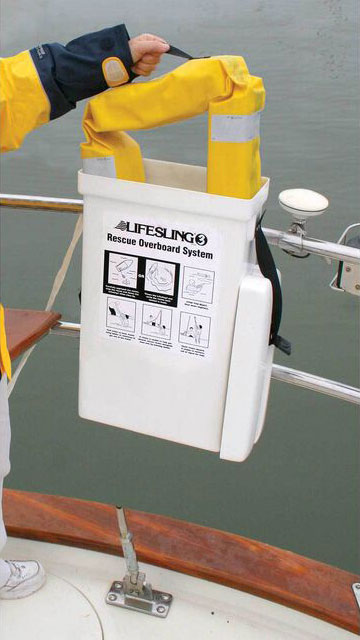
Two versions matter to cruisers. The Lifesling2 carries 125 feet of line and is rated for sailboats over 20 feet. The Lifesling3 has 150 feet of line, stainless D-rings, reflective tape and a rigid case, and is aimed at bigger boats.
On the water, the Cruising Club of America's Safety at Sea notes recommend pairing a quick stop with the Lifesling as the first method a shorthanded crew should learn. It keeps you close to the casualty and cuts sail handling until they're connected. You tack without releasing the jib sheet, stream the sling and keep circling. Once the casualty is in the collar, the same notes suggest taking a halyard straight to the sling's rings if your winches are big enough, or to a loop tied four to six feet above them. For extra leverage, use a three- or five-part tackle off the halyard.
So where does it fall short? It assumes a conscious casualty who can get into the collar, and the Cruising Club notes treat an injured casualty who can't as a separate problem. The circling approach needs sea room and a boat you can manage alone. And with a foresail on a pole and the wind well aft, the standard sequence needs rethinking before you're in the situation, not during it.
Jon Buoy Recovery Module: A Different Answer
The Jon Buoy Recovery Module sits in a slim canister on the pushpit. One latch releases it over the side, where it inflates into a small raft with a light, a lifting harness and a 5m throwing line. Ocean Safety says the MK6 is accepted under the World Sailing Offshore Special Regulations as a replacement for one traditional danbuoy, horseshoe, drogue, light and whistle set. It also says the casualty is supported out of the water and recovered horizontally.
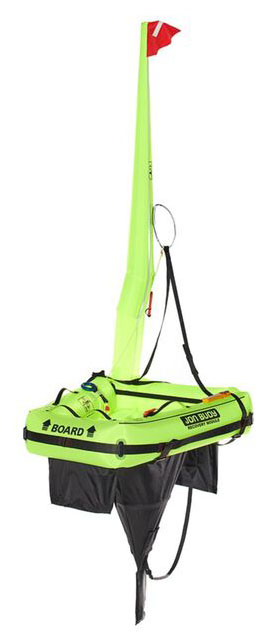
The independent testing is more cautious. Yachting World's Rachael Sprot and Bruce Jacobs tried an earlier Jonbuoy with a real person in the water, in benign conditions in the Azores. They found it far easier to deploy than a standard danbuoy, and lifting a casualty in it was straightforward once they'd hooked the strop. Their worries were about the casualty reaching it.
They doubted they'd get it within 200 metres of someone in the dark, their fit test casualty had to scull 20 metres to reach it, and he struggled to get in while wearing a 290N lifejacket. They suspected that above Force 5 a casualty might not manage it at all, and gave it 3.5 out of 5. Yachting Monthly's earlier test of the MkV called it easily the most comfortable recovery, but noted retrieval was only practical at 5m range.
Those tests are older than the MK6, so treat them as questions to ask rather than a verdict. Yachting World also raised upfront cost, servicing and the difficulty of training with the device, so check Ocean Safety's current manual for your unit's service interval and ask about practice options.
Comparing the Main Man Overboard Recovery Systems
| System | How it connects and lifts | Suits | Main limits |
|---|---|---|---|
| Lifesling2 or Lifesling3 with hoisting rig | Towed floating line and collar; halyard to winch, or 3:1 tackle on a halyard | Shorthanded crews with a conscious casualty | Casualty must get into the collar; needs sea room to circle; lifting rig must be ready |
| Jon Buoy Recovery Module MK6 | Inflatable raft with lifting harness and 5m throwing line; halyard clipped to the strop | Marking and supporting a casualty who can reach it | Reach and boarding in rough water (earlier model tested by Yachting World); servicing; hard to practise |
| Heaving line with boarding ladder or scramble net | Casualty hauls in and climbs | Conscious, capable casualty in calm water | Ladder or swim platform suits calm conditions only, per the RYA |
| Halyard or handy billy clipped to lifejacket | Direct lift, for example a 4:1 handy billy on a spinnaker halyard | Low freeboard with two or more crew aboard | Needs crew within reach of the water; a vertical single-point lift is a poor fit for an unconscious casualty |
| Catch and Lift | Floating sling, pulley on the shrouds and a drogue that pulls the casualty in | Experienced crews willing to drill it often | Yachting World rated it 2.5 out of 5; the lift can't be reversed once moving |
If you'd like to see how the Lifesling2, Lifesling3 and Jon Buoy Recovery Module MK6 compare on price, installation and limitations, our man overboard recovery systems comparison page sets them out side by side.
The Lifting Point Problem
This is the gap in most kit lists. The Lifesling literature quotes a hoisting point about ten feet above the water for powerboats, and many sailboats simply don't have a fixed point at that height above the rail. The practical answer on most cruising boats is a spare halyard led to a winch.
Yachting Monthly's test of pushpit-mounted kit described the quick version: get slack in the topping lift or main halyard, pass it to the casualty to clip to the D-ring on their harness, then start winching. At deck level you'll probably need to cut the lashings on the lower guardwire. Practical Boat Owner's Force 6 recovery used a 4:1 handy billy on the end of the spinnaker halyard, clipped to the casualty's lifejacket, and noted that lifting the casualty would have been a challenge with fewer than two people aboard.
So decide now which halyard you'd use, check it actually reaches the water on both sides, know which winch takes it and which lashings you'll cut. Yachting World also liked the idea of permanently rigged clamps on the shrouds as a strong point, with a ready-to-use purchase in a cockpit locker. That's a fitting worth pricing up for your own rig.
Lifting Horizontally & Looking After the Casualty
The RYA says that when you lift an unconscious casualty they should stay horizontal, to avoid complications caused by hydrostatic squeeze. In the same breath it stresses that drowning remains the primary risk, so getting them aboard is the priority. Practical Boat Owner makes a similar point: horizontal lifting is preferable, and sometimes vital, if the casualty is unconscious or hypothermic or the freeboard is too high to reach the water. Its route there is sending someone over the side, and it says that shouldn't be considered unless at least two fit, competent people stay aboard. It's a decision to make before you're in it.
The RYA also covers the casualty who's still clipped on. Stop the boat altogether, because any movement through the water, even at very low speed, risks forcing water into their lungs. If you can't stop or lift them, it suggests carefully considering cutting the tether and returning with the boat at a standstill.
Recovery isn't the end. The RYA says conscious casualties, and those who've recovered themselves, are still at risk of shock, hypothermia, secondary drowning and injuries from the fall. Remove wet clothing, warm them, monitor them and get them to a medical facility for review.
Two-Person Crews & the Skipper-Overboard Scenario
The RYA asks a blunt question: if the man overboard is the skipper, is anyone else aboard trained to take control and manage the recovery? On a two-person boat that's the whole plan. Cruising World's list of the three most useful pieces of kit for shorthanded sailors names an inflatable Man Overboard Module, the Lifesling and an Ocean Signal rescueMe personal locator beacon. The logic is the same three jobs: mark, connect, and help the casualty be found.
The Offshore Special Regulations nudge the same way for very small crews. The 2026-2027 edition requires a searchlight suitable for finding a person overboard at night, and lists GNSS tracking of a crew overboard from on deck as a double-handed requirement in one published category extract. Whether or not you race, it's worth asking whether the non-skipper can find the MOB button, work the plotter and handle the lift alone, without being told
What the Offshore Special Regulations Ask For
You don't have to race to use the World Sailing Offshore Special Regulations as a benchmark, and rally organisers such as World Cruising Club use them as a guideline when setting their own safety lists. The 2026-2027 edition sets out the following for recovery kit.
| Item | What the regulations say |
|---|---|
| Recovery sling (Categories 0 to 3) | Buoyant line no shorter than the lesser of four times the boat's length or 36m; horseshoe with at least 90N of buoyancy; strong enough to hoist a crew member aboard |
| Heaving line | At least 6mm diameter, 15 to 25m long, readily accessible to the cockpit |
| Searchlight | Suitable for searching for a person overboard at night and for collision avoidance |
| Routine training | Crews practise crew-overboard recovery, and abandoning the vessel, at least annually |
One point to check for your own event or insurer: Ocean Safety's acceptance of the Jon Buoy covers the danbuoy, horseshoe, drogue, light and whistle set. It doesn't say the module replaces a recovery sling, so read the wording that applies to you.
Practising So It Works at Three in the Morning
Yachting World's conclusion is worth keeping on the chart table: it's hard to test rescue kit on real people in real situations, but however clever the gear, you still have to train with it. So rehearse in pieces. Rig the halyard lift alongside the pontoon, or with a volunteer in a lifejacket in a tender in sheltered water, and time it. Then let the smallest crew member try it alone. If it takes longer than the cold-water window allows, that's the finding you needed.
Then rehearse the sequence at sea, in daylight first: alarm, spotter, buoyancy over the side, MOB button, the turn, the connection and the lift. Repeat it whenever the crew or the kit changes. The regulations ask for an annual drill at minimum, and the RYA's Helmsman, Competent Crew and Day Skipper courses all cover the basics if your crew needs a structured start.
Summing Up
The kit gets a line to the casualty. The lift gets them home. Choose the system you can rig alone, in the dark, with cold hands, and prove it before you leave. For most offshore couples that means a Lifesling, a spare halyard you've already chosen, a heaving line and a plan for the skipper going in. A Jon Buoy is a serious option for boats that want a compact, self-inflating marker and haven for the casualty, as long as you've asked honestly whether they could reach it in the conditions you actually sail in.

This article was written by Dick McClary, RYA Yachtmaster and author of the RYA publications 'Offshore Sailing', member of The Yachting Journalists Association (YJA), erstwhile member of the Ocean Cruising Club (OCC) and owner/administrator of 'Liveaboard Sailboats for Sale'.

FAQs
What is the best man overboard recovery system for a shorthanded sailboat?
What is the best man overboard recovery system for a shorthanded sailboat?
For most two-person crews, a Lifesling with a rigged halyard lift is the best-proven starting point. You tow it to the casualty, clip the halyard on and winch from the cockpit. Add a heaving line, a danbuoy or lifebuoy and a plotter MOB button, then rehearse the whole sequence with the smaller crew member working alone.
Can a Jon Buoy replace a Lifesling?
Can a Jon Buoy replace a Lifesling?
Not automatically. Ocean Safety says the Recovery Module is accepted as a replacement for one danbuoy, horseshoe, drogue, light and whistle set. That's a marking and support job. If your event or insurer asks for a recovery sling, check the wording, and remember a Jon Buoy only helps if the casualty can reach it and get into it.
How long do you have to recover someone from cold water?
How long do you have to recover someone from cold water?
MAIB analysis reported by the RYA found crews have under 11 minutes on average before a casualty in cold water becomes unresponsive, and sometimes only four or five. Colder water and rougher seas shorten it, which is why the lift needs to be rigged before you leave the dock.
How do you lift a casualty when freeboard is high?
How do you lift a casualty when freeboard is high?
Use mechanical advantage. A spare halyard led to a winch works on most sailboats, and a 3:1 or 4:1 tackle on the halyard adds leverage for a heavy casualty or a small crew. Attach it to the casualty's harness or sling first, then hoist, and practise it at the pontoon before you rely on it.
Should a man overboard be lifted horizontally?
Should a man overboard be lifted horizontally?
Where you can, yes, especially if they're unconscious or have been in cold water for some time. The RYA advises keeping an unconscious casualty horizontal to avoid hydrostatic squeeze complications, but stresses that drowning remains the main risk, so getting them aboard comes first.
What if the casualty is still attached by a tether?
What if the casualty is still attached by a tether?
Stop the boat completely. The RYA warns that any movement through the water, even at very low speed, risks forcing water into the casualty's lungs. If you can't stop the boat or lift them, it suggests carefully considering cutting the tether and returning to them with the boat at a standstill.
How often should you practise man overboard recovery?
How often should you practise man overboard recovery?
The Offshore Special Regulations ask crews to practise crew-overboard recovery at least annually, which is a sensible minimum for any offshore boat. Practise again whenever the crew or the kit changes, and time each drill so you know how long the lift really takes.
Recent Articles


-
Offshore Lifejackets: The Complete Buyer's Guide
Sep 29, 26 10:12 AM
A practical guide to offshore lifejackets: buoyancy levels, inflation types, must-have features and servicing advice -
Serious Sailboat Safety Gear: Beacons, Lifejackets, Liferafts
Sep 29, 26 09:27 AM
Serious sailboat safety gear for offshore crews: EPIRBs, PLBs, lifejackets and liferafts, plus the 2026 UK beacon registration change and pre-passage checks. -
MOB Recovery Systems: Lifesling vs Ocean Safety Jon Buoy
Sep 29, 26 09:21 AM
Compare man overboard recovery systems for sailboats: Lifesling2, Lifesling3 and Ocean Safety's Jon Buoy, with pricing and which suits your boat.