- Home
- Electronics & Instrumentation
- VHF/DSC Radios and GMDSS
- DSC Distress Alerts MOB Comparison
Handheld DSC Distress Alerts versus Fixed Mount Alerts in an MOB Emergency
Key Takeaways: In an MOB emergency, a fixed mount DSC radio will always outgun a handheld for sheer range and signal strength. Twenty five watts from a masthead antenna carries far further than five watts from deck level. But the handheld stays with the casualty, which means it is often the only device capable of sending an accurate, up to date position. In practice, both radios have strengths that matter at different moments in the rescue.
Table of Contents
- How DSC Distress Alerts Work at Sea
- Why Fixed Mount DSC Radios Reach Further
- The Strength of a Handheld DSC in an MOB
- What the Safety Bodies Say
- Range, Reliability and the Human Factor
- Battery Life and Waterproofing Considerations
- Integration with AIS MOB Devices
- Training Gaps Highlighted by Cruising Forums
- Summing Up
How DSC Distress Alerts Work at Sea
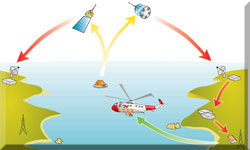
Digital Selective Calling is the automated distress signalling system built into modern VHF radios. Pressing the red button sends a digital alert on Channel 70 containing the vessel’s MMSI and, if available, its GPS position. The receiving stations then switch to Channel 16 for voice coordination.
In an MOB situation, the question is simple: which DSC device is most likely to get a distress alert out quickly and be heard by the right people.
Why Fixed Mount DSC Radios Reach Further
A fixed mount VHF has two major advantages: power and height.
- Transmit power: 25 watts
- Antenna height: typically 12 to 18 metres above sea level
- Result: a signal that can travel tens of miles, often reaching coast stations and commercial shipping
World Sailing and the RYA both emphasise that antenna height is the single biggest factor in VHF range. A masthead antenna dramatically increases the radio horizon, which is why fixed sets are the backbone of distress communication offshore.
The Strength of a Handheld DSC in an MOB
A handheld DSC radio cannot match the range of a fixed set, but it has one critical advantage: it stays with the person in the water.
- Transmit power: usually 5 watts
- Antenna height: effectively sea level
- Range: often 2 to 5 miles to another handheld, 10 to 12 miles to a masthead antenna
Cruising World and Attainable Adventure Cruising both highlight the same point: in an MOB, the casualty’s position moves with wind and tide. A handheld DSC radio with built in GPS can send repeated distress alerts with the casualty’s current location, not the vessel’s last known position.
This is often the difference between a quick recovery and a prolonged search.
What the Safety Bodies Say
A review of guidance from World Sailing, the RYA and ASA shows a consistent message:
- A fixed mount DSC radio is the primary distress device for the vessel.
- A handheld DSC radio is a valuable secondary device, especially for MOB scenarios.
- Both should be programmed with the correct MMSI and tested regularly.
Noonsite’s incident reports also show several MOB rescues where handheld DSC alerts were the only accurate position source once the casualty drifted away from the yacht.
Range, Reliability and the Human Factor
Yachting World’s technical writers often point out that range is only part of the story. In an MOB emergency, the crew may be disoriented, short handed or dealing with poor visibility. A handheld DSC radio clipped to the casualty’s lifejacket removes the need for anyone on board to operate the fixed set immediately.
Meanwhile, the fixed mount radio continues to provide long range coverage, ensuring the alert reaches the coastguard and any vessels further afield.
The two devices complement each other rather than compete.
Battery Life and Waterproofing Considerations
Handheld DSC radios are designed for survival use, but they still have limitations:
- Battery life varies widely between models
- Cold water reduces battery efficiency
- Waterproofing standards differ (IPX7 vs IPX8)
- Some units float, others do not
PredictWind’s safety guides note that a handheld DSC radio should be fully charged before departure and ideally carried in a waterproof pouch if the model does not float.
A fixed mount radio, by contrast, draws from the vessel’s power supply and is not affected by immersion.
Need help deciding which VHF suits your boat and your budget? Click here to see my recommended fixed models and here for handheld VHFs.
Integration with AIS MOB Devices
A growing number of sailors now carry AIS MOB beacons in their lifejackets. These transmit a dedicated AIS target to nearby vessels and, in some cases, trigger an alarm on the yacht’s chartplotter.
Cruising forums such as YBW and Cruisers Forum frequently discuss the benefits of pairing AIS MOB with handheld DSC:
- AIS provides a live track of the casualty
- DSC provides a formal distress alert
- Both systems update position automatically
This layered approach is increasingly recommended for offshore sailing.
Training Gaps Highlighted by Cruising Forums
A recurring theme across YBW Forums, ASA discussions and Attainable Adventure Cruising is that many sailors misunderstand how DSC distress alerts actually work.
Common gaps include:
- Not knowing whether the handheld has its own MMSI
- Assuming a handheld will have the same range as a fixed set
- Forgetting to enable or test the handheld’s GPS
- Not realising that a fixed mount DSC alert sends the vessel’s position, not the casualty’s
These gaps matter during an MOB, which is why regular practice and familiarisation are strongly encouraged.
Summing Up
A fixed mount DSC radio gives you the range and power needed to raise help from a distance, while a handheld DSC radio gives the casualty a fighting chance of sending their own position as they drift. One provides reach, the other provides accuracy. Used together, they form a far stronger safety net than either device alone.

This article was written by Dick McClary, RYA Yachtmaster and author of the RYA publications 'Offshore Sailing', member of The Yachting Journalists Association (YJA), erstwhile member of the Ocean Cruising Club (OCC) and owner/administrator of 'Liveaboard Sailboats for Sale'.

Recent Articles


-
Should I Buy a Boat? Four Questions to Answer Before You Commit
Oct 02, 26 04:40 AM
Thinking "Should I buy a boat?" This guide helps you decide, with key considerations from cost & maintenance to your personal sailing aspirations. -
Offshore Internet with Starlink: Hardware, Plans, and Setup Guidance
Oct 01, 26 01:15 PM
A clear, practical guide to choosing the right Starlink hardware and plan for offshore cruising. Learn what to buy, how to install it, and how to manage power afloat. -
Offshore Liferaft Guide: Choosing, Stowing and Servicing One
Oct 01, 26 06:28 AM
Choosing an offshore liferaft? Learn what ISO 9650 Group A means, where to stow it, how often to service it and what to pack in the grab bag.