- Home
- Anchoring
- Picking Up a Mooring
- Preparing Your Boat on a Mooring for a Gale
Preparing Your Boat on a Mooring for a Gale: The Pre-Storm Checklist and When to Move
For many boat owners, a well-maintained mooring is the safest place for a yacht during bad weather. Moorings are designed to allow a boat to ride naturally to wind and tide, avoiding the snatch loads often experienced alongside a pontoon.
However, not all moorings are equal, and not all storms are ordinary. When forecasts predict gale-force winds or stronger, the time to prepare is before the first squall arrives. A few hours of preventative work can make the difference between returning to an undamaged boat and facing thousands of pounds worth of repairs.
This guide provides a practical pre-storm checklist and helps you decide when leaving the boat on the mooring remains the best option, and when moving elsewhere becomes the safer choice.
Start with the Mooring Itself
The strongest cleats, ropes and fenders in the world cannot compensate for a failed mooring.
If possible, inspect the complete system before the storm season begins. Ground tackle components hidden beneath the water are often neglected until something goes wrong.
Pay particular attention to:
- Sinker condition
- Mooring chain wear
- Shackles and swivels
- Pick-up line chafe
- Buoy buoyancy
- Attachment points aboard
Any component nearing the end of its service life should be replaced long before severe weather arrives.
The Pre-Storm Mooring Checklist
| Item | Check |
|---|---|
| Inspect mooring strop for wear, UV damage and chafe | ☐ |
| Rig independent backup strop | ☐ |
| Fit chafe protection at all contact points | ☐ |
| Check cleats and bollards are secure | ☐ |
| Remove or secure roller-furling sails | ☐ |
| Remove sprayhood and cockpit enclosure if appropriate | ☐ |
| Remove or secure dinghy | ☐ |
| Lash down loose deck gear | ☐ |
| Close non-essential seacocks | ☐ |
| Test bilge pumps and float switches | ☐ |
| Fully charge batteries | ☐ |
| Clear cockpit drains and scuppers | ☐ |
| Secure internal equipment and lockers | ☐ |
| Check weather forecast updates | ☐ |
Rig a Backup Mooring Strop
One of the most effective storm preparations is adding a completely independent backup strop.
Ideally, the primary and secondary strops should:
- Use separate attachment points on the buoy
- Lead to different cleats aboard
- Have different lengths so loads are shared progressively
- Include proper chafe protection
A backup line costs little compared with the consequences of a single-point failure.
Eliminate Windage Wherever Possible
Wind pressure increases dramatically as wind speed rises. Every square metre of exposed canvas adds load to the mooring.
Remove or secure:
- Headsail UV covers that flap loose
- Sprayhoods
- Cockpit tents
- Biminis
- Deck awnings
- Paddleboards
- Kayaks
A stripped boat presents far less windage and is kinder to the mooring system.
Deal with Roller-Furling Sails
Partially unfurled genoas have destroyed countless rigs during storms.
If a serious gale is forecast, the safest option is usually to remove the headsail entirely.
If removal is impractical:
- Apply extra sail ties
- Secure furling lines independently
- Use additional wraps on the foil
- Inspect drum locking arrangements
Any sail that comes loose in gale-force wind can rapidly become uncontrollable.
Protect Against Chafe
Chafe causes many mooring failures.
Even high-quality rope can fail surprisingly quickly when subjected to constant movement under load.
Common chafe points include:
- Fairleads
- Bow rollers
- Toe rails
- Cleat edges
- Mooring rings
Purpose-made anti-chafe sleeves, reinforced hose or heavy-duty webbing may all be used depending on the application.
Secure Everything Above and Below Deck
Imagine turning the boat upside down. Anything that would move should be secured.
Check:
- Cockpit lockers
- Gas bottles
- Anchors
- Liferafts
- Outboard motors
- Solar panels
- Wind generators
- Cabin contents
Below deck, secure heavy items and close internal lockers.
Check Bilge Pumps and Batteries
Heavy rain often accompanies strong winds.
Ensure:
- Automatic pumps operate correctly
- Float switches are functioning
- Battery banks are fully charged
- Drainage channels are clear
Many boats survive the wind only to suffer damage from water ingress afterwards.
When a Mooring Is Usually the Best Place
In many situations, remaining on a properly maintained mooring is actually preferable to moving.
A good mooring often provides:
- Freedom to swing naturally
- Reduced collision risk
- No pontoon surge damage
- Less load concentration on lines
- Greater separation from neighbouring boats
This is especially true in sheltered estuaries and harbours where moorings have a proven record during previous storms.
Special Considerations for Fore-and-Aft Moorings
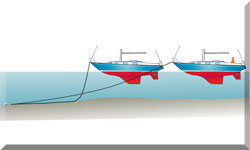
The advice so far assumes a conventional single-point swinging mooring, where the yacht is free to weathercock into the wind and align itself with the forces acting upon it.
Fore-and-aft moorings present a different set of challenges.
Because the yacht is restrained between two mooring points, it cannot always adopt the angle of least resistance to the wind and waves. As wind direction shifts, the hull may be forced to lie partly broadside to the gusts, substantially increasing aerodynamic loads and placing greater strain on both the mooring system and the boat's attachment points.
In strong crosswinds, a yacht on a fore-and-aft mooring may experience:
- Higher loads on mooring lines and fittings
- Greater heeling forces
- Increased yawing and snatching
- More violent motion in waves
- Higher stresses on cleats, sampson posts and fairleads
- Accelerated chafe on mooring strops
The situation becomes particularly demanding when strong winds blow at a significant angle to the mooring alignment or when wind and tide oppose one another.
For this reason, sailors using fore-and-aft moorings should be especially cautious when gale-force conditions are forecast. The mooring may be subjected to substantially greater loads than an equivalent swinging mooring in the same conditions.
Additional Fore-and-Aft Mooring Checklist
| Item | Check |
|---|---|
| Inspect both fore and aft mooring strops | ☐ |
| Check all cleats and attachment points | ☐ |
| Fit chafe protection to every mooring lead | ☐ |
| Confirm adequate clearance from neighbouring boats | ☐ |
| Inspect stern fittings as carefully as bow fittings | ☐ |
| Check for excessive line angles at fairleads | ☐ |
| Review forecast wind direction as well as wind strength | ☐ |
| Consider relocating if strong crosswinds are forecast | ☐ |
When You Should Consider Moving
Not all moorings are capable of handling every forecast.
Consider relocating if any of the following apply.
| Situation | Stay on Mooring | Consider Moving |
|---|---|---|
| Well-maintained mooring with recent inspection | ✓ | |
| Protected harbour with little fetch | ✓ | |
| Forecast 35-45 knots | ✓ | |
| Forecast above 50 knots | ✓ | |
| Exposure to swell or breaking seas | ✓ | |
| Uncertain mooring tackle condition | ✓ | |
| Nearby poorly maintained boats | ✓ | |
| No backup strop fitted | ✓ | |
| Secure marina berth available locally | ✓ |
You Have Doubts About the Mooring
If you are unsure about:
- Chain condition
- Ground tackle size
- Mooring maintenance history
- Attachment security
then now is not the time to discover weaknesses.
Forecast Winds Exceed the Mooring's Intended Design
Private moorings are often designed around typical local conditions rather than exceptional storm events.
Extreme forecasts may justify moving to:
- A secure marina berth
- A sheltered marina lock
- A drying berth
- A hurricane hole or sheltered creek where available
Significant Wave Action Is Expected
Wave action often causes more stress than wind alone.
A mooring exposed to:
- Long fetch
- Storm swell
- Wind-over-tide seas
may subject both yacht and tackle to violent snatch loads.
Nearby Boats Appear Poorly Prepared
Your own preparations are irrelevant if a neighbouring vessel breaks free and drifts into you.
If surrounding boats look vulnerable, a more secure location may be prudent.
Move Early, Not Late
The best time to move is often 24-48 hours before the storm arrives.
Benefits include:
- Better berth availability
- Safer manoeuvring conditions
- More daylight
- Less pressure on marina staff
- Reduced risk to crew
Waiting until conditions have already deteriorated can turn a straightforward relocation into a dangerous exercise.
Frequently Asked Questions
How much wind can a typical yacht mooring safely withstand?
How much wind can a typical yacht mooring safely withstand?
There is no universal answer because the safe limit depends on the design of the mooring, the condition of its components, seabed holding characteristics, fetch, wave action and the windage of the boat itself. A professionally engineered swinging mooring in good condition may withstand far stronger winds than a neglected private mooring. The key question is not the forecast wind speed alone, but whether every part of the mooring system has been maintained and inspected to cope with the expected loads.
Is a marina berth safer than a mooring during a gale?
Is a marina berth safer than a mooring during a gale?
Not necessarily. In many situations a yacht is safer on a well-maintained mooring because it can swing naturally to wind and tide without being forced against pontoons or neighbouring boats. Marinas can become hazardous during severe weather if surge develops inside the basin or if pontoon cleats, fingers or shore lines fail. The safest option depends on the local conditions, exposure and the quality of both the mooring and the marina.
This is especially true for boats on conventional swinging moorings. Fore-and-aft moorings can experience significantly higher loads during strong crosswinds because the boat cannot always align naturally with the wind. In some circumstances, a protected marina berth may be the safer option.
Should I leave fenders out when my boat is on a mooring during a storm?
Should I leave fenders out when my boat is on a mooring during a storm?
In most cases, no. Fenders serve little purpose when a yacht is swinging freely on a mooring and can create additional windage. However, if there is a realistic possibility of contact with a nearby boat, a harbour wall or another structure, strategically placed fenders may provide useful protection. The decision depends on the particular mooring location and surrounding hazards.
Is it worth removing sails completely before a major storm?
Is it worth removing sails completely before a major storm?
Yes, particularly if storm-force winds are forecast. Even a well-furled genoa can partially unfurl if a furling line fails or chafes through. Once loose, the sail can generate enormous loads and may damage the rig, furling gear or mast. Removing headsails and loose canvas before a severe storm is one of the most effective ways to reduce risk.
Can a boat sink while safely attached to its mooring?
Can a boat sink while safely attached to its mooring?
Unfortunately, yes. Many storm losses occur not because the mooring fails but because water enters the boat. Failed cockpit drains, leaking deck fittings, damaged hatches, exhausted batteries or blocked bilge pumps can all allow flooding. Part of any pre-storm preparation should include checking drainage systems, battery condition and bilge pump operation.
What is the most common cause of mooring failure during a gale?
What is the most common cause of mooring failure during a gale?
Chafe is responsible for many failures. A rope that appears perfectly adequate in calm conditions can wear through surprisingly quickly when subjected to continuous movement and heavy loads. This is why experienced sailors pay particular attention to chafe protection, backup strops and eliminating sharp edges wherever mooring lines pass through fairleads or over rollers.
How early should I move my boat if severe weather is forecast?
How early should I move my boat if severe weather is forecast?
As a rule, move early rather than late. If you decide relocation is necessary, it is usually far safer to do so 24 to 48 hours before the strongest winds arrive. Waiting until the harbour is already experiencing rough conditions can make departure, arrival and berth manoeuvring considerably more difficult and potentially dangerous.
Should I stay aboard my boat during a gale on a mooring?
Should I stay aboard my boat during a gale on a mooring?
For most cruising sailors, remaining ashore is often the safer option. A person aboard cannot prevent a mooring chain from failing and may place themselves at unnecessary risk if conditions deteriorate. Exceptions exist where boats are being actively monitored or emergency action may be required, but in general good preparation beforehand is usually more valuable than remaining aboard during the storm itself.
Final Thoughts
A well-maintained mooring remains one of the safest places for many cruising yachts during gale-force weather. The key is preparation. Inspect the mooring system, rig backup strops, eliminate unnecessary windage and address chafe before conditions worsen.
Most importantly, be realistic. If the forecast, location or mooring condition gives you genuine cause for concern, move early. The safest decision is usually the one made before the first gust arrives rather than after the storm has already begun.
Recent Articles


-
Preparing Your Boat on a Mooring for a Gale: Pre-Storm Checklist
Nov 23, 26 04:39 AM
Learn how to prepare a sailboat on a mooring for gale-force conditions. Follow this practical pre-storm checklist and discover when moving to a marina or alternative berth is the safer option. -
Mooring Pennants, Bridles and Chafe Protection for Storm Survival
Nov 22, 26 05:13 PM
Learn how to size and rig mooring pennants and bridles, choose the right rope, prevent chafe and avoid common mistakes that can cause mooring failures in heavy weather. -
Can You Trust That Mooring? A Checklist for Vetting Private Buoys
Nov 22, 26 01:54 PM
Before you leave your boat unattended on a private or visitors' mooring, use this practical skipper's checklist to assess whether the buoy, tackle and location are up to the job.