- Home
- Cruising Yachts 40' to 45'
- Saga 43
The Saga 43 Sailboat
Specs, Performance Analysis & Cruising Characteristics
Key Takeaways
The Saga 43 is a performance-oriented blue water cruiser designed for short-handed sailing. It features a unique "Variable Geometry Rig" that allows for efficient sail handling across various wind speeds. With its moderate displacement, narrow beam, and long waterline, the boat offers a comfortable motion at sea and impressive passage-making speeds. It is particularly well-regarded for its high-quality construction and thoughtful interior layout, making it an excellent choice for couples looking to cross oceans with confidence.
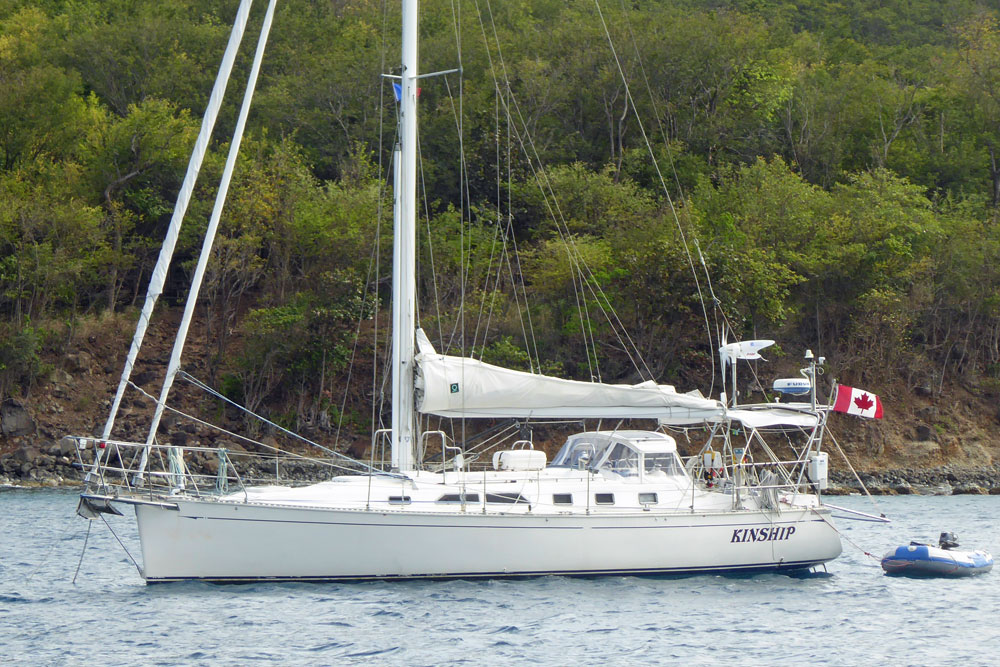 The Saga 43
Design & Construction
The Saga 43 was designed by the late Robert Perry, a man whose name is synonymous with the "performance cruiser" movement. Built by Saga Yachts in Ontario, Canada, the hull is constructed using vacuum-bagged balsa core sandwich with E-glass and vinylester resin. This method ensures a stiff, light, and durable structure. The use of high-quality materials was a hallmark of the builder, aiming to provide a vessel that could handle the rigours of offshore sailing without the weight penalty of traditional heavy-displacement cruisers.
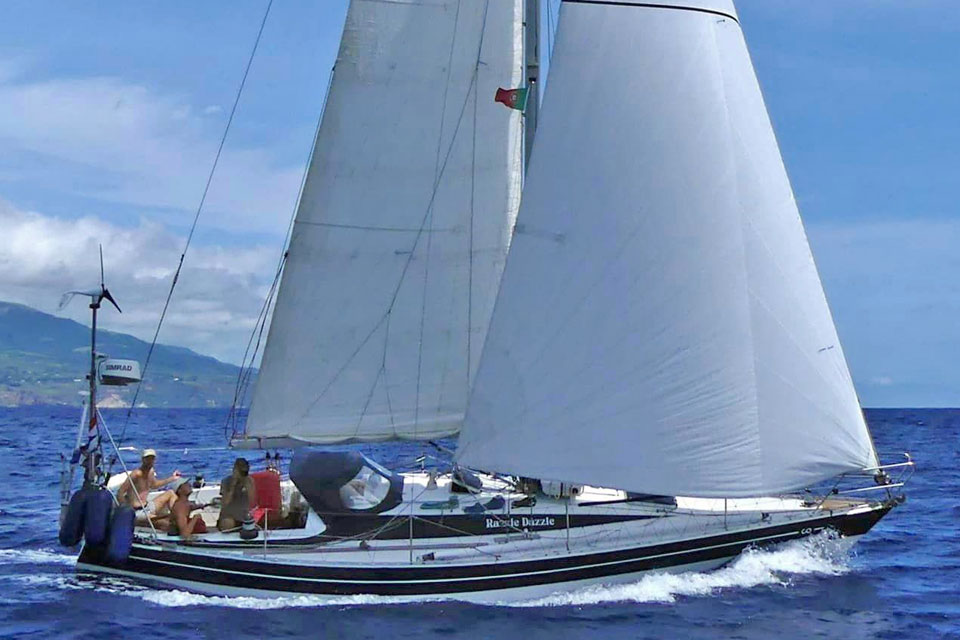
The defining feature of the Saga 43 is its Variable Geometry Rig. Unlike a traditional cutter, the Saga 43 uses a fractional rig with a large, self-tacking jib for upwind work and a reaching sail (often a Code 0 or a large genoa) set on a permanent carbon fibre bowsprit. This allows the crew to shift gears easily as the wind angle changes without the need for frequent sail changes on the foredeck. This design philosophy focuses on maintaining high average speeds with minimal physical effort from a small crew.
While the core design remained consistent, Saga offered variations in draft to suit different cruising grounds. Most were built with a deep fin keel for maximum windward performance, but a shoal-draft version was also produced for sailors frequenting shallower waters like the Bahamas or the Chesapeake Bay. The cockpit is an aft-cockpit configuration, designed to be deep and secure, providing excellent protection from the elements.
Sail Areas & Rig Dimensions
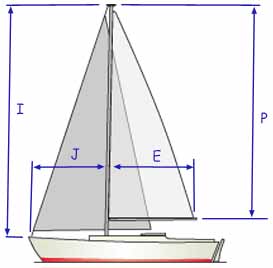 Rig dimensions
The rig is a crucial component of the Saga 43 performance. The sail plan is designed to be versatile, allowing the boat to remain balanced under a wide variety of conditions.
- Mainsail Area: 458 ft² (42.55 m²)
- Total Sail Area (100% Foretriangle): 864 ft² (80.27 m²)
- I (Forestay Height): 52'10" (16.10 m)
- J (Foredeck Length): 15'4" (4.67 m)
- P (Mainsail Hoist): 47'3" (14.40 m)
- E (Mainsail Foot): 19'4" (5.89 m)
Published Specification: The Saga 43 Blueprint
| Feature | Measurement / Detail |
|---|---|
| LOA | 43'3" (13.18 m) |
| LWL | 39'2" (11.94 m) |
| Beam | 12'0" (3.66 m) |
| Draft (Deep) | 6'6" (1.98 m) |
| Draft (Shoal) | 5'4" (1.63 m) |
| Displacement | 19,500 lbs (8,845 kg) |
| Ballast | 7,500 lbs (3,402 kg) |
| Rig Type | Fractional Sloop / Variable Geometry |
| Hull Material | GRP / Balsa Core Sandwich |
| Production Dates | 1996 – 2005 |
Performance Analysis: Understanding the Design Ratios
The following ratios provide a mathematical perspective on how the Saga 43 behaves in various sea states. For more context on these figures, you may refer to our guide on Understanding Boat Performance & Design Ratios.
| Ratio | Value | Interpretation |
|---|---|---|
| SA/D | 19.1 | A healthy ratio for a cruiser, indicating spirited performance in light to moderate winds. |
| D/L | 145 | Classified as a "light-moderate" displacement boat, favouring speed and surfing potential. |
| B/D | 38% | Solid ballast ratio, ensuring high initial stability and good stiffness when the breeze picks up. |
| CSF | 1.81 | Well below the 2.0 limit, indicating excellent suitability for ocean crossings and heavy weather. |
| Comfort Ratio | 28.5 | Moderate comfort; the boat will feel more active than a heavy cruiser but remains predictable. |
Structural Integrity & Stability Dynamics
The choice of a balsa-cored hull might give some traditionalists pause, but the execution by Saga Yachts was top-tier. By using vinylester resin in the outer layers, they effectively mitigated the risk of osmosis. The core provides thermal and acoustic insulation, which is a significant bonus for liveaboards in both cold and tropical climates. The hull-to-deck joint is a robust inward-turning flange, through-bolted and chemically bonded, creating a monocoque structure capable of withstanding significant torsion.
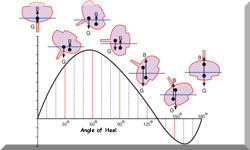
Stability is enhanced by the narrow beam and deep keel. Unlike modern "fat" cruisers that rely on form stability, the Saga 43 relies on its ballast and low centre of gravity. This means that as the boat heels, its righting moment increases steadily, making it a very safe platform in a blow. The long waterline relative to its overall length also helps reduce pitching, which is often the most exhausting motion for a crew on a long passage.
Configuration, Layout & Cruising Characteristics
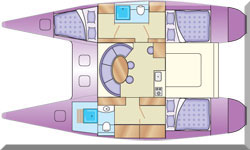
The interior of the Saga 43 is designed with the reality of life at sea in mind. The galley is a secure, U-shaped arrangement located to port, immediately adjacent to the companionway. It provides excellent bracing for the cook while under sail. Storage throughout the boat is abundant, with dedicated lockers for dry goods and deep bilges for heavier items.
Tankage is impressive for a boat of this size, with 150 gallons (568 L) of water and 85 gallons (322 L) of fuel. This allows for extended periods of self-sufficiency. The aft cabin is a generous double, and the forward Pullman-style berth allows for a large head and shower in the bow, a layout often preferred by long-term cruisers as it keeps the "wet" areas away from the main living space.
The cockpit is designed for efficiency. All lines are led aft to the safety of the cockpit, and the self-tacking jib makes tacking as simple as turning the wheel. The integrated carbon fibre bowsprit not only extends the sail plan but also keeps the anchor clear of the stem, a small but appreciated detail when anchoring in a crosswind.
Impressed?
Has this article suggested that this could be your ideal cruising boat and, as a result, deserves to be on your "Worth a Look" list?
But if, like me, you find sailboats to be seductive creations, then that list could rapidly get to be a pretty long one. If that is the case, wouldn't it be good if you could narrow it down bit through an objective, pragmatic process?
Well, that's where my eBook 'How to Avoid Buying the Wrong Sailboat' comes in...
Summing Up
The Saga 43 is a fine example of balanced yacht design. By combining Robert Perry's eye for performance with a build quality that prioritises longevity, Saga created a boat that remains highly sought after on the second-hand market. While the moderate displacement and narrow beam mean it might not have the interior volume of a modern 43-foot "caravan," it makes up for it with superior sea-keeping and speed. It is a boat that rewards a sailor who enjoys the journey as much as the destination, providing a fast, safe, and comfortable home on the water.
If you'd like to compare this boat with others in this size range, take a look at Cruising Boats from 40' to 45' overall....
This article was written by Dick McClary, RYA Yachtmaster and author of the RYA publications 'Offshore Sailing' and 'Fishing Afloat', member of The Yachting Journalists Association (YJA), and erstwhile member of the Ocean Cruising Club (OCC).
Frequently Asked Questions (FAQs)
How does the self-tacking jib perform in light air?
How does the self-tacking jib perform in light air?
While the self-tacking jib is exceptionally easy to handle, its smaller surface area can be a disadvantage in light air when sailing off the wind. This is why the Saga 43 is designed to carry a larger reaching sail on the bowsprit, which is essential for maintaining boat speed in sub-10 knot conditions.
Is the balsa core a concern for long-term maintenance?
Is the balsa core a concern for long-term maintenance?
As with any cored hull, the key is maintaining the integrity of the skin. If deck hardware is properly bedded and any hull penetrations are correctly sealed with solid laminate, the core remains dry and structural. Saga’s build quality was high, but a professional survey is always recommended to check for moisture.
Can the Saga 43 be sailed solo?
Can the Saga 43 be sailed solo?
Yes, it is one of the better 40-footers for solo sailing. The self-tacking jib and the fact that all control lines lead to the cockpit mean you rarely have to leave the safety of the helm during manoeuvres.
What is the expected cruising speed under power?
What is the expected cruising speed under power?
Most Saga 43s were equipped with a 50hp Westerbeke or Yanmar engine. You can comfortably expect a cruising speed of 7 knots at moderate RPMs, with the long waterline providing a very efficient hull form under power.
How does the narrow beam affect its performance at anchor?
How does the narrow beam affect its performance at anchor?
The narrow beam can make the boat slightly more prone to rolling in a beam-on swell compared to wider, flat-bottomed modern designs. However, this same characteristic allows it to slice through chop much more comfortably when underway.
Recent Articles


-
Rigging a Carbon Mast: Carbon, PBO or Dyneema Compared
Sep 20, 26 08:01 AM
Rigging a carbon mast: how carbon rod, PBO and Dyneema compare on cost, weight and inspection, and why stainless wire or rod rarely make sense. -
Top-Down Furling Guide: Code Zeros and Asymmetric Spinnakers
Sep 19, 26 04:57 PM
Top-down furling explained for cruisers: how it works, which boats need one, common faults, sock versus furler costs, and the rule everyone forgets. -
Standing Rigging Inspection Checklist: A Sailor's Full Guide
Sep 19, 26 03:46 PM
A complete standing rigging inspection checklist covering swage fittings, chainplates, tension and going aloft safely, plus when to call in a professional rigger.