- Home
- Sailing eBooks: Download them here!
- Coastal Passage Planning and Preparation System
Confident Coastal Passage Planning
The 5-Phase Prep System for Safer, Smoother Coastal Departures
You've checked the forecast. You've looked at the tide tables. And you still feel that knot in your stomach as departure time gets closer.
That isn't a sign you're a poor sailor. It's a sign that too many decisions are still vague. Most short coastal passages feel stressful because the limits, the timing, the crew's jobs and the bailout plan were never written down, not because the sailing is hard.
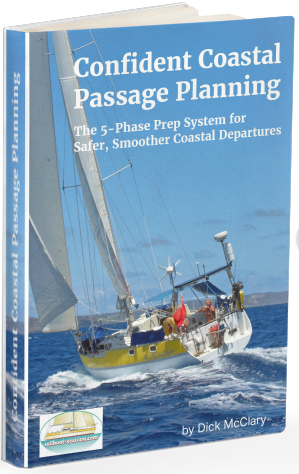
Confident Coastal Passage Planning gives you a written, repeatable five-phase system you can use before every weekend hop, day sail or short overnight. You'll know what would make it a go, what would make it a no-go, and what you'll do if things change.
- Set your go / no-go limits while you're calm, not at the dock
- Match route, tide, daylight and forecast so you arrive with margin to spare
- Brief your crew, including man overboard and the radio
- Leave with a calm 30-minute countdown instead of a scramble
Written for cruising sailors in the UK and the US. Instant PDF download after purchase.
Most coastal trouble starts before you leave the dock
Short passages seldom go wrong because of one dramatic failure. They go wrong because several ordinary problems line up: an engine fault you've been meaning to fix, a late start that eats your daylight, lifejackets that are aboard but not worn, a crew member who has gone quiet, a forecast that was inside your limits on paper but wrong for the route.
The figures are a reminder of how often it happens. In its 2025 Annual Report, the RNLI recorded 713 lifeboat launches to sailing vessels. In the United States, the Coast Guard's 2024 Recreational Boating Statistics Report found that 87 per cent of drowning victims weren't wearing a life jacket.
None of this needs exceptional seamanship to avoid. It needs decisions made early, in writing, before the day gets busy. Mental checklists work until you're distracted, optimistic or short of time. A written process doesn't forget.
One idea runs through the whole book: protect your margin
Margin is the spare time, daylight, fuel, crew energy, boat reliability and options you have when something goes slightly wrong. Each of the five phases protects a different kind of margin, so whenever you're unsure what to do, you ask one question: which choice leaves me more margin?
| Phase | The question it answers | What you walk away with |
|---|---|---|
| 1. Passage Definition | What trip are we really making, and what would stop it? | Written go / no-go limits, your personal minimums |
| 2. Route, Weather and Timing | Do the route, tide, daylight and forecast fit together? | A primary route, a fallback, a latest departure time and checkpoints |
| 3. Boat Readiness | Is this boat ready for this passage, today? | A clear call: ready, simplify or no-go |
| 4. Crew, Safety Briefing and Provisioning | Does everyone know their job and what to do if something goes wrong? | A five-minute brief covering lifejackets, man overboard and the radio |
| 5. Departure Day Execution | Can we leave in order, not in a rush? | A 30-minute countdown and a controlled cast-off |
What's inside
The book is over 30 pages, and it's built to be used on the boat, not just read at home.
- Two worked examples. One passage, Portsmouth to Yarmouth, is followed through all five phases so you can see what a good plan looks like, and a shorter US example on Chesapeake Bay shows the same method in American waters
- Starting numbers for your limits. Beginners often don't know what a sensible wind or sea-state limit looks like, so you get clearly labelled examples to adjust for your own boat and crew.
- The seamanship behind the decisions. How to turn a wind number into a sea state, why wind against tide matters, tidal gates, lee shores, and a simple method for working out your latest departure time.
- Fuel and boat readiness. A fuel reserve rule of thumb and an every-trip check that separates readiness from maintenance.
- A safety brief you'll use. A lifejacket and tether policy, including how to use cockpit strong points and a jackstay, a man-overboard brief, and the Mayday and Pan-Pan calls, with notes for fixed and handheld DSC radios.
- A departure routine that works. A T-minus-30 countdown, plus what to do with the tender when you're leaving from a mooring or anchor.
- Five printable tools. A Passage Plan, a Boat Readiness Sheet, a Crew Brief and Provisioning Planner, a Departure Sequence Card, and a shore-contact passage plan (float plan) with harbour notes.
- A UK and US glossary. Terms, acronyms and where to find local forecasts, rules and training in each country.
Who it's for
This book is for beginner-to-intermediate cruising sailors and hobbyist owners planning short coastal passages. It's a good fit if you:
- can handle basic sailing but want a better preparation process
- have done short passages and still feel rushed before departure
- sail with a partner, family or casual crew, and want everyone clear on their jobs
- want practical planning rather than a theory-heavy seamanship manual
It isn't designed for offshore passages, heavy-weather tactics or expedition planning, and it doesn't replace sailing training, local knowledge, current official forecasts or the skipper's judgement. It's there to make sure the decisions you already know you should make actually get made.
Written for sailors on both sides of the Atlantic
Tides, weather, boats and people behave the same way everywhere, but forecast services, rescue organisations, equipment rules and training schemes don't. The book uses British spelling, gives the American term where it differs, and points you to the right starting places in each country, from the Met Office and the RNLI to NOAA and the US Coast Guard. Wherever the rules vary, it tells you to check with your own authority.
About the author
Dick McClary writes sailboat-cruising.com and is the author of the ebook How to Avoid Buying the Wrong Sailboat, first published in 2019. He's a long-term cruising sailor with thousands of sea-miles under his keel.
Ready to plan with confidence?
Your next passage is going to happen anyway. The question is whether you'll leave with a plan you've written down, or with a feeling that you've probably covered everything.
Try it risk-free. If Confident Coastal Passage Planning doesn’t help you plan your passages with more confidence, contact me within 30 days at [your email address] and I’ll refund you in full.
Common Questions
I'm an experienced sailor. Will this still be useful?
I'm an experienced sailor. Will this still be useful?
Yes, particularly if you sail with casual crew or often feel rushed on departure day. The system is a discipline as much as a lesson: it makes you set limits before the day starts to slide, and it keeps small problems from stacking up unnoticed.
Does it cover offshore passages?
Does it cover offshore passages?
No. It's written for short coastal passages, from day sails to weekend hops and a short overnight. Offshore planning, heavy-weather tactics and expedition preparation are outside its scope.
Is it for UK sailors or US sailors?
Is it for UK sailors or US sailors?
Both. The method is the same, and the book gives you the terms, forecast sources and organisations for each country. Rules and equipment requirements differ between countries and, in the US, between states, so the book always points you back to your own authorities.
Can I print the worksheets?
Can I print the worksheets?
Yes. The worksheets and checklists are designed to be printed and kept aboard, and you can print only the ones you'll use. You’ll receive the ebook as a PDF, so you can print the pages you want.
Does it replace a sailing course or the official forecast?
Does it replace a sailing course or the official forecast?
No. It supports training, local knowledge and current official forecasts, and the skipper stays responsible for the boat and everyone aboard.
The RNLI and US Coast Guard figures quoted above come from the RNLI Annual Report 2025 and the US Coast Guard 2024 Recreational Boating Statistics Report.
Copyright © 2026 Dick McClary. All rights reserved.
Recent Articles


-
Coastal Passage Planning Made Easy: A 5-Phase Prep Guide
Oct 24, 26 10:51 AM
Master short coastal passage planning with our 5-phase preparation system. Avoid dockside stress, set safe limits, and cast off with complete confidence. -
Nonsuch 30 Sailboat Review, Specs, Performance and Buying Guide
Oct 21, 26 05:45 PM
Independent Nonsuch 30 review covering specs, performance, Classic vs Ultra layouts, owner feedback, common faults and buying advice. -
Hallberg Rassy 42E Review, Specs & Buyer's Guide
Oct 21, 26 07:00 AM
Hallberg Rassy 42E review with specs, design ratios, sailing performance, ownership insights, common issues and buyer guidance.