- Home
- Sailboats 50'-55'
- Jeanneau Sun Odyssey 51
Jeanneau Sun Odyssey 51: Specs, Performance Analysis & Cruising Characteristics
Key Takeaways: A high-volume, performance-oriented cruiser from the board of Bruce Farr, the Sun Odyssey 51 is a formidable passage-maker and spacious liveaboard. Its masthead sloop rig and modern hull form deliver rewarding speeds, but prospective buyers should prioritise inspection of the structural grid tabbing, chemically bonded coachroof windows, and internal chainplate tie-rods for signs of age-related fatigue.
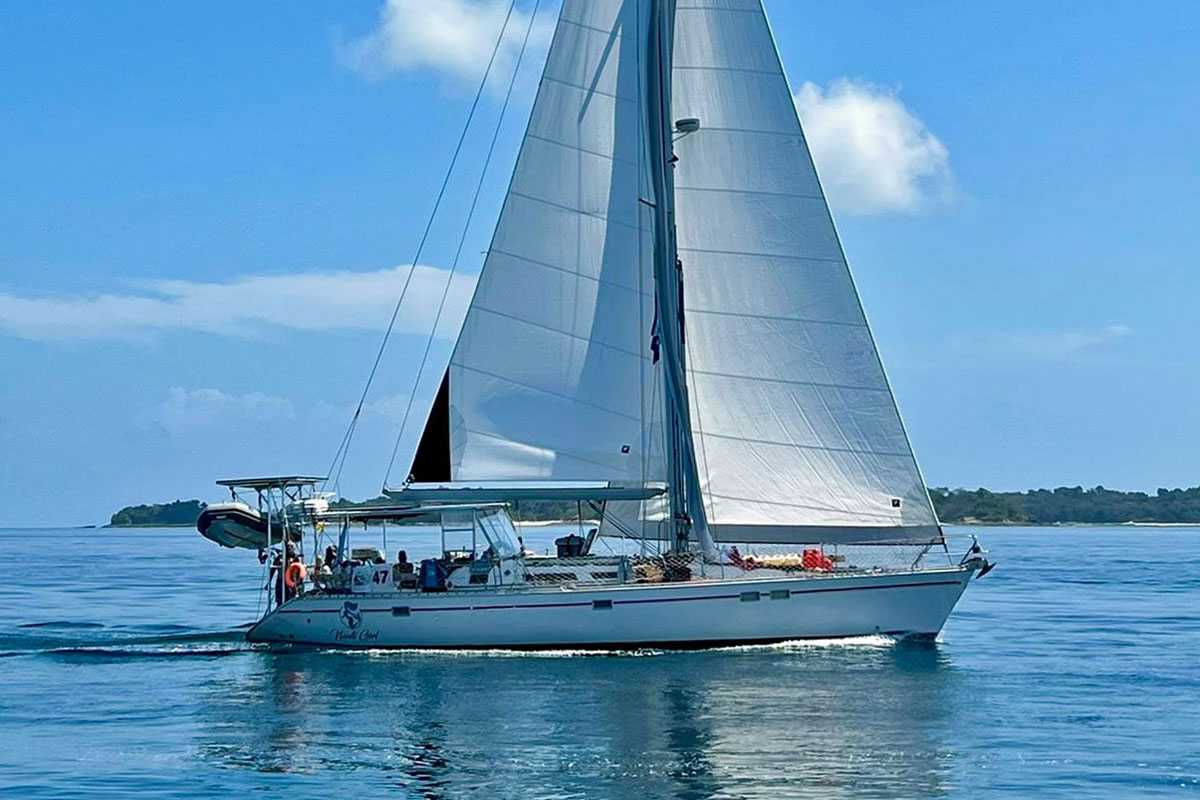 'Nauti Girl', a Jeanneau Sun Odyssey 51
Pic by kind permission of the owner
Table of Contents
- Design & Construction
- Sail Areas & Rig Dimensions
- Configuration, Layout & Cruising Characteristics
- Published Specification: The Jeanneau Sun Odyssey 51 Blueprint
- Performance Analysis: Understanding the Design Ratios
- The Buyer’s Checklist: Common Problem Areas
- Comparison: Jeanneau Sun Odyssey 51 vs The Competition
- Summing Up
- Frequently Asked Questions (FAQs)
Design & Construction
Launched in 1989, the Jeanneau Sun Odyssey 51 was the product of a sophisticated collaboration between renowned racing designer Bruce Farr and the J&J Design studio. Built during a period of transition for the French yard, the model aimed to combine grand-prix hull efficiency with the luxury and volume demanded by the emerging high-end charter and private offshore markets. The hull is constructed of solid hand-laid glass-reinforced plastic (GRP), while the deck utilises a balsa core to maintain stiffness without adding excessive weight aloft.
A defining feature of this model is its exceptionally wide beam, carried well aft. This allowed for twin steering wheels—a revolutionary feature for a production boat of this size at the time. The arrangement gave the helmsman superior visibility and created a clear, unobstructed path from the companionway to the sugar-scoop transom.
Managing rig loads on a boat of this scale required a departure from traditional external chainplates. The Sun Odyssey 51 utilises a sophisticated internal tie-rod system. Stainless steel deck plates are connected to high-tensile rods that lead down to heavy-duty brackets bolted directly to the main structural bulkheads. This arrangement creates a direct load path to the hull's internal grid, allowing for narrower sheeting angles and improved upwind performance. However, because these rods are often concealed behind cabinetry, they should be inspected carefully for leaks that can lead to "tea-staining" or bulkhead rot.
Visually, the boat is distinguished by its long, sweeping coachroof windows. Instead of using heavy aluminium frames, Jeanneau opted for large acrylic panels chemically bonded to a recessed flange in the GRP. This creates a sleek profile, but over decades the bond can succumb to UV degradation and thermal expansion, making meticulous re-bedding necessary.
Production ran from 1989 to 1992, and the yacht eventually evolved into the Sun Odyssey 52.2. Common variations include the four-cabin layout favoured by charter fleets and a more palatial three-cabin owner’s version. Under the European Recreational Craft Directive, the Sun Odyssey 51 is recognised as a Category A (Ocean) vessel. That means it is certified for extended voyages where conditions may exceed wind Force 8 and significant wave heights of 4 metres.
Sail Areas & Rig Dimensions
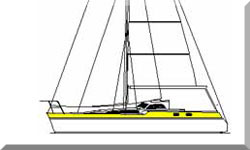
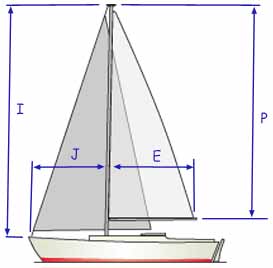 Rig dimensions
Although often found with an optional inner forestay for offshore work, the Sun Odyssey 51 was primarily designed and delivered as a powerful masthead sloop. This configuration provides a large foretriangle, allowing for high-overlap genoas that drive the boat effectively in light-to-moderate air.
I (Foretriangle Height): 62'0" (18.90 m)
J (Foretriangle Base): 17'11" (5.46 m)
P (Mainsail Luff): 54'10" (16.72 m)
E (Mainsail Foot): 18'8" (5.70 m)
Individual Sail Areas:
- Mainsail: 513 ft² (47.7 m²)
- 100% Foretriangle: 555 ft² (51.6 m²)
- Total (100% Foretriangle & Main): 1,068 ft² (99.3 m²)
Configuration, Layout & Cruising Characteristics
The Sun Odyssey 51 is designed for social cruising. The cockpit is expansive, with a fixed central table that serves as the hub for alfresco dining. The twin-wheel arrangement not only aids sailing performance but also keeps the cockpit uncluttered, making it one of the most functional outdoor spaces of its era.
Below decks, the layout reflects a modern sensibility. The longitudinal galley to port offers vast counter space and excellent refrigeration capacity, making it a favourite for liveaboards. However, the lack of a bracing point can make it harder to use in a seaway than a traditional U-shaped galley. Tankage is significant, with water capacity exceeding 200 gallons (950 litres). Combined with the boat's high average speeds, that makes it an excellent choice for crossing oceans.
Published Specs: The Jeanneau Sun Odyssey 51 Blueprint
| Feature | Specification |
|---|---|
| LOA | 50'10" (15.49 m) |
| LWL | 42'4" (12.90 m) |
| Beam | 16'0" (4.88 m) |
| Draft (Standard Fin) | 6'0" (1.83 m) |
| Displacement | 30,860 lb (13,998 kg) |
| Ballast | 9,920 lb (4,500 kg) |
| Rig Type | Masthead Sloop |
| Hull Material | Solid GRP |
| Production Dates | 1989 – 1992 |
Performance Analysis: Understanding the Design Ratios
The following design ratios offer a clear expert-level view of how the Sun Odyssey 51 performs across various sea states.
| Ratio | Value |
|---|---|
| Sail Area/Displacement (SA/D) | 17.3 |
| Displacement/Length (D/L) | 182 |
| Ballast/Displacement (B/D) | 32.1% |
| Capsize Screening Formula (CSF) | 2.04 |
| Brewer Motion Comfort Ratio | 26.9 |
SA/D (17.3): This indicates a moderately powerful rig. The boat is energetic enough to perform well in light winds without being overly reactive or requiring constant reefing.
D/L (182): A low-to-moderate ratio that confirms Bruce Farr's performance DNA. The boat is relatively light for its length, allowing it to surf in following seas and maintain high average speeds.
B/D (32.1%): Standard for a modern cruiser. Much of the stability is derived from the wide beam (form stability) rather than just the weight of the keel.
CSF (2.04): This is slightly above the preferred offshore threshold of 2.0, though the boat's large size and high righting moment help offset that in practice.
Motion Comfort (26.9): This score suggests a somewhat "active" motion compared to a heavy-displacement traditionalist. It will be faster and more responsive, but perhaps a bit more tiring in a short, choppy head sea.
For a broader look at how these numbers influence your time at sea, refer to our guide on Understanding Boat Performance & Design Ratios.
Structural Integrity & Stability Dynamics
The hull relies on an internal glassed-in grid (the "matrix") to provide stiffness and distribute rig and keel loads. While this is highly effective, age and high-impact sailing can lead to tabbing failure, where the grid partially detaches from the hull skin.
The stability of the Sun Odyssey 51 is heavily influenced by its 16'0" beam. This provides massive initial stability, making the boat feel very stiff and comfortable when at anchor or under sail in moderate conditions. However, the spade rudder and wide stern require the boat to be sailed relatively flat to maintain optimal steering control. Once over-canvassed, the large rudder can lose "grip," leading to a rounding up into the wind.
The Buyer’s Checklist: Common Problem Areas
When inspecting a Sun Odyssey 51, focus on these model-specific points:
- Chainplate Tie-Rods: Remove access panels to inspect the stainless steel tie-rods and their bulkhead mounting brackets. Look for "tea-staining" or signs of moisture that could lead to crevice corrosion or structural rot in the bulkhead.
- Bonded Coachroof Windows: Look closely at the black primer around the window edges. Any signs of "creeping" or silvering indicate the bond is failing, which can be an expensive and time-consuming repair.
- Hull Stringers & Tabbing: Check the bilge for any signs of the internal grid lifting or cracking, especially near the mast step and keel stump.
- Rudder Bearings: Given the size of the spade rudder, the bearings endure significant loads. Check for excessive play in the steering system.
- Deck Softness: The balsa-cored deck is strong, but any poorly sealed aftermarket fittings can allow water ingress, leading to core rot and delamination.
Comparison: The Jeanneau Sun Odyssey 51 vs The Competition
The Sun Odyssey 51 was a direct competitor to the Beneteau Oceanis 510. While both offered high volume, the Sun Odyssey 51 is generally regarded as having the edge in sailing performance thanks to the Farr-designed hull and more sophisticated rig engineering. Compared with the Bavaria 50 of the same era, the Jeanneau typically feels more refined in its interior finishing and cockpit ergonomics.
If you'd like to compare this boat with others in this size range, take a look at Cruising Boats from XX' to XX' overall....
Could this be your ideal cruising boat?
It may well be, but before going any further, it might be worth taking a look at my eBook 'How to Avoid Buying the Wrong Sailboat'...
Summing Up
The Jeanneau Sun Odyssey 51 is a classic "modern" cruiser that has aged gracefully. It offers a level of space and comfort that still rivals newer designs, making it an excellent choice for a family seeking a fast, capable offshore yacht. Its design ratios reveal a boat that performs well, provided the crew manages the sail area effectively. It does require a keen eye on structural grid integrity, window maintenance, and the internal tie-rod system, but its sheer size and Farr pedigree make it a formidable and rewarding yacht for the experienced sailor.
This article was written by Dick McClary, RYA Yachtmaster and author of the RYA publications 'Offshore Sailing' and 'Fishing Afloat', member of The Yachting Journalists Association (YJA), and erstwhile member of the Ocean Cruising Club (OCC).
Frequently Asked Questions (FAQs)
Is the Sun Odyssey 51 suitable for a solo sailor?
Is the Sun Odyssey 51 suitable for a solo sailor?
While the twin wheels and lines led aft make it manageable, the sheer loads on a 50' yacht are significant. A bow thruster and electric winches are highly recommended for shorthanded docking and sail handling.
How does the internal tie-rod system work?
How does the internal tie-rod system work?
Instead of external chainplates, the rig loads are transferred via stainless steel rods to internal brackets bolted to structural bulkheads, which are tabbed to the hull grid.
How does the wing keel version perform compared to the deep fin?
How does the wing keel version perform compared to the deep fin?
The wing keel reduces draft for shallow cruising grounds but carries a slight penalty in pointing ability and a marginally higher centre of gravity.
What is the typical cruising speed under power?
What is the typical cruising speed under power?
With an 80hp Perkins or Yanmar, you can expect a comfortable cruising speed of 7.5 to 8 knots at 2,200 RPM, depending on hull cleanliness and load.
What should I expect when re-bedding the coachroof windows?
What should I expect when re-bedding the coachroof windows?
This is a major maintenance item. It involves removing the old sealant, thoroughly cleaning the GRP and acrylic, and using specific marine primers and structural adhesives to create a UV-stable, waterproof bond.
Recent Articles


-
Discovery 55 Sailboat Review: Specs, Ratios & Bluewater Capability
Oct 14, 26 06:04 AM
Detailed Discovery 55 buyer’s guide covering specs, ratios, sailing behaviour, problem areas and bluewater suitability. -
Should I Buy a Boat? Four Questions to Answer Before You Commit
Oct 02, 26 04:40 AM
Thinking "Should I buy a boat?" This guide helps you decide, with key considerations from cost & maintenance to your personal sailing aspirations. -
Offshore Internet with Starlink: Hardware, Plans, and Setup Guidance
Oct 01, 26 01:15 PM
A clear, practical guide to choosing the right Starlink hardware and plan for offshore cruising. Learn what to buy, how to install it, and how to manage power afloat.