- Home
- Cruising Yachts 35' to 40'
- Buyer-focused Technical & Ownership Review of the Beneteau Oceanis 390 Cruising Yacht
Beneteau Oceanis 390 Sailboat
Specs, Performance Analysis & Cruising Characteristics
 The Beneteau Oceanis 390
Key Takeaways: The Beneteau Oceanis 390 sits in that useful middle ground between comfortable family cruiser and capable passage-maker. Designed by Philippe Briand and launched in the late 1980s, it offers generous interior volume, straightforward systems and easy handling, especially for couples.
Performance is respectable rather than aggressive, with moderate ratios that favour comfort over drama. The wing keel option opens up shoal-water cruising, while the fin keel gives crisper upwind work. Age-related issues are now the main differentiator between good and poor examples, so a buyer’s eye needs to be firmly on structure, systems and refit history.
For sailors who value space, practicality and sensible sailing manners over ultimate ruggedness, the Oceanis 390 can still be a very appealing platform.
Table of Contents
- The Beneteau Oceanis 390 at a Glance
- Design & Construction
- Published Specification: The Beneteau Oceanis 390 Blueprint
- Sail Areas & Rig Dimensions
- Performance Analysis: Understanding the Design Ratios
- How the Beneteau Oceanis 390 Sails
- Bluewater Capability: Strengths & Trade-Offs
- Configuration, Layout & Cruising Characteristics
- Who This Boat Is Best For
- The Buyer’s Checklist: Common Problem Areas
- Summing Up
- Frequently Asked Questions (FAQs)
The Beneteau Oceanis 390 at a Glance
- Type: Production GRP cruising monohull
- Designer: Philippe Briand
- Builder: Beneteau, France
- Production Years: Approx. 1987–early 1990s (around 1987–1993)
- Rig: Masthead sloop, deck-stepped aluminium spar with single spreaders
- Best for: Coastal & offshore cruising, liveaboard use, charter-derived layouts with good cabin privacy
- Strengths: Spacious interior, comfortable cockpit, moderate ratios, easy handling, wing keel option for shallow waters
- Trade-offs: Moderate motion comfort, relatively high capsize screening number, age-related structural & systems issues now critical to assess
Design & Construction
Philippe Briand’s brief for the Oceanis 390 was to create a modern cruising yacht with generous accommodation, simple handling and enough performance to keep owners engaged on passage without intimidating them.
The hull is a contemporary fin-and-spade configuration, with a fairly beamy midsection and a fine entry that broadens aft to support the large cockpit and roomy stern cabins. Construction is glass-reinforced plastic (GRP), with a solid laminate hull and a moulded structural grid bonded inside to spread keel and rig loads into the shell.
The deck is typically a GRP moulding with local core to stiffen wide flat areas, and the hull–deck joint is chemically bonded and mechanically fastened, then capped with the toerail.
Cabin windows and fixed portlights on boats of this era from Beneteau are generally bonded rather than through-bolted, using adhesive sealants and mechanical framing to secure acrylic or glass panels into the mouldings. That gives a clean exterior and reduces potential leak paths, but it does mean that aged sealant and UV-degraded plastics can become a maintenance item.
Chainplates are typically stainless steel components tied into the internal grid or bulkheads, effectively laminated into the structure rather than simply bolted through a single skin. This approach spreads loads well but makes inspection slightly more involved, as access panels and liners may need to be removed to see the critical interfaces.
Keel options include a standard fin keel and a wing keel variant. The fin keel draws about 5'5" (1.65 m), while the wing keel version reduces draft to roughly 4'6" (1.37 m), trading some upwind bite for easier access to shoal anchorages and tidal estuaries.
The rudder is a spade type, hung on a stock that passes through the hull and supported by bearings at the top and bottom. This gives a light helm and good manoeuvrability but places more emphasis on the condition of bearings and the integrity of the rudder blade and stock.
Layouts vary between two-cabin “owner’s” versions and three-cabin charter-oriented arrangements, usually with two heads. All share a large saloon, U-shaped galley and generous tankage for a boat of this size.
As the Oceanis 390 predates the widespread use of the STIX index under the EU Recreational Craft Directive, there is no published STIX figure to reference for this model.
Published Specification: The Beneteau Oceanis 390 Blueprint
Below are the headline numbers that define the Oceanis 390’s hull & rig.
| Specification | Value |
|---|---|
| LOA | 38'4" (11.68 m) |
| LWL | 33'3" (10.13 m) |
| Beam | 12'10" (3.91 m) |
| Draft (fin keel) | 5'5" (1.65 m) |
| Draft (wing keel) | 4'6" (1.37 m) |
| Displacement | 14,300 lb (6,486 kg) |
| Ballast | 5,180 lb (2,350 kg) |
| Rig Type | Masthead sloop |
| Hull Material | GRP (fibreglass) |
| Production Dates | Approx. 1987–1993 |
Sail Areas & Rig Dimensions
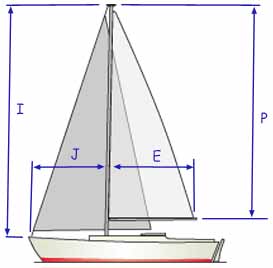 Rig dimensions
From the published rig data, the Oceanis 390 carries a moderate sail plan for its displacement.
- I: 47.51 ft (14.48 m)
- J: 14.40 ft (4.39 m)
- P: 41.67 ft (12.70 m)
- E: 13.78 ft (4.20 m)
- Mainsail area (triangular): 287 ft2 (26.67 m2)
- Foretriangle / working headsail area: 342 ft2 (31.78 m2)
- Total sail area (main + 100% foretriangle): 629 ft2 (58.45 m2)
Many owners and sailmakers have fitted larger genoas (up to roughly 140–150% LP) and asymmetric spinnakers to improve light-air performance, but the baseline numbers above are a useful reference for assessing the standard boat.
Performance Analysis: Understanding the Design Ratios
Using the published displacement, sail area and hull dimensions, we can look at the key ratios that frame the Oceanis 390’s behaviour.
| Ratio | Value | Interpretation |
|---|---|---|
| Sail Area / Displacement (SA/D) | ≈ 17.1 | Moderate power; adequate drive for coastal & passage cruising without being rig-hungry. |
| Displacement / Length (D/L) | ≈ 174 | “Light” by classic definitions; easier to push to hull speed, but not ultra-light. |
| Ballast / Displacement (B/D) | ≈ 36% | Reasonable stiffness; stands up to canvas but not a heavy-weather bruiser. |
| Capsize Screening Formula (CSF) | ≈ 2.12 | Above the classic 2.0 threshold; acceptable for coastal & moderate offshore use with care. |
| Brewer Motion Comfort Ratio | ≈ 21.2 | Firmly in coastal cruiser territory; motion is livable but not heavy-ship gentle. |
These figures align with the design intent: a comfortable cruiser that can make respectable passage times, rather than a heavy-displacement ocean slogger or a stripped-out performance machine.
For more on this topic, you might want to take a look at Understanding Boat Performance & Design Ratios...
How the Beneteau Oceanis 390 Sails
Upwind, the fin-keel Oceanis 390 tracks reasonably well and will point adequately with a good headsail and fair bottom. The wing-keel version gives away a little pointing ability and leeway in exchange for shallower draft, but owners report that with a modern sail wardrobe and careful trim it still makes acceptable progress to windward. The masthead rig favours a powerful headsail, so a well-cut genoa and a sensible reefing plan are key to keeping the boat balanced as the breeze builds.
The helm is generally light, with the spade rudder giving quick response and good feel. In moderate conditions the boat settles into a comfortable groove, with a slight tendency to heel early due to the relatively light displacement and beamy hull. Once reefed appropriately, the boat stiffens up and feels more composed. Downwind, the Oceanis 390 is happy under poled-out headsails or asymmetric kites, and the broad stern gives good control when surfing in moderate seas, though this is not a high-speed planing hull.
Short-handed, the boat benefits from its simple deck layout and large cockpit. Primary winches are within reach of the helm on many examples, and the mainsheet is usually led to a traveller on the coachroof, keeping the cockpit clear. With sensible sail choices (for example, a smaller working jib and in-mast or slab reefing with good lazyjacks), a couple can manage the boat comfortably. Motion is livable, though in a steep chop the lighter displacement and beamy hull can produce a more lively ride than a heavier, narrower bluewater design.
Bluewater Capability: Strengths & Trade-Offs
The Oceanis 390 has crossed oceans and completed long passages, but its design sits closer to the “comfortable coastal & occasional offshore” end of the spectrum than the “purpose-built expedition” category. Tankage is respectable for a 38'4" (11.68 m) cruiser, with around 145 US gallons (549 L) of fuel in original configurations and generous water capacity on many layouts, though exact figures vary by build and refit.
Load-carrying is reasonable, but like many lighter production boats, performance and motion suffer if the boat is overloaded with gear, spares and stores. Owners planning extended voyaging tend to focus on keeping weight low and central, upgrading stowage solutions and being disciplined about what comes aboard. Deck safety is generally good, with wide side decks, a substantial toerail and decent handholds, though some examples benefit from upgraded guardrails, additional jackstay points and more aggressive non-slip on high-traffic areas.
From a structural perspective, the internal grid and bonded hull–deck joint are sound when in good condition, but buyers should be alert to any signs of keel stub stress, grounding damage, or delamination around high-load areas. The CSF and motion comfort ratios suggest that while the boat can handle offshore work, it is not the most forgiving platform in extreme conditions compared with heavier, deeper-bodied designs. For many sailors, that is an acceptable compromise in exchange for better light-air performance and more generous living space.
Configuration, Layout & Cruising Characteristics
The cockpit is one of the Oceanis 390’s strong suits: large, comfortable and well-protected, with good backrests and space for crew to move around. Wheel steering is standard, and the helm position offers reasonable visibility forward, though sprayhoods and biminis can obscure sightlines if not carefully designed. The transom is typically closed on early boats, with later refits sometimes adding sugar-scoop modifications or boarding platforms.
Below, the interior reflects Beneteau’s charter and family-cruising focus of the era. Expect a bright saloon with large windows, a substantial dining table and settees that can double as sea berths with lee cloths. The galley is usually U-shaped, located near the companionway for good ventilation and safe working at sea, with decent refrigeration and storage once upgraded from original equipment. Two- and three-cabin layouts share a forward cabin with a double berth and one or two aft cabins with generous doubles. Head compartments are functional, with separate shower areas on some versions.
For liveaboard use, the Oceanis 390 offers enough volume to make long stays comfortable: good headroom, plenty of locker space once rationalised, and the ability to separate sleeping areas for guests or family. Ventilation can be improved with additional opening hatches and fans, and many boats have had their original upholstery, headlinings and joinery refinished or replaced, which can transform the feel of the interior. Storage for long-term cruising benefits from custom shelving, improved access to under-berth spaces and thoughtful organisation of technical areas such as the electrical panel and engine compartment.
Who This Boat Is Best For
Good fit for:
- Couples & families wanting a comfortable cruising boat with genuine passage-making ability and generous living space.
- Owners moving up from smaller production cruisers who value familiar systems and straightforward handling.
- Sailors planning coastal circuits with occasional longer hops, where moderate ratios and good interior comfort matter.
- Liveaboard owners who want a practical, affordable platform with room to personalise systems and interior finishes.
Less ideal for:
- Skippers seeking a heavy-displacement ocean tank, prioritising ultimate seakindliness over interior volume.
- Performance-focused racers, as the moderate SA/D and hull form are aimed at cruising rather than podiums.
- Owners unwilling to tackle refit work, given the age of the fleet and the likelihood of structural, rigging and systems upgrades being needed.
The Buyer’s Checklist: Common Problem Areas
For a buyer looking at an Oceanis 390 today, the key is to separate well-maintained, sensibly upgraded examples from tired ex-charter or neglected boats. Areas to focus on include:
- Keel & hull structure: Look for signs of grounding damage, cracking or distortion around the keel stub, and any evidence of repairs. Check the internal grid for separation from the hull, especially near keel bolts and mast step.
- Rudder & steering: Inspect the rudder blade for water ingress, delamination or swelling. Check bearings for play and smooth movement, and confirm that steering linkages and quadrant are free of corrosion and wear
- Deck, windows & leaks: Bonded cabin windows and portlights can suffer from aged sealant and crazed acrylic. Look for staining, soft spots around deck fittings, and any signs of core moisture, particularly near chainplates, stanchions and mast partners.
- Rigging & chainplates: Standing rigging on many boats will be well beyond the typical replacement interval unless already renewed. Inspect chainplate attachments within the laminated grid or bulkheads, looking for corrosion, cracking or movement.
- Engine & systems: Original installations often used Perkins 4-108 diesels. Check for cooling system issues, exhaust elbow condition, fuel tank cleanliness and any history of overheating. Electrical systems may have grown organically; a tidy, labelled panel and modern charging setup are strong positives.
- Interior & tankage: Headlinings, upholstery and joinery can show their age. Water tanks and plumbing may need replacement or thorough cleaning. Look for odours, staining and evidence of previous leaks.
Typical refit budgets for a production cruiser of this age and type can easily run into the mid five figures if you are tackling rigging, sails, electronics, safety gear and cosmetic work together. A boat with recent rigging, modern navigation kit, upgraded tankage and a documented structural survey is usually worth a premium over a cheaper but tired example that will absorb time and money before being ready for serious voyaging.
Could this be your ideal cruising boat?
It may well be, but before going any further, it might be worth taking a look at my eBook 'How to Avoid Buying the Wrong Sailboat'...
Summing Up
The Beneteau Oceanis 390 is not trying to be a rugged expedition yacht, nor a stripped-out performance machine. Instead, it offers a sensible blend of moderate performance, comfortable accommodation and manageable systems in a size that many couples and families find approachable. The design ratios confirm what owners feel on the helm: enough sail power to make good passage times, a hull that is light enough to respond but not so light that it becomes skittish, and motion comfort that sits squarely in the coastal cruiser band.
For a buyer today, the boat’s age means that condition and refit history matter more than the original brochure. A structurally sound hull, healthy keel stub, dry deck, renewed rigging and a well-maintained engine turn the Oceanis 390 into a very capable cruising partner. Neglected examples, by contrast, can become expensive projects. If you value space, practicality and honest sailing manners, and you are prepared to be thorough in your inspections, the Oceanis 390 still has plenty to offer as a comfortable cruising & liveaboard platform.

Written by Dick McClary, cruising sailor and yachting journalist, publisher of Sailboat‑Cruising.com and admin of the Liveaboard Sailboats for Sale community.

Frequently Asked Questions (FAQs)
1. How does the Oceanis 390 cope with heavy weather compared with heavier bluewater designs?
1. How does the Oceanis 390 cope with heavy weather compared with heavier bluewater designs?
It can handle strong conditions if sailed conservatively, reefed early and kept within its design envelope, but it will not feel as slow-moving or forgiving as a deep-bodied heavy-displacement cruiser.
2. Is the wing-keel version a compromise for serious cruising, or a sensible choice for shoal waters?
2. Is the wing-keel version a compromise for serious cruising, or a sensible choice for shoal waters?
For sailors spending time in shallow estuaries, tidal rivers or coral areas, the wing keel is a practical option. It does trade some pointing ability and leeway performance, but many owners find the access benefits outweigh the modest loss in upwind efficiency.
3. What are the priority structural checks before committing to a survey on an Oceanis 390?
3. What are the priority structural checks before committing to a survey on an Oceanis 390?
Keel stub integrity, rudder condition, grid bonding, chainplate attachments and deck core around high-load fittings are the headline items. A quick pre-survey inspection of these areas can help decide whether a boat is worth pursuing.
4. How much refit work is typical when taking a 1980s Oceanis 390 into extended cruising?
4. How much refit work is typical when taking a 1980s Oceanis 390 into extended cruising?
Expect to address standing rigging, sails, navigation electronics, safety gear, plumbing and at least some cosmetic interior work. Many owners also upgrade charging systems, install modern battery banks and improve ventilation and insulation.
5. Is the Oceanis 390 a comfortable long-term liveaboard platform for two people?
5. Is the Oceanis 390 a comfortable long-term liveaboard platform for two people?
Yes, provided storage is organised and systems are upgraded to suit liveaboard use. The interior volume, separate cabins and generous saloon make it easy to create distinct living zones, and the cockpit works well as an outdoor room in warmer climates.
Recent Articles


-
Mystery 35 Review: Specs, Performance & Buying Guide
Aug 29, 26 09:42 AM
An in-depth review of the Mystery 35 sailboat. Read technical specs, design ratios, sail performance, and common buyer inspection areas. -
Beneteau First 405 Review: Specs, Performance & Buyer’s Guide
Aug 26, 26 03:58 AM
Detailed Beneteau First 405 review covering specs, performance, bluewater capability, layouts and buyer’s checklist. -
Moody S38 Review: Specs, Ratios & Buyer’s Guide
Aug 12, 26 04:22 AM
In‑depth Moody S38 review covering specs, performance, design ratios, layout, strengths, trade‑offs & buyer inspection points.