- Home
- Electronics & Instrumentation
- Marine EPIRB
- EPIRB Automatic Activation Failures
Why EPIRBs Sometimes Fail to Activate Automatically
Key Takeaways: Automatic activation failures are unusual but not unheard of. When they do happen, it is almost always down to something avoidable: a bracket that was never set up quite right, a hydrostatic release unit that has quietly expired, or the beacon being trapped by sails, lines, or deck gear as the boat goes down. A few failures come from the EPIRB not being properly seated in its cradle in the first place. Treat the HRU expiry date as fixed, check the bracket every season, and you’ll remove most of the risk.
Table of Contents
- How Automatic Activation Is Supposed to Work
- How Often EPIRBs Fail to Activate
- The Main Causes of Automatic Activation Failures
- Installation Mistakes That Create Hidden Vulnerabilities
- How Sinking Dynamics Affect EPIRB Release
- HRU Expiry: Why It Matters More Than Many Owners Realise
- Bracket Design Differences and Their Impact on Reliability
- Preventative Checks Every Skipper Should Carry Out
- A Simple Annual Test Routine
- Summing Up
How Automatic Activation Is Supposed to Work
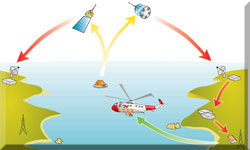
A float free EPIRB relies on two linked mechanisms. The hydrostatic release unit lets go when it reaches a set depth, allowing the beacon to float clear. Once in the water, the EPIRB’s water contacts trigger activation. When everything is installed correctly and the HRU is in date, the system is remarkably dependable.
The trouble is that the chain is only as strong as its weakest link. A small oversight in installation or maintenance can stop the whole process.
How Often EPIRBs Fail to Activate
Failures are uncommon, but they do appear in incident reports often enough to take seriously. They tend to cluster around the same themes: expired HRUs, incorrect mounting, and physical obstruction during the sinking. These are preventable issues rather than design flaws.
The Main Causes of Automatic Activation Failures
Most failures fall into one of four categories:
- Incorrect bracket installation
- Expired hydrostatic release units
- Obstruction by sails, lines, or deck gear
- EPIRB not properly seated in the bracket
Each of these can stop the beacon from floating free or prevent the water contacts from doing their job.
Installation Mistakes That Create Hidden Vulnerabilities
A surprising number of failures trace back to the bracket being mounted in a spot that looked tidy but was never suitable. Common problems include:
- Mounting too close to rigging or deck hardware
- Installing the bracket at an angle that prevents clean release
- Using fastenings that distort the bracket over time
- Placing the EPIRB where a tender, paddleboard, or spare anchor can trap it
A float free EPIRB needs a clear vertical path to the surface. Anything that narrows that path increases the chance of trouble.
How Sinking Dynamics Affect EPIRB Release
A sinking yacht is rarely upright and orderly. It may roll, pitch, or invert. Loose gear moves unpredictably. Spray hoods collapse. Solar panels twist off their mounts. All of this can trap an EPIRB that was perfectly accessible in normal conditions.
Two scenarios appear repeatedly in reports:
- Inversion before flooding: The EPIRB ends up beneath the boat, pinned by its own bracket or by deck gear.
- Rapid flooding: The boat sinks so quickly that the HRU has no time to release before the EPIRB is dragged down.
These are reminders that the mounting location must work in the worst possible orientation, not just the tidy one we see at the dock.
HRU Expiry: Why It Matters More Than Many Owners Realise
The hydrostatic release unit is a consumable item. Once it passes its expiry date, its reliability drops sharply. Some owners assume it will still work “for a bit longer”. That assumption has caused avoidable fatalities.
An expired HRU may:
- Fail to release at the correct depth
- Release too late
- Jam partially, trapping the EPIRB
- Corrode internally and seize entirely
Treat the expiry date as fixed. Replace it on time, every time.
Bracket Design Differences and Their Impact on Reliability
Not all brackets behave the same way. Some are more tolerant of slight misalignment, while others require precise seating. A few observations from incident patterns:
- Older brackets often rely on a single latch that can stiffen with age.
- Modern brackets tend to have smoother release paths but can still jam if the EPIRB is inserted with even a small twist.
- Aftermarket brackets vary widely in quality and may not match the EPIRB’s intended release geometry.
If the EPIRB does not drop out of the bracket under its own weight when tested on land, something is wrong.
Preventative Checks Every Skipper Should Carry Out
A few simple checks eliminate most of the known failure modes:
- Confirm the EPIRB is fully seated in the bracket
- Inspect the HRU expiry date
- Check for corrosion on the bracket or fastenings
- Make sure nothing has been stored near the EPIRB’s release path
- Verify that the bracket has not warped or cracked
- Ensure the EPIRB can be removed with one hand in poor conditions
These checks take minutes and cost nothing.
A Simple Annual Test Routine
Once a year, carry out a physical release test. You are not activating the beacon, just confirming the bracket will let go.
- Remove the EPIRB from the bracket.
- Inspect the cradle for wear, distortion, or salt build up.
- Reinsert the EPIRB and check that it clicks into place cleanly.
- Gently pull upward to confirm the release tension is correct.
- If the EPIRB sticks, binds, or hesitates, replace the bracket.
| Check | What to Look For |
|---|---|
| Bracket condition | Cracks, distortion, corrosion, stiff latch |
| EPIRB seating | Beacon clicks in cleanly and releases smoothly |
| HRU expiry | Replace before the printed date |
| Obstruction check | No gear stored near the release path |
Need help deciding which EPIRB suits your boat and your budget?
Click here to see my recommended models and comparison table.
Summing Up
Automatic activation failures are rare enough that most sailors will never encounter one, but common enough that they deserve attention. The good news is that almost every known cause is preventable with a little care. Keep the HRU in date, mount the bracket sensibly, and give the release mechanism a quick annual check. Do that, and your EPIRB will be ready to do its job when everything else has gone wrong.

This article was written by Dick McClary, RYA Yachtmaster and author of the RYA publications 'Offshore Sailing' and 'Fishing Afloat', member of The Yachting Journalists Association (YJA), erstwhile member of the Ocean Cruising Club (OCC) and owner/administrator of 'Liveaboard Sailboats for Sale'.

Recent Articles


-
Mystery 35 Review: Specs, Performance & Buying Guide
Aug 29, 26 09:42 AM
An in-depth review of the Mystery 35 sailboat. Read technical specs, design ratios, sail performance, and common buyer inspection areas. -
Beneteau First 405 Review: Specs, Performance & Buyer’s Guide
Aug 26, 26 03:58 AM
Detailed Beneteau First 405 review covering specs, performance, bluewater capability, layouts and buyer’s checklist. -
Moody S38 Review: Specs, Ratios & Buyer’s Guide
Aug 12, 26 04:22 AM
In‑depth Moody S38 review covering specs, performance, design ratios, layout, strengths, trade‑offs & buyer inspection points.