- Home
- Cruising Yachts 35' to 40'
- Hallberg-Rassy 38 Review
Hallberg-Rassy 38 Sailboat
Specs, Performance Analysis & Cruising Characteristics
Key Takeaways: The Hallberg-Rassy 38 is a Swedish-built, centre-cockpit cruiser from the late 1970s and early 1980s, aimed squarely at serious coastal and ocean passagemaking rather than marina posing. It is a heavy-displacement, masthead sloop with a long fin keel and skeg-hung rudder, solid GRP hull and encapsulated iron ballast. Under sail it rewards a steady hand and a bit of breeze, tracking well and feeling reassuring when the sea state gets up, but it is not a sprightly light-air performer.
Below, the boat offers a practical two-cabin layout, good tankage and storage, and the sort of joinery that has helped Hallberg-Rassy build its reputation. Buyers should focus on structural condition (hull, deck, keel, rudder), ageing systems and any teak deck issues, but a sound example remains a capable bluewater home for couples and families who value comfort, protection and conservative design choices.

Table of Contents
- The Hallberg-Rassy 38 at a Glance
- Design & Construction
- Published Specification: The Hallberg-Rassy 38 Blueprint
- Sail Areas & Rig Dimensions
- Performance Analysis: Understanding the Design Ratios
- How the Hallberg-Rassy 38 Sails
- Bluewater Capability: Strengths & Trade-Offs
- Configuration, Layout & Cruising Characteristics
- Who This Boat Is Best For
- The Buyer’s Checklist: Common Problem Areas
- Summing Up
- Frequently Asked Questions (FAQs)
The Hallberg-Rassy 38 at a Glance
- Type: Offshore cruising monohull, centre cockpit
- Designer: Olle Enderlein
- Builder: Hallberg-Rassy Varv AB, Ellös, Sweden
- Production Years: 1977–1986 (around 202 hulls)
- Rig: Masthead sloop, deck-stepped aluminium spar
- Best for: Owners wanting a traditional, strongly built cruising yacht for extended passages, high-latitude summers or trade-wind routes, with comfortable accommodation and good protection in the cockpit.
- Strengths: Solid GRP hull, encapsulated ballast, protected rudder, conservative sail plan, generous tankage, practical interior, strong reputation in the used market.
- Trade-offs: Modest sail area relative to displacement, heavier helm, limited performance in light airs, ageing machinery and deck structures on older examples, and potential cost of major refits (teak decks, rigging, engine).
Design & Construction
The Hallberg-Rassy 38 sits in the transition between the yard’s early motorsailer-influenced designs and the later Frers generation, and you can feel that in the hull and rig. Olle Enderlein drew a relatively high-freeboard hull with a long fin keel and separate skeg-hung rudder, combining directional stability with a shorter keel than a full-keel cruiser. The hull is solid GRP, laid up in single-skin glass-reinforced polyester, with encapsulated iron ballast in a deep bilge. The deck is a GRP sandwich with PVC core, typically finished with teak laid over the moulding on many boats of this era.
Chainplates are internal, tied into substantial GRP structures and timber reinforcements rather than simple through-bolted strap fittings on the topsides. This arrangement has generally aged well, but it still deserves close inspection around the knees and any hidden areas for signs of moisture or movement. The cabin windows are framed units set into the coachroof moulding; on boats of this vintage they are usually mechanically fastened and sealed rather than fully bonded flush panes, so you should expect to see screws or bolts and sealant lines, and check for leaks or corrosion.
The keel is a deep fin with encapsulated iron ballast, giving a ballast ratio in the mid-40% range and a draft around 5'9" (1.75 m), which is a sensible compromise for coastal cruising in most regions while still providing good stiffness offshore. The rudder is mounted on a substantial skeg, protecting the blade and stock from debris and grounding, and contributing to the boat’s tracking ability. Structurally, the boat benefits from Hallberg-Rassy’s conservative approach: substantial floors, longitudinal stringers and bulkheads, and a high standard of joinery that also acts as secondary structure.
There are no widely published STIX stability index figures for the Hallberg-Rassy 38, as the design predates the routine use of STIX in marketing material, but the traditional ratios and owner experience point towards a boat that sits comfortably in the offshore-cruiser bracket rather than the lightweight performance category.
Variants are limited: the 38 was built as a centre-cockpit masthead sloop, with the same basic hull and keel across the production run. Draft is essentially standard, and there is no mainstream centreboard or bilge-keel version. Interior layouts are broadly similar, with minor differences in details and fit-out over the years rather than major alternative plans.
Published Specification: The Hallberg-Rassy 38 Blueprint
| Specification | Value |
|---|---|
| Type | Offshore cruising monohull, centre cockpit |
| Designer | Olle Enderlein |
| Builder | Hallberg-Rassy Varv AB (Sweden) |
| Production dates | 1977–1986 (≈202 hulls) |
| LOA | 37.96' (11.57 m) |
| LWL | 31.17' (9.50 m) |
| Beam | 11.42' (3.48 m) |
| Draft (max) | 5.75' (1.75 m) |
| Displacement | 18,739 lb (8,500 kg) |
| Ballast | 8,157 lb (3,700 kg) encapsulated iron |
| Rig type | Masthead sloop, deck-stepped aluminium mast |
| Hull material | Single-skin GRP hull, GRP sandwich deck |
| Sail area (jib) | ≈651 ft² (60.5 m²) upwind with working jib |
| Engine (original) | Volvo Penta MD21, 55 hp diesel |
| Fuel capacity | ≈93 US gal (350 L) |
| Fresh water capacity | ≈106 US gal (400 L) |
Sail Areas & Rig Dimensions
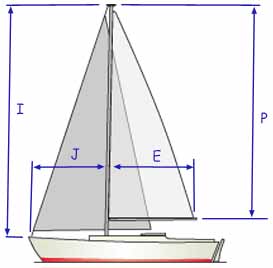 Rig dimensions
Rig dimensions:
- I: 49.25' (15.02 m)
- J: 15.09' (4.60 m)
- P: 43.31' (13.20 m)
- E: 14.76' (4.50 m)
Sail areas (approximate standard working sails):
- Mainsail: ≈329 ft² (≈30.6 m²)
- Working jib: ≈321 ft² (≈29.8 m²)
- Total upwind (main + jib): ≈651 ft² (≈60.5 m²)
- Typical genoa (150% LP): ≈554 ft² (≈51.5 m²)
These figures are representative; individual boats may carry slightly different sail plans depending on sailmaker, age and owner preference, so measuring a specific rig before ordering new sails is wise.
Performance Analysis: Understanding the Design Ratios
The Hallberg-Rassy 38’s key ratios, using standard displacement and sail area figures, are:
| Ratio | Value | Practical meaning |
|---|---|---|
| Sail Area/Displacement (SA/D) | ≈14.8 | Indicates a conservative sail plan on a heavy hull. The boat is not lively in light airs, but once the wind is above about 12–15 knots it settles into a steady groove and carries sail comfortably. |
| Displacement/Length (D/L) | ≈276 | Firmly in the heavy-displacement cruising band. Expect a smooth motion, good carrying capacity and less slam in a head sea, at the cost of acceleration and speed in marginal conditions. |
| Ballast/Displacement (B/D) | ≈43.5% | A relatively high ballast fraction for a cruising boat, contributing to stiffness and the ability to carry sail without excessive heel, especially with the ballast deep in the encapsulated keel. |
| Capsize Screening Formula (CSF) | ≈1.72 | Below the commonly cited 2.0 threshold, suggesting favourable resistance to capsize compared with many lighter, beamier production boats, assuming good seamanship and loading. |
| Brewer Motion Comfort Ratio | ≈34 | In the upper range for production cruisers of this size, pointing towards a comparatively gentle motion and reduced fatigue on longer passages, especially when loaded for cruising. |
Taken together, these ratios describe a boat that prioritises comfort, load-carrying and seakindliness over speed. It is not a slow boat by traditional standards, but it will not match modern light-displacement designs in marginal breeze or around the cans.
For more on this topic, you might want to take a look at Understanding Boat Performance & Design Ratios...
How the Hallberg-Rassy 38 Sails
Upwind, the Hallberg-Rassy 38 rewards patience and trim. In under 10 knots of true wind, especially with a tired genoa, you may find yourself wishing for more sail area or a lighter hull. Once the breeze builds into the low teens, the long fin keel and skeg-hung rudder come into their own, giving a steady, predictable feel and good tracking. Owners often describe the helm as on the heavier side but informative, with the boat settling at a moderate heel angle and carrying full sail longer than many contemporaries before reefing becomes sensible.
Downwind, the protected rudder and conservative hull shape help the boat resist sudden yawing or broaching when running in waves. It is not immune to misbehaviour if pushed hard with too much sail, but compared with lighter, flatter designs with spade rudders, the 38 tends to hold its line more willingly. A pole for the headsail and a well-cut main make trade-wind sailing straightforward, and many boats have logged long passages with relatively modest drama.
Reefing is typically via slab reefs in the main and roller furling on the headsail. With the centre cockpit and windscreen, crew can work the lines with good protection, and the boat lends itself to short-handed sailing by a couple who know their systems. The motion is steady rather than lively, and while that can feel a bit sluggish in flat water, it becomes a virtue when the sea state is confused.
Bluewater Capability: Strengths & Trade-Offs
From a bluewater perspective, the Hallberg-Rassy 38 ticks many of the boxes that experienced cruisers look for: solid GRP hull, encapsulated ballast, protected rudder, conservative rig, good tankage and a centre cockpit with shelter. Fuel capacity around 93 US gallons (350 L) and water around 106 US gallons (400 L) give sensible autonomy for a boat of this size, and the hull form carries cruising stores without becoming overwhelmed.
Deck safety is helped by the high bulwarks, substantial guardrails and wide side decks. The centre cockpit keeps crew away from the stern in heavy weather, and the fixed windscreen is a hallmark of the brand, offering protection that many owners value highly on long passages. The trade-off is that visibility astern is more limited than on some aft-cockpit designs, and the cockpit is further from the water, which some sailors notice when docking or handling lines.
Load-carrying is a strong point: the boat was designed with volume and displacement to carry the gear, spares and provisions that serious cruising demands. That said, like any heavy cruiser, it is possible to overdo it. A heavily laden 38 will sit lower, increasing wetted surface and further dulling light-air performance, so thoughtful stowage and avoiding unnecessary weight is still important.
The main trade-offs for bluewater use are age-related rather than conceptual. These boats are now several decades old, so their bluewater capability depends heavily on the state of the hull, deck, rig, machinery and systems. A well-maintained, sensibly refitted example can be a very capable ocean boat; a tired, neglected one may require significant investment before you would be comfortable pointing the bow at another continent.
Configuration, Layout & Cruising Characteristics
The Hallberg-Rassy 38 has a classic centre-cockpit layout with an aft cabin, which was one of the features that helped define the brand. The cockpit is deep and protected, with a fixed windscreen and often a sprayhood or hard dodger added by owners. Wheel steering is standard, with engine controls and instruments grouped around the helm. Side decks are reasonably wide, and the foredeck offers good working space for anchoring and sail handling.
Below, the boat typically offers a forward cabin with V-berths, a heads compartment, a saloon with settees and a folding table, a walkthrough or passageway to the aft cabin, and a galley arranged either along the passage or at the saloon. Headroom in the saloon is around 6'1" (1.85 m), which feels comfortable for most crew. Berths are long enough for taller sailors, and storage is generous in lockers, under-berth spaces and dedicated stowage areas.
The joinery is typically in mahogany and teak, with a warm, traditional feel. Ventilation depends on hatches and opening ports; many boats have had additional vents or fans fitted over the years. For liveaboard use, the combination of two cabins, a protected cockpit and good storage works well for a couple or small family. The galley is practical rather than showy, with enough space for serious cooking but not the vast worktops of some modern designs.
Under way, the interior feels secure, with good handholds and sensible sea berths. At anchor, the centre cockpit and aft cabin arrangement gives privacy and separation that many owners appreciate, especially when sharing the boat with guests.
Who This Boat Is Best For
Good fit for:
- Owners prioritising comfort and protection: Sailors who value a sheltered cockpit, solid construction and a steady motion more than outright speed.
- Couples planning extended cruising: A pair who want a manageable size, traditional systems and the ability to carry stores for weeks at a time.
- Sailors moving up from smaller cruisers: Those familiar with traditional rigs and systems, ready for a heavier boat but not wanting to jump to 45'+ straight away.
Less ideal for:
- Performance-focused sailors: If your joy is light-air racing or fast coastal hops, the 38’s ratios and hull form may feel too conservative.
- Owners wanting very shallow draft: At around 5.75' (1.75 m), the boat is fine for most cruising grounds but not ideal for very shallow estuaries or extensive creek crawling.
- Buyers unwilling to tackle refit work: These boats are old enough that some level of refit is almost inevitable; if you want a low-maintenance, near-new yacht, this may not be the right match.
The Buyer’s Checklist: Common Problem Areas
For a prospective buyer, the Hallberg-Rassy 38 should be approached with a structured survey and inspection plan. Key areas include:
Hull & Osmosis / Delamination:
- Check: Gelcoat for blistering, any signs of previous osmosis treatment, and localised delamination, especially around stress points.
- Implication: Minor blistering is manageable; widespread delamination or poorly executed past repairs can be expensive to rectify.
Teak Decks & Deck Core:
- Check: Condition of teak planks, caulking, screw holes, and any signs of water ingress into the deck core.
- Implication: Worn, leaking teak can lead to core damage and major refit costs. Replacement is labour-intensive and expensive, whether in real teak or synthetic alternatives.
Chainplates & Structural Knees:
- Check: Access to chainplate bases, any staining, cracking or movement in surrounding GRP and timber, and signs of leaks at deck penetrations.
- Implication: Sound chainplates are vital; hidden corrosion or structural cracking can be serious but is usually repairable with proper reinforcement.
Rudder, Skeg & Steering Gear:
- Check: Play in bearings, condition of skeg-hull joint, any signs of impact damage, and steering linkage wear.
- Implication: Worn bearings or damaged skegs need attention; the protected rudder is a strength, but only if the structure is sound.
Keel & Bilge:
- Check: Internal bilge for rust staining from encapsulated iron, any signs of cracking at keel-hull interface, and moisture levels.
- Implication: Some surface rust is normal; significant cracking or movement is a red flag.
Rigging & Mast Step:
- Check: Age and condition of standing rigging, mast step area for compression or cracking, and spreader roots.
- Implication: Many boats will be due or overdue for a full rigging replacement; budget accordingly.
Engine & Systems:
- Check: Original Volvo MD21 engines may be at or beyond their comfortable lifespan; look at service history, cooling system, mounts, exhaust and fuel system.
- Implication: Repowering is a major cost but can transform reliability; a well-maintained original engine can still serve, but you should be realistic.
Electrics & Plumbing:
- Check: Wiring quality, any “owner improvements”, battery capacity, charging systems, and plumbing for water and waste.
- Implication: Many boats have had incremental upgrades; a tidy, documented system is a plus, while spaghetti wiring is a warning.
Typical refit costs can range from modest (new sails, electronics) to substantial (full teak deck replacement, engine swap, complete rigging renewal). A buyer should build a realistic budget that includes survey findings and a contingency for surprises.
Could this be your ideal cruising boat?
It may well be, but before going any further, it might be worth taking a look at my eBook 'How to Avoid Buying the Wrong Sailboat'...
Summing Up
The Hallberg-Rassy 38 is a product of a particular design philosophy: conservative, strongly built, and aimed at sailors who value comfort and security over headline speed. The design ratios confirm what the eye suggests: heavy displacement, generous ballast and modest sail area, all pointing towards a boat that comes alive in a proper breeze and looks after its crew when the sea state turns unfriendly. The centre cockpit, protected rudder and solid GRP hull make sense for offshore work, while the interior layout and tankage support extended cruising and liveaboard life.
From a buyer’s perspective, the key is to separate reputation from condition. A structurally sound hull, healthy deck, good rudder and keel, and a rig and engine with known histories can make the 38 an excellent long-term cruising partner. Conversely, a boat with neglected teak decks, unresolved osmosis, tired machinery and muddled systems can absorb a lot of time and money before it reaches the standard you might want for ocean passages.
If you are comfortable with traditional systems, prepared to invest in survey and targeted refit work, and drawn to the idea of a steady, protective cruiser rather than a lightweight flyer, the Hallberg-Rassy 38 deserves a place on your shortlist.

This article was written by Dick McClary, RYA Yachtmaster and author of the RYA publications 'Offshore Sailing' and 'Fishing Afloat', member of The Yachting Journalists Association (YJA), erstwhile member of the Ocean Cruising Club (OCC) and owner/administrator of 'Liveaboard Sailboats for Sale'.

Frequently Asked Questions (FAQs)
How does the Hallberg-Rassy 38 compare to later Frers-designed Hallberg-Rassys for ocean cruising?
How does the Hallberg-Rassy 38 compare to later Frers-designed Hallberg-Rassys for ocean cruising?
The 38 is heavier and more traditional than the Frers generation, with a slightly slower hull and more conservative rig, but it offers a very steady motion and strong construction. A downstream article could explore detailed handling differences, refit implications and resale trends between the 38 and, say, the 36, 382 and 39.
What are the typical costs and scope of a full teak deck replacement on a Hallberg-Rassy 38?
What are the typical costs and scope of a full teak deck replacement on a Hallberg-Rassy 38?
Costs vary widely by yard and region, but the job is labour-heavy: removal of old teak, repair of any core damage, fairing, and installation of new decking (teak or synthetic). A dedicated sub-page could break down stages, cost ranges and decision points (keep teak, go synthetic, or revert to painted GRP).
Is repowering from the original Volvo MD21 common, and what engines are typically chosen?
Is repowering from the original Volvo MD21 common, and what engines are typically chosen?
Many owners have repowered with modern diesels in the 50–60 hp range from Volvo, Yanmar or other brands.
How much can you safely load a Hallberg-Rassy 38 for long-term cruising before performance suffers too much?
How much can you safely load a Hallberg-Rassy 38 for long-term cruising before performance suffers too much?
The boat can carry substantial stores thanks to its displacement and volume, but overloading will increase wetted surface and reduce light-air performance. A deeper article could model loading scenarios, trim effects and practical stowage strategies for ocean passages.
What survey priorities are most critical when buying a Hallberg-Rassy 38 for offshore use?
What survey priorities are most critical when buying a Hallberg-Rassy 38 for offshore use?
Keel and hull integrity, rudder and skeg condition, deck core and teak, chainplates and rig, and engine and fuel systems are all high-priority. A sub-page could present a structured survey checklist, typical findings and how they affect negotiation and refit planning.
Recent Articles


-
Mystery 35 Review: Specs, Performance & Buying Guide
Aug 29, 26 09:42 AM
An in-depth review of the Mystery 35 sailboat. Read technical specs, design ratios, sail performance, and common buyer inspection areas. -
Beneteau First 405 Review: Specs, Performance & Buyer’s Guide
Aug 26, 26 03:58 AM
Detailed Beneteau First 405 review covering specs, performance, bluewater capability, layouts and buyer’s checklist. -
Moody S38 Review: Specs, Ratios & Buyer’s Guide
Aug 12, 26 04:22 AM
In‑depth Moody S38 review covering specs, performance, design ratios, layout, strengths, trade‑offs & buyer inspection points.