- Home
- Anchoring
- Picking Up a Mooring
- How to Pick Up a Mooring Single-Handed
How to Pick Up a Mooring Single-Handed: The 'Line-Led-Aft' Method Step by Step
Picking up a mooring under sail or power is straightforward with a crew aboard. Single-handed, however, it can become one of the more challenging boat-handling manoeuvres you'll face.
The traditional method requires leaving the helm, moving forward to the foredeck, grabbing the mooring buoy, and securing the pennant before the boat drifts away. That's easy enough in calm conditions on a small yacht, but becomes progressively more difficult as boat size, wind strength and tidal flow increase.
Many experienced single-handed sailors use a safer and more controlled technique known as the line-led-aft method. Instead of trying to secure the mooring permanently on the foredeck at the first attempt, you temporarily secure the boat from the cockpit, where you remain in control throughout the manoeuvre.
Here's how it works.
Why the Line-Led-Aft Method Works
The key principle is simple:
Stay at the helm until the boat is securely attached to the mooring.
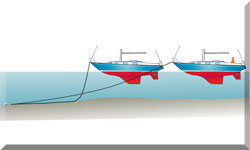
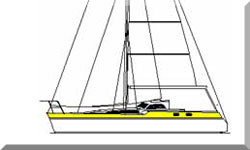
Rather than relying on perfect timing while scrambling forward, you use a pre-rigged line that runs from the bow, outside all guardwires and stanchions, back to the cockpit.
Once the mooring is picked up, this line can be attached to the buoy or pennant and secured from the cockpit. The yacht is then effectively tethered to the mooring, allowing you to move forward at leisure* to make the permanent connection.
This approach:
- Reduces stress
- Improves safety
- Maintains boat control
- Eliminates rushed foredeck work
- Works on yachts of almost any size
Equipment You'll Need
Before approaching the mooring, prepare a suitable line.
Recommended Specifications
| Boat Length | Suggested Line Diameter | Typical Length |
|---|---|---|
| Up to 30ft | 10-12mm | 10-12m |
| 30-40ft | 12-14mm | 12-15m |
| 40-50ft | 14-16mm | 15-18m |
The line should be long enough to run:
- From a strong bow cleat.
- Outside the guardrails.
- Back along the side deck.
- Into the cockpit.
Attach the forward end securely to a bow cleat before beginning your approach.
Additional Equipment for Ring-Only Moorings
| Equipment | Best Use |
|---|---|
| Standard boat hook | Pickup buoys and tether lines |
| Large pre-formed loop in line-led-aft | Ring-only moorings in moderate conditions |
| Hook & Moor or similar threading device | Ring-only moorings where a direct attachment is needed |
| Lightweight messenger line | Useful with threading devices |
| Sailing gloves | Protect hands when handling loaded pennants |
Step 1: Rig the Line Before the Approach
Preparation is everything.
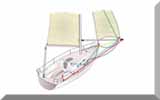
Lead the line from the bow cleat aft outside shrouds, guardwires and stanchions. Coil the cockpit end neatly where it can be reached instantly.
Ensure:
- No twists are present.
- The line cannot snag on deck fittings.
- The bitter end remains aboard.
- The helm can be left briefly without losing control.
Many failed single-handed mooring attempts result from inadequate preparation rather than poor boat handling.
Step 2: Assess Wind and Tide
Before making your run, determine which force is dominant:
- Wind
- Tidal stream
Your approach should always be made into whichever force is strongest.
This slows the boat and improves steering control.
Quick Reference
| Conditions | Preferred Approach Direction |
|---|---|
| Strong tide, light wind | Into the tide |
| Strong wind, weak tide | Into the wind |
| Wind and tide aligned | Into both |
| Wind and tide opposing | Into the stronger force |
Step 3: Approach Slowly
ngage ahead gear at idle or just above idle speed.
The objective is not to stop exactly at the buoy.
Instead, aim to bring the boat under complete control with minimum way on.
Think: Slow enough to stop instantly, but fast enough to maintain steerage.
Maintain a straight approach and avoid large course corrections close to the buoy.
Step 4: Bring the Mooring Alongside
As you close with the buoy, position it slightly to windward of the bow if possible.
Allow the yacht's natural drift to carry the buoy towards you.
Avoid charging directly at the buoy.
A slow, controlled approach gives more time to react.
Step 5: Retrieve the Mooring
At this stage, the procedure depends on the type of mooring you're approaching.
Option 1: Mooring with a Pickup Line (Most Common)
Many moorings are equipped with a pickup buoy or floating tether attached to the main pennant.
As the buoy comes alongside:
- Select neutral.
- Use a boat hook from the cockpit.
- Retrieve the pickup line or pennant.
- Bring it aboard while remaining at the helm position.
This is the simplest arrangement because the pickup line brings the attachment point within easy reach.
Option 2: Mooring with Only a Ring on the Buoy
Some moorings have no pickup line at all. Instead, you'll find only a ring, eye or shackle on top of the buoy.
There are two practical ways to deal with this single-handed:
Method A: Lasso the Buoy
Before beginning the approach, tie a large loop in the working end of your line-led-aft.
As the buoy comes alongside:
- Open the loop.
- Drop it over the buoy.
- Allow it to settle around the buoy below the attachment ring.
Once the line comes under load, the loop will tighten and provide a temporary connection to the mooring buoy.
Provided the buoy is substantial and conditions are moderate, this can be an effective way of securing the yacht long enough to move forward and make the permanent connection.
Method B: Use a Threading Boat Hook
A more elegant solution is a specialist boat hook designed to pass a light messenger line through the ring on the buoy.
Examples include:
- Hook & Moor
- Moorfast
- EasyMoor
- Similar threading pickup devices
These allow you to remain safely in the cockpit while threading a line through the attachment ring and retrieving it aboard.
The result is exactly the same as if a pickup line had already been fitted.
Step 6: Secure the Temporary Connection
Once you've recovered either:
- The pickup pennant,
- A threaded line through the buoy's ring, or
- The lasso loop around the buoy,
attach the working end of the line-led-aft to a cockpit cleat or winch.
You have now established a temporary connection:
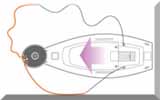
Bow Cleat → Mooring → Cockpit Cleat
The yacht is effectively secured to the mooring while you remain in control from the cockpit.
Allow the boat to settle back under wind or tide before moving forward to complete the permanent attachment.
Step 7: Let the Boat Settle
Once connected, allow the yacht to drift gently back under the influence of wind or tide.
The tension in the line will bring the bow naturally into the correct position relative to the mooring.
At this point:
- Engine can remain in neutral.
- Boat movement becomes predictable.
- You are no longer trying to "catch" the mooring.
The difficult part is over.
Step 8: Secure the Mooring Properly
With the yacht now safely attached, move forward unhurriedly.
Pick up the permanent mooring strop or pennant and secure it according to your normal practice.
Common arrangements include:
- Single heavy pennant.
- Twin bridle.
- Pair of bow cleats.
- Centreline attachment.
Once the permanent connection is complete, recover the temporary line and stow it ready for the next use.
*On the Water...
Since writing this article, I've modified the line-led-aft arrangement owing to a near miss. It occurred on a day when the wind and tide on the River Tamar (on the Devon/Cornwall border in the UK) were in the same direction—and there was a lot of both.
I had attached my line to the buoy's pick-up line but must have been a little slow in getting to the foredeck. By the time I arrived, the line was stretched taut and my boat was worryingly close to the boat moored astern. Had someone been in the cockpit this wouldn't have been an issue—they could have motored back up to the buoy while I recovered the line. But there wasn't, I was on my own, so had to pull the boat by hand against wind and tide back up to my mooring ball which was a lot more work than I would choose to become accustomed to.
The solution? I've now attached a block to the foredeck cleat via a short strop, through which the line is routed back to the cockpit. Now, once having attached this line to the pick-up line, I can pull the boat to the buoy from the cockpit before wind and tide have time to conspire against me. I suggest you do the same.
Dick McClary
Common Mistakes to Avoid
Approaching Too Fast
Most missed moorings stem from excess speed.
Remember:
You can always add power, but you cannot instantly remove momentum.
Going Forward Too Early
Never leave the helm while the boat is still moving unpredictably.
The line-led-aft system exists precisely to avoid this situation.
Poor Line Routing
Ensure the line remains outside:
- Pulpit rails
- Stanchions
- Guardwires
- Anchors
A snagged line can prevent the system working properly.
Relying on One Attempt
Even experienced skippers occasionally miss the pickup.
If the approach isn't developing as planned:
- Abort early.
- Go around.
- Set up again.
A second attempt is always preferable to a rushed first one.
Advantages of the Line-Led-Aft Method
| Benefit | Why It Matters |
|---|---|
| Safer | Reduces rushed foredeck work |
| Better control | Helm remains attended until secured |
| Less stressful | No need for perfect timing |
| Works on larger yachts | Particularly useful above 35ft |
| Easy to learn | Requires little additional equipment |
Final Thoughts
The biggest challenge in single-handed mooring is not picking up the buoy. It's maintaining control of the yacht while doing so.
The line-led-aft method solves that problem elegantly by allowing you to establish a secure connection from the cockpit before moving forward. Once practised a few times, many single-handed sailors find it faster, safer and more reliable than traditional foredeck-first techniques.
In anything other than flat calm conditions, it's a technique well worth adding to your seamanship toolkit.
Recent Articles


-
How to Pick Up a Mooring Single-Handed Using the Line-Led-Aft Method
Nov 22, 26 05:35 AM
Learn how to pick up a mooring single-handed using the line-led-aft method. A safe, controlled step-by-step technique that avoids risky foredeck manoeuvres. -
Downeaster 32 Review, Specs & Bluewater Cruising Guide
Nov 20, 26 05:55 PM
Detailed Downeaster 32 review covering specs, performance, construction, common problems, bluewater capability and buying advice. -
Swage or Mechanical Rigging Terminals? Spot Failure Early
Nov 20, 26 04:06 PM
Swage terminals can crack out of sight. Learn the warning signs, how dye testing helps, and when Sta-Lok or Norseman fittings are the better choice.