- Home
- Cruising Yachts 35' to 40'
- Jeanneau Sun Odyssey 37 Performance & Ownership Guide
Jeanneau Sun Odyssey 37 Sailboat
Specs, Performance Analysis & Cruising Characteristics
 The Jeanneau Sun Odyssey 37
Key Takeaways: The Jeanneau Sun Odyssey 37 is a late‑1990s French production cruiser aimed at family coastal cruising and charter work, with enough ability to tempt experienced sailors who know what they are buying. It offers generous accommodation for its length, straightforward systems, and predictable handling once you understand its preferences for sail trim and loading. The design leans towards comfort and volume rather than heavy‑weather passagemaking, so tankage, stowage and motion need to be judged against your intended use. For coastal passages, Channel crossings and occasional longer trips in sensible weather windows, it can be a capable and enjoyable boat.
Table of Contents
- The Jeanneau Sun Odyssey 37 at a Glance
- Design & Construction
- Published Specification: The Jeanneau Sun Odyssey 37 Blueprint
- Sail Areas & Rig Dimensions
- Performance Analysis: Understanding the Design Ratios
- How the Jeanneau Sun Odyssey 37 Sails
- Bluewater Capability: Strengths & Trade-Offs
- Configuration, Layout & Cruising Characteristics
- Who This Boat Is Best For
- The Buyer’s Checklist: Common Problem Areas
- Summing Up
- Frequently Asked Questions (FAQs)
The Jeanneau Sun Odyssey 37 at a Glance
- Type: Production GRP fin‑keel cruising monohull
- Designer: Jacques Fauroux
- Builder: Jeanneau (France)
- Production Years: 1998 onwards (now out of production; distinct from earlier 37.1/37.2)*
- Rig: Masthead sloop, deck‑stepped aluminium spar
- Best for: Coastal cruising, charter use, family sailing, lighter‑weight passagemaking with conservative routing
- Strengths: Spacious interior, good light‑air and moderate‑air performance, simple systems, wide availability on the used market
- Trade‑offs: Form‑stability hull that prefers to be sailed fairly flat, moderate tankage, production‑boat fit‑out and hardware, motion and slamming upwind in a chop if driven hard
* The Sun Odyssey 37 (1998 onwards) is not the same design as the Sun Odyssey 37.1 or 37.2 (1994–1998). Even though the names are similar, they are different hulls, different rigs, different interiors and different design teams.
Design & Construction
Jacques Fauroux’s brief for the Sun Odyssey 37 was to create a mid‑size cruiser that could serve both private owners and charter fleets without becoming a stripped‑out racer or a heavy displacement plodder. The hull is a fairly beamy fin‑keel form with a raked stem and reverse transom, carrying its volume well aft to maximise accommodation and form stability. Construction is predominantly glass‑reinforced plastic with structural stringers; boats of this era typically use a solid laminate hull with a moulded inner structure, and a balsa or foam‑cored deck. The keel is a fin with a bulb, offered in a standard deep version and an optional shoal‑draft alternative, both using iron ballast. Steering is via an internally mounted spade rudder on stock bearings, controlled by a wheel.
Cabin side windows on the Sun Odyssey 37 are generally bonded into the moulding rather than through‑bolted framed units. That gives a clean exterior look and reduces potential leak paths from fasteners, but it does mean that ageing sealant and UV‑affected acrylic need to be inspected carefully on a used boat. Chainplates are typically integrated into the structure, with stainless steel plates tied into the hull or inner grid rather than simple deck‑bolted strap fittings; again, inspection for crevice corrosion and any movement at the deck is important as the boat ages.
Several versions share this basic hull: the standard Sun Odyssey 37 in two‑ and three‑cabin layouts, the charter‑focused Moorings 37, and the more performance‑oriented Sun Fast 37 which uses the same hull with a racier rig and interior emphasis. Earlier Sun Odyssey 37.1 and 37.2 models (1994–1998) are related in concept but have slightly different dimensions and sail plans, so they should be treated as separate designs when researching. The Sun Odyssey 37 was built under the EU Recreational Craft Directive and typically sold as Category A or B depending on configuration, but there is no widely published STIX number specific to this model, so it is safer to judge its offshore suitability from ratios, structure, and owner experience rather than relying on a single index.
Published Specification: The Jeanneau Sun Odyssey 37 Blueprint
| Specification | Value |
|---|---|
| LOA | 37'5" (11.41 m) |
| LWL | 31'9" (9.68 m) |
| Beam | 12'1" (3.68 m) |
| Draft (deep keel) | 6'4" (1.93 m) |
| Draft (shoal keel) | 4'9" (1.45 m) |
| Displacement | 14,175 lb (6,430 kg) |
| Ballast | 4,453 lb (2,020 kg) |
| Rig Type | Masthead sloop |
| Hull Material | Fibreglass (GRP) |
| Production Dates | From 1998 (now out of production) |
Sail Areas & Rig Dimensions
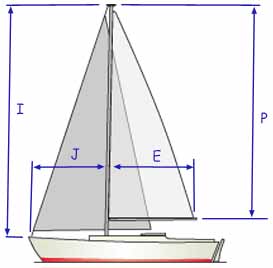 Rig dimensions
Using the standard masthead sloop rig:
- I (foretriangle height): 44'9" (13.65 m)
- J (foretriangle base): 12'6" (3.82 m)
- P (mainsail luff): 39'0" (11.90 m)
- E (mainsail foot): 13'11" (4.24 m)
Sail areas (100% foretriangle plus main):
- Mainsail area: 271.5 ft² (25.2 m²)
- Foretriangle (working headsail) area: 280.6 ft² (26.1 m²)
- Total sail area (main + 100% foretriangle): 552.1 ft² (51.3 m²)
Many boats in service carry larger furling genoas and downwind sails, which lift the effective sail area and change the feel underway, particularly in lighter airs.
Performance Analysis: Understanding the Design Ratios
| Ratio | Value | Interpretation |
|---|---|---|
| Sail Area/Displacement (SA/D) | ≈ 15.1 | Moderate power; not a light‑air flyer, but adequate for cruising with sensible sail choices. |
| Displacement/Length (D/L) | ≈ 198 | At the upper end of the “light” band, suggesting reasonable speed potential with a relatively firm motion. |
| Ballast/Displacement (B/D) | ≈ 31% | Moderate ballast; stiffness comes from both ballast and hull form, so the boat prefers to be sailed fairly flat. |
| Capsize Screening Formula (CSF) | ≈ 2.0 | Right on the commonly cited offshore threshold; acceptable for coastal and moderate offshore work with prudent loading. |
| Brewer Motion Comfort Ratio | ≈ 23.7 | Typical of a coastal cruiser; motion will be livelier than a heavier bluewater boat, especially upwind in a chop. |
These figures place the Sun Odyssey 37 firmly in the modern production‑cruiser camp: enough sail to keep moving, not so much ballast that it feels leaden, and a hull that trades some soft motion for interior volume and speed potential. For an experienced skipper, the numbers say “capable but not bulletproof”—a boat that rewards good sail handling and conservative passage planning.
For more on this topic, you might want to take a look at Understanding Boat Performance & Design Ratios...
How the Jeanneau Sun Odyssey 37 Sails
Upwind, the Sun Odyssey 37 will track steadily if you keep heel angles under control. With the deep keel, it points reasonably well, but the beamy hull and moderate ballast mean that once pressed beyond about 20° of heel, leeway increases and the helm loads up. Owners report that reefing earlier than you might on a heavier boat pays dividends: a first reef and a slightly rolled genoa in the mid‑teens of apparent wind keeps the boat moving without excessive slamming.
In lighter airs, the moderate SA/D can feel a little conservative with a small working jib, but many boats carry larger furling genoas or asymmetric spinnakers, which transform performance off the wind. Downwind and on a reach, the hull shape encourages good speeds, and the boat will surf modestly in favourable sea states if handled with care. The spade rudder gives a positive helm feel, but like most modern production boats, once it starts to round up hard under too much sail, it tends to go all the way rather than gently easing back.
Short‑handed, the layout is workable but not perfect. The mainsheet traveller is relatively short and set forward, and the sheet itself is not ideally placed for trimming from behind the wheel. For coastal cruising, this is more of an annoyance than a safety issue, but for long passages in changeable conditions, some owners choose to upgrade hardware or rethink their mainsheet system. With sensible reefing and a focus on keeping the boat upright, the Sun Odyssey 37 can be a relaxed, predictable partner for a couple or small crew.
Motion is where the design ratios show through. In a short steep chop, especially upwind, the relatively flat forward sections can slam if driven hard. Easing sheets slightly, reducing speed, and accepting a slightly more open angle to the wind can make life much more comfortable. Off the wind, the motion is kinder, and the wide stern gives a feeling of stability when running or broad reaching.
Bluewater Capability: Strengths & Trade-Offs
The Sun Odyssey 37 was not conceived as a heavy‑displacement circumnavigator, but that does not mean it is confined to fair‑weather pottering. Structurally, the solid GRP hull, internal grid, and fin keel with bulb give a sound platform, provided keel bolts, rudder bearings, and chainplates are inspected and maintained. The CSF and comfort ratio sit around the commonly quoted thresholds for offshore work, suggesting that the boat can handle open‑water passages if sailed conservatively and not overloaded.
Tankage is moderate: around 30 US gallons (25 imp gal, 110 L) of fuel and 70 US gallons (58 imp gal, 260 L) of water in standard form. For coastal cruising and short passages, this is fine; for longer trips, many owners add flexible tanks, watermakers, or jerrycan stowage. Load‑carrying needs care: the beamy hull will accept a fair amount of gear, but piling weight high and aft will hurt performance and motion. Stowage is adequate for a couple or small family, but less generous than some heavier cruisers once you start adding spares, tools, and extra safety kit.
Deck safety is typical of late‑1990s production boats: reasonable side decks, moulded non‑slip, and stainless guardrails, but not the deep bulwarks or heavy‑duty fittings of a purpose‑built expedition yacht. For bluewater use, many owners upgrade jackstay points, add stronger padeyes for storm sails, and review the anchoring setup. With those changes, and with a skipper who respects weather windows, the Sun Odyssey 37 can serve for Atlantic crossings and similar passages, but it is best thought of as a capable coastal and limited‑offshore cruiser rather than a high‑latitude workhorse.
Configuration, Layout & Cruising Characteristics
On deck, the cockpit is open and sociable, with a single wheel, good access to the transom, and seating that works well at anchor. Under sail, shorter‑legged crew can find the seat spacing a little wide, making bracing to windward harder; the small teak foot brace helps but is not perfect. Winch placement is typical of the era, with primary winches within reach of the helm and secondary winches forward. The wide stern and swim platform make boarding from a dinghy straightforward, which is a plus for cruising.
Below, the Sun Odyssey 37 feels generous for its length. Two‑cabin versions offer a large aft cabin to starboard and a roomy forecabin, with a big galley to port and a compact but workable navigation station opposite. Three‑cabin boats split the aft space into two smaller cabins, which suits charter use and families but reduces storage. Headroom is around 75" (1.91 m), which most adults find comfortable.
The galley is L‑shaped with a two‑burner stove, double sink, and icebox or fridge, and works well at sea if you add extra handholds. Locker space is reasonable, though some owners note the lack of a truly large dedicated locker for an inflatable dinghy; many store it in an internal locker aft of the heads or on deck. Berths are generous, and the saloon can sleep additional crew if needed, but for extended liveaboard use, the two‑cabin layout with more storage is generally preferred.
For liveaboard life, the boat offers a pleasant balance of space and manageability. A couple can cruise comfortably with room for occasional guests. Ventilation through hatches and opening ports is adequate, though older boats may benefit from upgraded fans and blinds. With careful organisation, the Sun Odyssey 37 can be turned into a tidy, efficient home afloat, but it will not swallow gear in the way a heavier 40‑footer might.
Who This Boat Is Best For
Good fit for:
- Coastal cruisers: Couples or families sailing coastal routes, the English Channel (La Manche if you're French), and similar waters with occasional longer hops.
- Charter‑style usage: Owners who value easy access, comfortable accommodation, and straightforward systems over extreme offshore capability.
- Experienced sailors stepping into ownership: Skippers who understand sail trim, reefing discipline, and weight management, and want a responsive, modern hull.
- Refit‑minded buyers: Those happy to upgrade sails, electronics, and some hardware to bring a solid hull up to their preferred standard.
Less ideal for:
- Heavy‑load ocean voyagers: Sailors planning to carry very large stores and spares for long remote passages; the boat can do it, but it is not optimised for that role.
- High‑latitude explorers: Those seeking deep‑cockpit, high‑freeboard, heavy‑displacement designs for extreme conditions.
- Performance‑driven racers: Crews wanting high SA/D and stiff ballast ratios; the Sun Fast 37 or other performance designs will suit better.
- Owners who dislike production‑boat compromises: If you want heavy hardware, deep lockers, and traditional joinery everywhere, this era of Jeanneau may feel too light.
The Buyer’s Checklist: Common Problem Areas
When viewing a Jeanneau Sun Odyssey 37, it is worth approaching the boat with a structured checklist:
Keel & keel bolts:
- Check: Signs of grounding, cracking around the keel‑hull joint, corrosion on keel bolts, and any movement.
- Implication: Repairs here can be costly; minor cosmetic “smiles” are common, but structural issues are a serious negotiation point.
Rudder & steering system:
- Check: Rudder bearings for play, smoothness of steering, any water ingress into the rudder blade, and wheel hub security.
- Implication: Worn bearings and loose steering components are reported by some owners; replacement is manageable but not trivial.
Chainplates & rig:
- Check: Any staining or cracking around chainplate exits, signs of movement, and the age of standing rigging.
- Implication: Hidden corrosion can be a concern on older boats; budget for a full rig inspection and possible replacement if over 10–15 years old.
Bonded windows & deck leaks:
- Check: Crazing, UV damage, and any signs of leaks around bonded windows, pulpit bases, and deck fittings.
- Implication: Resealing windows and rebedding hardware is common refit work; persistent leaks can damage interior joinery.
Electrical & commissioning issues:
- Check: Shore‑power wiring, battery charger, windlass wiring, and instrument installations for tidy, secure work.
- Implication: Some owners report early‑life commissioning snags; by now most should be resolved, but poor work can linger.
Engine, shaft & bearings:
- Check: Condition of the Volvo engine, shaft alignment, cutless bearing wear, and prop condition.
- Implication: Replacing shafts, bearings and props is not unusual on older boats; factor this into your budget.
Osmosis & hull condition:
- Check: Blistering, previous treatments, and general hull fairness.
- Implication: Serious osmosis is not widely reported on this model, but any GRP hull of this age deserves a careful survey.
Typical refit costs will vary by region, but as a rough guide, a full standing rigging replacement, new sails, updated electronics, and attention to steering and deck hardware can easily run into the mid‑five‑figure range in sterling. The upside is that the underlying hull and layout respond well to investment, turning a tired charter veteran into a capable private cruiser.
Could this be your ideal cruising boat?
It may well be, but before going any further, it might be worth taking a look at my eBook 'How to Avoid Buying the Wrong Sailboat'...
Summing Up
The Jeanneau Sun Odyssey 37 sits in a useful niche: big enough to cruise comfortably, small enough to handle without drama, and widely available on the used market. Its design ratios and construction mark it out as a modern coastal cruiser with the ability to stretch its legs offshore when handled with care. The beamy hull and moderate ballast reward early reefing and thoughtful loading, while the interior and deck layout make life aboard pleasant for a couple or family.
For a buyer who understands that this is a production GRP cruiser rather than a heavy‑displacement ocean tank, the Sun Odyssey 37 offers a lot of boat for the money. The key is to approach the purchase with a clear eye: inspect keel, rudder, chainplates, windows and systems; budget for rig and sail upgrades; and be honest about your sailing plans. Do that, and you can end up with a comfortable, capable 37‑footer that will carry you across bays, channels and, with sensible planning, oceans.

Written by Dick McClary, cruising sailor and yachting journalist, publisher of Sailboat‑Cruising.com and admin of the Liveaboard Sailboats for Sale community.

Frequently Asked Questions (FAQs)
1. How does the Jeanneau Sun Odyssey 37 cope with heavy weather compared to heavier bluewater cruisers?
1. How does the Jeanneau Sun Odyssey 37 cope with heavy weather compared to heavier bluewater cruisers?
The Sun Odyssey 37 can handle strong winds if reefed early and sailed conservatively, but its motion will be livelier than a heavier displacement boat, especially upwind. Understanding when to slow down, ease sheets and change course angle is key.
2. Is the deep‑keel or shoal‑keel version better for coastal cruising?
2. Is the deep‑keel or shoal‑keel version better for coastal cruising?
The deep keel offers better pointing and reduced leeway, which many skippers value for tidal work. The shoal keel improves access to shallow harbours and estuaries but trades some upwind performance. Choice depends on your home waters and priorities.
3. What are the most cost‑effective upgrades for a used Sun Odyssey 37?
3. What are the most cost‑effective upgrades for a used Sun Odyssey 37?
New sails, refreshed standing rigging, upgraded deck hardware (including mainsheet arrangements), and modern navigation electronics typically deliver the biggest gains in safety and enjoyment. Addressing any leaks and steering wear should sit high on the list.
4. How does the Sun Odyssey 37 compare to the Sun Fast 37 for performance‑oriented owners?
4. How does the Sun Odyssey 37 compare to the Sun Fast 37 for performance‑oriented owners?
The Sun Fast 37 uses the same hull but carries a racier rig and interior emphasis. It is quicker and more performance‑focused, but the Sun Odyssey 37 offers a more relaxed cruising layout and slightly softer interior fit‑out aimed at comfort.
5. Is the two‑cabin or three‑cabin layout better for long‑term liveaboard use?
5. Is the two‑cabin or three‑cabin layout better for long‑term liveaboard use?
For a couple or small crew planning extended cruising, the two‑cabin layout usually works better, with a larger aft cabin and more storage. The three‑cabin version suits charter and larger families but sacrifices some stowage and space per cabin.
Recent Articles


-
Mystery 35 Review: Specs, Performance & Buying Guide
Aug 29, 26 09:42 AM
An in-depth review of the Mystery 35 sailboat. Read technical specs, design ratios, sail performance, and common buyer inspection areas. -
Beneteau First 405 Review: Specs, Performance & Buyer’s Guide
Aug 26, 26 03:58 AM
Detailed Beneteau First 405 review covering specs, performance, bluewater capability, layouts and buyer’s checklist. -
Moody S38 Review: Specs, Ratios & Buyer’s Guide
Aug 12, 26 04:22 AM
In‑depth Moody S38 review covering specs, performance, design ratios, layout, strengths, trade‑offs & buyer inspection points.