- Home
- Electronics & Instrumentation
- Marine EPIRB
- PLB Return Link Service Value
Is RLS Worth Paying For On A PLB?
Key Takeaways: RLS doesn’t make the rescue itself any faster, but it does tell you that your distress alert has been received and processed by the satellite system. That confirmation can make an enormous difference to your state of mind when things have gone badly wrong. For offshore sailors, especially solo or shorthanded, RLS has become a valued reassurance feature rather than a luxury.
Table of Contents
What RLS Actually Does
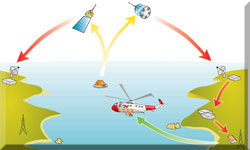
Return Link Service is a feedback mechanism built into the latest generation of PLBs. Once your distress alert has been received and validated by the satellite network, the system sends a short confirmation message back to your beacon. The beacon then flashes a blue light to show that your alert is in the queue and being handled.
It’s important to be clear about what RLS does not do. It doesn’t speed up the rescue chain, it doesn’t give you two-way communication, and it doesn’t provide position updates to you. It’s simply a confirmation that the system has your distress message and has passed it on.
Why RLS Matters When You’re Offshore
The offshore environment is full of variables. Weather, sea state, fatigue, and the sheer distance from help all add layers of uncertainty. When you activate a PLB, you’re placing absolute trust in a device you hope you’ll never need. Without RLS, you’re left waiting for signs of approaching help with no idea whether your alert has even been heard.
RLS removes that first layer of doubt. It tells you that the system is working and that your distress alert is in the hands of the rescue authorities.
The Psychological Weight of Uncertainty
Survival psychology is often overlooked in discussions about safety equipment. Yet the mental side of an emergency can be as important as the physical.
Offshore sailors who’ve been through abandonments or prolonged SAR waits often describe the same thing: the hardest part is not knowing whether anyone is coming. That uncertainty can lead to poor decision making, wasted energy, and a rapid slide in morale.
RLS doesn’t change the timeline, but it changes your mindset. Knowing that your alert has been received helps you settle into the practical tasks of staying alive: conserving heat, managing flotation, staying visible, and keeping your group together if you’re not alone.
Does RLS Improve Survival Odds?
There’s no direct evidence that RLS shortens rescue times. The SAR chain still follows the same steps, and the satellites don’t prioritise RLS-equipped beacons over others.
Where RLS may indirectly improve outcomes is in the way it helps you manage yourself. A calmer sailor is more likely to stay with the raft, maintain flotation, avoid unnecessary exertion, and make better decisions. Those factors do influence survival.
RLS in Practice: What Offshore Sailors Report
A sweep through offshore sailing discussions and incident reports shows a consistent pattern:
- Sailors who’ve carried RLS-equipped PLBs say the feature gives them confidence when sailing solo or at night.
- Those who’ve been involved in SAR events without RLS often say they would have welcomed confirmation that their alert had been received.
- Delivery skippers and race crews increasingly treat RLS as a standard feature rather than an upgrade.
- Some cruisers still see it as optional, especially if they sail coastal routes with reliable VHF coverage.
The trend is clear: offshore sailors are warming to RLS as a worthwhile addition.
Limitations and Misunderstandings
RLS is helpful, but it’s not magic. A few points are worth keeping straight:
- RLS doesn’t confirm that a rescue asset has been launched. It only confirms that your alert has been received and processed.
- RLS doesn’t work everywhere. Coverage is expanding, but there are still gaps.
- RLS doesn’t replace a full-featured communicator. If you want two-way messaging, you need a satellite device.
- RLS doesn’t guarantee a faster response. SAR authorities still prioritise based on the situation, not the beacon type.
Understanding these limits helps you see RLS for what it is: reassurance, not communication.
When Paying for RLS Makes Sense
RLS is most valuable for sailors who:
- Sail solo or shorthanded
- Spend long periods offshore
- Cross areas with limited VHF coverage
- Want the psychological reassurance of knowing their alert has been received
- Sail in colder waters where survival time is shorter and mental resilience matters
If you mostly sail coastal routes, have reliable VHF coverage, and rarely venture beyond a few miles offshore, RLS may feel less essential.
For offshore sailors, though, the small price difference between RLS and non-RLS PLBs is increasingly easy to justify.
Need help choosing the right PLB for you and your crew?
Click here to see my recommended models and comparison table.
Summing Up
RLS won’t bring the helicopter any faster, but it will tell you that the system has your distress alert and that help is being organised. In the middle of a long night offshore, that knowledge can be worth far more than the modest extra cost. For many sailors, especially those who sail alone or far from land, RLS has become a reassuring feature that’s well worth having.

This article was written by Dick McClary, RYA Yachtmaster and author of the RYA publications 'Offshore Sailing' and 'Fishing Afloat', member of The Yachting Journalists Association (YJA), erstwhile member of the Ocean Cruising Club (OCC) and owner/administrator of 'Liveaboard Sailboats for Sale'.

Recent Articles


-
Mystery 35 Review: Specs, Performance & Buying Guide
Aug 29, 26 09:42 AM
An in-depth review of the Mystery 35 sailboat. Read technical specs, design ratios, sail performance, and common buyer inspection areas. -
Beneteau First 405 Review: Specs, Performance & Buyer’s Guide
Aug 26, 26 03:58 AM
Detailed Beneteau First 405 review covering specs, performance, bluewater capability, layouts and buyer’s checklist. -
Moody S38 Review: Specs, Ratios & Buyer’s Guide
Aug 12, 26 04:22 AM
In‑depth Moody S38 review covering specs, performance, design ratios, layout, strengths, trade‑offs & buyer inspection points.