- Home
- Electronics & Instrumentation
- Marine EPIRB
- PLB Alert Timing and GPS Acquisition
How Quickly Will Rescuers Receive My Position After I Activate a PLB?
Key Takeaways: A modern PLB usually gets its first GPS fix within a minute or so, but that is only the start of the chain. The alert still has to travel through the Cospas Sarsat system, be validated, and then passed to the correct rescue authority. In practice, the first usable position normally reaches them within three to seven minutes. Poor antenna angle, heavy cloud, or your body shielding the unit can slow things down, but the system is designed to keep trying until it gets a clean fix.
Table of Contents
- How a PLB Generates and Sends Your Position
- The Timeline from Activation to Rescue Authority
- What Slows Down the First Position Fix
- Why the First Position Is Not Always the Final One
- How RLS Confirms Your Alert Has Been Received
- Offshore Scenarios That Influence Alert Timing
- Improving the Chances of a Fast, Accurate Fix
- Summing Up
How a PLB Generates and Sends Your Position
A PLB does two jobs the moment you lift the antenna and press the activation button. First, it starts searching for satellites to obtain a GPS position. Second, it begins transmitting a distress alert on the 406 MHz frequency used by the Cospas Sarsat satellite network.
Modern units with multi constellation receivers usually secure a position within thirty to ninety seconds. That fix is then wrapped into the next 406 MHz burst and sent upwards. If the PLB cannot get a position immediately, it still sends the alert, and the system will use Doppler processing to estimate your location until a proper GPS fix arrives.
The Timeline from Activation to Rescue Authority
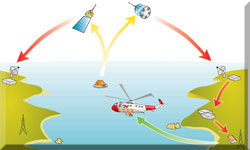
Once the PLB transmits its first burst, the message follows a predictable path:
- Satellite reception The alert is picked up by a passing satellite. Depending on the constellation overhead at that moment, this can be almost instant or take a short while.
- Routing to the mission control centre The satellite forwards the alert to a ground station, which passes it to the mission control centre responsible for your registered country.
- Forwarding to the correct rescue authority The mission control centre identifies the appropriate rescue coordination centre and forwards the alert, including the latest available position.
In most cases, the first actionable position reaches the rescue authority within three to seven minutes of activation. That is the typical window quoted by experienced search coordinators and aligns with how the system is designed to operate.
What Slows Down the First Position Fix
A PLB is a small device working in a harsh environment. Several factors can delay the first accurate position:
- Antenna angle If the antenna is not fully upright or is partially folded, the unit may struggle to see enough satellites.
- Body shielding Holding the PLB against your chest or having it tucked into a lifejacket pocket can block the sky view.
- Sea state In the water, every wave that washes over the antenna interrupts reception.
- Heavy cloud or precipitation These conditions do not stop GPS reception, but they can slow acquisition.
- Cold batteries Very low temperatures reduce battery efficiency and can lengthen the time to first fix.
Why the First Position Is Not Always the Final One
The first position a PLB sends is often accurate enough for a rescue authority to begin planning, but it is not always the best fix the unit will produce. As the PLB continues transmitting, it usually refines its position. Search teams often see the accuracy tighten over the first ten minutes.
This is why the system keeps updating the rescue authority with each new burst. The search pattern may be adjusted as the PLB settles into a stable fix.
How RLS Confirms Your Alert Has Been Received
Some modern PLBs include Return Link Service. This feature sends a short confirmation message back to the beacon once the distress alert has been processed by the satellite system. It does not speed up the rescue, but it reassures you that the alert has been received and routed correctly.
RLS messages can take a few minutes to arrive, and they depend on the same antenna orientation as the outgoing signal.
Offshore Scenarios That Influence Alert Timing
Different offshore situations can affect how quickly your position reaches rescuers:
- MOB from a moving yacht If the PLB is activated while you are still drifting away from the boat, the first fix may be delayed by waves and body shielding.
- Activation inside a liferaft The canopy can reduce sky visibility. Holding the PLB near a viewing window helps.
- High latitude sailing Satellite geometry changes with latitude. Coverage is still global, but acquisition times can vary.
- Storm conditions Strong winds and breaking seas make it harder to keep the antenna upright.
Improving the Chances of a Fast, Accurate Fix
A few simple habits make a noticeable difference:
- Keep the antenna fully upright and clear of the water.
- Hold the PLB away from your body if possible.
- If in a liferaft, position it near a window or opening.
- Register your beacon details and keep them up to date.
- Test the PLB according to the manufacturer’s schedule so you know it is healthy.
Need help deciding which PLB suits you and your crew?
Click here to see my recommended models and comparison table.
Summing Up
A modern PLB is remarkably quick at getting your position into the hands of the people who can help you. A GPS fix usually arrives within a minute or so, and the rescue authority typically receives the first usable position within three to seven minutes. Conditions, antenna angle, and how you hold the unit can slow things down, but the system is built with enough redundancy to keep pushing updates until it has a solid fix.

This article was written by Dick McClary, RYA Yachtmaster and author of the RYA publications 'Offshore Sailing' and 'Fishing Afloat', member of The Yachting Journalists Association (YJA), erstwhile member of the Ocean Cruising Club (OCC) and owner/administrator of 'Liveaboard Sailboats for Sale'.

Recent Articles


-
Mystery 35 Review: Specs, Performance & Buying Guide
Aug 29, 26 09:42 AM
An in-depth review of the Mystery 35 sailboat. Read technical specs, design ratios, sail performance, and common buyer inspection areas. -
Beneteau First 405 Review: Specs, Performance & Buyer’s Guide
Aug 26, 26 03:58 AM
Detailed Beneteau First 405 review covering specs, performance, bluewater capability, layouts and buyer’s checklist. -
Moody S38 Review: Specs, Ratios & Buyer’s Guide
Aug 12, 26 04:22 AM
In‑depth Moody S38 review covering specs, performance, design ratios, layout, strengths, trade‑offs & buyer inspection points.