- Home
- Types of Sailboats
- Cruising Catamaran
- Seawind 1260 Catamaran Review
The Seawind 1260 Catamaran
Specs, Performance Analysis & Cruising Characteristics
Key Takeaways: The Seawind 1260 is a foam‑cored, production cruising catamaran aimed at couples and families who want a capable coastal and offshore platform without drifting into extreme performance or heavy charter‑style volume. Narrower hulls, sensible weight control and a practical rig give her good everyday speeds, especially in moderate trades, while the protected cockpit and Tri‑Fold door arrangement make life at anchor easy.
The trade-offs are typical of this size and concept: payload still matters, daggerboards are not part of the package, and interior volume is balanced against seakindliness rather than maximised. She suits owners who value build quality, sailing feel and thoughtful ergonomics more than sheer cabin count.
 'Anjuna', a Seawind 1260
This one's for sale! See below...
Table of Contents
- The Seawind 1260 at a Glance
- Design & Construction
- Published Specification: The Seawind 1260 Blueprint
- Seawind 1260s for Sale
- Sail Areas & Rig Dimensions
- Performance Analysis & Bruce Number
- How the Seawind 1260 Sails
- Bluewater Capability: Strengths & Trade-Offs
- Configuration, Layout & Cruising Characteristics
- Who This Boat Is Best For
- The Buyer’s Checklist: Common Problem Areas
- Summing Up
The Seawind 1260 at a Glance
| Type | Cruising sailing catamaran |
| Designer | Richard Ward & Seawind design team |
| Builder | Seawind Catamarans (Vietnam production, Australian brand) |
| Production years | From 2018, still in production |
| Rig | Fractional sloop with square‑top mainsail, self‑tacking jib |
| Best for | Owner‑skippered coastal & offshore cruising, liveaboard couples or families |
| Strengths | Foam‑cored construction, sensible weight, good SA/D, protected cockpit, twin helms |
| Trade offs | No daggerboards, payload still affects performance, beam can be awkward in tight marinas |
Design & Construction
The Seawind 1260 is an evolution of the earlier 1250 and 1160 designs, refined for modern cruising expectations while keeping the brand’s emphasis on practical sailing and robust construction. Hulls are foam‑cored GRP with vinylester in critical areas to reduce the risk of osmotic blistering, and the hull‑deck joint is fully glassed rather than simply mechanically fastened, which gives a stiff box structure and reduces creaking over time. The sheer line has a subtle reverse sweep that allows good headroom in the passageways without pushing freeboard to ungainly heights, and weight is deliberately kept out of the ends to limit hobby‑horsing.
The bridgedeck carries a central nacelle and the well‑known Tri‑Fold door system, which hinges up to connect cockpit and saloon into one continuous living space. Bridgedeck clearance is respectable for a 40‑footer: not extreme, but high enough that slamming is more about sea state and loading than a fundamental design flaw. The crossbeam and forward structure are conventional but solid, with trampolines between the bows and no gimmicky forward cockpit to complicate structure or add weight.
Appendages are fixed mini‑keels rather than daggerboards, which simplifies ownership and removes the risk of case wear or board damage on coral or sandbars. Twin spade rudders are hung well aft, giving good control and redundancy with the usual twin‑engine installation. Bulkheads are bonded into a structural grid, and the builder has a track record of paying attention to tabbing and load paths; this is not a lightly tabbed charter platform. Windows are bonded rather than old‑school framed and through‑bolted, which looks cleaner and reduces potential leak points, but still demands careful inspection of sealant condition on older boats.
Chainplates are integrated into the structure rather than simply bolted through thin laminates, and the rig loads are spread sensibly into the hulls and bridgedeck. Layouts vary between owner‑focused three‑cabin versions and four‑cabin charter‑friendly arrangements, with the galley typically up in the saloon to keep the hulls free for cabins and storage. Helm positions are twin outboard wheels under a hard targa, giving good visibility and protection.
Published Specification: The Seawind 1260 Blueprint
| Specification | Value |
|---|---|
| LOA | 40'10" (12.45 m) |
| LWL | 40'10" (12.45 m) |
| Beam | 22'3"–22'4" (≈6.8 m) |
| Draft (mini keels) | 3'8"–3'10" (≈1.16 m) |
| Displacement (light ship) | 18,078 lb (8,200 kg) |
| Hull material | Foam‑cored GRP with vinylester in key areas |
| Rig type | Fractional sloop, square‑top main, self‑tacking jib |
| Upwind sail area (main + jib) | 1,014 ft² (94.2 m²) |
| Downwind sail area (incl. asymmetric) | 1,945 ft² (180.7 m²) |
| Production dates | From 2018, ongoing |
Seawind 1260s for Sale

Sail Areas & Rig Dimensions
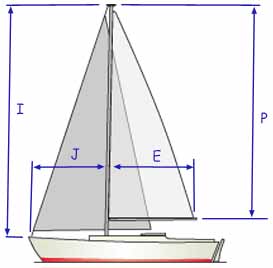 Rig dimensions
- Mainsail area: 707 ft² (65.7m2)
- Self‑tacking jib area: 307 ft² (28.5m2)
- Asymmetric spinnaker (typical): 1,238 ft² (115m2)
Published data from mainstream spec sites and the builder confirms these sail areas. Exact rig dimensions (I, J, P, E) are not consistently listed in public sources; buyers should obtain the sail plan from Seawind or the sailmaker when planning new sails or rig changes. For a 40‑foot fractional rig of this type, the values sit in the expected band for a moderate‑powered cruising catamaran rather than a stripped‑out racer.
Performance Analysis & Bruce Number
Using the standard Bruce Number formula for multihulls:
\[ BN = \frac{\sqrt{SA}}{D^{1/3}} \]where 𝑆𝐴 is upwind sail area in ft² and 𝐷 is light displacement in lb.
For the Seawind 1260:
SA = 1,014 ft²
D = 18,078 lb
√SA ≈ 31.8
D1/3 ≈ 26.2
BN ≈ 1.21
| Metric | Value | What it suggests underway |
|---|---|---|
| Bruce Number | ≈1.21 | Above many volume‑oriented charter cats (often around 1.0), below performance cruisers (≈1.3–1.6) and far below racing multihulls (>1.7). Indicates a boat that will sail willingly, especially in moderate trades, without being twitchy or demanding. |
| SA/D (upwind) | ≈23 | Comfortably into the “easily driven” band for cruising cats. She responds in lighter airs than many heavier, fuller‑hulled cats, but still needs sensible reefing once the breeze builds and will slow if heavily loaded with gear and stores. |
| LOA/Beam ratio | ≈40.8' / 22.3' ≈ 1.83 | A relatively beamy platform for her length, giving good stiffness, generous deck and cockpit space, and stable behaviour at anchor. The flip side is that some marina berths will be tight or more expensive. |
| Hull slenderness (LWL / individual hull beam) | High (narrow hulls) | Narrow hulls favour efficiency and reduce drag, helping light‑air performance and moderating pitching. Interior volume in the hulls is adequate rather than cavernous, which suits owners who prioritise sailing qualities. |
| Indicative payload tolerance | Moderate | Designed as a cruising boat, not a bare platform racer, but performance will drop if tanks, toys and heavy gear push her far beyond light ship displacement. Owners report best speeds when keeping weight sensible and avoiding clutter in the ends. |
Taken together, these metrics paint a picture of a catamaran that sits between pure comfort‑first platforms and performance‑oriented designs. She is quick enough to make good passages in typical trade wind conditions, yet forgiving enough for owner‑skippers who do not want to sail on the edge.
If you need more info on the this topic, please take a look at our article The Bruce Number vs the Sail Area/Displacement Ratio (SA/D) (Why Multihulls Need Different Performance Metrics)
How the Seawind 1260 Sails
Upwind, the fixed mini‑keels mean she will not point as high as a daggerboard cat, but the narrow hulls, decent SA/D and efficient rig still give respectable angles and speeds. Reports of 7 knots at around 45° true in moderate breeze are consistent with the numbers. The self‑tacking jib makes short‑tacking simple, and the boat tracks well without excessive leeway when sailed properly.
Downwind, the asymmetric and generous main area let her stretch her legs. In moderate trades she will sit happily in the 7–9 knot band without drama, and in stronger breeze with reefed main and working headsail she remains composed. The helm feel from the twin outboard stations is positive; you sit close to the action, with good sightlines to the sails and water, and the steering is light but not vague.
Reefing is straightforward, with the square‑top main needing a bit of attention to batten and car handling but otherwise behaving predictably. Owners who reef early tend to report comfortable, controlled passages rather than white‑knuckle rides. Motion is helped by the hull shape and bridgedeck clearance: there can be some slamming in steep chop, as on any 40‑foot cat, but it is not a chronic complaint when the boat is kept within sensible weight limits.
Short‑handed sailing is one of the design’s strengths. The self‑tacking jib, sensible sheet leads and protected cockpit mean a couple can manage the boat without drama, and the twin engines make close‑quarters manoeuvring straightforward. Weight sensitivity is noticeable: load her up like a floating apartment and speeds will drop, especially in lighter airs, but she is more tolerant than many fuller‑bodied charter cats.
Bluewater Capability: Strengths & Trade-Offs
The Seawind 1260 carries a CE category A rating and has already logged significant offshore miles in owner hands. Structurally, the foam‑cored hulls, fully glassed hull‑deck joint and robust crossbeam give confidence for ocean passages. Twin engines and twin rudders provide redundancy, and the protected cockpit with solid targa and Tri‑Fold door arrangement offers shelter without isolating the crew from the deck.
Load carrying is adequate for a 40‑footer: tankage and storage allow proper cruising, but she is not a 50‑foot packhorse. Sensible owners treat payload as something to manage, not ignore. Seakindliness is helped by the hull shape and weight distribution; she is less prone to hobby‑horsing than many fuller‑nosed cats, and the bridgedeck clearance is sufficient to keep slamming within acceptable bounds in most conditions.
Tankage for fuel and water is generous enough for extended cruising, especially when combined with watermakers and solar, which many owners add. Deck safety is good: wide side decks, solid handholds and a straightforward foredeck layout make moving around at sea less stressful. The absence of daggerboards removes one potential failure point offshore, at the cost of a few degrees of pointing ability.
Configuration, Layout & Cruising Characteristics
Cockpit ergonomics are a strong point. The aft cockpit is protected by the hard targa, with seating and table arranged to work both at anchor and underway. The Tri‑Fold door system allows the saloon and cockpit to merge into one large living area, which is particularly attractive for liveaboard use in warm climates.
Visibility from the twin helms is better than many centre‑cockpit or bulkhead‑helm cats. You can see the sails, the bows and the water, and you are close enough to the cockpit to stay part of the social space. Deck layout is clean, with the traveller on the arch, sheets led sensibly and no cluttered flybridge to complicate sail handling.
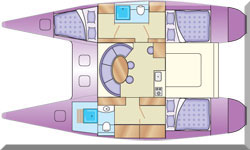
Interior layouts vary between three‑cabin owner versions (with a dedicated owner hull) and four‑cabin arrangements aimed at charter or larger families. The galley is typically up in the saloon, which keeps the hulls free for cabins and storage and works well for social cooking. Berths are generous, ventilation is helped by opening hatches and fans, and storage is good for a 40‑footer, though not limitless.
As a liveaboard platform, the 1260 suits couples and families who value a comfortable, connected cockpit‑saloon space and are willing to manage weight and systems sensibly. She is not a floating apartment with towering topsides, but a practical cruising home that still sails properly.
Who This Boat Is Best For
Good fit for:
- Owner‑skippers: Couples or families who want a capable 40‑foot cat that actually sails, with manageable systems and good ergonomics.
- Distance cruisers: Sailors planning coastal passages, seasonal migrations and occasional ocean crossings who value build quality and practical layouts.
- Liveaboards: People living aboard full‑time who prefer a balanced mix of comfort and sailing performance rather than maximum interior volume.
Less ideal for:
- Pure charter operators: If cabin count and huge interior volume are the primary drivers, there are fuller‑bodied alternatives.
- Performance‑obsessed sailors: Those chasing double‑digit averages and daggerboard‑level pointing will find more suitable designs in the performance cat segment.
- Owners who over‑load boats: If you plan to treat a 40‑footer like a 50‑foot packhorse, performance and motion will suffer.
The Buyer’s Checklist: Common Problem Areas
When inspecting a Seawind 1260, use a catamaran‑specific lens rather than monohull habits:
- Bulkhead tabbing: Check for any signs of tabbing cracks or movement around major bulkheads, especially near chainplates and mast support areas. The design is robust, but poor repairs or hard use can still show up here.
- Crossbeam & forward structure: Inspect the crossbeam, its attachments and the surrounding deck for stress cracks, corrosion around fittings and any signs of movement.
- Windows & seals: Bonded windows look clean but rely on sealant integrity. Look for crazing, UV damage and any evidence of leaks around saloon and hull windows.
- Rudder stocks & bearings: Check for play in the rudders, wear in bearings and any signs of water ingress into stocks. Twin rudders are a strength, but they still need attention.
- Mini‑keels & grounding scars: While there are no daggerboard cases to worry about, inspect the mini‑keels for grounding damage, repairs and fairing quality.
- Osmosis: Vinylester use reduces risk, but older or poorly maintained boats can still show blistering. Pay attention to underwater surfaces and any previous treatments.
- Engine access & corrosion: Access is generally reasonable, but check for corrosion on mounts, exhausts and saildrives, and confirm that bilges around engines are dry and clean.
- Steering linkages: Inspect cables, quadrants and linkages for wear, corrosion and smooth operation. Any stiffness or play should be investigated.
- Rigging age & fittings: As with any cruising boat, standing rigging, chainplates and mast fittings should be assessed against age and usage. Budget for replacement if the rig is approaching typical service life.
Typical refit costs will centre on standing rigging, sails, electronics and cosmetic work rather than major structural surgery, assuming the boat has not been abused. A surveyor with multihull experience is strongly recommended.
Could this be your ideal cruising boat?
It may well be, but before going any further, it might be worth taking a look at my eBook 'How to Avoid Buying the Wrong Sailboat'...
Summing Up
The Seawind 1260 sits in a thoughtful middle ground: a 40‑foot cruising catamaran with foam‑cored construction, sensible weight, a decent Bruce Number and SA/D, and a layout that works for people who actually sail. She is not a stripped‑out performance weapon, nor a bloated charter platform. Her strengths lie in build quality, ergonomics, and a sailing experience that rewards owners who keep weight under control and reef with judgement.
The main limitations are the usual ones for this size and concept: payload must be managed, pointing is limited by fixed keels, and marina beam can be a consideration. From a maintenance perspective, attention to windows, engines, steering and rigging will keep her in good shape, while structural issues are more likely to arise from abuse than inherent design flaws. For many cruising sailors, that is exactly the balance they are looking for.

Written by Dick McClary, cruising sailor and yachting journalist, publisher of Sailboat‑Cruising.com and admin of the Liveaboard Sailboats for Sale community.

Recent Articles


-
Mystery 35 Review: Specs, Performance & Buying Guide
Aug 29, 26 09:42 AM
An in-depth review of the Mystery 35 sailboat. Read technical specs, design ratios, sail performance, and common buyer inspection areas. -
Beneteau First 405 Review: Specs, Performance & Buyer’s Guide
Aug 26, 26 03:58 AM
Detailed Beneteau First 405 review covering specs, performance, bluewater capability, layouts and buyer’s checklist. -
Moody S38 Review: Specs, Ratios & Buyer’s Guide
Aug 12, 26 04:22 AM
In‑depth Moody S38 review covering specs, performance, design ratios, layout, strengths, trade‑offs & buyer inspection points.