- Home
- Anchoring
- Picking Up a Mooring
- Wind Against Tide Mooring Pick-Up
Wind Against Tide: How to Read the Conditions and Pick Up a Mooring with Confidence
Of all the conditions that can make picking up a mooring buoy challenging, few catch skippers out more often than a strong wind blowing directly against a tidal stream.
On a calm day, approaching a mooring often seems straightforward. The boat responds predictably, speed is easy to judge, and the bow points naturally in the direction of travel. Introduce a wind-against-tide situation, however, and things can become surprisingly confusing. Boats may appear stationary when they're actually moving quickly over the seabed, and many skippers find themselves repeatedly overshooting or missing the buoy altogether.
Understanding exactly what's happening and adjusting your approach accordingly can transform a stressful manoeuvre into a controlled and repeatable procedure.
What Does "Wind Against Tide" Mean?
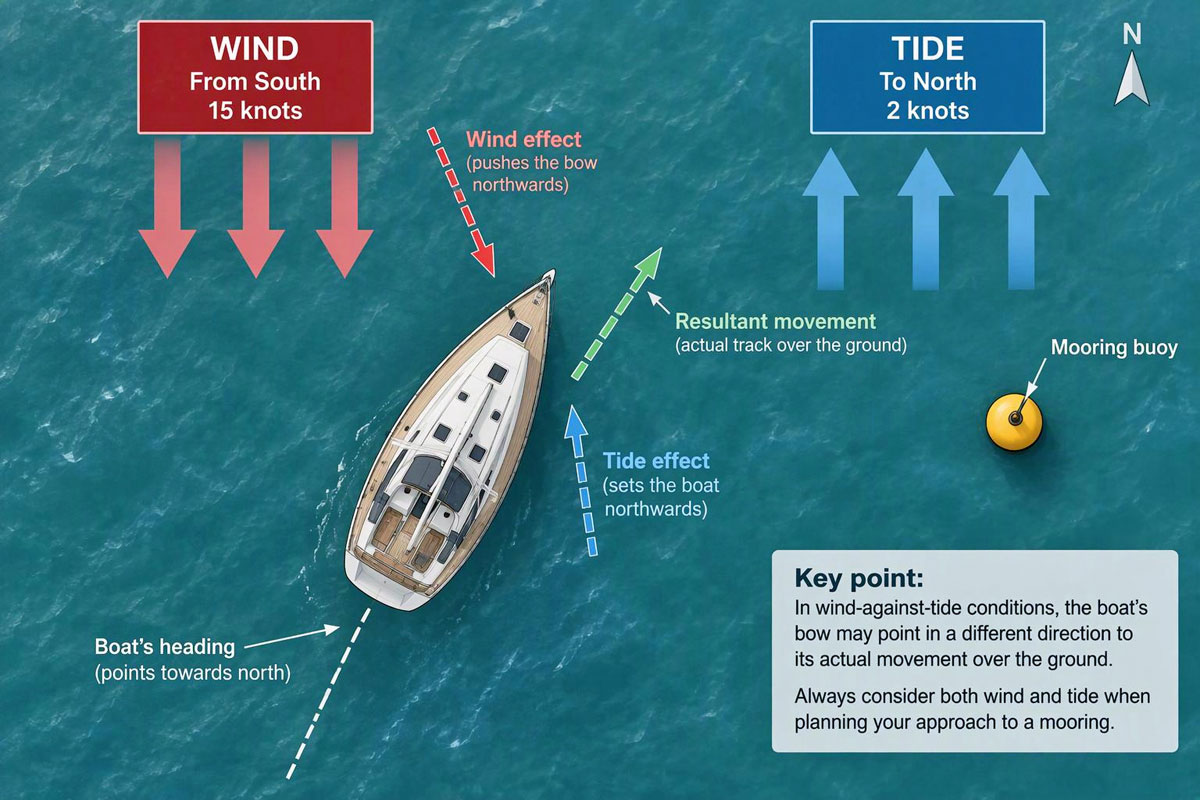
Wind-against-tide occurs when the wind and tidal current flow in opposite directions.
For example:
- Wind from the south at 15 knots
- Tidal stream flowing north at 2 knots
In these conditions, your sailboat experiences forces from both the wind and the current. Which force dominates depends largely on your boat's underwater profile, freeboard, and the strength of each force.
When picking up a mooring, the key point is that your boat's behaviour may be dramatically different from the direction it's actually travelling over the ground.
Why Wind Against Tide Creates Difficult Conditions
Many skippers instinctively focus on the bow.
Unfortunately, the bow doesn't always point in the direction the boat is moving.
Consider a tidal stream strong enough to dominate the boat's movement through the water. The hull may be carried sideways by the current while the wind blows the bow in the opposite direction.
The result is a boat that:
- Appears to be heading one way
- Is actually moving another way
- May crab sideways across the mooring buoy
This often leads to last-minute corrections and hurried attempts with the boathook.
Understanding the Three Key References
Before approaching any mooring, identify three separate factors:
1. The Wind Direction
Observe:
- Masthead indicators
- Burgees
- Nearby anchored boats
- Ripples and wave patterns
2. The Tidal Direction
Look for:
- Floating debris movement
- Mooring buoys lying at an angle
- Navigation marks
- Local pilotage information
3. The Dominant Force
Ask yourself:
"Which force is having the greater effect on my boat?"
This is the most important question.
The answer determines the direction from which you should make your approach.
Which Force Is Likely to Dominate?
| Condition | Likely Dominant Force |
|---|---|
| Wind under 10 knots, tide over 2 knots | Tide |
| Wind 10–15 knots, tide 1–2 knots | Usually tide |
| Wind 15–20 knots, tide under 1 knot | Wind |
| Strong gusts on high-freeboard boats | Wind |
| Full-keel offshore yacht in strong stream | Tide |
How Boats Lie on Their Moorings
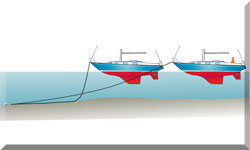
A useful clue is the behaviour of boats already attached to nearby moorings.
The majority of vessels will naturally align with the strongest force acting on them.
Typical Boat Behaviour
| Equipment | Best Use |
|---|---|
| Standard boat hook | Moorings fitted with pickup buoys and tether lines |
| Large pre-formed loop in line-led-aft | Temporarily securing to a ring-only mooring buoy by dropping the loop over the buoy |
| Hook & Moor or similar threading device | Passing a line through a buoy attachment ring from the cockpit |
| Light messenger line | Used with threading pickup devices |
| Sailing gloves | Protect hands when handling loaded pennants and mooring lines |
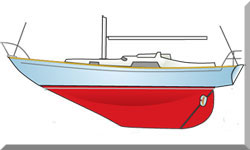
Even identical boats may lie differently depending on displacement, keel design, topside area and windage.
The Most Common Mistake
Many skippers approach from the direction the buoy appears to face.
This isn't always correct.
The buoy's orientation may be influenced by:
- Windage from attached boats
- Wave action
- Local eddies
- Uneven current flow
Instead, determine what force is controlling your own boat and plan accordingly.
The Golden Rule
Always make your final approach from the direction that gives you maximum control at minimum speed.
In most cases, this means approaching against the dominant force.
Approaching against the force that's strongest allows you to:
- Maintain steerage
- Use small power adjustments
- Stop easily
- Avoid overshooting
Reading the Mooring Area Before Your Approach
Taking a minute to observe can save several failed attempts.
Watch:
- Other boats on moorings
- How arriving boats are manoeuvring
- Floating weed or debris
- The wake from moving vessels
- The orientation of pick-up buoys
A quick assessment often reveals exactly how the water is moving.
Planning Your Approach
A good technique is to set up well downwind or down-current and make one steady approach.
Avoid:
- Multiple sharp turns close to the buoy
- Excess speed
- Last-minute changes of plan
Instead:
- Position the boat at a safe distance.
- Align with the intended approach line.
- Keep speed just above steerage way.
- Allow the boat to drift naturally towards the buoy.
- Use short bursts of ahead or astern power as required.
Using Speed Correctly
Too much speed is the root cause of most failed pick-ups.
Remember:
You should never arrive at the buoy faster than you're willing to hit it.
In challenging wind-against-tide conditions, the best approaches often look surprisingly slow.
The objective is not to reach the buoy quickly.
The objective is to arrive accurately.
Accounting for Bow Blow-Off
Strong crosswinds frequently push the bow away from the buoy at the last moment.
This effect is often greater on:
- Long-keel boats with high topsides
- Centre-cockpit cruisers
- Boats with furling genoas on deck
Compensate by approaching slightly upwind and allowing the bow to settle onto the desired track as you close the final few metres.
Single-Handed Pick-Ups
For single-handers, wind-against-tide conditions can appear intimidating.
In reality, they often become easier when using a line-led-aft arrangement.
By preparing the pick-up line in advance and leading it outside everything to a cockpit winch or cleat, you can remain in the cockpit throughout the manoeuvre.
Benefits include:
- Full engine control
- Immediate correction capability
- No foredeck scramble
- Reduced risk of falling overboard
The slower and more controlled your approach, the easier the line-led-aft method becomes.
When to Abort
Good seamanship includes recognising a poor approach early.
Abort and reposition if:
- Speed becomes excessive
- The buoy disappears under the bow
- A gust pushes you significantly off track
- Crew are not ready
- Visibility of the pick-up line is lost
There's never any shame in making another attempt.
Most experienced skippers do exactly that.
Visual Clues for Reading Wind Against Tide Conditions
| Observation | What It Tells You |
|---|---|
| Boats lying firmly in one direction | One force is clearly dominating |
| Boats sheering from side to side | Wind and tide are closely balanced |
| Floating debris moving steadily | Shows actual tidal direction and speed |
| Mooring buoys leaning noticeably | Strong current may be present |
| Small wave crests opposing current flow | Classic wind-against-tide conditions |
Wind Against Tide Approach Checklist
| Check | Confirmed |
|---|---|
| Wind direction identified | □ |
| Tidal direction identified | □ |
| Dominant force determined | □ |
| Approach route planned | □ |
| Pick-up line prepared | □ |
| Crew briefed | □ |
| Escape route identified | □ |
Final Thoughts
Wind-against-tide conditions are often viewed with unnecessary apprehension. The challenge isn't usually the strength of either force, but misunderstanding which force is actually controlling the boat.
Once you've identified the dominant influence, observed how the mooring field is behaving and planned an approach that maintains control at low speed, picking up a mooring becomes far more predictable.
The secret isn't boat handling brilliance. It's observation, patience, and a willingness to slow everything down. In most cases, the skipper who approaches calmly and methodically will secure the mooring on the first attempt while others rush, overshoot and start again.
Recent Articles


-
Can You Trust That Mooring? A Checklist for Vetting Private Buoys
Nov 22, 26 01:54 PM
Before you leave your boat unattended on a private or visitors' mooring, use this practical skipper's checklist to assess whether the buoy, tackle and location are up to the job. -
Wind Against Tide: Safe Mooring Pick-Up in Challenging Conditions
Nov 22, 26 10:55 AM
Learn how wind-against-tide conditions affect your sailboat and discover proven techniques for picking up a mooring safely and confidently. -
How to Pick Up a Mooring Single-Handed Using the Line-Led-Aft Method
Nov 22, 26 07:10 AM
Learn how to pick up a mooring single-handed using the line-led-aft method. A safe, controlled step-by-step technique that avoids risky foredeck manoeuvres.