- Home
- Cruising Yachts 45' to 50'
- Beneteau Oceanis 48 Review
The Beneteau Oceanis 48 Sailboat
Specs, Performance Analysis & Cruising Characteristics
Key Takeaways: The Beneteau Oceanis 48 is a modern, beamy, light-displacement cruising sloop aimed at comfortable coastal and offshore passagemaking rather than hardcore expedition work. It offers a huge cockpit, generous interior volume and straightforward sailhandling, especially for couples who want space and ease of use. The trade-offs are typical of this genre: relatively high topsides, modest ballast ratio and a design optimised more for living at anchor and sailing in moderate conditions than charging upwind in heavy weather. In the right hands, with sensible loading and a thoughtful refit, it can be a capable long-distance cruiser for sailors who value comfort, volume and modern systems.
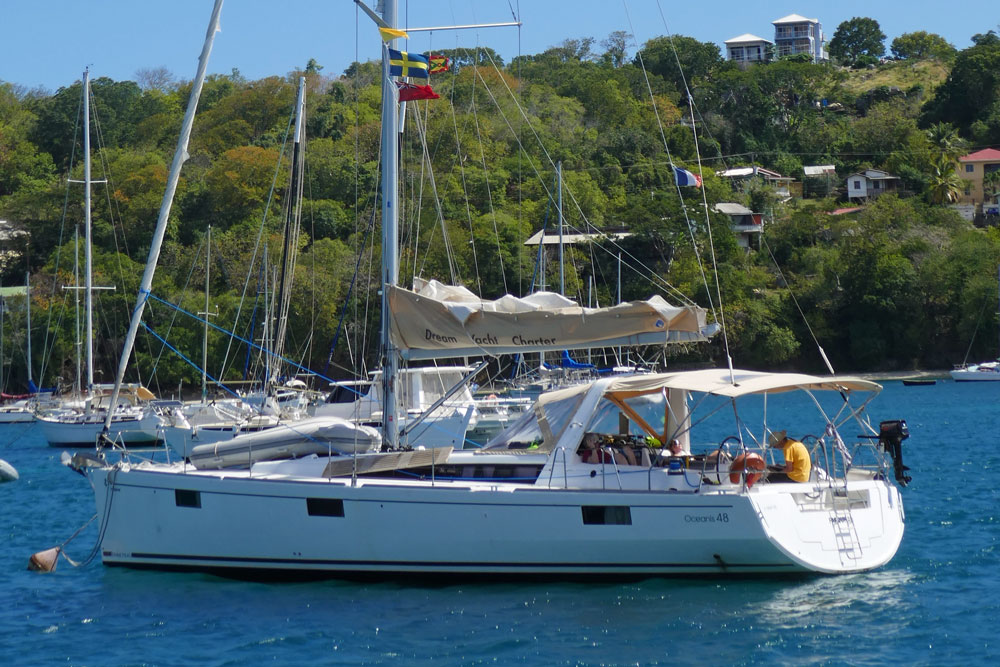 A Beneteau Oceanis 48
Table of Contents
- The Beneteau Oceanis 48 at a Glance
- Design & Construction
- Published Specification: The Beneteau Oceanis 48 Blueprint
- Sail Areas & Rig Dimensions
- Performance Analysis: Understanding the Design Ratios
- How the Beneteau Oceanis 48 Sails
- Bluewater Capability: Strengths & Trade-Offs
- Configuration, Layout & Cruising Characteristics
- Who This Boat Is Best For
- The Buyer’s Checklist: Common Problem Areas
- Summing Up
- Frequently Asked Questions (FAQs)
The Beneteau Oceanis 48 at a Glance
- Type: Production GRP cruising monohull
- Designer: Berret Racoupeau Yacht Design (exterior) & Nauta Design (interior)
- Builder: Bénéteau, France
- Production Years: Around 2011–2018
- Rig: Fractional sloop with deck-stepped aluminium mast
- Best for: Couples or families wanting a spacious, modern cruiser for coastal passages, Atlantic circuits and extended liveaboard life
- Strengths: Big cockpit, generous interior, easy sailhandling, good light to moderate wind performance, strong owner support network
- Trade-offs: Modest ballast ratio, relatively high capsize number, large window areas, and systems complexity that demands proactive maintenance as the boat ages
Design & Construction
The Oceanis 48 follows the familiar Beneteau recipe of a beamy hull with a broad transom, twin wheels and a large, sociable cockpit. Berret Racoupeau drew a relatively fine entry to help the boat move in lighter airs, with the beam carried well aft to maximise interior volume and form stability. Underwater, the deep-draught version carries an L-shaped cast-iron keel with a bulb, paired with a single spade rudder. A shoal-draught option was offered, trading some upwind bite for access to shallower cruising grounds.
Construction is typical modern GRP. The hull is a single-skin glass reinforced polyester laminate, while the deck is a balsa-cored sandwich to keep weight down and stiffness up. Structural floors and stringers are moulded and bonded into the hull, with the keel loads taken into a reinforced grid. The twin wheels sit aft, flanking a wide drop-down swim platform that forms the transom when raised.
The large hull and coachroof windows are bonded rather than through-bolted, which gives the boat its contemporary look and floods the interior with light. As with any bonded glazing, long-term adhesion and any signs of crazing or leaks deserve careful inspection on older examples. Chainplates are integrated into the structure and laminated into the hull/deck system rather than being simple bolted strap fittings; this keeps the deck clean and spreads loads, but makes inspection and repair more involved if corrosion or movement is suspected.
Several versions of the Oceanis 48 were produced. In addition to deep and shoal draught keels, there were multiple interior layouts, typically three to five cabins with varying combinations of en-suite heads. Most boats share the same basic cockpit and rig configuration: fractional sloop, swept spreaders, no backstay adjuster as standard, and a mainsail arch carrying the mainsheet above the cockpit. CE certification is to Category A for a crew of around eleven, reflecting an intended use that includes offshore passages, though no formal STIX number is widely published in the usual public databases.
Published Specification: The Beneteau Oceanis 48 Blueprint
Below is a consolidated specification based on recognised data sources and manufacturer information.
| Parameter | Value |
|---|---|
| LOA | 47'11" (14.6m) |
| LWL | 43'0" (13.1m) |
| Beam | 15'7" (4.75m) |
| Draft (deep) | 7'1" (2.17m) |
| Draft (shoal) | 5'11" (≈1.80m) |
| Displacement | 29,313lb (13,296kg) |
| Ballast | 7,826lb (3,550kg) |
| Rig Type | Fractional sloop |
| Hull Material | GRP (glass reinforced polyester) |
| Production Dates | Approx. 2011–2018 |
Sail Areas & Rig Dimensions
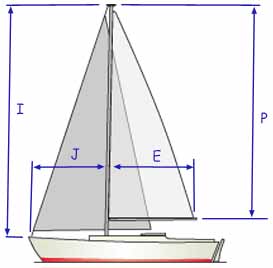 Rig dimensions
The standard rig is a 9/10 fractional sloop with swept spreaders and a deck-stepped mast. Typical published figures are:
- I: 61'6" (18.75m)
- J: 19'11" (6.06m)
- P: 56'1" (17.09m)
- E: 18'2" (5.55m)
Sail areas (standard cruising configuration):
- Mainsail area: 603ft² (56m²)
- Genoa (approx. 105%) area: 603ft² (56m²)
- Upwind sail area (main + headsail): 1,206ft² (112m²)
- Asymmetric spinnaker: 1,399ft² (130m²)
- Downwind sail area (with kite): 2,002ft² (186m²)
These numbers put the Oceanis 48 firmly in the “cruising but not under-canvassed” bracket, especially in the deep-draught version.
Performance Analysis: Understanding the Design Ratios
Using the displacement and sail plan above, the key design ratios are:
| Ratio | Value | What it suggests |
|---|---|---|
| Sail Area/Displacement (SA/D) | ≈19 | Good power for a cruising boat; should move in light to moderate airs without feeling sluggish. |
| Displacement/Length (D/L) | ≈165 | Light to moderate displacement; easier to drive than heavier traditional cruisers, with slightly livelier motion. |
| Ballast/Displacement (B/D) | ≈0.27 (27%) | Moderate ballast; relies on hull form and beam for stability as much as ballast weight. |
| Capsize Screening Formula (CSF) | ≈2.0–2.1 | On the higher side of the traditional offshore guideline; acceptable for coastal and ocean cruising with prudent loading. |
| Brewer Motion Comfort Ratio | ≈26–27 | Moderate comfort; motion should be tolerable on passage but not as gentle as heavier, narrower bluewater designs. |
Taken together, these ratios describe a modern production cruiser that favours speed and interior volume over heavy-displacement steadiness. It is not a lightweight flyer, but it is far from a heavy tank.
For more on this topic, you might want to take a look at Understanding Boat Performance & Design Ratios...
How the Beneteau Oceanis 48 Sails
Upwind, the deep-draught Oceanis 48 rewards a firm hand on sail trim. With the bulb keel and reasonably tall rig, it will point adequately and maintain respectable speeds, especially in flat water. The shoal-draught version gives away some pointing ability and leeway, so expectations should be adjusted if you sail in areas with strong tides or frequent short-tacking.
The helm is generally light, with the single spade rudder giving good feedback. In moderate conditions the boat tracks well, and the twin wheels make it easy to find a comfortable steering position. As heel builds, the broad stern can start to feel lively, particularly if the boat is heavily loaded aft. Keeping weight out of the lazarette and avoiding overloading the stern with gear helps maintain balance.
Downwind, the boat comes into its own. The generous beam and flat run aft encourage surfing in a following sea, and with an asymmetric spinnaker or code sail the Oceanis 48 will cover miles efficiently. The mainsail arch keeps the mainsheet clear of the cockpit, which is reassuring when gybing in breeze.
Reefing is straightforward, with most boats set up for in-boom or slab reefing and a furling headsail. For short-handed crews, electric winches and a sensible line layout make it realistic to manage the boat from the cockpit. As with many modern cruisers, the key is to reef early; the moderate ballast ratio and big sail plan mean the boat is happiest when sailed fairly upright rather than pressed hard.
Motion is typical of a beamy, light to moderate displacement hull. In a gentle swell the boat feels lively but not uncomfortable. In steeper seas, especially upwind, the wide bow sections can slap, and the high freeboard can make the boat feel more “on top” of the water than “in” it. Careful loading, good weight distribution and avoiding excessive windage (davits, large dinghies, solar arches) help keep the motion manageable.
Bluewater Capability: Strengths & Trade-Offs
The Oceanis 48 carries CE Category A certification and has crossed oceans in the hands of many owners. Tankage is reasonable for a production cruiser: around 106 US gallons (401L) of fuel and roughly 182 US gallons (689L) of water in standard form, with scope to add flexible tanks or watermakers for extended voyaging.
Strengths for bluewater use include:
- A large, protected cockpit with good coaming height.
- Twin wheels offering redundancy and good visibility.
- A modern rig that is easy to handle with powered winches and sensible reefing.
- Plenty of interior volume for storage if organised carefully.
The trade-offs are familiar to anyone looking at contemporary production cruisers. The high topsides and big windows demand careful attention to watertight integrity. Deck safety needs to be enhanced with additional handholds, jackstays and possibly extra padeyes for clipping on. Load-carrying must be managed; the design ratios assume a certain displacement, and adding large amounts of gear, fuel and water will push the boat out of its sweet spot, affecting motion and stability.
For ocean work, many owners upgrade ground tackle, fit stronger sprayhoods and biminis, add storm sails and improve redundancy in critical systems (autopilot, steering, power generation). With those upgrades and a conservative sailing style, the Oceanis 48 can serve well on Atlantic circuits and similar passages. For high-latitude or heavy-weather-focused voyaging, more traditional, heavier designs may be a better match.
Configuration, Layout & Cruising Characteristics
On deck, the Oceanis 48 is all about space. The cockpit is wide, with long benches and a central table, making it a social hub at anchor. The mainsheet arch keeps the boom and sheet clear, and the traveller is typically on the arch rather than the cockpit sole, which reduces clutter. Side decks are reasonably wide, though the beam and cabin height mean you will appreciate extra grab rails and good non-slip.
Below, Nauta Design created an interior that feels more like a modern apartment than a traditional yacht. Large bonded windows and hull ports bring in plenty of light. Layouts vary, but common themes include:
- A forward owner’s cabin with island berth and en-suite heads.
- A spacious saloon with U-shaped seating and a large table.
- A workable galley, often along the port side, with decent refrigeration and storage.
- Aft cabins that can be generous doubles or, in charter-oriented layouts, multiple smaller cabins.
For liveaboard use, the boat offers good volume and storage, but it benefits from thoughtful organisation. Deep lockers, under-berth spaces and the large cockpit lazarette can swallow a lot of gear; keeping weight low and central is important. Ventilation is reasonable, with opening hatches and ports, but in hotter climates additional fans and sun protection are welcome.
The overall cruising character is that of a comfortable floating home that still sails well enough to keep passages enjoyable. It is not a stripped-out performance boat, nor a heavy traditional cruiser; it sits in the middle, which suits many owners who split their time between sailing and living at anchor.
Who This Boat Is Best For
Good fit for:
- Sailors moving up from smaller production cruisers who want more space without stepping into full custom territory.
- Couples or families planning coastal cruising, Mediterranean or Caribbean seasons, and occasional ocean crossings.
- Owners who value a modern interior, big cockpit and straightforward sailhandling, and are willing to invest in sensible upgrades for longer passages.
Less ideal for:
- Skippers who prioritise heavy-displacement comfort and ultimate seakeeping over interior volume.
- Those wanting a boat optimised for high-latitude or heavy-weather expedition sailing.
- Owners who prefer simple, low-tech systems; the Oceanis 48’s size and equipment level mean more systems to maintain.
The Buyer’s Checklist: Common Problem Areas
If you are inspecting an Oceanis 48 with purchase in mind, pay particular attention to:
- Bonded windows & ports: Look for signs of leaks, crazing, UV damage or loss of adhesion around hull and coachroof glazing.
- Chainplates & structural grid: Check for any cracking, staining or movement around chainplate areas and the internal structural grid, especially near keel loads.
- Keel & rudder: Inspect the keel joint for any signs of movement or “smile”, and check the rudder for play, moisture ingress or delamination.
- Steering system: Twin wheels, cables and quadrants need careful inspection; look for wear, corrosion and smooth operation.
- Rig & fittings: Standing rigging age, spreader roots, mast step and gooseneck fittings should be assessed, particularly on boats that have done long passages.
- Systems & electrics: Larger production cruisers carry complex electrical systems, multiple batteries, chargers and often inverters. Check for tidy wiring, clear labelling and evidence of professional upgrades.
- Deck hardware & non-slip: Winches, clutches, stanchions and guardrails should be checked for corrosion and movement. Non-slip areas can wear smooth over time.
- Interior joinery & moisture: Look for staining, soft spots or mould around windows, chainplates and heads compartments, which can indicate leaks.
Typical refit costs will vary, but a full standing rigging replacement, upgraded ground tackle, new electronics and some cosmetic work can easily run into the mid five-figure range in pounds. Budgeting for that, especially on earlier hulls, is sensible.
Could this be your ideal cruising boat?
It may well be, but before going any further, it might be worth taking a look at my eBook 'How to Avoid Buying the Wrong Sailboat'...
Summing Up
The Beneteau Oceanis 48 is a modern, comfortable cruiser that has earned a following among owners who want space, ease of use and respectable performance without chasing racing numbers. The design ratios tell you what to expect: a light to moderate displacement hull with good sail power, moderate ballast and a motion that is lively but manageable when the boat is sensibly loaded. The construction is typical of a major production yard, with a strong structural grid, balsa-cored deck and bonded windows that demand routine inspection as the years pass.
As a buyer, the key is to match the boat to your sailing plans. For coastal cruising, Mediterranean summers, Caribbean seasons and Atlantic circuits, an Oceanis 48 that has been well maintained and thoughtfully upgraded can be a very satisfying platform. For more demanding, heavy-weather-focused voyaging, you may prefer a heavier, more conservative design. If the numbers, the layout and the ownership stories align with your expectations, the Oceanis 48 deserves a place on your shortlist.
 DMcC
DMcCThis article was written by Dick McClary, RYA Yachtmaster and author of the RYA publications 'Offshore Sailing' and 'Fishing Afloat', member of The Yachting Journalists Association (YJA), erstwhile member of the Ocean Cruising Club (OCC) and owner/administrator of 'Liveaboard Sailboats for Sale'.

Frequently Asked Questions (FAQs)
1. How does the Oceanis 48 cope with heavy weather compared to heavier traditional cruisers?
1. How does the Oceanis 48 cope with heavy weather compared to heavier traditional cruisers?
In heavy weather the Oceanis 48 relies on early reefing, good weight distribution and conservative routing. It will not feel as steady as a heavier, narrower boat, but with sensible sail plans and a well-prepared crew it can handle typical ocean conditions.
2. Is the shoal-draught version a compromise for serious passagemaking?
2. Is the shoal-draught version a compromise for serious passagemaking?
The shoal keel opens up shallow cruising grounds but gives away some upwind performance and leeway. For predominantly trade-wind routes and downwind passages it is acceptable; for frequent upwind work in strong tides, the deep keel is usually preferred.
3. What are the most important structural checks before committing to a long refit?
3. What are the most important structural checks before committing to a long refit?
Focus on the keel attachment, rudder condition, chainplate areas, bonded windows and the internal structural grid. Any signs of movement, cracking or persistent leaks should be investigated before you commit to major upgrades.
4. How suitable is the standard tankage for extended offshore passages?
4. How suitable is the standard tankage for extended offshore passages?
Standard fuel and water capacities are adequate for coastal cruising and shorter passages. For longer routes, many owners add watermakers, extra fuel storage and improved monitoring to increase autonomy.
5. Can the Oceanis 48 be comfortably managed by a couple on long passages?
5. Can the Oceanis 48 be comfortably managed by a couple on long passages?
Yes, provided the boat is set up with sensible sailhandling systems (electric winches, good reefing, reliable autopilot) and the crew are disciplined about reefing early and managing fatigue. The size is manageable, but systems reliability becomes more important than raw physical strength.
Recent Articles


-
Mystery 35 Review: Specs, Performance & Buying Guide
Aug 29, 26 09:42 AM
An in-depth review of the Mystery 35 sailboat. Read technical specs, design ratios, sail performance, and common buyer inspection areas. -
Beneteau First 405 Review: Specs, Performance & Buyer’s Guide
Aug 26, 26 03:58 AM
Detailed Beneteau First 405 review covering specs, performance, bluewater capability, layouts and buyer’s checklist. -
Moody S38 Review: Specs, Ratios & Buyer’s Guide
Aug 12, 26 04:22 AM
In‑depth Moody S38 review covering specs, performance, design ratios, layout, strengths, trade‑offs & buyer inspection points.